By Alexander Merz · Published on · Details checked on 6 November 2026
Chromatic aberration is an imaging error of lenses: glass refracts blue light more strongly than red, so the colours do not come to the same focus. It shows up as a coloured fringe along bright edges – in photos, in binoculars and in refracting telescopes. In astrophotography it appears as a blue-violet halo around bright stars.
⭐ In short: A little colour fringing is normal with any lens; what matters is how much. In a photo, the lateral error can be removed with one click, the longitudinal error only partly. At the telescope, an apochromat, a long achromat or a reflector helps – a filter only softens the fringe.
Cause: why glass separates colours
The refractive index of glass depends on the wavelength – this is called dispersion. Blue light is bent more strongly than red, just as in a prism that splits white light into a rainbow (German Wikipedia: Chromatic aberration). A simple converging lens therefore brings blue to a focus closer to the lens than red.
That is why there is no point at which all colours are sharp at the same time. If you focus on green, blue and red surround it as a blurred halo. With faint objects you hardly notice this; with bright edges and stars you see it immediately.
Longitudinal and lateral chromatic aberration
Chromatic aberration comes in two forms, and they behave differently. The longitudinal error shifts the focal points along the optical axis; the lateral error renders each colour at a slightly different size (Wikipedia).
| Feature | Longitudinal (axial) aberration | Lateral (transverse) aberration |
|---|---|---|
| Where in the image | everywhere, including the centre of the image | not in the centre, stronger towards the edge |
| Typical fringe | violet or green around bright points | red/cyan or blue/yellow along edges |
| Stopping down helps | yes | hardly predictable |
| In software | only partly (defringe slider) | well (rescaling the colour channels) |
| At the telescope | the violet halo around the Moon and Venus | hardly matters visually |
For star photos, the longitudinal error is the more troublesome one. It also sits in the centre of the image and cannot simply be calculated away. The lateral error, on the other hand, is the one that Lightroom and similar programs correct with a checkbox.
Chromatic aberration in telescopes
Refractors fight colour error with several types of glass. An achromat combines two glasses with different dispersion and brings two colours to one focus; an apochromat manages three (Wikipedia). Chester Moor Hall designed the first achromats around 1733, and John Dollond received the patent in 1758 (German Wikipedia: Achromat).
| Design | Colours at the focus | Visible fringe | Example |
|---|---|---|---|
| Short achromat (f/5–f/7) | two | clear on the Moon, Venus, Jupiter | travel refractors |
| Long achromat (f/10 and longer) | two | weak | Orion Observer 90EQ Refractor TelescopeOmegon Telescope AC 90/1000 EQ-2 |
| ED refractor / apochromat | three | practically none | Sky-Watcher Evostar EDX 80 APO Doublet TelescopeSky-Watcher EvoStar 80ED Apo Refractor |
| Reflecting telescope | all (a mirror does not refract) | none from the primary mirror | Newtonian, Dobsonian |
In principle, reflecting telescopes are free of colour error. A mirror reflects all wavelengths at the same angle instead of refracting them. Only eyepieces, Barlow lenses and correctors add a residual amount, because they are made of lenses again.
At the eyepiece, you recognise colour error at the Moon’s limb. Focus the Moon at high magnification and look at the edge against the dark sky: a violet strip that changes colour as you rack through focus is longitudinal chromatic aberration. In the German-language forum of astronomie.de, the colour error of achromats such as the 70/700 or 90/500 is repeatedly and clearly criticised (thread in German, 2023; thread in German, 2021).
Colour fringing in star photos
The camera shows colour error more clearly than the eye. In long exposures the sensor also collects the out-of-focus blue and violet light, and bright stars get a bloated halo. A user of the German-language forum describes how his first DSLR photo of the Pleiades through a short achromat made it immediately clear to him why apochromats exist (forum.astronomie.de, 24 Jan 2021, in German).
Not every violet edge is chromatic aberration. With overexposed points of light, sensor blooming is also discussed as a cause, as are noise and image processing (Wikipedia: Purple fringing). One test helps: if the fringe also appears with a shorter exposure, the optics are to blame.
Colour-pure entry point: Sky-Watcher EvoStar 80ED Apo Refractor
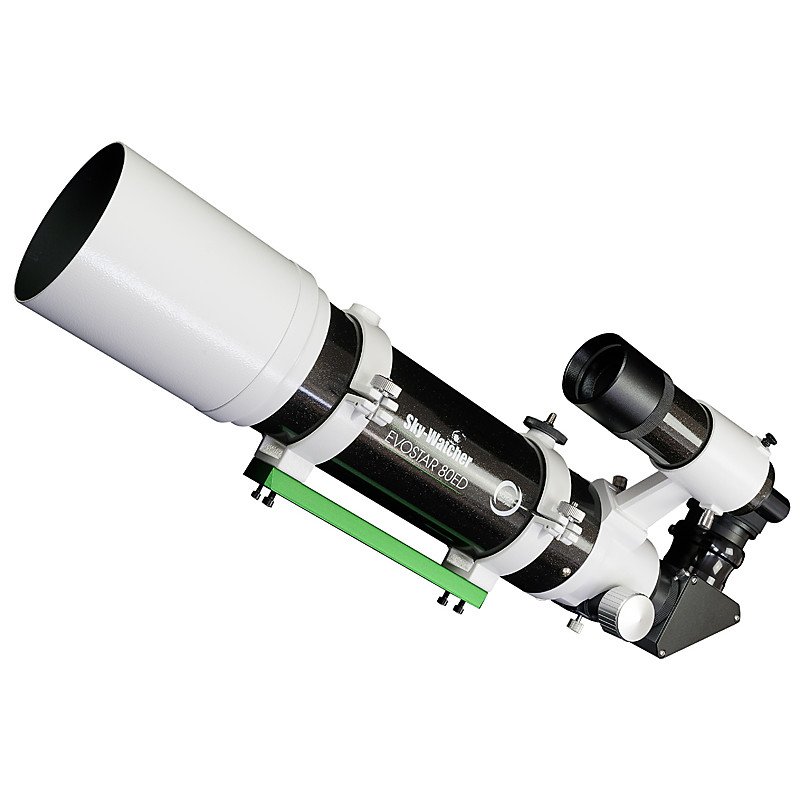
80 mm ED refractor with a short tube: stars stay pinpoint instead of swelling into blue blobs – the usual entry-level optics for deep-sky photos.
Price: € 795
Tip for camera lenses: Stopping down by one f-stop often works wonders. The longitudinal error decreases with a smaller aperture; Adobe names shooting wide open with inexpensive lenses as the main risk (Adobe). Our astrophotography guide covers which lenses are suitable for star photos.
How to remove chromatic aberration
Software removes the lateral error almost completely. In Lightroom, tick the “Remove Chromatic Aberration” box under “Lens Corrections” (Adobe). Technically, the colour channels are scaled differently until they line up again (Wikipedia).
Against the longitudinal error there is only the defringe slider. It selectively desaturates violet or green fringes that you pick with the eyedropper (Adobe). With stars, the halo then stays grey instead of blue – it does not get any smaller.
| Where | What helps | Limit |
|---|---|---|
| When shooting | stop down, medium focal length, good lens | costs light |
| In Lightroom/Camera Raw | “Remove Chromatic Aberration”, defringe slider | longitudinal error only desaturated |
| At the telescope (visual) | colour filter or aperture mask | colour cast or less aperture |
| At the root | apochromat or reflecting telescope | price or design |
Filters against colour fringing on an achromat
A filter does not turn an achromat into an apochromat, but it takes the edge off the fringe. In two recent threads on the German-language forum forum.astronomie.de, owners of 120/600 and 150/1200 achromats compared their experiences (“Semi-Apo vs. Fringe Killer”, 12/2025, in German; “Filter recommendation for a 6″ f/8 achromat”, 08–10/2026, in German).
| Solution | What owners report | Mentions |
|---|---|---|
| Semi-Apo filter | most effective filter, slightly green-yellow image | 3 positive |
| Fringe Killer | weaker than Semi-Apo, does not convince everyone | 2 rather lukewarm |
| Contrast Booster | milder middle way, more neutral image | 1 |
| Aperture mask (e.g. 150 down to 105 mm) | on the Moon and planets “simply beautiful views”, costs aperture | 1, plus 2 agreeing |
| Yellow filter (Wratten 12) | works, but tints strongly | 1 |
| UV/IR cut filter | pointless visually, only for cameras | 1 |
For nebulae, colour error hardly matters. One forum user now uses his 120/600 only with OIII or H-beta filters, which pass only a narrow colour band anyway (thread in German, 28 Dec 2025). The fringe is mainly a nuisance on the Moon, the planets and bright stars.
Chromatic aberration in the eye and in games
The human eye also has longitudinal chromatic aberration. When it is focused on green, the blue focal point lies in front of the retina and the red one behind it (Wikipedia). In everyday life we hardly notice this.
In video games, chromatic aberration is an artificial effect. It imitates the colour fringing of camera lenses towards the edge of the frame and can be switched off in the graphics settings; for competitive play, manufacturers such as Corsair recommend turning it off (Corsair).
FAQ about chromatic aberration
Is chromatic aberration normal?
Yes. Every glass lens shows it, because glass refracts colours by different amounts. Good lenses and apochromats suppress it so far that you practically no longer see it.
What causes chromatic aberration?
Dispersion: the refractive index of the glass depends on the wavelength. Blue is refracted more strongly than red, so the colours have different focal points.
How can I remove chromatic aberration?
In a photo, with the lens correction of your RAW program and the defringe slider. When shooting, stopping down helps. At the telescope, only a more colour-pure instrument, a filter or an aperture mask helps.
Do reflecting telescopes have chromatic aberration?
The mirror itself does not, because it reflects rather than refracts. Eyepieces, Barlow lenses and coma correctors can, however, add a small colour error.
How does it differ from spherical aberration?
Spherical aberration is caused by the spherical shape of the lens: marginal rays are focused differently from rays close to the axis, even with a single colour. Chromatic aberration is purely a colour error (German Wikipedia: Spherical aberration).
Should you turn off chromatic aberration in games?
That is a matter of taste. The effect makes the image more cinematic, but less sharp towards the edges; competitive players usually switch it off.
Read more
- Achromat or apochromat? The colour error comparison – with the Sidgwick calculation and recommendations
- Reflector vs refractor – refracting telescopes compared
- Deep-sky astrophotography – why an apo is a must there
- Vignetting – the second typical optical error in astrophotos
Sources: German Wikipedia: Chromatic aberration · German Wikipedia: Achromat · Wikipedia: Purple fringing · Adobe · German Wikipedia: Spherical aberration · Corsair · Experiences from the German-language forum forum.astronomie.de (threads linked in the text).
* Affiliate link: if you buy through this link we may earn a small commission from Astroshop, High Point Scientific or another linked retailer, at no extra cost to you.