By Alexander Merz · Updated on · Details checked on 14 September 2026
NASA’s Artemis programme is meant to bring humans back to the Moon for good. The schedule has shifted considerably of late – here you can read which mission flies when, and what it actually does.
Artemis timeline: all missions at a glance
| Mission | Date | What happens | Status |
|---|---|---|---|
| Artemis 1 | December 2022 | Uncrewed test flight: Orion circled the Moon and returned | ✅ completed |
| Artemis 2 | 1–11 April 2026 | Four astronauts circled the Moon without landing – the first crewed Moon flight since 1972. Greatest distance from Earth: 406,771 km | ✅ completed |
| Artemis 3 | 2027 (planned) | ⚠️ replannedOriginally the landing at the south pole. Now a test in Earth orbit: Orion docks with the commercial landers – no Moon landing | ⏳ planned |
| Artemis 4 | Early 2028 (planned) | The programme’s first Moon landing: two of the four crew members are to stay at the south pole for about a week | ⏳ planned |
Why the delay? Both landers are running behind – SpaceX’s Starship variant just as much as Blue Origin’s Blue Moon. Instead of keeping the date and carrying the risk, NASA turned Artemis 3 into a practice flight without a landing.
For you as an observer that means: nobody will land on the Moon before 2028. Anyone who wants to follow the missions still gets something out of it – the launches themselves are events, and the Moon is up there every night anyway.
What is the Artemis mission?
The Artemis mission is a NASA spaceflight programme with the goal of bringing humans back to the Moon for good. The first crewed flight happened long ago: Artemis 2 circled the Moon in April 2026. Under current planning, the first landing is scheduled for Artemis 4 in early 2028. The name “Artemis” comes from the twin sister of the Greek god Apollo, under whose name the first Moon missions were carried out.
This time, however, it is not just a symbolic visit; the mission aims to establish a lasting human presence on the Moon and serves as a stepping stone for further exploration of space, including Mars. (There is more on this in our article on future space missions.)
Why go back to the Moon?
One of the first questions people often ask is: “Why should we go back to the Moon?” The answer lies in the countless possibilities the Moon offers for scientific research, technology development and future space missions.
It serves as a test bed for new technologies, it makes scientific investigations possible that would not work on Earth, and it helps us prepare for future missions to other planets.
The stages of the Artemis mission
The Artemis mission is divided into several phases:
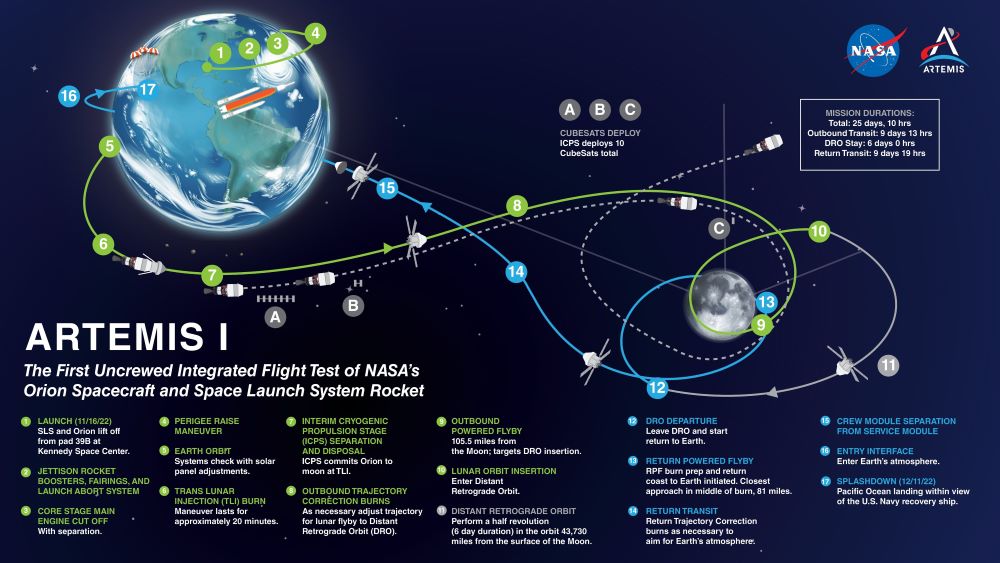
Artemis 1: the uncrewed test flight of the Orion spacecraft, successfully completed in December 2022.
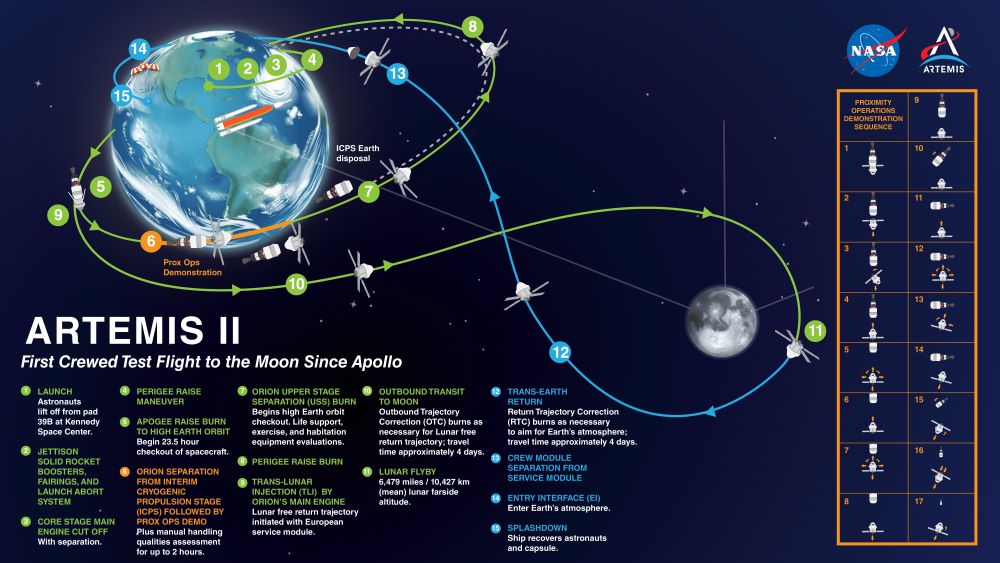
Artemis 2: the crewed flight around the Moon, without landing – launched on 1 April 2026 and splashed down successfully on 11 April. Four astronauts came 406,771 km from Earth in the process.
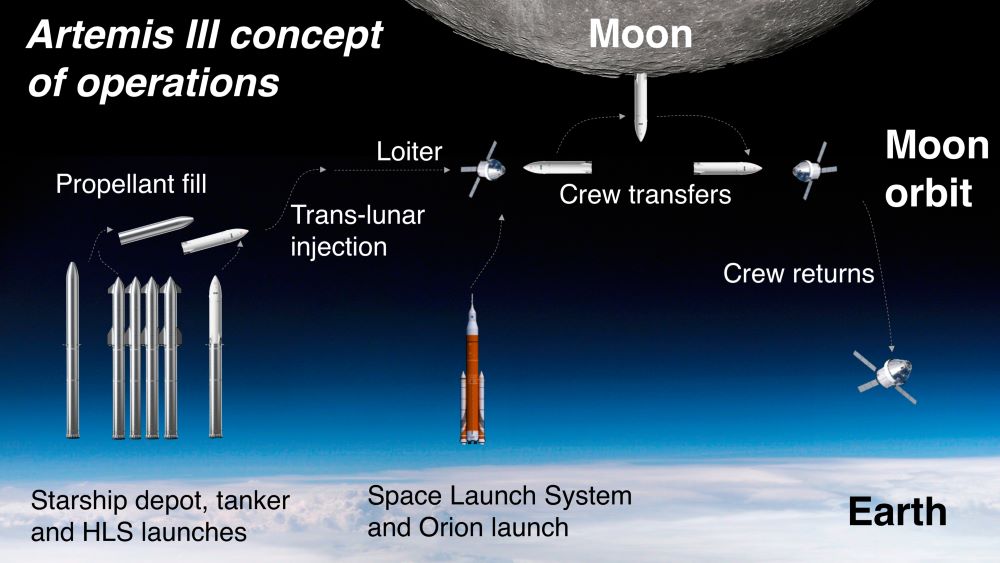
Artemis 3: replanned. Instead of a landing, the mission will practise rendezvous and docking manoeuvres with the commercial landers in Earth orbit in 2027.
Artemis 4: the actual landing flight, planned for early 2028 – it would be the first Moon landing since Apollo 17 in December 1972, and the first woman on the Moon.
Each of these phases has its own goals and challenges, but all of them serve the overarching aim of building a lasting presence on the Moon.
Technological milestones
The Artemis mission is a masterpiece of engineering and involves some of the most advanced technology ever developed. That includes:
- The Space Launch System (SLS): a new generation of rockets, more powerful than anything we have seen so far.
- Orion spacecraft: the modern capsule that will carry astronauts to the Moon and back.
- Lunar Gateway: a space station in orbit around the Moon that will serve as a staging post and operations base for missions to the lunar surface.
The role of the private sector
Alongside NASA, private companies such as SpaceX and Blue Origin are involved in the Artemis mission too. Their contributions could range from delivering supplies to developing new technology that makes the mission more efficient and cheaper.
How the Artemis mission could change the future of humankind
The effects of the Artemis mission reach far beyond spaceflight. It has the potential to move humankind forward in several areas:
- Science: new insights into how the Moon and the Solar System formed.
- Technology: advances in spaceflight technology that could find applications on Earth as well.
- Inspiration: a new age of discovery that could draw young people into STEM careers (science, technology, engineering and mathematics).
- Future exploration: a successful and lasting stay on the Moon would pave the way for missions to other planets, and to Mars above all.
Conclusion
The Artemis mission is not just another step in spaceflight; it could be a turning point in human history. The mission offers unlimited opportunities for scientific discovery, technological innovation and inspiration for future generations.
With the Artemis mission we are on the threshold of a new chapter in the exploration of space and of humankind itself. This is the perfect moment to get into astronomy and witness this historic adventure.