By Alexander Merz · Published on · Details checked on 14 September 2026
What does the night sky in June have to offer in the way of exciting things to observe? Here is a clear summary.

The key facts in brief
In the northern hemisphere there are a few observing highlights that come round every June. Here are some of them:
- Summer solstice: the summer solstice falls on 21 or 22 June, marking the longest day and the shortest night of the year. That date also marks the beginning of astronomical summer.
- Bright planets: Venus is often visible in the western sky shortly after sunset, while Jupiter and Saturn can appear later in the night and in the early hours of the morning. Exactly how visible these planets are can vary from year to year.
- Constellations: in June the summer constellations such as Scorpius and Hercules are well placed. The constellation Hercules contains M13, one of the brightest globular clusters – densely packed balls of hundreds of thousands of stars – visible from the northern hemisphere.
- Meteor showers: the June Bootids meteor shower is usually active around 27 June, although the activity of this shower can vary a great deal.
- The Milky Way: June marks the start of the best time for observing the Milky Way. Around midnight it stands high in the sky and can look impressive under a dark sky.
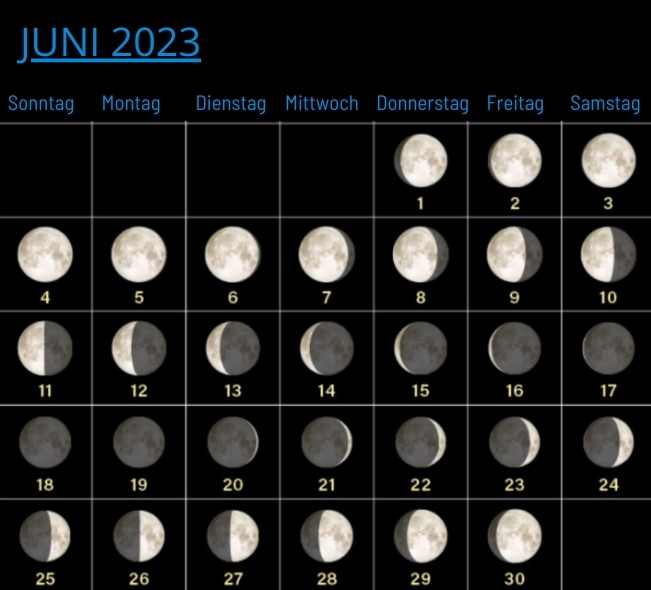
The moon phases in June
The middle of the month is the best time for observing deep-sky objects. The moon is very dark then.
The planets in June
In June Mercury will not appear in the night sky.
Venus reaches its greatest angular distance from the Sun at the beginning of June and remains a bright evening star. On 13 June it moves close to the edge of the Beehive Cluster (Praesepe) in Cancer. On 21 June, Venus together with Mars and the narrow crescent moon makes an impressive sight in the evening sky.
Mars in the evening sky is almost caught up by Venus at the end of June, but shortly before that Venus changes direction. As early as 2 June, Mars passes through the star cluster M44 (the Beehive Cluster in Cancer).


Jupiter in Aries can be seen in the morning sky. On 14 June it has an encounter with the narrow waning moon.
Saturn can be observed in the early hours of the morning above the south-eastern horizon.
Uranus is still close to the Sun and is therefore not visible in the dark night sky.
Neptune in the morning sky is still hard to make out in June.
The dates that are actually worth it are often months apart – and easily forgotten. So you do not miss one:
One short email, in good time – with the times and an honest take on whether it is worth getting up for.
You will get a confirmation email in a moment. Your address stays with us – no sharing, no third-party ads.
Night sky in June: must-see events
- June – Mercury at its best in the morning sky
- June – close encounter of the moon and Saturn
- June – close encounter of the moon and Jupiter
- June – the June solstice
- June – close encounter of the moon and Venus
- June – close encounter of the moon and Mars
- June – peak of the June Bootids meteor shower
Deep-sky objects in June
Most of the events mentioned so far are visible with the naked eye, but this month I wanted to add a new section covering all the deep-sky objects you can see.
You will need binoculars or a telescope for these, but it is worth setting up to take in the fascinating wonders of the June sky.
- On 2 June, Mars will have a close encounter with Messier 44, the Beehive Cluster, in the constellation Cancer.
- On the same night, around midnight local time, the Great Hercules Cluster will be well placed.
- On 3 June the globular cluster Messier 12 in the constellation Ophiuchus will stand high in the sky.
- On 6 June the globular cluster Messier 10, also in Ophiuchus, will be well placed.
- On 7 June the globular cluster Messier 62 in Ophiuchus is at its best for viewing.
- On 11 June Messier 92, another globular cluster, will be easiest to pick out in the constellation Hercules.
- On 13 June the Beehive Cluster (Messier 44) moves close to Venus.
- On 17 June the Butterfly Cluster (Messier 6) will stand high in the sky.
- On 20 June the Ptolemy Cluster (Messier 7) in the constellation Scorpius is easiest to spot.
- On 23 June the Lagoon Nebula (Messier 8) in the constellation Sagittarius stands high in the sky.
Enjoy observing these fascinating objects in the sky!