By Alexander Merz · Published on · Details checked on 14 September 2026
There aren’t many presents you can hand over and say: this is older than the Earth. A meteorite is one of them – and it costs less than most people expect.
An iron fragment from Argentina goes for € 16.90. A genuine piece of the Moon starts at about 25 euros. The price depends less on weight than on origin – and that’s exactly where the appeal lies.
For a first meteorite, an iron from Campo del Cielo makes the best gift: heavy, magnetic, unmistakable and available from € 16.90. If you want more, go for a lunar or Martian meteorite from around 25 euros – small, but with a backstory nobody can beat. Always look for a certificate of authenticity with an official classification; finds from online marketplaces are usually terrestrial rock.
Why a meteorite works as a gift
Most astronomy gifts are equipment: you have to assemble them, understand them and use them under a clear sky. A meteorite asks for none of that.
You hold it in your hand and the story does the rest. The iron in Campo del Cielo formed inside a small planet that broke apart long before the Earth existed.
That works just as well with children as with adults who already have everything – and it works even if the recipient has no interest in telescopes.
The best place to start: Campo del Cielo Iron Meteorite in Gift Pouch
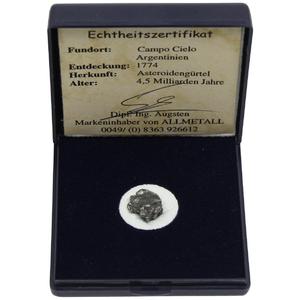
A genuine iron meteorite fragment from Argentina, about 4.5 billion years old — the cheapest way to hold outer space in your hand.
Price: € 16.90
Iron, stone or special case: the three groups
Almost everything on sale falls into one of these groups. For a gift the group matters more than the find site, because it determines how the piece looks and feels.
| Group | Share of all finds | Characteristic | Who it suits |
|---|---|---|---|
| Iron meteorite | about 5 % | Heavy, magnetic, metallic sheen, often deeply pitted | The classic to hold – it lands immediately |
| Stony meteorite (chondrite) | about 94 % | Grey to brown, often with a dark fusion crust | Anyone wanting the most common and scientifically most important type |
| Stony-iron (pallasite) | under 1 % | Olivine crystals in an iron matrix – spectacular when cut and polished | Collectors; the finest slices run into four figures |
| Moon and Mars | fractions of a percent | Unremarkable to look at, but from another world | Anyone who wants the story, not the looks |
You’ll find more on the individual types in our overviews of chondrites and pallasites.
Rock from the Moon and Mars: the small sensation
The fact that you can buy a piece of the Moon for 25 euros surprises almost everyone. The explanation is an impact: if an asteroid hits the Moon hard enough, material is flung away faster than escape velocity.
Some of it eventually crosses Earth’s orbit and falls. It is mostly found in deserts – dark rock stands out on pale sand and weathers slowly there.
Hence the abbreviations: NWA stands for Northwest Africa, and the running number is issued by the Meteoritical Society following scientific classification. Martian meteorites work exactly the same way, just more rarely.
A piece of the Moon from 25 €: Genuine lunar meteorite NWA 10203 (XS)
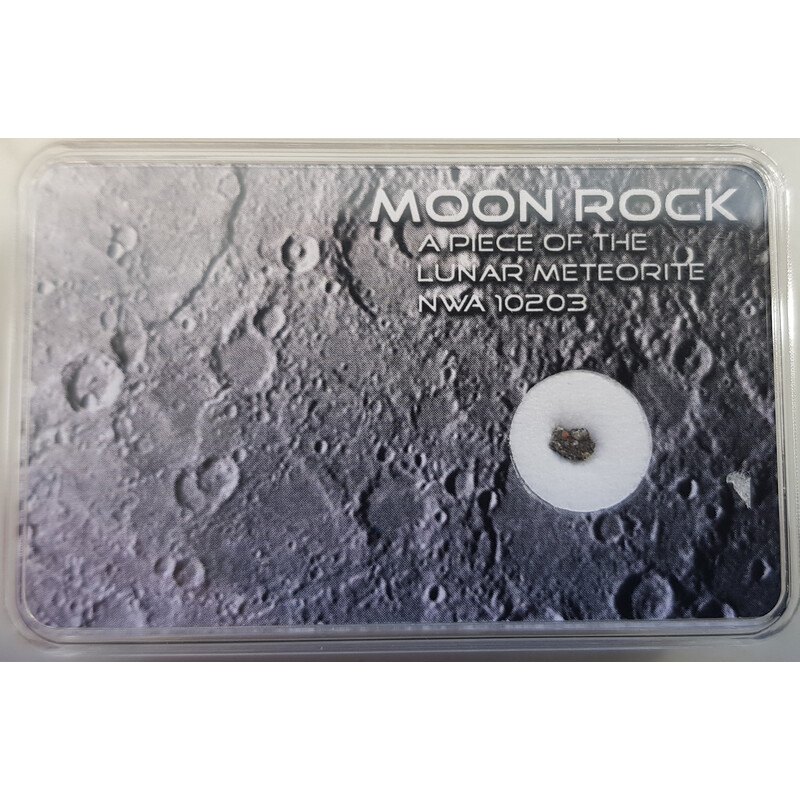
A genuine sliver of the Moon: blasted into space by an impact, found in the Sahara, with certificate.
Price: € 24.90
If you want a bit more substance, take a larger fragment. The difference is literally palpable: the XS pieces are a few millimetres across, whereas a gram of lunar rock has a presence you can see in a display case.
The Moon by the gram: Lunar meteorite Adrar 013 (0.5–1.0 g)
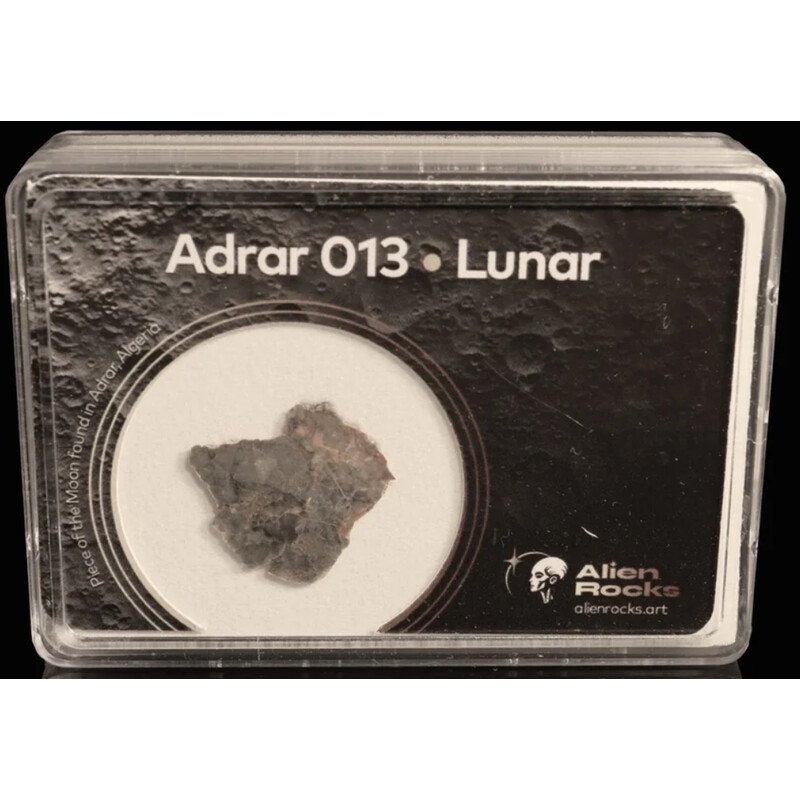
Lunar rock from the Sahara in a graspable size – the affordable alternative to museum Apollo cabinets.
Price: € 41
And then there’s Mars. Around 400 of the more than 70,000 classified meteorites come from the Red Planet – they cost accordingly more and are traded by the tenth of a gram.
From the Red Planet: Mars meteorite Amgala 001 (0.16–0.39 g)
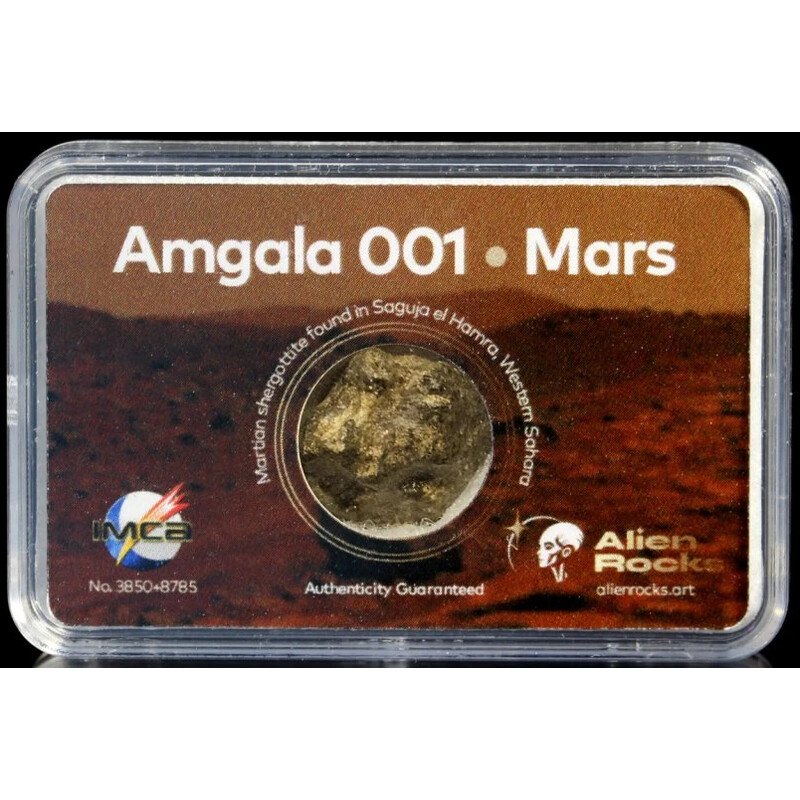
A piece of Mars in your hand: flung off the Red Planet and landed on Earth, with certificate.
Price: € 99
The background is covered in our pages on moon rock and Mars meteorites.
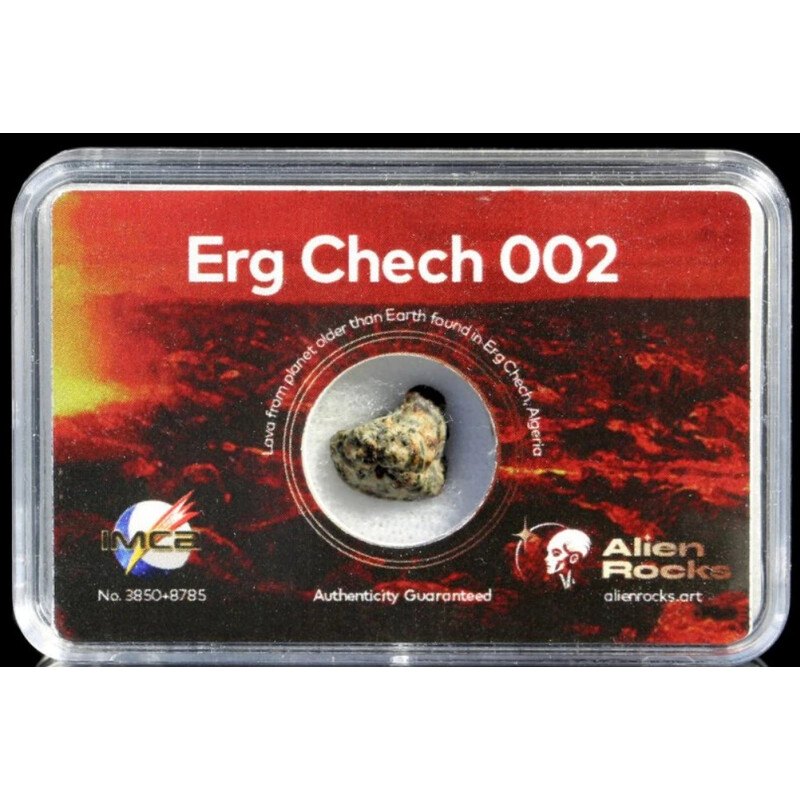
Older than the Earth: the special case of Erg Chech 002
In May 2020, searchers in the Algerian Sahara found an unusually coarse-grained rock with a greenish shimmer. Dating put it at roughly 4.566 billion years – the oldest known magmatic rock of any kind.
For comparison: the Earth formed about 4.5 billion years ago. Erg Chech 002 probably comes from the crust of a protoplanet that was destroyed again in the early days of the solar system.
For collectors: Erg Chech 002 meteorite (0.7–0.99 g)
One of the oldest known rocks in the solar system – older than the Earth itself. For collectors after something special.
Price: € 149
Genuine or fake: what to watch out for
The meteorite market has a fakes problem, above all on classified-ad sites. By far the most common case isn’t fraud, though, but mistaken identity: slag, basalt or iron ore look exactly the same to a layperson.
- Classification and name – a real meteorite has an official name such as “NWA 10203” or “Campo del Cielo”, listed in the Meteoritical Bulletin.
- A certificate of authenticity from the dealer, with find site and type.
- Magnetic – almost all of them are, but magnetism on its own proves nothing; slag can be magnetic too.
- No bubbles in the break: pores and bubbles almost always point to terrestrial slag.
Buying from a specialist dealer takes care of all this for you. With iron meteorites it’s worth looking at the Widmanstätten pattern – that etched crystal structure cannot form on Earth, because it takes millions of years of slow cooling.
What a meteorite should cost
Prices follow rarity, not size. This overview helps you place them.
| Budget | Piece | Why | Price |
|---|---|---|---|
| up to 20 € | Campo del Cielo in a gift case | ⭐ Our recommendationHeavy, magnetic, instantly understandable – and already boxed for giving. | € 16.90 |
| up to 30 € | Lunar meteorite NWA 10203 XS | The cheapest route to genuine lunar rock. | € 24.90 |
| up to 40 € | Campo del Cielo on a silver chain | To wear rather than to display. | € 34.90 |
| up to 50 € | Lunar meteorite Adrar 013 | About a gram of the Moon – far more present than the XS splinters. | € 41 |
| up to 100 € | Mars meteorite Amgala 001 | A piece of the Red Planet, with certificate. | € 99 |
| from 150 € | Erg Chech 002 | Older than the Earth – the collector’s item among affordable meteorites. | € 149 |
Frequently asked questions about meteorites as gifts
Is trading in meteorites legal?
It depends on where a piece comes from and where you are, so check the rules that apply to you. Some source countries ban the export of meteorites outright, and lunar material brought back by the Apollo missions is US government property that may not be traded at all.
What specialist dealers offer are desert finds with documented provenance, which is why a certificate stating the find site matters.
How can a piece of the Moon cost only 25 euros?
Because it’s tiny. The price is set per gram, and the cheap offers weigh a few hundredths of a gram. The value sits in the origin and the certificate, not in the mass.
How do I recognise a genuine meteorite?
By the official classification with name and number, by the dealer’s certificate and – with iron meteorites – by the Widmanstätten pattern in the etched cut surface. A magnet test alone isn’t enough, because slag can be magnetic too.
Does an iron meteorite rust?
Yes, if it’s kept damp. Store it dry, don’t handle it constantly with sweaty hands, and put a desiccant in the case with valuable pieces. A light film of oil gives extra protection.
Which meteorite suits children?
Campo del Cielo. It’s tough, heavy enough to impress, magnetic so there’s something to try out, and cheap enough that it doesn’t matter if it ends up in a trouser pocket.
What’s the difference between a meteor and a meteorite?
A meteor is the streak of light in the sky, the shooting star. Meteorite is only what actually reaches the ground. Before that, out in space, it’s called a meteoroid.
Read on
- Meteorites: origin, types and famous finds
- Meteorite impacts on Earth
- Astronomy gifts: ideas from 15 to 500 euros
Links marked with * are affiliate links. If you buy through them, we earn a small commission – the price stays the same for you.