
By Alexander Merz · Published on · Details checked on 14 September 2026
⭐ In short: Darks are frames taken with the cap on – same exposure time, same gain or ISO and the same sensor temperature as your real images. They show only what the camera itself produces: dark current, hot pixels and amp glow. During stacking this self-generated signal is subtracted from every raw frame. 20 to 30 of them are enough, and with a cooled camera you shoot them once per setting and use them for a whole year.
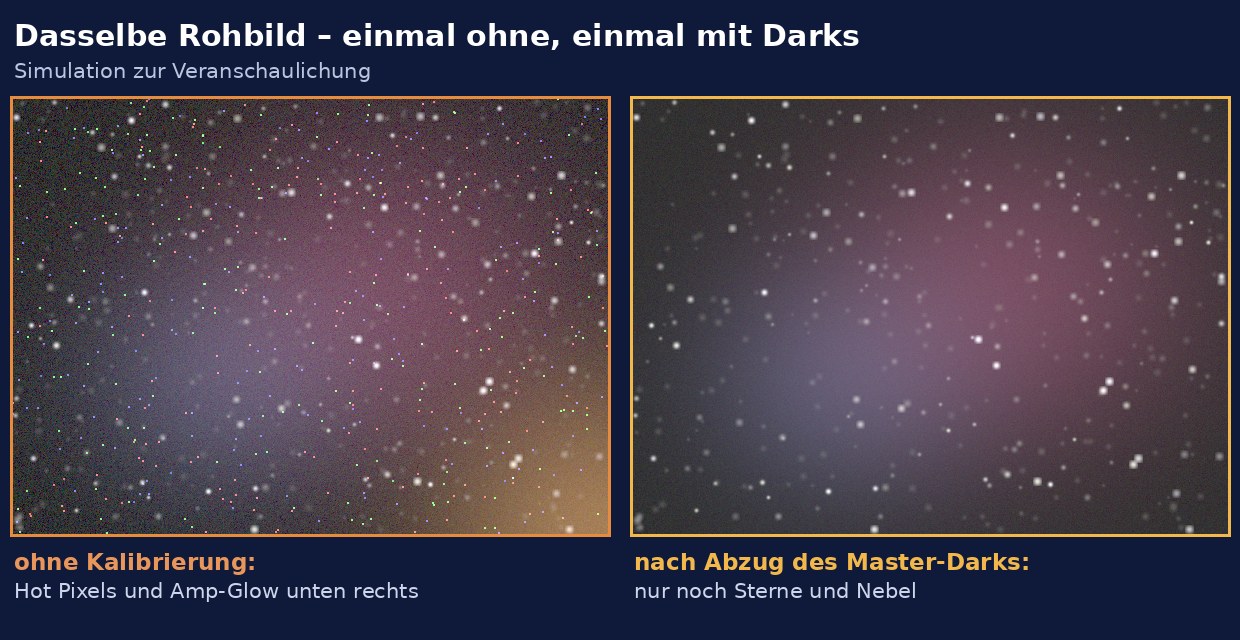
What darks remove
A camera sensor delivers a signal even when no light at all falls on it. Heat knocks electrons loose in the silicon, and the camera cannot tell these electrons apart from starlight. This self-generated signal is called dark current.
Luckily the dark current is not random, it is a pattern. At the same temperature and the same exposure time, the same camera shows the same bright pixels in the same places again and again. That is exactly why it can be calculated out.
A dark is nothing more than a recording of this pattern: cap on, same settings, expose. In the end you have an image that consists only of the camera’s own signal – and the stacking software later subtracts that from every raw frame.
- Dark current – the broad background noise that grows with exposure time and heat.
- Hot pixels – individual pixels that always read out too bright. In the finished image they show up as coloured dots, and as short coloured dashes in tracked exposures.
- Amp glow – a veil of brightness in one corner of the frame, caused by the readout electronics. Nothing helps against it except darks.
Rule of thumb: The dark current roughly doubles every 6 °C. A night that cools down from 18 to 6 °C therefore quarters it – and that is why darks from early in the evening usually do not match the shots taken in the morning.
Darks, bias and flats
Darks are only one of three calibration frames, and the three get mixed up regularly. Each one corrects a different error, and none of them replaces another. Your actual shots of the sky are called lights.
| Criterion | Darks | Bias | Flats |
|---|---|---|---|
| Corrects | dark current, hot pixels, amp glow | read noise of the electronics | vignetting, dust on the sensor |
| Exposure time | exactly like the lights | as short as the camera can go | long enough that the histogram sits in the middle |
| Light needed | no, cap on | no, cap on | yes, an evenly lit surface |
| Temperature matters | yes, crucial | no | no |
The difference between a dark and a bias is time. A bias measures what the camera adds all by itself during readout – that happens in a fraction of a second. A dark additionally collects heat electrons over the full exposure time. Every dark therefore already contains a bias.
Taking darks properly
With 120-second exposures the whole procedure takes about an hour, and you do not have to stand next to it. Five points decide whether your darks are worth anything in the end.
- Block out all light. Cap on the telescope or lens, and on a DSLR tape over the viewfinder as well. Even a laptop display is enough to cause visible light leakage.
- Copy the settings exactly: exposure time, gain or ISO and – on astro cameras – the offset. A single value that differs makes the dark worthless.
- Match the temperature. Without cooling, take the darks straight after the session, while the camera is still outside and equally warm. Not later in the living room.
- 20 to 30 frames. Fewer noticeably adds noise, considerably more hardly gains you anything.
- File them tidily. Folder name with exposure time, gain and temperature, for example darks_120s_gain100_-10C. Otherwise by your second project you will no longer know what belongs to what.
Tip: Look at a single dark right after shooting it, stretched hard. A brightness gradient that is not sitting in your camera’s known amp glow corner is stray light – in that case there is still a gap open somewhere.
The dark library
This is where the real advantage of a cooled camera lies, and it is usually underestimated when buying. A cooled astro camera keeps the sensor at a fixed target value, for example −10 °C, no matter whether the night is mild or freezing.
That makes your darks reproducible. You shoot around 50 frames once per combination of exposure time and gain and keep using them for a year. Instead of an hour of darks on every clear night, you simply photograph the sky.
Without cooling this does not work. The sensor temperature then follows the outside air, and that is different in July from January – a library would be wrong after the first change in the weather.
Cheapest way into cooling: ZWO Camera ASI 585 MC Pro Color
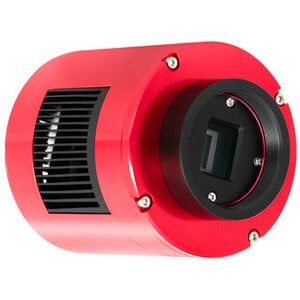
Cooled colour camera with an IMX585 sensor: no amp glow, low noise and with a sensor temperature you can set to a fixed value – the requirement for a dark library you can keep reusing.
Price: € 799
Building a master dark
A single dark does nothing for you, quite the opposite: it contains noise of its own and would calculate that noise into every one of your images. That is why all darks are stacked into one master dark.
The software averages pixel by pixel and throws out the outliers. What remains is the fixed pattern – clean and practically noise-free. In Siril (free) you just put the files into the folders provided and start the matching script; DeepSkyStacker, Astro Pixel Processor and PixInsight do the same thing through their calibration dialogues.
Most common mistake: subtracting the bias twice. Your dark already contains it – if you additionally subtract a master bias from the lights, it ends up missing twice over and the dark parts of the image get crushed. You need the bias for the flats, not a second time for the lights. There is one exception: if you use dark optimisation in Siril or PixInsight, letting the dark be scaled to a different exposure time, you do need the master bias after all – it is then removed from the dark beforehand.
The most common mistakes
When darks have no effect or even make the image worse, one of these four points is almost always behind it.
| Mistake | How you spot it | Solution |
|---|---|---|
| Darks too warm | Bright hot pixels turn into dark dots | repeat the darks at the temperature of the lights |
| Darks too cold | Hot pixels stay visible | repeat the darks at the temperature of the lights |
| Too few darks | The image is noisier after calibration than before | stack at least 20 frames |
| Light in the dark | Bright gradient coming in from one edge | cover the viewfinder and gaps, shoot again |
When darks are unnecessary
Honestly: not everyone needs darks. There are two situations in which you can save yourself the hour – and one in which nothing else helps.
The first case is dithering. Here the mount shifts the telescope by a few pixels between the individual frames. A hot pixel then sits on a different part of the subject in every image and is automatically thrown out during stacking. Against hot pixels, dithering is even more reliable than darks.
The second case is short exposures in cool air with a modern sensor that has no amp glow. Below 30 seconds the dark current is often so small that you cannot find the difference in the finished image.
What dithering cannot do, on the other hand: remove amp glow. If your camera produces a glowing corner, there is no way around darks – that is an area-wide signal and not a single pixel.
The most honest test is your own: process your next project once with and once without darks and compare the two results side by side. It costs you half an hour and answers the question for your camera better than any general recommendation.
How darks fit into the complete workflow of a deep-sky night is explained in the guide to deep-sky astrophotography.
Common questions about darks
How many darks do I need?
20 to 30 darks are the sensible standard for a single session. For a library that you keep using over months, 50 are worth it, because the master dark then gets a little cleaner still. Beyond 50 the gain is so small that it no longer shows in the finished image.
New darks every night?
With an uncooled camera yes, because the sensor temperature depends on the outside air and changes from night to night. With a cooled camera no: as long as exposure time, gain and target temperature stay the same, you simply fall back on your library.
Can I take darks in daylight?
Yes, darks have nothing to do with daylight as long as no light reaches the sensor. What matters is the temperature: with a cooled camera that is no problem, without cooling you would have to hit the night-time temperature indoors, which rarely works in practice.
What happens without darks?
Hot pixels stay in the image as coloured dots or dashes, and any amp glow stays as a bright veil in the corner. If you have dithered, the dots largely disappear anyway – the amp glow does not.
Do CMOS cameras need darks?
That depends on the sensor, not on the technology. Modern CMOS sensors without amp glow often manage without them at short exposures in cool air. If your camera does show a glowing corner, or if you expose for several minutes at a time, darks remain the simplest solution.
Darks with a smart telescope?
That is nothing you have to worry about. Devices like the Seestar and DWARF take their calibration frames themselves and subtract them right inside the device. How that works in practice is explained in our guide to smart telescopes.
* Affiliate link: if you buy through this link we may earn a small commission from Astroshop or High Point Scientific, at no extra cost to you.