By Alexander Merz · Published on
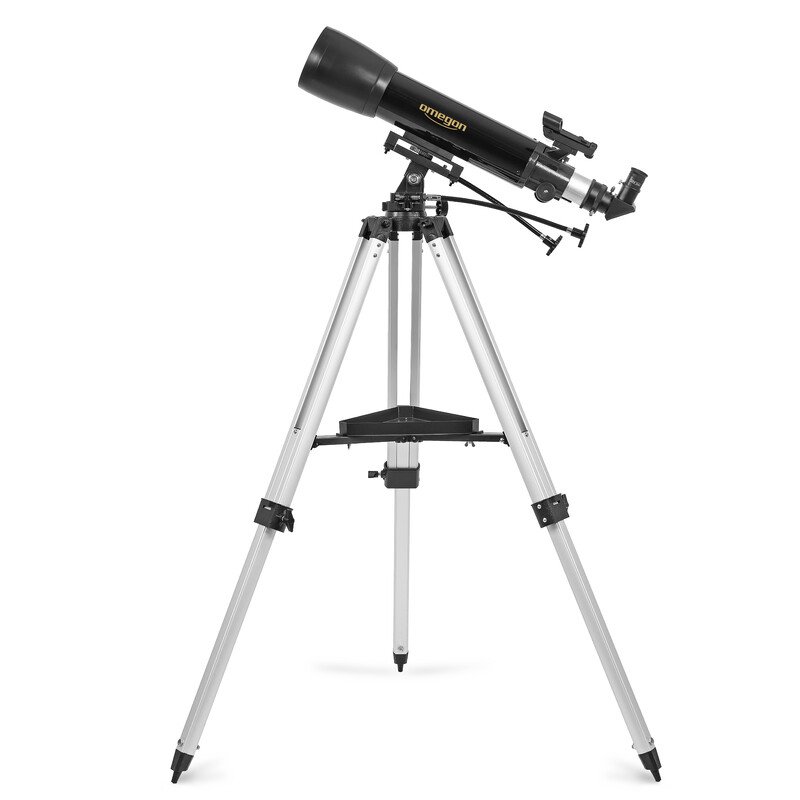
A refractor telescope is a lens telescope: an objective lens at the front of the tube gathers the light, the tube is closed and never needs collimating.
The bigger picture is in our overview: best telescopes.
⭐ In short: For the Moon, planets and double stars, a refractor is the lowest-maintenance telescope there is. As an all-rounder we recommend the Omegon AC 102/660 AZ-3 Telescope (about $369€ 369). If you want to see galaxies and nebulae, a Dobsonian gives you far more aperture for the same money.
Buying a refractor telescope: who it suits
A refractor is the telescope for people who want to start observing quickly. Set it up outside, wait ten minutes, off you go. No mirror that can go out of alignment, no open tube for dust to settle in.
- ✔ Moon, planets, double stars: sharp, high-contrast views with no secondary mirror in the light path.
- ✔ Short on time: short cool-down, no collimation, robust in transport.
- ✔ Daytime viewing: with an Amici prism it makes a good spotting scope for nature and landscapes.
- ✔ Astrophotography: small ED apochromats are the standard optics for nebulae and galaxies.
- ✘ If you want as much aperture per dollareuro or dollar as possible: a 200 mm Dobsonian costs about as much as a 102 mm achromat.
- ✘ Faint galaxies visually: a refractor up to 100 mm simply lacks the aperture.
Achromat, ED or apochromat: the key difference
The price of a refractor depends almost entirely on the glass. A lens bends blue light more strongly than red. A simple achromat cannot fully correct this, so a violet fringe appears around bright objects.
| Design | What you see | Price range (80–100 mm, euros or dollars) |
|---|---|---|
| Achromat | Violet fringe on the Moon, Venus, Jupiter. Hardly matters at long focal ratios (f/10 and longer). | roughly 100–400 complete |
| ED doublet | Colour fringe barely visible, very good sharpness. | roughly 400–800, tube only |
| Apochromat (triplet) | Practically colour-free, even for demanding photos. | from roughly 900, tube only |
For a first telescope, an achromat is perfectly fine. You notice the fringe on bright planets; on the Moon you hardly see it after a few nights. If you want to go deeper, the detailed comparison is under achromat vs apochromat.
Short or long: what the focal ratio means
The second number in the name is the focal length, and it defines the character. An 80/400 has a focal ratio of f/5, a 90/1000 sits at f/11.
| Type | Example | Strengths | Weaknesses |
|---|---|---|---|
| Short (f/5–f/7) | Omegon AC 80/400 AZ-3 Telescope | Huge field of view: star clusters, Milky Way, comets | More colour fringe, planets stay small |
| Medium (f/6.5) | Omegon AC 102/660 AZ-3 Telescope | A good compromise for almost everything | Not quite as colour-free on planets as a long one |
| Long (f/10–f/11) | Orion Observer 90EQ Refractor TelescopeOmegon Telescope AC 90/1000 EQ-2 | Moon and planets sharp and high in contrast | Long tube, wobbles on small mounts |
Tip: If you do not want to commit, choose a medium focal ratio around f/6.5. Planets still work well, and the Pleiades fit completely into the field.
Refractor recommendations by use
The list only contains telescopes whose mount suits the tube. That is exactly where many cheap refractors fail; more on that in a moment.
| Class | Refractor | What for | Price |
|---|---|---|---|
| First telescope | Celestron AstroMaster 70AZ RefractorOmegon Telescope AC 70/700 AZ-2 | Moon and Jupiter’s moons, a first telescope for kids | $199.95€ 129 |
| Long focal length | Orion Observer 90EQ Refractor TelescopeOmegon Telescope AC 90/1000 EQ-2 | Moon and planets | $124.95€ 289 |
| Wide field | Omegon AC 80/400 AZ-3 Telescope | Milky Way, star clusters, comets | about $299€ 299 |
| All-rounder | Omegon AC 102/660 AZ-3 Telescope | ⭐ Our recommendationThe best all-rounder: 102 mm, sturdy AZ-3, 2-inch focuser. | about $369€ 369 |
Links marked with an asterisk are affiliate links.
Our all-round refractor: Omegon AC 102/660 AZ-3 Telescope
The big beginner refractor: 102 mm aperture, 2-inch focuser, wide field at 660 mm – Moon, planets and bright deep-sky objects with no collimation.
Price: € 369
The most common mistake: a long tube on a weak mount
A refractor stands or falls with its mount. A one-metre tube on a thin tripod keeps shaking for several seconds after every touch. At 150× magnification, Jupiter then dances across the field.
Common mistake: refractors with 1,000 mm focal length or more on EQ-1 or AZ-1 mounts. Forum users call it “the wobbles” for a reason. Better to go one size smaller on the tube than on the tripod.
The rule of thumb: the mount should carry clearly more than the tube weighs. That is the case with the recommendations above. How equatorial and alt-azimuth mounts differ is explained under equatorial mount.
Refractor or reflector?
Per dollareuro or dollar, a reflector gathers more light; the refractor wins on comfort and contrast. A 200 mm Dobsonian gathers four times as much light as a 100 mm refractor, but it needs collimating and cooling down.
| Refractor | Reflector (Dobsonian) | |
|---|---|---|
| Aperture per dollareuro or dollar | low | high |
| Maintenance | none | occasional collimation |
| Ready to use after | about 10–15 minutes | about 30–60 minutes |
| Strength | Moon, planets, double stars, daytime | Galaxies, nebulae, star clusters |
You will find the detailed comparison with all pros and cons under reflector vs refractor.
Refractor, Dobsonian or smart telescope? We will tell you honestly what suits your sky.
Six short questions, an honest answer by email.
Refractors for advanced observers
From around 700 (euros or dollars), you no longer buy a complete kit but tube and mount separately. In return you get ED glass and a focuser that also carries a camera.
| Refractor (tube only) | Strength | Price |
|---|---|---|
| Sky-Watcher Evostar EDX 100 APO Doublet TelescopeSky-Watcher AP 100/700 EvoStar 100 EDX | Colour-free 100 mm ED for planets and deep sky | $895.00€ 759 |
| Sky-Watcher Evostar EDX 80 APO Doublet TelescopeSky-Watcher EvoStar 80ED Apo Refractor | Classic for getting started in astrophotography | $750.00€ 795 |
| Apertura 90 mm Triplet APO with Field FlattenerOmegon Pro APO 96/575 Triplet ED | A true triplet apo, for visual use and imaging | $1,799.95€ 1,099 |
| Sky-Watcher Esprit EDX 120 Super APO TripletSky-Watcher AP 120/840 Esprit 120 EDX | A premium apo for years to come | $3,295.00€ 2,469 |
Links marked with an asterisk are affiliate links.
🚀 If you want more: Sky-Watcher Evostar 100 EDX
This ED refractor shows Jupiter and Saturn without a violet fringe and stays crisp even at 200×. It comes without a mount: add a solid mount such as the EQM-35 Pro. It pays off once the achromat has been with you for a year and you know exactly what bothers you.
➜ Sky-Watcher Evostar EDX 100 APO Doublet TelescopeSky-Watcher AP 100/700 EvoStar 100 EDX – $895.00€ 759
If you want to take pictures with your refractor, read telescope for astrophotography first: different things matter there than for visual observing.
Accessories a refractor really needs
- Star diagonal: usually included and makes viewing comfortable. The image is then mirror-reversed.
- Amici prism: for daytime viewing, so the image is upright and correct left to right.
- Moon filter: dims the bright full Moon, for example the Apertura 1.25" Moon FilterOmegon Premium Moon Filter 1.25″ for $14.95€ 19.90.
- A good eyepiece: the supplied eyepieces are usable, a zoom eyepiece is more fun.
Sun warning: Never look at the Sun without a certified full-aperture solar filter in front of the lens, not even briefly. Filters that screw into the eyepiece can crack and permanently damage your eye.
Buying a used refractor?
Used refractors are the safest second-hand buy in the telescope world. There is no mirror coating that can degrade and no collimation that can be off. Still check the lens for scratches, fungus and a loose cell, and make sure the focuser runs smoothly.
FAQ: refractor telescope
What is a refractor telescope?
A refractor is a lens telescope. An objective lens at the front of the tube focuses the light into an image that you magnify with the eyepiece. The name comes from the bending of light (refraction).
Which refractor is right for beginners?
For most beginners, an achromat with 90 to 102 mm aperture on a sturdy mount is right, for example the Omegon AC 102/660 AZ-3 Telescope. With 70 mm you can start for less; the Moon then shows craters and Jupiter its moons.
Which refractor is the best?
There is no neutral overall winner, because refractors are built for very different purposes. In our evaluation the AC 102/660 AZ-3 is the best all-rounder in the entry class. More telescopes are compared in our best telescopes guide.
How much magnification can a refractor handle?
As a rule of thumb, twice the aperture in millimetres: about 200× at 102 mm. In practice, atmospheric turbulence usually limits you to 100× to 150×.
Is a refractor good for astrophotography?
Yes, but only with ED or apo glass and a motorised equatorial mount. In photos, an achromat shows a violet halo around every bright star. Which combination is worth it is explained under telescope for astrophotography.
* Affiliate link: if you buy through this link we may earn a small commission from Astroshop, High Point Scientific or another linked retailer, at no extra cost to you.