By Alexander Merz · Updated on · Details checked on 27 September 2026
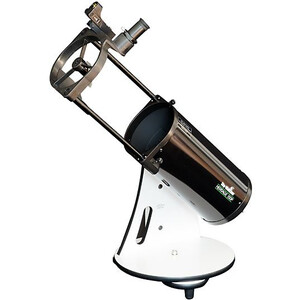
A smart telescope is telescope, camera and mount in a single device: it points at objects by itself and shows you a photo on your phone. A Dobsonian is a mirror telescope on a simple rotating base that you look through yourself – with a mirror three to five times larger for the same budget.
More in our overview: Best Telescopes.
⭐ In short: Want to see it with your own eyes, the Moon and planets first? Get a Dobsonian. Want nebulae and galaxies in colour, from the city and without learning the constellations? Get a smart telescope. One is an instrument for observing, the other an automatic camera – both are astronomy, but the experience is nothing alike.

*Affiliate links: if you buy through them we receive a small commission – the price does not change for you. Prices are updated automatically every day.
Transparency: these statements rest on the data sheets from Skywatcher, Celestron, ZWO and DWARFLAB, on optical figures we recalculated ourselves, and on current discussions at forum.astronomie.de (a German-language forum) and Cloudy Nights. In 2026 the choice between a smart telescope and a classic one is among the most common beginner questions there.
Smart telescope or Dobsonian: the comparison in one table
| Dobsonian | Smart telescope | |
|---|---|---|
| How you observe | live, with your eye at the eyepiece | a stacked photo on phone or tablet |
| Aperture for $350 to $1,000350 to 1,000 euros | 130 to 200 mm | 30 to 50 mm |
| Moon | razor sharp, craters down to the detail | pretty, but smaller and with less detail |
| Planets | Saturn’s rings, Jupiter’s bands and moons, the Martian polar cap | small discs |
| Nebulae and galaxies | grey; impressive under a dark sky, faint in the city | in colour, even from the city (with a filter) |
| Light pollution | hurts a lot | hardly matters |
| Finding objects | yourself, with a star chart or an app | automatically, with a tap in the app |
| Setup until the first look | 5 minutes, fully sharp after roughly 30 minutes of cooling down | 2 to 5 minutes |
| Maintenance | collimate the mirror now and then | firmware updates |
| Weight | 7.5 kg (150P) to 26 kg (8-inch Dobsonian) | 0.8 to 2.8 kg |
| Sharing images | only with a phone holder, and it is fiddly | straight away |
| What you learn | the sky, the constellations, how to star-hop | little about the sky, a lot about image processing |
| Entry price | the tabletop Dobsonianthe tabletop Dobsonian: $355.00€ 345 | DWARF 3DWARF 3: $549.00€ 529 |
What you really see in a Dobsonian
A 150 mm mirror collects roughly 460 times as much light as your eye. On the Moon and the planets that is unbeatable: Saturn’s ring with the dark Cassini division, Jupiter’s cloud belts, the shadow of one of its moons. You see it live, with the air shimmering slightly – and that is exactly the moment beginners often describe as the one that hooked them.
For nebulae and galaxies, honest expectations matter. The eye sees no colour at night; nebulae appear grey and delicate. Under a dark country sky a 150 mm Dobsonian shows hundreds of clusters, nebulae and galaxies; from the city many of them stay invisible.
A common disappointment: if you have Hubble images in your head, the eyepiece will let you down. What you see is real light that travelled for millions of years – but it is not a photo. How big Saturn actually looks in which instrument, we show in Saturn through a telescope.
What the smart telescope shows
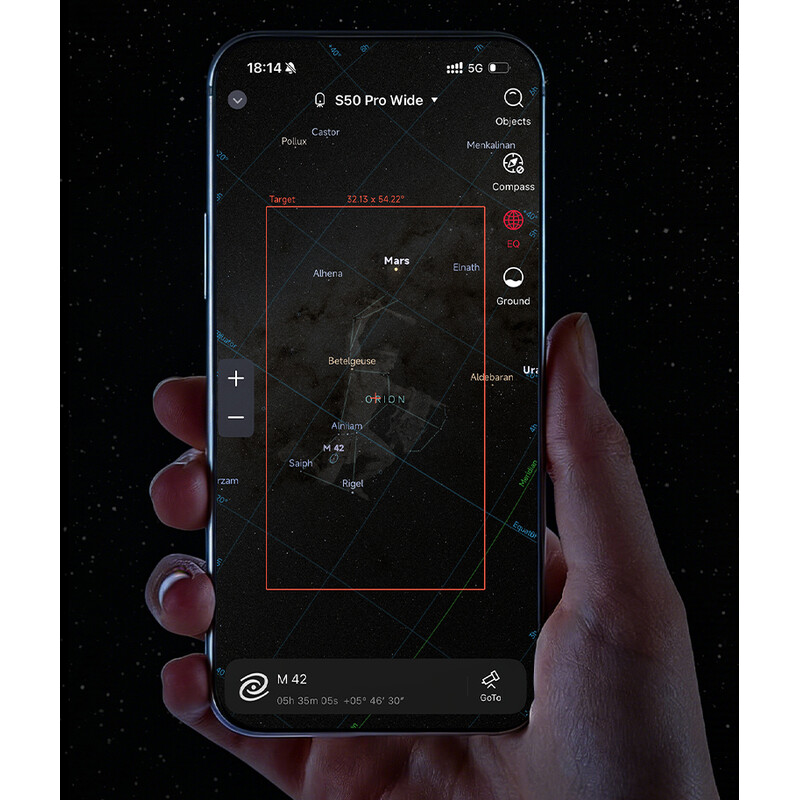
A smart telescope takes many short exposures and keeps adding them up. After ten to twenty minutes it shows colours and structures you would never see at the eyepiece – even from a city balcony, thanks to its built-in nebula filter.
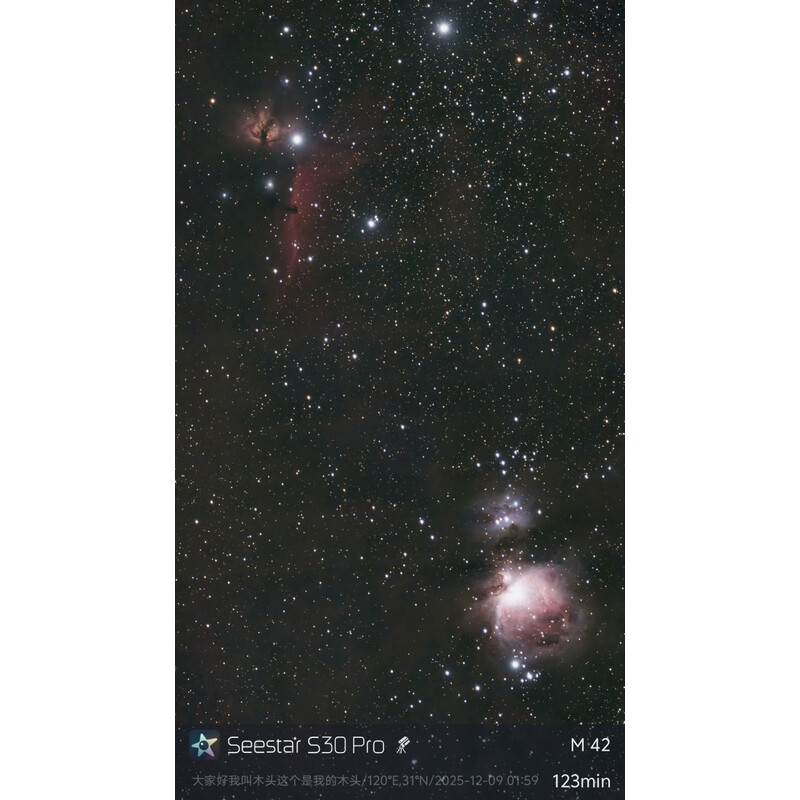
The flip side: with 30 to 50 mm of aperture and a short focal length, planets are nothing more than small discs. And you are not looking through anything – you are looking at a screen. On the forum, critics call it an “image vending machine”; supporters value exactly that as a stress-free way in.
City or countryside: your sky has a vote
Light pollution is the strongest argument for the smart telescope. Galaxies and nebulae vanish at the eyepiece under a washed-out city sky; on the stacked photo they stay visible. The Moon and the planets barely care – a Dobsonian shows them in the city too.
If you live in the city and will not drive out into the dark, a Dobsonian will rarely satisfy you on nebulae and galaxies. If you have a dark garden or enjoy the drive, a Dobsonian gives you far more for the same money.
The effort: setup, transport, maintenance
- Setup: you carry the Dobsonian outside and put it down – done. The mirror does need about half an hour to reach the outside temperature and show a sharp image. The smart telescope aligns itself in a few minutes.
- Weight: the Heritage 150P weighs 7.5 kg and needs a table or a stool. An 8-inch Dobsonian like the Skyliner 200/1200 comes to 26 kg in two parts. Smart telescopes weigh 0.8 to 2.8 kg.
- Finding things: at the Dobsonian you push the tube towards the target yourself. That takes a few evenings to learn, but it costs patience at the start. The smart telescope goes to any object at the tap of a finger.
- Maintenance: the mirrors of a Dobsonian need collimating now and then. With a little practice that takes five minutes. On a smart telescope there is nothing to collimate, but there are app and firmware updates.
The middle way: the Celestron StarSense Explorer 130mm Tabletop DobsonianCelestron StarSense Explorer Dobsonian 130/650 ($429.99€ 599) is a Dobsonian with phone navigation: the app uses arrows to show you where to push the tube. You look through the eyepiece yourself, but you never have to read a star chart.
For children: Dobsonian or smart telescope?
On forum.astronomie.de this exact question was asked several times in 2026 about children. For a child whose parents are not astronomers, the majority there recommended the smart telescope, because it delivers quick successes and never stalls on collimation or star-hopping.
The dissenting voices have a point: a child who sees Saturn with their own eyes in the eyepiece for the first time does not forget it. If an adult joins in, a small Dobsonian is the more intense experience. Our guide Telescope for kids collects recommendations by age.
Value for money: what do you get?
A 150 mm tabletop Dobsonian with two eyepieces costs $355.00€ 345. There is no new smart telescope for that money – the cheapest one in our comparison, the DWARF miniDWARF mini, sits at $419.00€ 429, and it comes without a tripod.A 150 mm tabletop Dobsonian with two eyepieces costs $355.00€ 345. Here the cheapest smart telescopes start in the same bracket: the ZWO Seestar S30 All-In-One Smart TelescopeZWO Seestar S30 Smart Telescope costs $299.00€ 479, the DWARF miniDWARF mini $419.00€ 429. Neither includes a tripod, and neither comes anywhere near the aperture.
Per unit of aperture the Dobsonian wins hands down; per finished colour image the smart telescope does. If you want both, most people start with one and add the other later – plenty of forum members use both kinds side by side.
Our pick for observing with your own eyes: Skywatcher Dobson Telescope N 150/750 Heritage FlexTube DOB
A 150 mm Newtonian optic on a tabletop Dobson base: short, collapsible and noticeably brighter than the 130 mm version.
Price: € 345
Our pick for images from the city: ZWO Seestar S30 Pro Smart Telescope
ZWO's benchmark smart telescope: a polished app, mosaic mode and stunning results in minutes.
Price: € 699
If you want to go further
On the Dobsonian side: the 8-inch class collects almost twice as much light as the 150P and resolves globular clusters like M 13 into a swarm of individual stars. It does weigh 26 kg – worth it if you can get it out of the garage or garden quickly. Apertura AD8 8" Dobsonian TelescopeSkywatcher Dobson Telescope N 200/1200 Skyliner Classic · $699.95€ 479
On the smart side: the Seestar S50 Pro has 50 instead of 30 mm of aperture and shows galaxies noticeably larger. Seestar S50 ProSeestar S50 Pro · $999.00€ 999
Which one suits you?
| Your situation | Recommendation | Why |
|---|---|---|
| You want to see it yourself, the Moon and planets first | Sky-Watcher Heritage 150 Tabletop DobsonianSkywatcher Dobson Telescope N 150/750 Heritage FlexTube DOB | ⭐ Pick for observingPlenty of aperture for the money, compact, two eyepieces included. |
| City, balcony, nebulae and galaxies in colour | Seestar S30 ProSeestar S30 Pro | ⭐ Pick for photosFilter and stacking beat the city lights, all of it automatic. |
| Looking through it yourself, but without a star chart | Celestron StarSense Explorer 130mm Tabletop DobsonianCelestron StarSense Explorer Dobsonian 130/650 | The phone app walks you to the object. |
| Dark garden, maximum performance at the eyepiece | Apertura AD8 8" Dobsonian TelescopeSkywatcher Dobson Telescope N 200/1200 Skyliner Classic | 8 inches: globular clusters resolved, galaxies with structure. |
| A child without an experienced grown-up | DWARF miniDWARF mini or ZWO Seestar S30 All-In-One Smart TelescopeZWO Seestar S30 Smart Telescope | Quick successes, nothing to collimate. |
| Travel and holidays | DWARF miniDWARF mini | 840 g, fits in any bag. |
Frequently asked questions: smart telescope or Dobsonian
Do you see more with a smart telescope than with a Dobsonian?
On nebulae and galaxies yes, because the image collects light over many minutes and brings out colour. On the Moon and the planets no – there a Dobsonian shows far more detail, live. So it depends on what you want to see.
Can I see Jupiter and Saturn with a smart telescope?
Yes, but only as small discs with hints of bands or a ring. For planets, a Dobsonian or another classic telescope with a long focal length is the better choice.
Do I have to collimate a Dobsonian?
Now and then yes, above all after transport. With a collimation eyepiece it is done in five minutes once you have practised it once or twice. The Heritage 150P comes with a simple collimation aid.
Which is better in the city?
For nebulae and galaxies the smart telescope, for the Moon and the planets the Dobsonian. Light pollution mainly affects the faint objects outside the solar system.
Can I take photos with a Dobsonian?
The Moon and the planets work well with a phone at the eyepiece or a planetary camera. For long-exposure images of nebulae a Dobsonian without tracking is unsuitable. If you want deep-sky photos, a smart telescope or a motorised mount serves you better.
Is it worth having both?
For many people yes: the Dobsonian for the Moon, the planets and dark nights, the smart telescope for nebulae from the balcony. It can even collect images alongside while you observe at the Dobsonian.
Conclusion: observing or photographing?
The Dobsonian is the better telescope, the smart telescope the better camera. If you want to get to know the sky and see it with your own eyes, take the Dobsonian; if you want images of nebulae and galaxies without a learning curve, especially in the city, take the smart telescope.
You will find more choices in our guides Buying a Dobsonian telescope and Smart telescope comparison. Right at the very beginning? Then read Telescope or binoculars first.
Links marked with an asterisk (*) are affiliate links. If you buy through them we receive a small commission – the price does not change for you.