By Alexander Merz · Updated on · Details checked on 25 September 2026
How do you like this device?
1 reader votes so far – we show the average from 5.
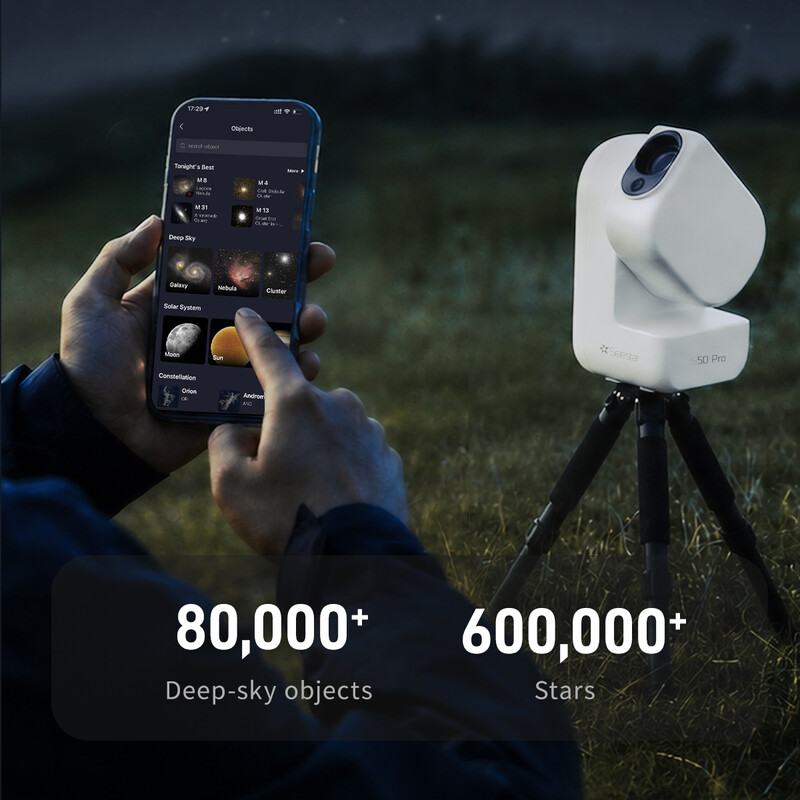
The Seestar S50 Pro is ZWO’s smart telescope with a 50 mm aperture, 260 mm focal length and two 4K cameras, released on August 25, 2026. This page sums up what owners actually report after their first weeks.
Where these experiences come from
We did not test a unit of our own. Instead, we analyzed what owners write in forums and what reviewers show in videos – between August 25 and September 24, 2026.
The upside: a single reviewer has one unit, we see dozens. Problems that only affect some units only show up this way. The downside, too: almost all owners have had their S50 Pro for just one to three weeks.
| Source | Scope | Context |
|---|---|---|
| Reddit (mainly r/seestar) | 60 threads, 863 comments, 45 owners with first-hand reports | Fan community: image posts get lots of upvotes, problem threads few |
| Cloudy Nights | 5 threads, about 30 owners | Experienced astrophotographers, often with measurements |
| astrotreff.de | Main thread, 407 posts since launch, 14 owners | German forum, very detailed on accessories and EQ mode |
| forum.astronomie.de | 6 threads, 2 owner reports | German forum, lots of debate, little hands-on |
| YouTube | 12 reviews, full transcripts | 5 units supplied by ZWO, 1 reviewer bought his own |
| Blogs and magazines | blickohnegrenzen.de (60-day diary, German), Digital Camera World, AstroBackyard, Star Walk, Galactic Hunter | blickohnegrenzen uses a loan unit from Astroshop |
We only counted people who demonstrably own an S50 Pro – who describe using it or show their own images. Comments about the old S50, the S30 Pro or from people still waiting for delivery don’t count. All sources are linked at the end.
What owners like about the Seestar S50 Pro
| Praise | How often | What exactly is reported |
|---|---|---|
| Sharper stars, less noise | very often | 15 owners on Reddit alone; all six S50 upgraders there see clear progress |
| Tracking with few rejected frames | very often | Typically 90–100 % usable frames at 30 s exposure |
| Easy start | often | NFC pairing in seconds, the wide-angle camera finds Sun and Moon immediately |
| Quieter and better built | several | Quieter than the S50, thicker neck, better plastics |
| Reliable autofocus | several | Two reviewers report not a single failure in a month |
The biggest step forward is tracking. With the old S50, about 10 to 20 seconds per frame was the limit in alt-az mode (standard setup without tilt). With the Pro, many owners report 30 seconds with hardly any rejects.
The field of view is four times larger, the image scale stays almost the same. You see more sky around a target, but small galaxies don’t get any bigger. Several video reviewers stress exactly this point.

What owners criticize
| Problem | How often | Owners’ fix |
|---|---|---|
| EQ plate works loose, rubber feet get in the way | often | Rubber or nylon washer (about 1.5–2 mm) under the plate, 3/8-inch plate instead of a 1/4-inch adapter |
| Misshapen stars at the edge (tilt, astigmatism) | about 10 owners | Check the unit in the first nights and return it within the return window if affected |
| Mosaic mode wastes a lot of time | several | Only 35–65 % of run time becomes exposure – use a single field where it fits |
| App crashes with large images | several | Phone with 8 GB RAM or more, process large mosaics on a tablet or Mac |
| USB-C port is loose or recessed | several | Short extension cable instead of a magnetic plug |
| Shipping delays, slow support | often | Ask the retailer for a delivery date before ordering |
Most complaints are about EQ mode, not the telescope itself. In normal use on the supplied tripod, owners report few problems. It only gets tricky once the unit goes on a tilt head for longer exposures.
Tracking in practice: how many frames are usable
The Seestar automatically rejects blurred frames. The fewer it throws away, the more exposure time ends up in your image. Owners and reviewers measured these values themselves:
| Who | Mode | Exposure | Rejected |
|---|---|---|---|
| YouTube reviewer, 2 self-bought units, Bortle 2 | EQ | 30 s | 0.3 % (5 of 1,680) |
| same reviewer | EQ | 60 s | 2.3 % (22 of 942) |
| Reddit owner, Bortle 4–5 | EQ | 30 s | 4.8 % |
| same owner | EQ | 60 s | 30 % |
| astrotreff owner, Germany | EQ | 60 s | 1–3 of 200 |
| astrotreff owner, single target | EQ | 60 s | 5–15 % |
| YouTube reviewer (lukomatico) | EQ | 60 s | about 30 % |
| Reddit owner | Alt-Az | 10 s | about 5 % |
30 seconds in EQ mode works for almost everyone, 60 seconds only with good polar alignment. Those reporting very few rejects usually repeated the polar alignment and got down to 0.1°. At 0.6°, one owner reports drift and elongated stars.
Battery: how long the Seestar S50 Pro really lasts
ZWO quotes up to 9 hours – measured above 25 °C, with the telephoto camera in alt-az mode. That’s a lab figure. Real-night reports come in lower, but usually last a whole night.
| Source | Conditions | Run time |
|---|---|---|
| YouTube-Test (Cuiv, Tokio) | Summer night, automatic plan | 10 pm to 6:30 am, 10 % left |
| blickohnegrenzen.de | Dew heater on all night, 8 °C by morning | 7 h 10 min |
| Digital Camera World | not stated | “well over six hours”, never ran out |
| YouTube-Test (Rooftop Astronomy) | Balcony | 6-hour session without issues |
| Star Walk | City garden | about 50 % after 3–4 hours |
EQ mode: what you need to buy
In EQ mode, the Seestar is tilted to align with the celestial pole. The field no longer rotates, and exposures up to 60 seconds become possible. You need a tilt head for this, which is not included.
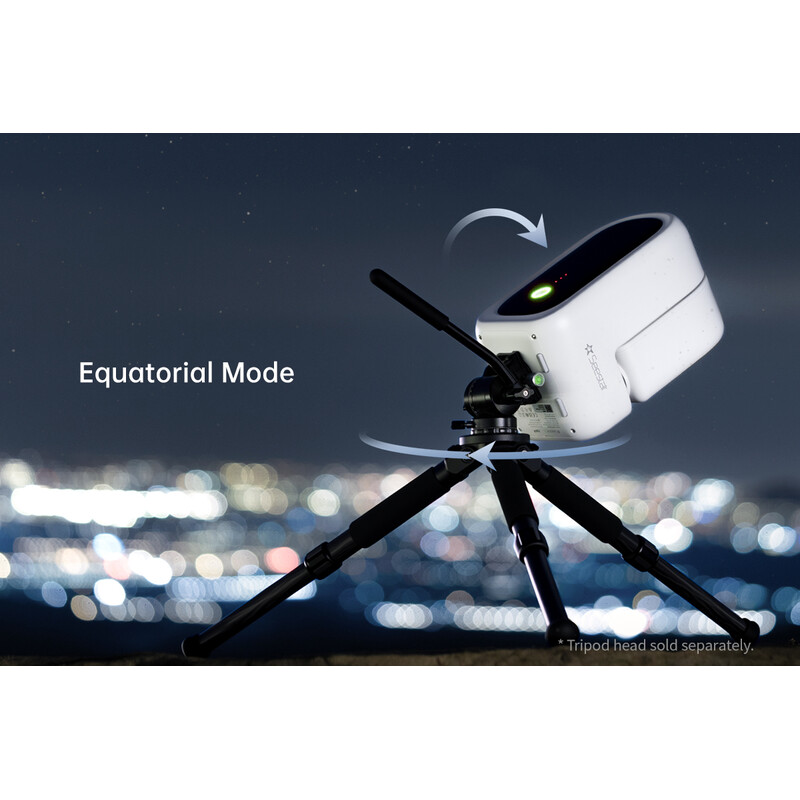
- Tilt head: the ZWO TH10ZWO TH10 fits directly; owners also use cheaper equatorial wedges from Sky-Watcher or others.
- Quick-release plate with a 3/8-inch screw: the ZWO TH10 plateZWO TH10 plate instead of a 1/4-inch adapter. The unit has a 3/8-inch thread at the bottom.
- Rubber washer: about 35 mm across, 1.5–2 mm thick, so the plate can’t twist.
- Sturdier tripod: optional – the supplied one is enough for some, others find it too low and wobbly in EQ mode.
The Seestar app in everyday use
The app is the telescope’s real user interface. You pick targets in the sky atlas, plan entire nights and process images right on your phone.
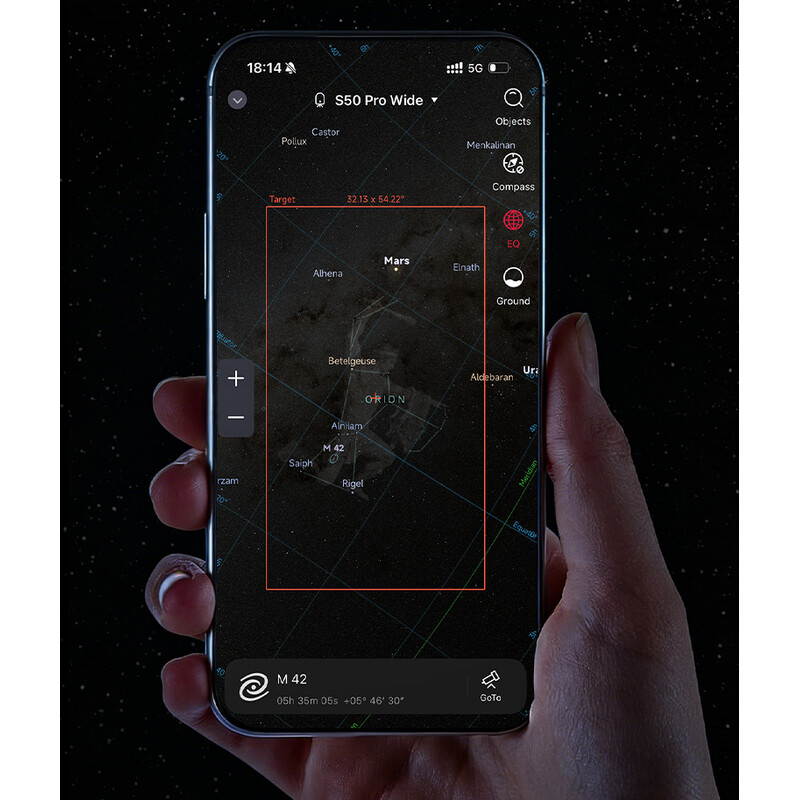
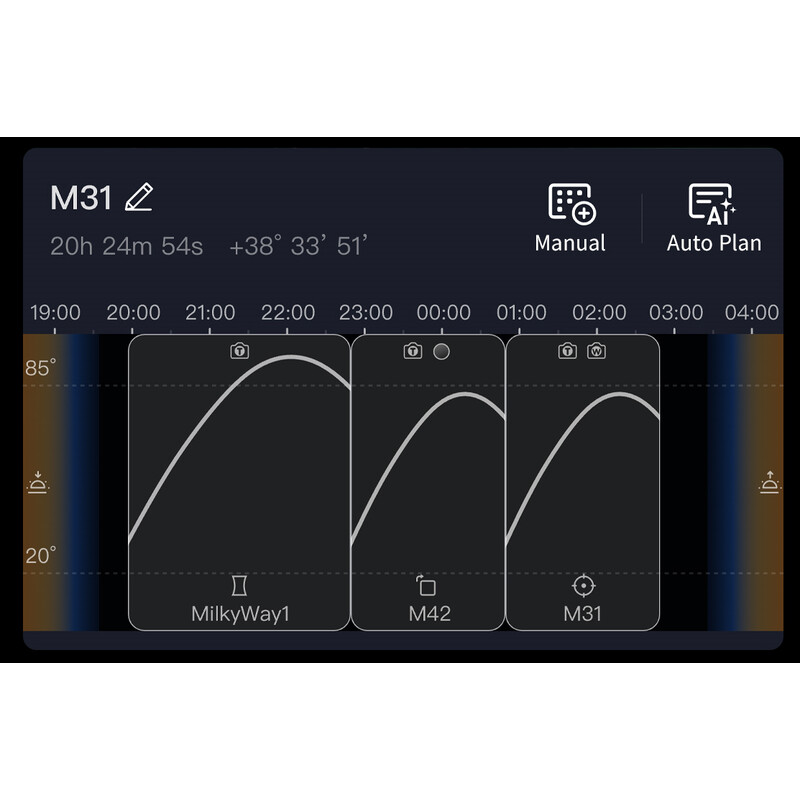
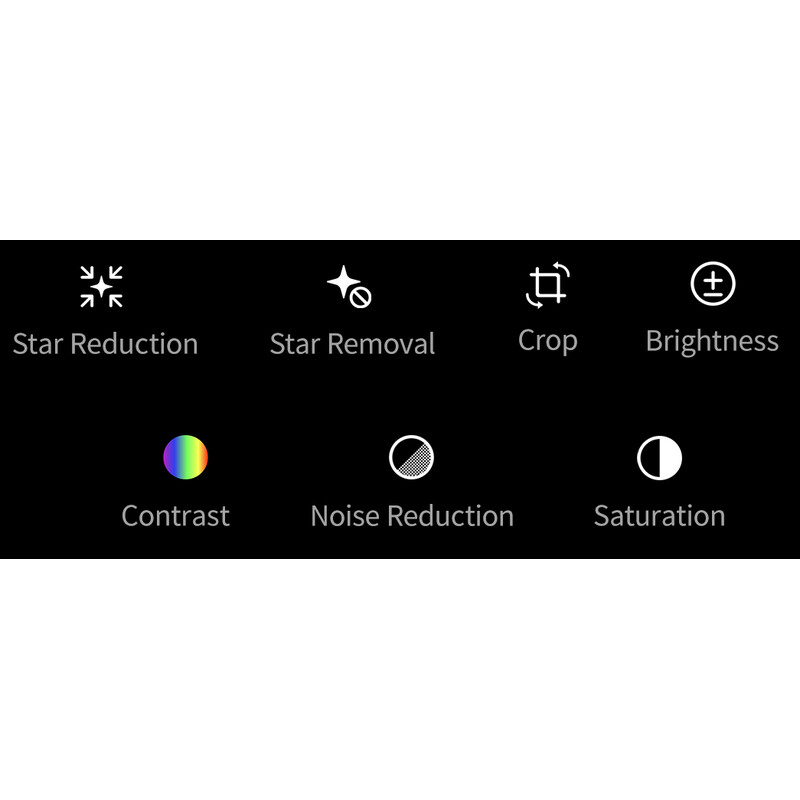
App screenshots: ZWO / Astroshop.
- ✅ Praised: NFC pairing, reliable autofocus, remote control over mobile data via the “Telescope Network”, frequent updates.
- ⚠️ Crashes on weak phones: With 4 GB RAM, AI processing of large mosaics fails; owners recommend 8–12 GB.
- ⚠️ Hidden settings: raw FITS frames have to be saved per session, and dark frames were switched off by default after one update.
For your first steps we have a guide: Seestar manual and first steps – from charging to the app to your first night.
Unit variation: tilted sensor and other defects
About ten of the 80-plus owners report misshapen stars – usually on one side of the frame, caused by a slightly tilted sensor or pinched optics. Two owners even had two units in a row with this issue.
That number is more likely too high than too low. People with a problem post more often than happy owners. Several owners measured their unit specifically and found no tilt.
On top of that, a few genuine defects: a wide-angle camera with no image, a broken dark-frame shutter and one unit that, according to its owner, arrived practically dead.
Upgrading from the S50 or S30 Pro – is it worth it?
| You have … | What owners report | Our take |
|---|---|---|
| no smart telescope yet | Beginners are almost all enthusiastic | Very good choice if galaxies and small nebulae matter to you |
| a Seestar S50 | Clearly better in sharpness, noise and tracking | Worth it for deep-sky images; hardly for Sun and Moon |
| a Seestar S30 Pro | More detail on small targets, but the S30 Pro stays lighter and shows more sky | Only if you specifically want to image small galaxies |
Notably, existing Seestar owners lean towards the larger DWARFLAB Draco. Beginners, on the other hand, recommend the S50 Pro as a first scope. Our page on the Seestar S30 Pro covers the smaller sibling.
The Draco has a 90 mm aperture instead of 50 mm and gathers over three times as much light – more detail on small galaxies. In return it weighs about 5.5 kg, costs considerably more and is so new that there are hardly any owner reports yet. Worth it for anyone who already has smart-telescope experience and can wait.
DwarfLab Draco Smart TelescopeCheck price of the DWARFLAB Draco · Our Draco article
Who the Seestar S50 Pro is for – and who it isn’t for
- ✅ Beginners who want to image galaxies and nebulae without technical know-how.
- ✅ City dwellers – the built-in light pollution filter delivers usable nebula images even at Bortle 8.
- ✅ S50 owners who want more sharpness and longer exposures.
- ⚠️ Not for planets: at 260 mm focal length, Saturn stays a tiny dot.
- ⚠️ Not for backpacking: at 2.8 kg, the S30 Pro is the more portable choice.
- ⚠️ Some effort required if you want to use EQ mode – that means extra accessories and some tinkering.
Owners' favorite: ZWO Seestar S50 Pro Smart Telescope
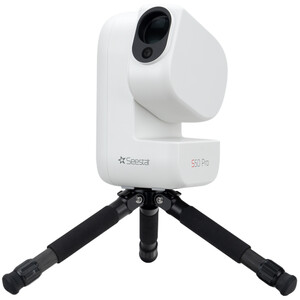
Sharper and cleaner than the S50, 30-second exposures with hardly any rejects. Not a planet scope.
Price: € 999
Frequently asked questions about Seestar S50 Pro experiences
How satisfied are Seestar S50 Pro owners?
The large majority are satisfied to enthusiastic, especially about sharpness and tracking. Criticism focuses on EQ accessories, unit-to-unit variation in the optics and delivery times.
How long does the battery really last?
Real-world reports range from just over 6 to 8.5 hours. The manufacturer’s 9 hours apply above 25 °C; with the dew heater and cold it’s less.
Can the Seestar S50 Pro do 60-second exposures?
In EQ mode yes, but only with accurate polar alignment and a solid mount. Reported reject rates range from 2 to 30 %; at 30 seconds they are almost always low.
How common is a tilted sensor?
About ten of 80-plus owners report misshapen stars at the edge of the frame. Since unhappy owners post more often, the real share is probably lower. Check your unit in the first nights.
Do I need accessories for EQ mode?
Yes, at least a tilt head or equatorial wedge and a quick-release plate with a 3/8-inch screw. Many owners add a thin rubber washer underneath.
How long does delivery take?
At launch it varied a lot: some buyers had their unit after a week, others waited four weeks or longer. Current details are on our Seestar S50 Pro buying guide.
Is there an independent test with a purchased unit?
Most video reviewers received their unit from ZWO; Astronomy Tips & Reviews with Curtis bought two units himself. In German, blickohnegrenzen.de runs a 60-day diary with a loan unit from Astroshop.
Sources
Forums and communities
- astrotreff.de: ZWO Seestar S50 Pro thread (German)
- forum.astronomie.de: Seestar S50 Pro launch thread (German)
- Cloudy Nights: SeeStar S50 Pro · Photos · vs. Draco
- Reddit: mechanical play and rejects · misshapen stars · sensor tilt · EQ drift · delivery times · S30 Pro, S50 Pro or Draco
Reviews and diaries
- blickohnegrenzen.de: 60-day diary (German, loan unit)
- heise/c’t: Seestar S50 Pro review (German, paywall)
- Digital Camera World: Review · AstroBackyard · Star Walk · Galactic Hunter
YouTube
- Astronomy Tips & Reviews with Curtis (self-bought) · Cuiv, The Lazy Geek · Nebula Photos · AstroBackyard · The Space Koala · lukomatico · AstroBlender · Rooftop Astronomy · High Point Scientific (retailer) · Astroshop.de (retailer) · ScottC · Damon Scotting
Analysis as of September 24, 2026. Links marked with an asterisk (*) are affiliate links: if you buy through them, we earn a small commission at no extra cost to you.