By Alexander Merz · Published on
The Unistellar Odyssey is a smart telescope from French manufacturer Unistellar: 85 mm mirror, 320 mm focal length, app control, 4 kg. The Odyssey Pro is identical in construction, but also has an electronic eyepiece that Unistellar developed together with Nikon.
⭐ In short: The Odyssey is a specialist for small galaxies, globular clusters and small nebulae – compact, quick to set up and your ticket to Unistellar’s citizen science programme. Large objects such as Andromeda don’t fit in the frame, and the Seestar S50 ProSeestar S50 Pro costs only a fraction of the price. The Pro’s eyepiece is only worth it if you often observe with family, friends or groups.
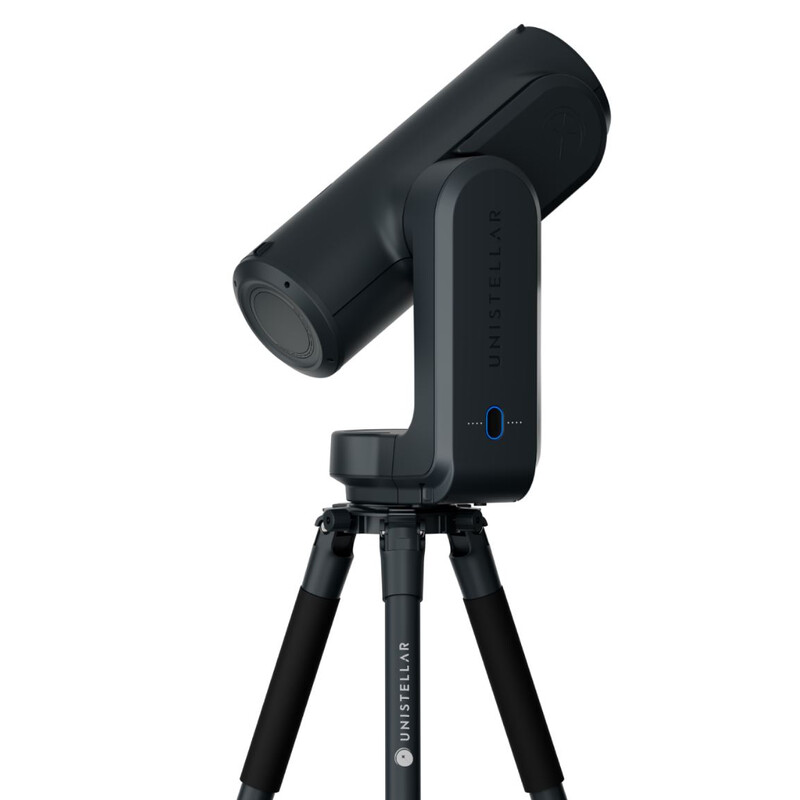
Compact, with citizen science: Unistellar Odyssey Smart Telescope
85 mm mirror, autofocus, app control and access to the observing campaigns of Unistellar and the SETI Institute. Strong on small galaxies and star clusters, weak on large nebulae and planets.
Price: € 2.399
Still unsure whether it should be a Unistellar at all? The smart telescope finder takes you from your budget to the right class of device in three questions.
Unistellar Odyssey: specifications, price and what’s in the box
The Odyssey and Odyssey Pro have the same optics, the same sensor and the same mount. The only difference is the Pro’s electronic eyepiece. All figures below come from Unistellar (as of 30/09/2026), the tripod weight from the Unistellar shop.
| Feature | Odyssey and Odyssey Pro |
|---|---|
| Optics | reflecting telescope, 85 mm aperture, 320 mm focal length, f/3.9 |
| Sensor | Sony IMX415, pixel size 1.45 µm |
| Field of view | 45 × 33.6 arcminutes (0.75° × 0.56°) |
| Image scale / resolving power | 0.93″ per pixel / 1.68″ |
| Limiting magnitude according to Unistellar | 17.2 mag |
| Mount | motorised, alt-azimuth (alt-az), GoTo, autofocus |
| Battery / storage | approx. 5 h / 64 GB |
| Weight | telescope 4 kg, tripod 2.5 kg, 6.5 kg in total |
| Eyepiece | Odyssey: none, image only on phone or tablet · Pro: electronic eyepiece with Nikon optics, plus phone and tablet |
| In the box | telescope, tripod, dust cap, charger, collimation tool; bag and solar filter extra |
| Price | Odyssey: about $2,399€ 2.399 · Odyssey Pro: about $4,199€ 4.199 |
Links marked with an asterisk are affiliate links. Sources: unistellar.com/de/odyssey and shop.eu.unistellar.com; Unistellar doesn’t name the sensor itself – Sony IMX415 according to Space.com, which matches the stated pixel size.
Why Astroshop quotes 12.3 mag and Unistellar 17.2: The 12.3 mag is the classic rule of thumb for the eye at the eyepiece of an 85 mm telescope. The 17.2 mag applies to the stacked camera image, which collects light for several minutes – both numbers are correct, they just measure different things.
How the Odyssey works: “Enhanced Vision” explained
The Odyssey has no glass eyepiece through which light reaches your eye directly. Inside the reflector sits a camera that takes a short exposure every few seconds. Unistellar calls the result “Enhanced Vision”.
Every other manufacturer calls the principle live stacking: the individual frames are continuously stacked on top of each other, the noise averages out and the object becomes brighter and more detailed with every minute. Seestar, DWARF and Vaonis do exactly the same – it isn’t new.
What really makes the Odyssey special is its long focal length combined with very small pixels. At 0.93″ per pixel, it images about two and a half times more finely than the Seestar S50 Pro (2.3″ per pixel). Small objects therefore appear large, while large ones no longer fit in the frame.
The app does the rest: the Odyssey works out where it’s pointing from the stars (plate solving), focuses automatically and uses the “Smart Star Finder” to suggest objects that are well placed right now. Against city light, “Deep Dark Technology” subtracts the brightened background.
What’s missing: Users on Cloudy Nights and Reddit miss equatorial tracking, a mosaic mode for large objects and a night planner like those offered by Seestar and DWARF (reports as of 2025). The Odyssey is an observing device, not a construction kit for astrophotographers.
Unistellar Odyssey Pro: is the eyepiece worth it?
The Pro’s eyepiece is a small OLED display behind Nikon optics. You look into it as you would with a normal telescope and see the same stacked image that the app shows. The Pro costs about $4,199€ 4.199 instead of about $2,399€ 2.399 – the entire extra cost goes into this eyepiece.
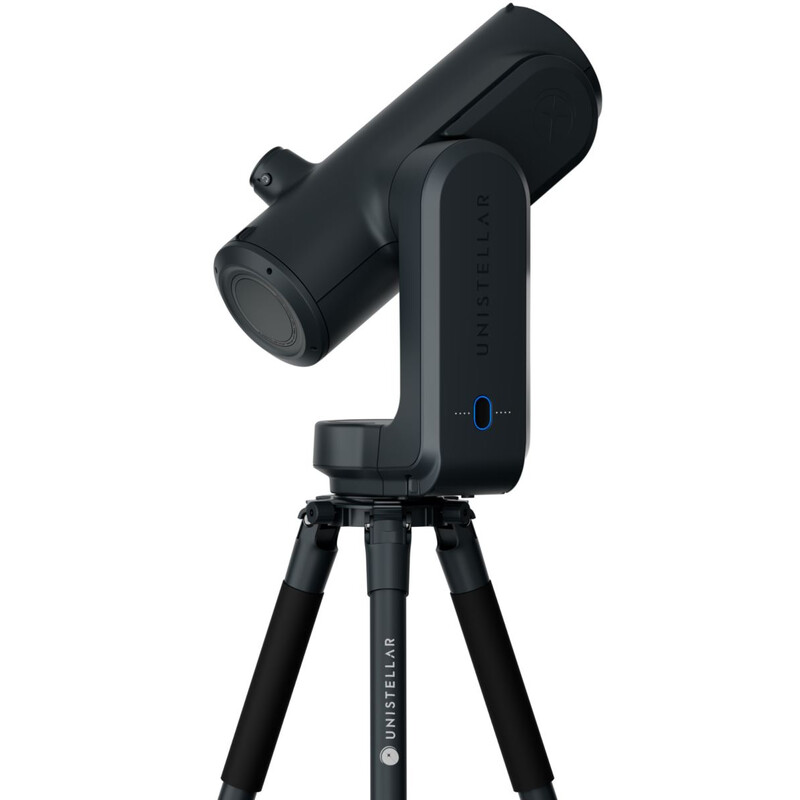
Pro owners often rave about the eyepiece. One owner on Reddit describes the Orion Nebula looking more three-dimensional in the eyepiece than on the iPad, and one owner on Cloudy Nights calls it “magical” for showing the sky to others. BBC Sky at Night and Skies & Scopes praise it as well.
But it remains a screen, not a view through the optics. The PetaPixel reviewer found the experience lovely but couldn’t justify the extra cost. And for the first few seconds the image in the eyepiece is dark until enough frames have been stacked – Sky at Night points this out too.
| The eyepiece is worth it if … | Save your money if … |
|---|---|
| you often let family, friends or groups take a look | you observe on a tablet anyway and share images |
| the feeling of “standing at the telescope” matters to you | you expect a real, optical image – only a classic telescope delivers that |
| you want to observe outdoors without a bright phone display | you’d rather put the extra cost into more aperture |
Our assessment: for most people, the Odyssey without the eyepiece is the more sensible choice. If you really want the eyepiece, weigh the Pro against the eVscope 2eVscope 2 ($4,999.00€ 4,911) – it also has a Nikon eyepiece, but more aperture. Unistellar offers a red special edition of the Pro at a higher price; technically it’s identical.
With electronic Nikon eyepiece: Unistellar Odyssey Pro Smart Telescope
Identical in construction to the Odyssey, plus an electronic eyepiece for that classic telescope feeling. Mainly worthwhile if you often observe together with others.
Price: € 4.199
What you see with the Odyssey – and what doesn’t fit in the frame
At 45 × 33.6 arcminutes, the Odyssey’s field of view is very small. That’s just about the height of the full Moon. The Seestar S50 Pro shows eight times as much sky, and the DWARF 3 a good eleven times as much.
Small objects are the Odyssey’s strength, large ones its weakness. Anything smaller than about half the Moon’s width fills the frame nicely. Anything extended only works as a crop.
| Object | Size in the sky | Fits in the Odyssey? |
|---|---|---|
| Dumbbell Nebula M27 | approx. 8′ × 6′ | ✅ yes, nice and large |
| Whirlpool Galaxy M51 | approx. 11′ × 7′ | ✅ yes, one of its showpieces |
| Globular cluster M13 | approx. 20′ | ✅ yes, fills the frame well |
| Full Moon | 29′ to 34′ | ⚠️ just about – tight when the Moon is close to Earth |
| Double Cluster h and χ Persei | approx. 1° span | ⚠️ “only just” according to Sky at Night |
| Orion Nebula M42 | approx. 65′ × 60′ | ⚠️ only the bright core |
| Pleiades M45 | approx. 2° | ❌ only a section |
| Andromeda Galaxy M31 | approx. 3° × 1° | ❌ only the core |
| North America Nebula | approx. 2° | ❌ no |
Object sizes rounded from common catalogue values.
Planets: Jupiter comes out at just under 50 pixels
Unistellar advertises Jupiter’s Great Red Spot and Saturn’s rings – and that’s accurate. At 0.93″ per pixel, Jupiter (around 45″ near opposition) comes out at just under 50 pixels, more than twice as large as in the Seestar S50 Pro. Saturn’s ring system reaches a good 40 pixels in width.
For planet fans, it’s still the wrong choice. All the expert reviews and the buyer review at Astroshop say that planets can’t keep up with classic telescopes; in our own review of the eVscope 2, too, Jupiter and Saturn were overexposed and lacking in detail. A classic 150 mm telescope with a planetary camera costs a fraction of the price and shows considerably more.
Moon and Sun
The Moon almost always fits completely in the frame, though the edge gets tight when it’s very close to Earth. The resolution is good for close-ups of individual craters.
⚠️ Sun only with a filter: Never point the Odyssey at the Sun without a certified objective solar filter – it destroys the sensor, and when looking into the Pro’s eyepiece there is an additional risk to your eyes. Unistellar offers a matching solar filter (82 mm) as an accessory; it isn’t included in the box.
Odyssey vs. Seestar S50 Pro, DWARF 3 and eVscope 2
In terms of price, the Odyssey plays in a different league from the bestsellers by ZWO and DWARFLAB. The table shows what you get for the extra money – and what you don’t.
| Feature | Odyssey | Seestar S50 Pro | DWARF 3 | eVscope 2 |
|---|---|---|---|---|
| Price | about $2,399€ 2.399 | $999.00€ 999 | $549.00€ 529 | $4,999.00€ 4,911 |
| Aperture / focal length | 85 / 320 mm | 50 / 260 mm | 35 / 150 mm | 114 / 450 mm |
| Field of view | 0.75° × 0.56° | 2.45° × 1.38° | 2.93° × 1.65° | 0.76° × 0.57° |
| Image scale | 0.93″/pixel | 2.3″/pixel | 2.75″/pixel | n/a |
| Eyepiece | no (Pro: yes) | no | no | yes, Nikon |
| Filters | none | dual-band Hα/OIII, UV/IR cut | astro, dual-band | none |
| Mosaic / EQ mode | no / no | yes / yes | yes / yes | no / no |
| Battery | approx. 5 h | up to 9 h | approx. 5.5 h | approx. 9 h |
| Weight | 4 kg + 2.5 kg tripod | 2.8 kg (device) | 1.35 kg (without tripod) | 9 kg with tripod |
| Citizen science (Unistellar/SETI) | yes | no | no | yes |
| Product | Unistellar Odyssey | Seestar S50 ProSeestar S50 Pro | DWARF 3DWARF 3 | eVscope 2eVscope 2 |
Links marked with an asterisk are affiliate links. Data: manufacturers’ specs, checked on 30/09/2026; image scale calculated from pixel size and focal length. Mosaic and EQ mode for Unistellar based on user reports.
Odyssey or Seestar S50 Pro?
On paper, the 85 mm mirror collects almost three times as much light as the Seestar’s 50 mm lens. Some of that is lost because the camera sits in the middle of the light path; Unistellar doesn’t say how much. On small, faint galaxies, that gives the Odyssey the edge.
The Seestar, in turn, wins on anything extended: Andromeda, the Pleiades, the North America and Heart Nebulae, plus narrowband filters for nebulae from the city, a mosaic mode and twice the battery life. For most beginners it’s the more versatile device – for a fraction of the price.
The Odyssey is only worth it over the Seestar if you have a clear reason: you mainly want to see small galaxies and globular clusters large, take part in citizen science campaigns or – with the Pro – have an eyepiece. Everything about the Seestar is in our Seestar S50 Pro check.
💶 The honest cheaper alternative: Seestar S50 Pro
The Seestar S50 Pro shows eight times as much sky and has filters, a mosaic mode and nine hours of battery. On small galaxies it delivers smaller images, but on large nebulae it’s clearly superior. If you don’t specifically need the Odyssey’s strengths, you’ll save a lot of money here.
Best value for money: ZWO Seestar S50 Pro Smart Telescope
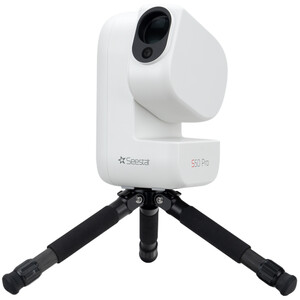
50 mm apochromat, dual-band filter, mosaic mode and up to 9 hours of battery – the more versatile smart telescope for most beginners.
Price: € 999
Odyssey or eVscope 2 and Equinox 2?
Within Unistellar’s range, the Odyssey is the compact model, while the “Expert” line with the eVscope 2 and Equinox 2 is the larger one. Both have 114 mm of aperture and 450 mm focal length – yet the field of view is almost the same size because a different sensor is fitted.
The larger aperture adds a full magnitude: Unistellar quotes a limiting magnitude of 18.2 mag for the eVscope 2 instead of 17.2 – stars and galaxy cores that are two and a half times fainter. In return, it weighs 9 kg with the tripod instead of 6.5 kg.
The Equinox 2 is the underrated option: 114 mm, eleven hours of battery, 7 kg, but no eyepiece. In the Unistellar shop on 30/09/2026 it cost less than a tenth more than the Odyssey (about $2,399€ 2.399) – if you don’t mind the size, you get more aperture for your money there.
🔭 If you want more: Unistellar eVscope 2
The eVscope 2 has 114 instead of 85 mm of aperture, i.e. around 80 % more light-collecting area, and reaches a magnitude deeper. On top of that come the Nikon eyepiece, as on the Pro, and nine instead of five hours of battery. The extra cost is worth it for anyone who hunts the faintest possible galaxies and comets from a fixed location and doesn’t have to carry the 9 kg far – we tested it ourselves.
For advanced users: more aperture: Unistellar eVscope 2 Smart Telescope
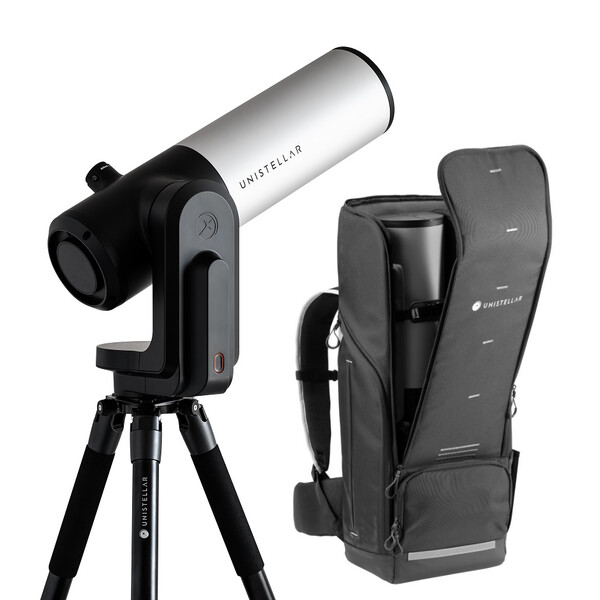
114 mm mirror, limiting magnitude 18.2 mag according to Unistellar, Nikon eyepiece and 9 hours of battery – the next step up from the Odyssey Pro.
Price: € 4,911
Our nights with the device: Unistellar eVscope 2 hands-on review.
Citizen science: observing for SETI and NASA with the Odyssey
The citizen science programme is what sets Unistellar apart from all other smart telescopes. Unistellar runs it together with the SETI Institute in California, and NASA is involved in the exoplanet campaigns. Anyone with a Unistellar telescope and the free app can take part.
| Campaign | What you observe |
|---|---|
| Asteroid occultations | An asteroid briefly passes in front of a star – measurements from many locations reveal its shape. |
| Planetary defence | Tracking near-Earth asteroids and determining their orbits more precisely. |
| Exoplanets (with NASA) | Measuring the tiny dimming of a star when a planet passes in front of it. |
| Comets | Documenting the brightness and changes of comets. |
| Cosmic explosions | Follow-up observations of supernovae and other objects that suddenly flare up. |
| Satellites | Recording satellites and their brightness. |
This isn’t a marketing gimmick – there are real results. Measurements from the Unistellar network fed into an analysis of NASA’s DART asteroid impact published in Nature. According to Unistellar, 26 citizen scientists tracked the asteroid 1999 AP10, and 40 observed the break-up of Comet ATLAS.
A realistic view: Campaigns run at fixed times, often in the middle of the night, and need clear skies at exactly that moment. If you fancy making real measurements, you get something here that no other smart telescope offers – if you only want pretty pictures, you’re paying for it anyway.
Unistellar Odyssey reviews and experiences: what the trade press and owners report
Transparency: we haven’t had the Odyssey in our own hands. We read five expert reviews and counted all posts by verified owners on Reddit, Cloudy Nights, the German forum astronomie.de and at Astroshop (as of 30/09/2026). The eVscope 2, which uses the same app and the same principle, on the other hand, we tested ourselves over several nights.
| Expert review | Model | Verdict in one sentence |
|---|---|---|
| BBC Sky at Night | Pro | 4.5 out of 5 stars: the fastest setup the editors have ever had; raw data on the PC much better than the app image. |
| Skies & Scopes | Pro (loan unit) | Excellent to use, the eyepiece sets it apart; but the images “won’t win any prizes”. |
| Space.com | Odyssey and Pro | Lovely nebulae and star clusters, not ideal for planets; the first review unit was out of focus, and a series fault in early units led to a recall. |
| PetaPixel | Pro | Fast, easy, family-friendly – but expensive, and the eyepiece surcharge is hard to justify. |
| Universe Today | Pro | Strong on nebulae and star clusters; the app was “glitchy” at times and needed a restart. |
What 9 owners report
We only counted people who verifiably own the Odyssey or Odyssey Pro: four owners on Reddit, three on Cloudy Nights and two buyers with reviews at Astroshop – seven with the Pro, two with the Odyssey. On the German forum astronomie.de we only found retailer posts, one sales ad and comments on the launch. The sample is small, so the numbers are trends, not statistics.
| Topic | Mentions | What exactly |
|---|---|---|
| ✅ Easy and fast | 5 of 9 | Set up in minutes, object found immediately, app “more mature” than the Celestron Origin’s |
| ✅ Handy for travel | 4 of 9 | fits in hand luggage, camping, observing in the mountains |
| ✅ Works in the city | 2 of 9 | M42, M51, M101 from a large German city, Orion Nebula from the pavement |
| ✅ Eyepiece impresses | 2 of 7 Pro owners | three-dimensional impression, ideal for showing others |
| ✅ Raw data usable | 2 of 9 | processing with astro software such as PixInsight |
| ⚠️ Technical or service problems | 3 of 9 | firmware update wouldn’t load, eyepiece stayed dark at first, support doesn’t clean mirrors (water spots) |
| ⚠️ Weak on planets | 1 of 9 | “not comparable with classic systems” |
| ⚠️ Image quality behind the competition | 1 of 9 | Owner of both devices: the Celestron Origin delivers the better images |
The harsh criticism comes almost exclusively from non-owners. On Reddit and Cloudy Nights the words “overpriced” and “bad images” come up often, mostly from Seestar and Vaonis users. The loudest voice is a former eVscope 2 owner who posts in almost every Unistellar thread – that skews the picture.
On the substance, though, the critics have a point: for the money, Seestar or Vaonis give you more features, and owners would like more frequent software updates. If you’re looking for a device for viewing, this bothers you little; if you want to process astrophotos, you’ll hit the limits sooner.
Two practical tips from the reports: The open mirror is delicate – always keep the dust cap on and never let rain or dew get on it; according to one owner, Unistellar doesn’t clean mirrors. And when buying a used unit from the first 2024 batch, ask whether it was affected by the focus recall.
Who the Unistellar Odyssey is worth it for
In short: the Odyssey is a good device with a difficult price. It’s worth it if its particular strengths match exactly what you want.
| Your situation | Recommendation | Why |
|---|---|---|
| You’re getting started and want to photograph extended nebulae and Andromeda | Seestar S50 ProSeestar S50 Pro | ⭐ Our recommendation for most peopleEight times larger field of view, filters, mosaic – for $999.00€ 999 |
| You want to see small galaxies and globular clusters large and take part in citizen science | Unistellar Odyssey | Long focal length, fine image scale, access to the SETI programme |
| You often show the sky to family, school classes or guests | Unistellar Odyssey Pro | The eyepiece makes observing together more tangible |
| You want to go as deep as possible and have a fixed location | eVscope 2eVscope 2 or Equinox 2 | 114 mm aperture, a full magnitude more |
| Budget of about a quarter of the Odyssey’s price, often on the move | DWARF 3DWARF 3 ($549.00€ 529) | 1.35 kg, a good eleven times larger field of view |
| Mainly planets and the Moon, visually | not a smart telescope | A classic telescope shows more and costs less |
Links marked with an asterisk are affiliate links.
Price tip: Unistellar prices fluctuate a lot. At the end of 2025, a German retailer at times offered the Odyssey considerably cheaper than today, and the Pro was reduced at Astroshop in late summer 2026 – the price in the boxes on this page is updated daily.
Frequently asked questions about the Unistellar Odyssey
How much does the Unistellar Odyssey cost?
The Odyssey costs about $2,399€ 2.399, the Odyssey Pro with electronic eyepiece about $4,199€ 4.199. Both are in stock at Astroshop; the prices on this page are updated automatically every day.
What is the difference between the Odyssey and the Odyssey Pro?
Only the eyepiece. Optics, sensor, mount, battery and app are identical. The Pro also has an electronic eyepiece with Nikon optics, in which you see the stacked image as in a classic telescope.
Can you really look through the Odyssey Pro?
You look into an eyepiece, but what you see there is a small display, not direct light from the sky. The image is the same stacked camera image as in the app. It feels like looking through a telescope and many people enjoy it, but it remains a screen.
Which sensor is in the Odyssey?
Unistellar doesn’t name the sensor itself. According to Space.com it’s a Sony IMX415; that matches the stated pixel size of 1.45 µm and the field of view of 45 × 33.6 arcminutes exactly. The eVscope 2 uses a different Sony sensor (IMX347).
Is the Odyssey better than the Seestar S50 Pro?
On small galaxies and globular clusters, yes: more aperture, finer image scale. On large nebulae, Andromeda and the Pleiades, the Seestar S50 ProSeestar S50 Pro with its eight times larger field of view is clearly better – and it costs only a fraction of the price.
Can you see planets with the Odyssey?
Yes, Jupiter with its cloud belts and Saturn with its ring are recognisable; Jupiter comes out at just under 50 pixels. For beautiful planetary images, though, a classic telescope with a planetary camera is considerably better and cheaper.
How long does the battery last?
About five hours according to Unistellar. For long nights, the PetaPixel reviewer recommends a power bank; the eVscope 2 (9 h) and Equinox 2 (11 h) last considerably longer.
Do I need a subscription for the Unistellar app?
No. According to Unistellar, the app for iOS and Android is included free of charge, as is participation in the citizen science campaigns.
Is the Odyssey suitable for beginners?
In terms of operation, yes – owners and reviewers unanimously praise the quick, easy start. In terms of price, it isn’t a typical beginner’s device: if you don’t yet know how deep you’ll get into the hobby, start with a cheaper smart telescope. Our free telescope advice can help you choose.
Verdict: a specialist with an eyepiece option – but not the best value for money
The Unistellar Odyssey is well thought out, quick to set up and strong on small deep-sky objects. With the citizen science programme and the Pro’s eyepiece, it offers two things no other manufacturer has.
Its problem is the price compared with the competition. For most beginners the Seestar S50 Pro is the better choice, and for more depth the eVscope 2 or the Equinox 2. You’ll find all devices at a glance in our smart telescope overview.
Is the Odyssey right for you?
- ✔ Yes, if you want to see small galaxies, globular clusters and small nebulae large.
- ✔ Yes, if you want to join real measurement campaigns with the SETI Institute.
- ✘ No, if you want to photograph Andromeda, the Pleiades and large nebulae: the Seestar S50 ProSeestar S50 Pro ($999.00€ 999) is better for that.
- ✘ No, if you mainly want to see planets – a classic telescope is better for that.
* Affiliate link: if you buy through this link we may earn a small commission from Astroshop or High Point Scientific, at no extra cost to you.