By Alexander Merz · Published on
Vaonis Vespera is the smart telescope range from French manufacturer Vaonis: a 50 mm apochromat (lens optics without colour fringes), camera, GoTo mount (finds celestial objects by itself) and battery in a 5 kg housing, controlled via the Singularity app.
Three models are currently on sale: Vespera II, Vespera 3 and Vespera Pro II. All three collect the same amount of light – they differ in sensor, battery and equipment.
⭐ In short: The Vespera 3Vespera 3 is the most complete package – tripod, 11 hours of battery and dew protection are included. The Vespera IIVespera II is only worth it once you factor in a tripod and a power bank, and the Vaonis Vespera Pro 2 Smart TelescopeVespera Pro II only for small galaxies in high resolution. And to be honest: the Seestar S50 ProSeestar S50 Pro has the same aperture for $999.00€ 999.
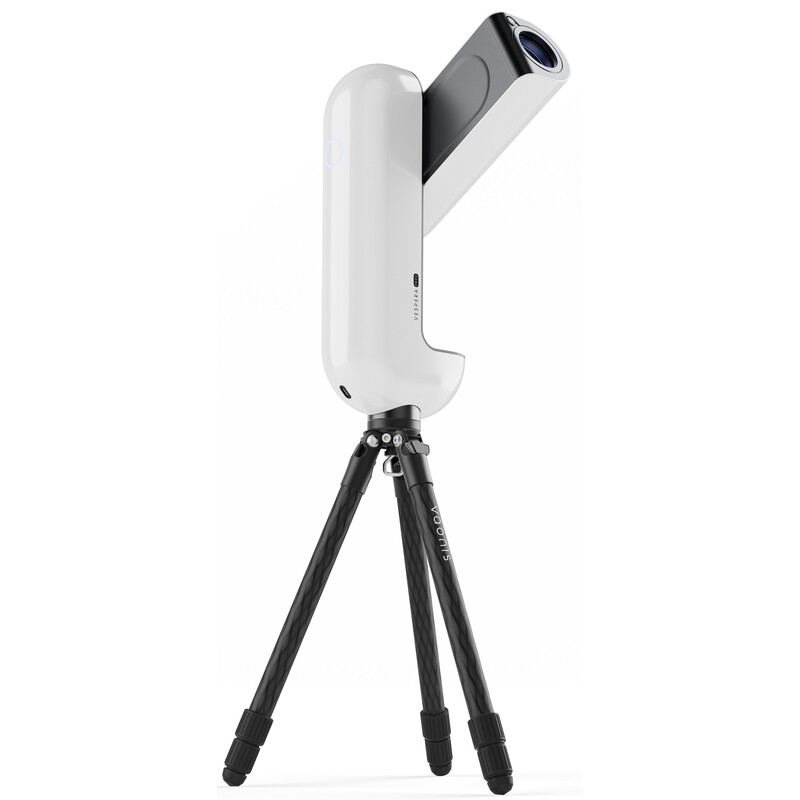
Which Vaonis Vespera is right for whom?
The decision depends less on the optics than on battery, sensor and accessories. The table sorts the three models by what you plan to do with them.
| Model | Who it’s for | Price |
|---|---|---|
| Vaonis Vespera IIVaonis Vespera II | Anyone who wants Vaonis optics at the lowest price and can live with a power bank and buying accessories | $1,590.00€ 1,590 |
| Vaonis Vespera 3Vaonis Vespera 3 | ⭐ Our pick in the Vespera rangeAnyone who wants a complete device: tripod, 11 hours of battery, dew protection and a 5-year warranty | $2,490.00€ 2,490 |
| Vaonis Vespera Pro 2 Smart TelescopeVaonis Vespera Pro II | Anyone who wants more detail on small galaxies and nebulae and processes the raw data themselves | $2,990.00€ 2,990 |
Links marked with an asterisk are affiliate links.
Specifications compared
Aperture, weight and housing are the same on all three. All figures come from the Vaonis spec sheets (as of 30 September 2026).
| Feature | Vespera II | Vespera 3 | Vespera Pro II |
|---|---|---|---|
| Optics | Apo, 4 lenses, 50 / 250 mm (f/5) | Apo, 4 lenses, new design, 50 / 245 mm (f/4.9) | same as Vespera 3 |
| Sensor | Sony IMX585, 8.3 MP | Sony IMX585, 8.3 MP | Sony IMX676, 12.5 MP |
| Resolution / pixel size | 3840 × 2160 / 2.9 µm | 3840 × 2160 / 2.9 µm | 3536 × 3536 / 2.0 µm |
| Field of view | 2.5° × 1.4° | 2.5° × 1.4° | 1.6° × 1.6° (square) |
| Image scale | approx. 2.4″ per pixel | approx. 2.4″ per pixel | approx. 1.7″ per pixel |
| Mosaic mode | up to 24 MP | up to 24 MP | up to 50 MP |
| Battery | approx. 4 h | approx. 11 h | approx. 11 h |
| Storage | 25 GB | 115 GB | 225 GB |
| Dew protection | heater built in, automatic only with hygrometer (accessory) | automatic, built in | automatic, built in |
| Tripod | not included | aluminium, included | carbon with case, included |
| Warranty | 3 years | 5 years | 5 years |
| Price | $1,590.00€ 1,590 | $2,490.00€ 2,490 | $2,990.00€ 2,990 |
Sources: Vaonis spec sheets and comparison page, warranty according to Astroshop. Filters and solar filters are not built into any of the models.
Vespera II: the most affordable way into Vaonis
The Vespera II has been the entry-level model since 2024 and is still on sale. It has the same Sony sensor as the Vespera 3 and optics with a field flattener that, according to reviews, show practically no colour fringing.
The low price comes with three catches. No tripod in the box, only around four hours of battery and 25 GB of storage, which fills up quickly on long nights with raw data. The dew heater is built in, but only switches on automatically with the hygrometer sensor (an extra accessory from Vaonis).
The cheapest route to Vaonis optics: Vaonis Vespera II Smart Telescope
Same 8.3 MP sensor as the Vespera 3, built-in mosaic mode and the mature Singularity app. Factor in a tripod and a power bank for long nights right away.
Price: € 1,590
The “Vespera II X Edition” is not a separate model. Vaonis limited it to 150 units: same technology, but a transparent housing, carbon tripod, case and built-in hygrometer. According to Vaonis, it is sold out.
Vespera 3: what changes compared with the Vespera II
The Vespera 3 is the successor to the Vespera II, unveiled in April 2026. The sensor stays the same; everything around it changes.
| Aspect | Vespera II | Vespera 3 |
|---|---|---|
| Optics | Apo quadruplet, 250 mm | newly designed apo quadruplet (3 groups), 245 mm, plus baffles against stray light |
| Battery | approx. 4 h | approx. 11 h |
| Storage | 25 GB | 115 GB |
| Dew protection | automatic only with accessory hygrometer | automatic as standard |
| Tripod | accessory | height-adjustable aluminium tripod with spirit level |
| Data transfer | Wi-Fi | Wi-Fi or directly via USB-C |
| Warranty | 3 years | 5 years |
| Sensor | unchanged: Sony IMX585, 8.3 MP, 2.5° × 1.4° | |
The new stray-light baffles are the most important change for city observers. Vaonis promises fewer halos around bright stars and more contrast under light-polluted skies. The manufacturer also cites slightly higher sensitivity in the blue and red – we don’t know of any independent measurements of this yet.
The complete package: Vaonis Vespera III Smart Telescope
Same sensor as the Vespera II, but newly designed optics with stray-light baffles, 11 hours of battery, 115 GB of storage, automatic dew protection and an aluminium tripod in the box – plus a 5-year warranty.
Price: € 2,490
Vespera Pro II: the square 12.5 MP sensor
The Vespera Pro II has the same optics as the Vespera 3, but a different sensor: the Sony IMX676 with 12.5 megapixels on a square area. At 2.0 µm, its pixels are considerably smaller than the 2.9 µm of the Vespera 3.
More pixels on a smaller field means more detail on small objects. Galaxies such as M51 or M101 appear noticeably larger, and the square format suits round nebulae well. Large objects such as Andromeda, on the other hand, need the mosaic mode more often.
The catch: smaller pixels catch less light per pixel. That’s exactly what’s being discussed on the Cloudy Nights forum – for the same noise level you need longer with the Pro II. Whether the 50 mm optics can make use of the finer resolution at all is disputed there.
In return you get the best equipment in the range: carbon tripod, carrying case, 225 GB of storage, 30 memory slots for multi-night observations and, according to Vaonis, BalENS image processing plus an automatic dark frame.
The top model in the range: Vaonis Vespera Pro II Smart Telescope
Square 12.5 MP sensor for more detail on small galaxies, the same new optics as the Vespera 3, carbon tripod and case included. Mainly worth it if you process the raw data yourself.
Price: € 2,990
Vespera Pro (first generation): is it still worth it?
The old Vespera Pro already has the 12.5 MP sensor, 11 hours of battery and 225 GB of storage. It lacks the newly designed optics with stray-light baffles, the carbon tripod with case and the five-year warranty. Vaonis still lists it at only slightly less than the Pro II (as of 30/09/2026), and so does Astroshop.
With a price gap of less than a tenth, go for the Pro II. The first Pro only becomes interesting used or heavily discounted.
Vespera II vs. Vespera Pro: the difference
Three things separate the Vespera II from the Pro (and the Pro II): the 12.5 MP sensor instead of 8.3 MP, 11 instead of 4 hours of battery and a tripod in the box. Aperture and light-gathering power are the same.
Today the question is really “Vespera 3 or Pro II”. Both have the battery and tripod; the extra cost now only pays for the sensor, the carbon tripod and the case.
Accessories: what the Vespera really costs
Unlike the Seestar, no Vespera has built-in filters or a built-in solar filter. The filters sit in front of the lens and carry a chip that lets the telescope recognise them. The prices come from the Vaonis shop (as of 30/09/2026) and are given here relative to the Vespera II price.
| Accessory | Price at Vaonis | Do you need it? |
|---|---|---|
| Tripod (Vespera II) | approx. 6 % (standard) or 13 % (Carbon High) surcharge in a bundle | For the Vespera II, yes – it’s included with the Vespera 3 and Pro II |
| Hygrometer sensor | approx. 6 % | Vespera II only: switches the dew heater on automatically |
| CLS filter (against artificial light) | approx. 14 % | Useful in the city; Vaonis currently includes it with the Vespera 3 and Pro II in its own shop |
| Dual-band filter (Hα + OIII, 12 nm each) | approx. a quarter | For emission nebulae under bright skies – the most noticeable improvement |
| Solar filter | approx. 9 % | Essential for any solar observation (sold out at Vaonis as of 30/09) |
With a tripod, hygrometer and dual-band filter, the accessories add well over a third to the price of the Vespera II. That amount belongs in every price comparison – including against its own successors.
Singularity app: what it can do and where it limits you
All Vespera models run on the same app, and it’s considered one of Vaonis’s strengths. You choose an object and the telescope does the rest: location via GPS, alignment using the star pattern, focus and live stacking (the continuous adding-up of many individual frames).
- Catalogue with more than 4,300 objects and suggestions to match your location and date.
- “Plan my night” schedules a whole night with several objects, and the Vespera then switches itself off.
- Multi-night observation accumulates exposure time on one object over several nights.
- CovalENS mosaic stitches several fields of view live into one large image.
- Expert mode with your own exposure times and raw data in FITS format.
- LumENS, an AI assistant with text in all languages and voice in English and French.
The flip side is a closed system. Unlike the Seestar, it can’t be controlled with astronomy software from other vendors. And firmware updates haven’t always gone smoothly: after version 3.0 several owners reported aborted captures, which version 3.1 fixed according to the community.
Vaonis Vespera or Seestar S50 Pro?
This is the awkward question for Vaonis: the Seestar S50 Pro has exactly the same aperture. 50 mm collects the same amount of light in both, and sensor size and image scale are almost level too.
| Feature | Vaonis Vespera 3 | Seestar S50 Pro |
|---|---|---|
| Aperture / focal length | 50 / 245 mm (f/4.9) | 50 / 260 mm (f/5.2) |
| Sensor | Sony IMX585, 8.3 MP | OmniVision OS08B10, 8.3 MP |
| Image scale | approx. 2.4″ per pixel | approx. 2.3″ per pixel |
| Battery | approx. 11 h | up to 9 h (according to ZWO) |
| Weight | 5 kg | 2.8 kg |
| Filter against artificial light | accessory in front of the lens | dual-band built in |
| Solar filter | accessory (extra cost) | included |
| Tripod / dew protection | included / included | included / included |
| Wide-angle camera | no | yes |
| Price | $2,490.00€ 2,490 | $999.00€ 999 |
| Product | Vaonis Vespera 3Vaonis Vespera 3 | Seestar S50 ProSeestar S50 Pro |
Links marked with an asterisk are affiliate links. The original Seestar S50 has been discontinued – if you’re searching for “Seestar S50 vs. Vespera 2”, today’s comparison is with the S50 Pro.
What you pay more for with Vaonis: build quality, optics praised in reviews for very sharp, colour-pure stars, the longer battery life and the app. Two Vespera owners on Reddit, one of whom also owns a Seestar, find the Vespera images visibly cleaner, especially on large screens.
What speaks for the Seestar: half the weight, built-in filters, solar filter, wide-angle camera and the larger community with lots of tutorials. More on this in our overview of the Seestar S50 Pro.
A much cheaper alternative: ZWO Seestar S50 Pro Smart Telescope
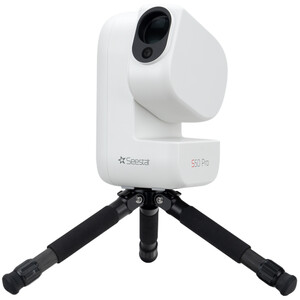
The same 50 mm aperture as every Vespera, plus a built-in filter against artificial light, solar filter, tripod and wide-angle camera in the box – for a fraction of the Vespera price.
Price: € 999
Experiences: what Vespera owners report
We haven’t had a Vespera to test ourselves. Instead, we analysed what owners write in forums and only counted posts whose authors verifiably own the device.
How we analysed it
- Reddit: all 204 posts in the user forum r/vaonis (December 2022 to September 2026) and 45 threads with “Vespera” in the title in r/telescopes – 1,069 posts and comments in total, including 41 identifiable owners.
- Cloudy Nights: the collective thread on the Vespera II (418 replies), the thread on the Vespera 3 and Pro II (69 replies) and a comparison discussion (13 posts).
- forum.astronomie.de (German): so far there are only retailer announcements there, but no owner reports on the Vespera 3 or Pro II.
- Limitation: r/vaonis is a fan forum, and a good half of the posts are image showcases. The numbers below are therefore small and not representative.
The praise is clear: image quality, build quality and ease of use. Several owners show images with 10 to more than 40 hours of total exposure from multi-night series – even from heavily light-polluted front gardens.
The Vespera II battery is the most common everyday topic. One owner only managed just over two hours on a mosaic, others run a power bank permanently. That’s exactly what Vaonis solved with the Vespera 3.
Sun and planets: what the Vespera can’t do
No Vespera is built for planets. With the Vespera 3, Jupiter works out at only around 20 pixels, with the Pro II just under 30 – you’ll barely make out the cloud belts. A classic telescope with 150 mm of aperture or more shows you more at the eyepiece.
With the filter, the app has a dedicated solar mode. It lets you watch sunspots almost live and compare them over several days.
If you want more: more aperture than 50 mm
All Vespera models stay at 50 mm – there’s no more light to be had within the range. If you want faint galaxies faster and with less noise, you need a larger aperture.
For advanced users: Celestron Origin Mark II
With 152 mm of aperture at f/2.2, the Origin collects many times the light of a Vespera. In return it weighs almost 19 kg and belongs in the garden, not in your luggage. The extra cost is worth it for you if you shoot from home and want galaxies with real depth.
For advanced users: Celestron Origin Mark II Smart Telescope
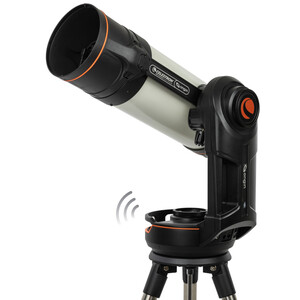
Fast 152 mm RASA optics instead of 50 mm: much more light for faint galaxies – but almost 19 kg and more of a home observatory than a travel scope.
Price: € 5,499
An intermediate step is the DWARFLAB Draco with 90 mm and a cooled sensor – though it’s brand new and hasn’t been independently reviewed yet. Everything about it is in our article on the DWARFLAB Draco.
Vaonis Atlas and Hyperia: the devices above the Vespera
On 15 October 2026, Vaonis will unveil the Atlas, a new premium smart telescope. Specs and price are still under wraps – for what’s known so far and the current alternatives, see our smart telescope overview. If you’re leaning towards the Pro II anyway, wait the two weeks.
The Hyperia is not a device for private buyers. 150 mm aperture at f/4, a 45 MP full-frame sensor and a starting price of US$99,000 according to Vaonis – built for museums, planetariums and observatories, shipping from 2027.
Frequently asked questions about the Vaonis Vespera
Which Vespera is best for beginners?
Within the range, the Vespera 3: tripod, 11 hours of battery and dew protection are included, so you don’t need to buy anything except filters. If you’re not set on Vaonis, the Seestar S50 Pro gives you the same aperture for considerably less.
Is it worth upgrading from the Vespera II to the Vespera 3?
Usually not. Sensor and aperture are the same, and battery and storage can be compensated for with a power bank and a laptop. The main new features are the stray-light baffles and the longer warranty.
Does the Vespera come with a tripod?
The Vespera 3 (aluminium) and the Vespera Pro II (carbon with case) do. The Vespera II comes without a tripod; Vaonis also offers it as a bundle with a tripod.
Can you photograph planets with the Vespera?
Only as small discs. The Vespera is built for nebulae, galaxies and star clusters; the Moon works well, but Jupiter and Saturn stay tiny.
Can you observe the Sun with the Vespera?
Yes, but only with the Vaonis solar filter in front of the lens. It isn’t included with any model and is sold separately by Vaonis for roughly a tenth of the Vespera II price.
What is the difference between the Vespera 3 and the Vespera Pro II?
Optics, battery and weight are the same. The Pro II has the square 12.5 MP sensor, twice as much storage, a carbon tripod and a case.
Is the Vespera a good travel telescope?
To a degree. At 5 kg plus tripod it’s heavier than a Seestar (2.8 kg), but it fits in a backpack and runs without a laptop or cables.
Verdict: beautiful devices, honest maths
The Vespera range impresses with its optics, build quality and app – not with more light than the competition. If it has to be a Vespera, the Vespera 3 is the most sensible model and the Pro II the one for detail fans.
All smart telescopes compared side by side can be found in our buying guide to the best smart telescope.
Is a Vespera right for you?
- ✔ Yes, if build quality, very clean optics and a simple app are worth the extra cost to you.
- ✔ Yes, if you want to shoot whole nights without recharging – then the Vespera 3 or Pro II.
- ✘ No, if price matters to you: the Seestar S50 ProSeestar S50 Pro ($999.00€ 999) has the same aperture.
- ✘ No, if you mainly want to see planets – a classic telescope is better for that.
* Affiliate link: if you buy through this link we may earn a small commission from Astroshop or High Point Scientific, at no extra cost to you.