By Alexander Merz · Updated on · Details checked on 24 September 2026
How much does a telescope cost? The honest answer runs from $100€100 to “the sky’s the limit.” The useful answer is sharper: a genuinely good beginner telescope costs between $305.00€ 265 and $699.95€ 479 in 2026, and another about $60€60–120 in accessories leaves you fully equipped. What you actually get in each price bracket, where the hidden costs lurk, and how to split your budget wisely – we’ll work through it step by step. Prices are guide prices; the current price and availability are always shown on the Astroshop product page.Dollar amounts on this page are approximate: our budget brackets are based on European prices, and US prices for the same model usually land in a similar range. The current price is always the one on the product page.
More in our overview: Best Telescopes.
⚡ The quick answer: For around $305.00€ 265 you already get a real telescope (a 130 mm tabletop Dobson) that shows Jupiter’s cloud bands and Saturn’s rings. The about $450€450–700 bracket is the sweet spot: an 8-inch Dobson at $699.95€ 479 remains the single best way to start. Below $200€200, tread carefully – a solid pair of binoculars beats a wobbly bargain-bin scope every time.
The price brackets at a glance
| Budget | What it is | What you get |
|---|---|---|
| under $200€200 | a first taste | small refractors (70 mm) – the Moon, planets roughly, bright clusters. Fine for a child; adults quickly outgrow it. |
| about $200€200–450 | a real start | tabletop Dobsons like the Sky-Watcher Heritage 130Sky-Watcher Heritage 130 ($305.00€ 265) already show Jupiter’s belts, Saturn’s ring and bright nebulae. |
| about $450€450–700 | the sweet spot | full-size Dobsons (8-inch, $699.95€ 479) or a Newtonian on a mount – the most telescope you’ll ever get for the money. |
| about $700€700–1,200 | comfort & tech | GoTo pointing (StarSense DX 130, $449.95€ 599), smart telescopes (DWARF 3 $549.00€ 529, Seestar S30 Pro $699.00€ 699), big Dobsons (10-inch, $1,199.00€ 622). |
| over $1,200€1,200 | specialization | large apertures, astrophotography rigs on equatorial mounts, premium smart telescopes (Vespera Pro $2,990.00€ 2,990) – worth it only once you know what you want. |
That’s the map. Now let’s walk through each bracket one by one – including the real question of what you’re actually paying for, and where cutting corners comes back to bite you.
Under €200: why you should be careful
“Department-store telescopes” promising 500× magnification are the single most common reason beginners give up in frustration: a shaky mount, useless accessories, a mushy image. The optics themselves often aren’t even the main problem – it’s everything around them. A telescope that shudders for seconds at the slightest touch turns even the Moon into a test of patience.
That doesn’t mean nothing works under $200€200. For children there are rugged, deliberately simple instruments. Adults are better off with one of two alternatives: either invest another about $150€150–250, or start with a good pair of astronomy binoculars. A decent 10×50 shows you more sky than any wobbly telescope and stays useful later on.
If you want a proper optical instrument from day one, a small entry-level refractor is the most honest compromise in this bracket: maintenance-free, it shows the Moon, Saturn’s rings and Jupiter’s moons.
Budget pick: Omegon Telescope AC 70/700 AZ-2
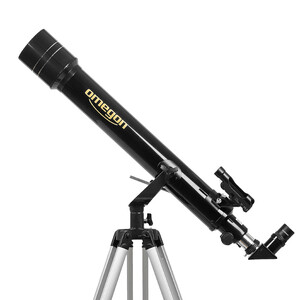
The no-pitfall starter refractor: Moon, Saturn's rings and Jupiter's moons from the very first night. No collimation.
Price: € 119
€200 to €450: where real astronomy begins
From around $305.00€ 265 you get a telescope you’ll still enjoy setting up five years from now. The classic of this class is the Sky-Watcher Heritage 130 tabletop DobsonSky-Watcher Heritage 130 tabletop Dobson ($305.00€ 265): a 130 mm tabletop Dobson that reveals Jupiter’s cloud belts, Saturn’s rings, lunar craters in impressive sharpness and bright deep-sky objects like the Orion Nebula. No pointless gimmicks – just a stable base that simply works.
Best value pick: Skywatcher Dobson Telescope N 130/650 Heritage FlexTube
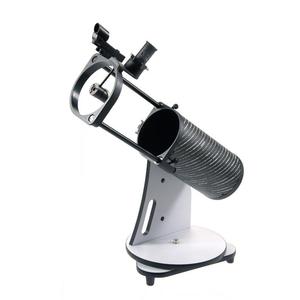
A compact tabletop Dobson with a true parabolic mirror. Folds down, fits in a bag: the Moon, planets and the bright deep-sky classics.
Price: € 265
If you’d rather have a classic telescope on a tripod, a 130 mm Newtonian on an equatorial mount (Orion SpaceProbe 130ST EQ Reflector TelescopeCelestron AstroMaster 130 EQ, $329.95€ 309) is a solid alternative: a little more of a learning curve, but with tracking on one axis. Both routes work; which one suits you comes down to your patience and how you like to observe.
€450 to €700: the sweet spot
If there’s one bracket where the ratio of money to performance peaks, it’s this one. The Apertura AD8 8-inch DobsonApertura AD8 8-inch Dobson ($699.95€ 479) isn’t the most-recommended beginner telescope in the US by accident: its 8-inch (203 mm) aperture gathers over 800 times more light than the naked eye – turning faint smudges into real structure. Other 8-inch Dobsons play in the same league at about $650€650–750.
Best value overall: Skywatcher Dobson Telescope N 200/1200 Skyliner Classic
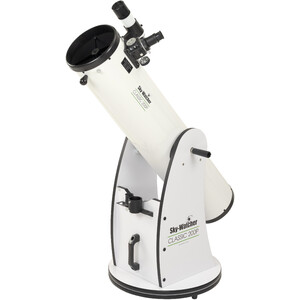
200 mm of aperture — the most sky for your money. Set it on the ground, point by hand: nebulae, clusters and galaxies for years to come.
Price: € 479
Here’s the key thing to understand: the jump from $305.00€ 265 to $699.95€ 479 buys you mostly aperture – and aperture is the one currency that truly counts under the night sky. More diameter means more light, more resolution, more detail. A bigger magnification number on the box, by contrast, means nothing at all.
€700 to €1,200: comfort, GoTo and smart telescopes
Above about $700€700 you increasingly pay for electronics and convenience rather than raw optics – though in the US this tech is a genuine bargain, and several of these options actually cost less than a large Dobson. The Celestron StarSense Explorer DX 130Celestron StarSense Explorer DX 130 ($449.95€ 599) guides you to any object via your smartphone – ideal if you’d rather not fuss with star charts. Then there are the smart telescopes: the DWARF 3DWARF 3 ($549.00€ 529) and the ZWO Seestar S30 ProZWO Seestar S30 Pro ($699.00€ 699) photograph nebulae and galaxies fully automatically, straight to your phone – a completely different way to enjoy the hobby than classic observing.
Visually, this bracket goes further too: the Apertura AD10 10-inch DobsonApertura AD10 10-inch Dobson ($1,199.00€ 622) is the ten-inch version of the sweet-spot classic – visibly more detail on galaxies and globular clusters, but also noticeably more weight in the trunk.
Over €1,200: specialize rather than “more of everything”
Beyond about $1,200€1,200 you’re not buying a “better beginner telescope” – you’re specializing: large Dobsons from 12-inch for deep-sky enthusiasts, apochromatic refractors and equatorial GoTo mounts for astrophotography, or premium smart telescopes like the Vaonis Vespera ProVaonis Vespera Pro ($2,990.00€ 2,990). Our advice: only spend these sums after a year of practice, once you know exactly what fascinates you.
What you’re actually paying for
Two telescopes with identical specs can be about $200€200 apart. The difference almost always comes down to these five things:
- Aperture: the biggest price driver – and the only one that directly determines how much you see. Rule of thumb: invest in aperture first, comfort second.
- Mount: the most underrated line item. A stable mount turns mediocre optics into a good telescope; a wobbly one turns good optics into a frustrating one.
- Optical quality: parabolic rather than spherical mirror, coated lenses, well-collimated manufacturing. Invisible on paper, clearly visible on a planet.
- Included accessories: the eyepieces reveal where corners were cut. Two usable eyepieces are worth more than five poor ones.
- Electronics: GoTo, Wi-Fi, camera – comfort costs. Every dollar spent on electronics is a dollar not spent on aperture.
The hidden costs: accessories
Budget $60€60–120 for worthwhile accessories – but only after your first few nights out, once you know what you’re missing. A moon filtermoon filter ($14.95€ 19.90) makes the bright Moon detailed rather than dazzling; a 2× Barlow lens doubles every magnification for a tiny outlay; and a good beginner’s book is often worth more than extra gear, because knowledge beats equipment.
* Affiliate link: if you buy through this link we may earn a small commission from Astroshop or High Point Scientific, at no extra cost to you.
Three complete budgets, honestly costed
Most guides only quote the telescope’s price. Here’s what a complete setup really costs – including the accessories you typically buy in the first year:
| Setup | Telescope | Accessories | Total |
|---|---|---|---|
| “Start smart” | Sky-Watcher Heritage 130Sky-Watcher Heritage 130 ($305.00€ 265) | moon filtermoon filter ($14.95€ 19.90) + beginner's book (about $20€ 20) | telescope price + about $45€45 in accessories |
| “The sweet spot” | Apertura AD8 8-inchApertura AD8 8-inch ($699.95€ 479) | moon filtermoon filter ($14.95€ 19.90) + 2× Barlow2× Barlow ($41.95€ 34.90) + book (about $20€ 20) | telescope price + about $100€100 in accessories |
| “Fully automatic” | Seestar S30 ProSeestar S30 Pro ($699.00€ 699) | star chartstar chart ($7.95€ 19.90) + book (about $20€ 20) – nothing more needed | telescope price + about $45€45 in accessories |
The striking part: even the “big” visual setup stays under $800€800. It only gets expensive once astrophotography rigs enter the picture.
The cost-per-night math: a telescope is cheaper than it looks
$699.95€ 479 sounds like a lot. But a telescope isn’t a consumable: a Dobson has no electronics to go obsolete and no battery to die – many instruments are still fully usable after 20 years. Do the math: observing just twice a month gets you to 240 nights over ten years – which works out to around $3€3 per observing night for the 8-inch Dobson, and falling.
On top of that comes resale value: sought-after models like the Apertura and Sky-Watcher Dobsons typically resell used for 60–70% of the new price. Your actual risk at purchase is therefore well below the sticker price – a point almost nobody factors in when wavering between “the about $150€150 compromise” and “a proper telescope.”
Buying used: save 30–40%
The second-hand market is an insider tip for telescopes, because many instruments have barely been used. Dobsons are almost indestructible. What to watch for:
- Check the optics in daylight: scratches on the mirror or lens? Is the mirror coating dull or blotchy?
- Test the mechanics: does the focuser run smoothly? Is the mount steady?
- A fair price: 30–40% below new is standard – expect less of a discount on sought-after Dobsons.
- The safe route: specialist dealers also stock checked second-hand instruments with a warranty – the low-risk option.
How much you really need to spend depends on what you want to see – the quick check gives you a realistic number.
Six short questions, an honest answer by email – even when binoculars are the better choice.
Frequently asked questions
How much does a good beginner telescope cost?
The honest floor sits at around $305.00€ 265 (Sky-Watcher Heritage 130). Between $450€450 and $700€700 you get the best value for money – for example an 8-inch Dobson at $699.95€ 479. For concrete picks, see the best beginner telescopes.
How much does a telescope cost to see galaxies?
Bright galaxies like Andromeda are already visible in a 130 mm Dobson from $305.00€ 265. For structured detail you need 8 inches of aperture or more (from $699.95€ 479) and a dark sky.
How much does a telescope for kids cost?
Rugged, frustration-free children’s telescopes start at roughly $100€100–150. A small entry-level refractor or a good pair of binoculars often makes the best first gift.
Is a €100 telescope good enough?
For a child as a first taster instrument: yes. For an adult with serious interest: usually no – wobbly mounts and poor accessories frustrate quickly. Better: a good pair of astronomy binoculars plus a star chart, then a proper telescope chosen later.
How much does a telescope that takes photos cost?
The cheapest way into astrophotography is a smart telescope: DWARF 3 ($549.00€ 529), Seestar S30 Pro ($699.00€ 699) or, in the premium class, the Vespera Pro ($2,990.00€ 2,990). Classic astrophoto rigs with mount, optics and camera realistically start at about $1,500€1,500–2,500.
Are used telescopes worth it?
Yes – Dobsons are almost indestructible. Check the optics for scratches and inspect the mirror coating; 30–40% below new is fair. Specialist dealers also stock checked second-hand instruments.