By Alexander Merz · Published on · Details checked on 14 September 2026
Quick answer: In a vacuum, light travels at exactly 299,792.458 kilometres per second – nearly 1.08 billion km/h. Nothing in the universe is faster.
How fast is that, really?
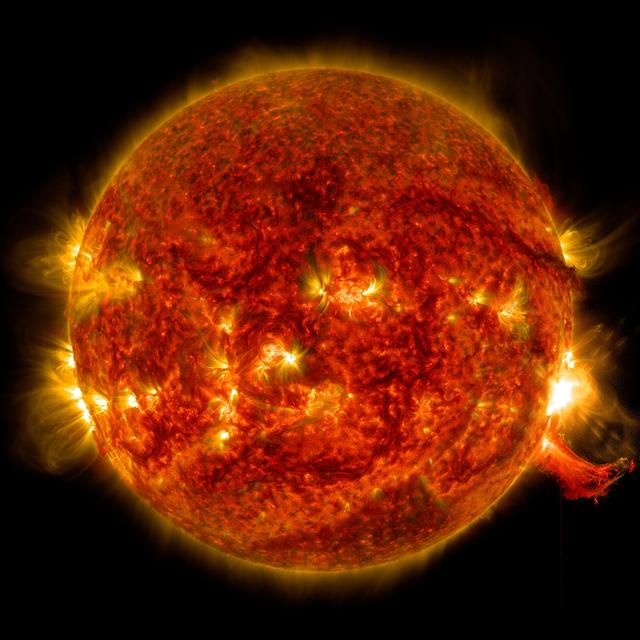
In one second, light circles the Earth 7.5 times. From the Earth to the Moon it takes 1.3 seconds, from the Sun to the Earth 8 minutes and 20 seconds. If the Sun went out right now, we wouldn’t notice for a good eight minutes. To the dwarf planet Pluto, light is already travelling for more than five hours, and to the nearest star 4.2 years – which is why astronomers measure distances in light-years.
Why is the speed of light the limit?
Einstein’s special theory of relativity shows that the faster an object with mass moves, the more energy each further acceleration requires – at the speed of light the energy needed would be infinite. Only massless particles such as the photon move at exactly c. The speed of light is so fundamental that, since 1983, even the metre has been defined in terms of it.
Light travel times in the solar system
| Route | Light travel time |
|---|---|
| Earth → Moon | 1.3 seconds |
| Sun → Earth | 8 min 20 s |
| Sun → Mars | approx. 12.7 minutes |
| Sun → Jupiter | approx. 43 minutes |
| Sun → Neptune | approx. 4.2 hours |
| Sun → Proxima Centauri | 4.2 years |
These travel times are everyday reality in space travel: depending on the planets’ positions, a radio signal to Mars is on its way for 3 to 22 minutes – which is why Mars rovers cannot be steered ‘live’.
Light in the telescope: every observation is history
For stargazers this means the sky is a history book. The light of the Orion Nebula is around 1,300 years old, that of the galaxies millions of years. With every glance through the telescope you receive photons that have travelled longer than human civilisation has existed.
Frequently asked questions
How fast is light in km/h?
Around 1,079,252,849 km/h – about 1.08 billion kilometres per hour.
How long does light take from the Sun to the Earth?
8 minutes and 20 seconds. So we always see the Sun as it was a good eight minutes ago.
Is light slower in water or glass?
Yes. In water it moves at about 225,000 km/s, in glass at around 200,000 km/s. The famous constant c applies to the vacuum.
Can you travel faster than light?
According to our current understanding of physics, no. Objects with mass would need infinite energy – c is the cosmic speed limit.