By Alexander Merz · Updated on · Details checked on 14 September 2026


The Key Facts at a Glance
- Betelgeuse is a red supergiant star in the constellation Orion.
- It is 550 light-years away.
- It is one of the brightest stars in the night sky, with an apparent magnitude of 0.4.
- Its name comes from Arabic and means “shoulder of the giant”.
- Betelgeuse is roughly 700 times larger than the Sun and has a mass of about 20 solar masses.
- It is a variable star whose brightness fluctuates over time.
- In 2019, Betelgeuse was observed to dim significantly, sparking speculation about a possible supernova explosion.
- Betelgeuse is estimated to undergo a supernova explosion within the next few thousand years, which will make it one of the brightest objects in the night sky.
🔭 Observing Betelgeuse Yourself
You can find Betelgeuse with the naked eye in Orion – our guide to the constellation Orion shows you how to identify the constellation reliably. For a deeper start: telescopes for beginners.
Product recommendations:
A rotating star chart (planisphere) – the classic for finding constellations yourself all year round, Orion and Betelgeuse included. High Point: Celestron Sky Maps and Planisphere*, $30.95 (checked 12 Sep 2026). Check availability →In Europe: Oculum Swivelling Sky Map 29 cm for € 19.90. Check availability →
A beginner’s book about the night sky – the kind you keep on the shelf and open again in a year, not a one-evening read. High Point: Orion “Exploring the Cosmos”*, $7.95 (checked 12 Sep 2026). Check availability →In Europe: Kosmos Astronomie für Einsteiger (German) for € 20 – a German-language title, and the standard starter book here. Check availability →
Betelgeuse: A Portrait of a Striking Star
Betelgeuse (also spelled Betelgeuse) is a red supergiant star in the constellation Orion and one of the most striking stars in the night sky. It is about 550 light-years away from us.
With an apparent magnitude of 0.4, it shines very brightly and is easy to spot. Its name means “shoulder of the giant” and refers to its position in the constellation Orion.
Betelgeuse has a mass of about 20 solar masses and is roughly 700 times larger than our Sun. It is a variable star whose brightness fluctuates over time. In 2019, Betelgeuse was observed to dim significantly, sparking speculation about a possible supernova explosion.
Betelgeuse is known for the fact that within the next few thousand years it will undergo a supernova explosion that will make it one of the brightest objects in the night sky.
As a red supergiant, it has already consumed most of its core fuel and will exhaust its hydrogen reserves in the future, leading to an explosion. The exact timing of this event, however, is hard to predict.
Where Can I Find Betelgeuse in the Night Sky?
Betelgeuse is located in the constellation Orion, which appears in the winter sky and is clearly visible from the northern hemisphere. Orion is easy to find because it consists of a conspicuous grouping of stars known as “Orion’s Belt”.
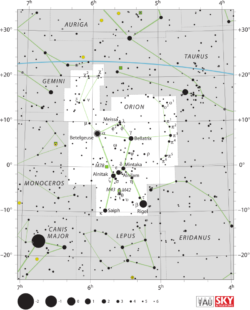
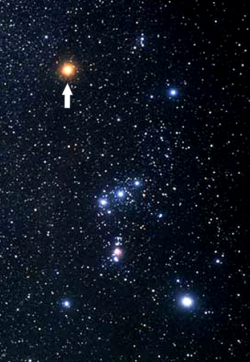
Betelgeuse is the left shoulder star in Orion. It is especially bright and stands out because of its reddish color.
The Cause of the Brightness Change
The exact cause of Betelgeuse’s change in brightness in 2019 is not fully understood, but it is thought to be related to activity on its surface.
Red supergiants like Betelgeuse have strong convection currents in their outer layer that transport material from the nuclear fusion in their interior and circulate it at their surface.
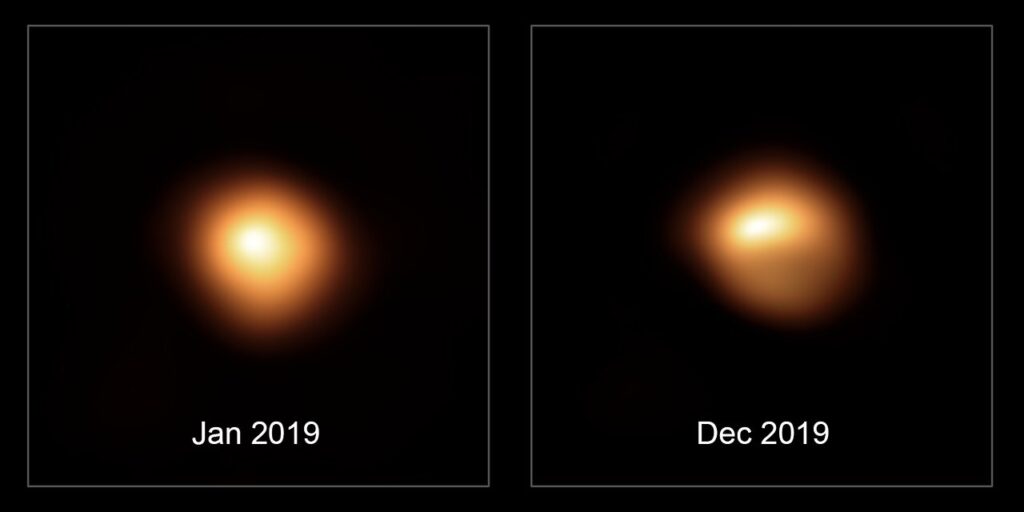
It is suspected that a large convection cell or a group of cells on Betelgeuse’s surface caused material to be drawn into the star’s deeper atmosphere, temporarily reducing its brightness.
Another theory holds that dust clouds that may have formed around Betelgeuse blocked part of the starlight, which also contributed to its dimming.
Betelgeuse Supernova: Still Within Our Lifetime?
In theory, it could happen any minute. Or, more precisely, it may have happened long ago and we could see it any minute, since the light takes a very long time to travel from Betelgeuse to us (550 light-years).
It is assumed that Betelgeuse will undergo a supernova explosion within about 100,000 years, which would be an impressive event if anyone could observe it.
The explosion would cause Betelgeuse to shine as bright as a half moon for about three months and even be visible during the day.
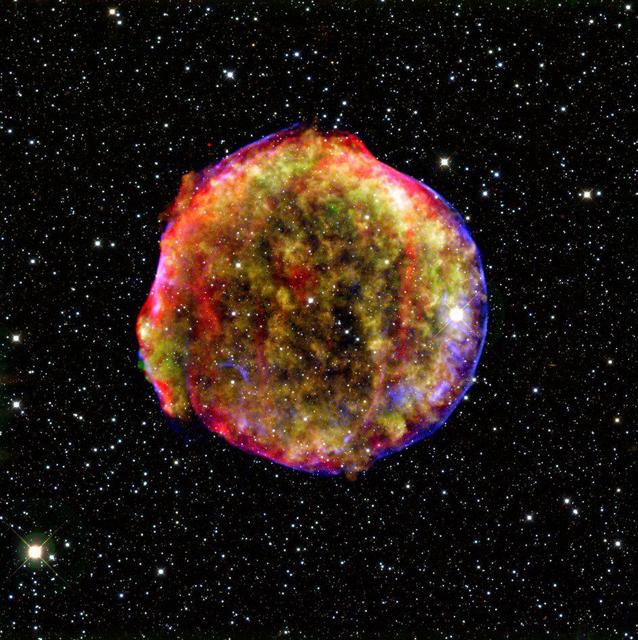
Although supernova explosions can emit dangerous radiation that endangers life on Earth, astronomers would point out that the radiation from Betelgeuse would most likely not be directed at Earth.
After the explosion, Betelgeuse would be expected to become a neutron star. These stellar corpses are only a few kilometers across but incredibly dense: a fragment the size of a table-tennis ball would weigh more than 20 billion tons on Earth.
Betelgeuse Through the Telescope
In amateur telescopes, Betelgeuse always remains point-like. However, its orange-reddish color can be seen even better, provided the image is color-pure. Simple telescopes (refractors) often have chromatic aberration. You can learn more about this in the article telescope guide.
Want to buy your first telescope? Here’s the quick check.
Quick Quiz: Which Telescope Suits You?
Answer the following questions to figure out which type of telescope best fits your needs:
1. Do you want to transport the telescope over long distances?
- Yes
- No
2. Do you want very simple operation and accept in return that the telescope cannot be upgraded further?
- Yes
- No
3. Do you want automatic target guidance (go-to)?
- Yes
- No
Based on your answers, you receive an individualized recommendation for the telescope type that suits you best.
Sensation of 2025/2026: Betelgeuse Has a Companion Star
For decades, astronomers puzzled over a mysterious 6-year cycle in Betelgeuse’s brightness. In the summer of 2025 came the resolution: using the Gemini North telescope in Hawaii, astronomers achieved the direct imaging of a small companion star, which experts affectionately dubbed “BetelBuddy”. The companion is significantly less massive than Betelgeuse and orbits the supergiant on such a tight path that it periodically plows through the giant’s extended outer envelope – which is exactly what produces the long-unexplained brightness rhythm.
For the supernova question, the discovery changes little: Betelgeuse remains a death candidate. But it shows how much there is still to discover even among the best-known stars in the sky – X-ray observations with the Chandra telescope provided further details about the unusual pair at the end of 2025.