By Alexander Merz · Updated on · Details checked on 6 October 2026
For centuries, Saturn was thought to mark the edge of the known solar system. Then, in 1781, an amateur astronomer swung his homemade telescope toward Taurus and doubled the size of our cosmic neighbourhood overnight. The planet Uranus, a blue-green ice giant that had slipped past observers for generations, was finally unmasked. Even today, tracking it down is a rewarding little challenge for backyard stargazers.
More in our overview: Planets of Our Solar System.
⚡ The quick answer: The planet Uranus is the seventh planet from the Sun, a blue-green ice giant discovered by Wilhelm Herschel on 13 March 1781. It takes 84 years to orbit the Sun, has 27 known moons, and spins on an axis tilted at 97.77°, so it effectively “rolls” along its orbit. At magnitude +5.7 it sits right at the edge of naked-eye visibility, so binoculars or a telescope are essential to spot it.

Uranus fact sheet
- Ice giant, 7th from the Sun
- Axis tilted by 98°
- Diameter: 51,118 km
- Orbital period: 84 years
- Length of day: 17 h 14 min (retrograde)
- Distance from the Sun: 2.87 billion km
- Temperature: −216 °C
The discovery of the planet Uranus
Friedrich Wilhelm Herschel wasn’t hunting for a new world. With his self-built 6-inch reflector, he simply wanted to measure the parallax of fixed stars. On 13 March 1781 he spotted an unusual object drifting between the constellations Taurus and Gemini. Convinced it was a comet, he had no idea he had just found the first planet ever discovered with a telescope.
Others had seen the object before him, but had catalogued it as an ordinary star in Taurus. For three months, professional astronomers studied this newly reported “seventh planet.” Uranus fit the Titius-Bode sequence perfectly and seemed to confirm Kepler’s idea of a “harmony of the heavens.” Suddenly the known solar system was twice as large as before. Herschel, the self-taught amateur, became famous overnight: King George III admitted him to the prestigious Royal Society of London, making him wealthy for life.
Name and quick profile
The name honours Ouranos, the primordial sky god of Greek mythology and son of Gaia. Under ideal conditions the planet Uranus can occasionally be glimpsed with the naked eye, but it takes at least 10 cm of aperture to reveal its tiny, pale-green disc of roughly 3.5 arcseconds.
| Property | Value |
|---|---|
| Type | Ice giant, blue-green atmosphere |
| Known moons | 27 |
| Orbital period | 84 years |
| Day length | ≈ 17 h |
| Distance from the Sun | ≈ 3 billion km |
| Mean temperature | ≈ -200 °C |
| Axial tilt | 97.77° |
| Apparent magnitude | ≈ +5.7 |
Interior structure: why an “ice giant”?
Like the other Jovian planets, the planet Uranus has a comparatively small silicon-iron core. But surrounding that core lies an icy mantle of water, methane and ammonia, a genuine “water-ammonia ocean.” This abundance of ices is why Uranus, along with Neptune, is called an ice giant. Notably, Uranus has no mesosphere at all.
A giant corona and near dust-free rings
Unique among the outer planets, Uranus is wrapped in an extraordinarily extended corona reaching out to about two planetary radii (roughly 50,000 km). This corona brakes the surrounding dust, which is why the ring system of Uranus is strikingly dust-poor.
Winds close to 700 km/h
From a distance, Uranus looks far calmer than Jupiter or Saturn. Yet deep in the troposphere, its densest atmospheric layer, winds race at up to 700 km/h. Over just 50 km of altitude the temperature drops by nearly 270 kelvin. Strangely, the planet radiates barely more heat than it receives from the Sun, a peculiarity often blamed on a colossal collision in the early solar system, the same event thought to have knocked its axis over.
Weather and extreme seasons on Uranus
Unlike Jupiter and Saturn, Uranus shows almost no surface detail: no hot spots, no bold cloud bands. This eerie calm is thought to stem from a very weak internal heat source and extremely slow thermal exchange. The Hubble Space Telescope did, however, detect a surge of activity, including banding, as the planet approached its equinox.
Why is Uranus blue-green?
The answer is methane. The upper cloud layers of Uranus are shrouded in methane gas, which absorbs the red part of sunlight. Only the blue component is reflected back into space, giving Earth-bound observers that characteristic soft, blue-green hue.
The tilted axis and the ring system
With an axial tilt of 97.77°, the planet Uranus seems to roll along its orbit rather than spin upright like a top. This “retrograde” rotation gives it polar days and nights that can last up to half a Uranian year, or 42 Earth years. Here too, a collision with a protoplanet during the formation of the solar system is the leading explanation.
The ring system, suspected in 1977 and confirmed during a spacecraft flyby in 1986, is dark and understated. Small chunks less than 10 metres across, along with fine dust, encircle the planet’s equator inside the “Roche limit.” Unlike Saturn’s famous rings, those of Uranus do not glow: the shepherd moons Cordelia and Ophelia keep them in place. Thirteen main rings have been catalogued so far.
Exploration: from Voyager 2 to future missions
Only one spacecraft has ever visited the planet Uranus: Voyager 2, which flew past in early 1986. It returned the only detailed photographs we have, along with invaluable data on the planet’s moons, rings and its oddly off-centre magnetic field. Since then Uranus has been the neglected giant of space exploration, though new missions now rank among the top priorities of the world’s space agencies.
The moons of Uranus: dark and lightweight
Uranus has the least massive moon system of any giant planet. Its satellites are dark and sometimes move in chaotic orbits. The five main moons are Miranda, Ariel, Umbriel, Titania and Oberon. Miranda, discovered in 1948, is the innermost of the five and the most dramatic: its surface is carved by canyons up to 20 km deep and stepped rocky terraces, most likely the aftermath of ancient collisions followed by partial reassembly.
Observing the planet Uranus: how to find the ice giant
At about magnitude +5.7, Uranus sits right at the naked-eye limit: only a perfectly dark rural sky and an accurate finder chart make an unaided sighting possible in theory. In practice, binoculars (from 7×50) are the minimum, in which Uranus appears as a faint, blue-green “star.” Only through a telescope, from around 100x magnification, does it reveal its tiny disc.
| Instrument | What you see |
|---|---|
| Naked eye | Nothing, or an extremely faint point under a perfect sky |
| 7×50 / 10×50 binoculars | A blue-green “star” to identify with a chart |
| 70-100 mm telescope | Coloured point, disc barely hinted at high power |
| 150-200 mm telescope | Small, crisp blue-green disc at 100-150x |
For getting started, an affordable refractor is enough to locate Uranus and enjoy the thrill of picking it out from the surrounding stars yourself.
Great for beginners: Omegon Telescope AC 70/700 AZ-2
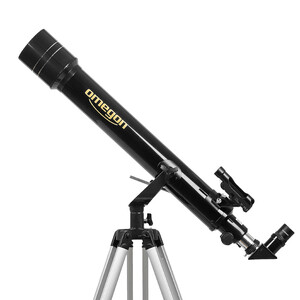
The no-pitfall starter refractor: Moon, Saturn's rings and Jupiter's moons from the very first night. No collimation.
Price: € 129
To actually resolve the planet’s disc and chase down faint objects, though, aperture is everything. A 200 mm Dobsonian gathers enough light to turn Uranus from a mere dot into a genuine little coloured disc.
Best value: Skywatcher Dobson Telescope N 200/1200 Skyliner Classic
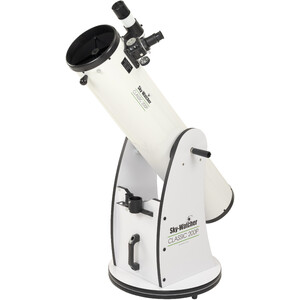
200 mm of aperture — the most sky for your money. Set it on the ground, point by hand: nebulae, clusters and galaxies for years to come.
Price: € 479
* Affiliate link: if you buy through this link we may earn a small commission from Astroshop or High Point Scientific, at no extra cost to you.
The best time to observe is around the annual opposition in autumn and winter, when the planet Uranus stays above the horizon all night. In late November 2026 it will shine conveniently between the Pleiades and the Hyades in Taurus, an ideal window to track it down.
Uranus is a small green-blue disc in a telescope – findable with a good map or a GoTo mount.
Six short questions, an honest answer by email – even when binoculars are the better choice.
Frequently asked questions about the planet Uranus
Can you see Uranus with the naked eye?
Only in theory: at +5.7 mag, Uranus sits at the threshold of perception. Under light-polluted skies it is practically invisible without binoculars.
What gives Uranus its blue-green colour?
Methane in its atmosphere absorbs red light and reflects the blue-green part of the sunlight.
How long is a year on Uranus?
Uranus takes about 84 Earth years to orbit the Sun. Because of its extreme axial tilt, each season lasts roughly 20 years.
When was the planet Uranus discovered?
On 13 March 1781, by Wilhelm Herschel, the first planet ever discovered with a telescope.
How many moons does Uranus have?
Twenty-seven moons are known to date, including the five main ones: Miranda, Ariel, Umbriel, Titania and Oberon.
📚 Read next: