By Alexander Merz · Updated on · Details checked on 9 October 2026
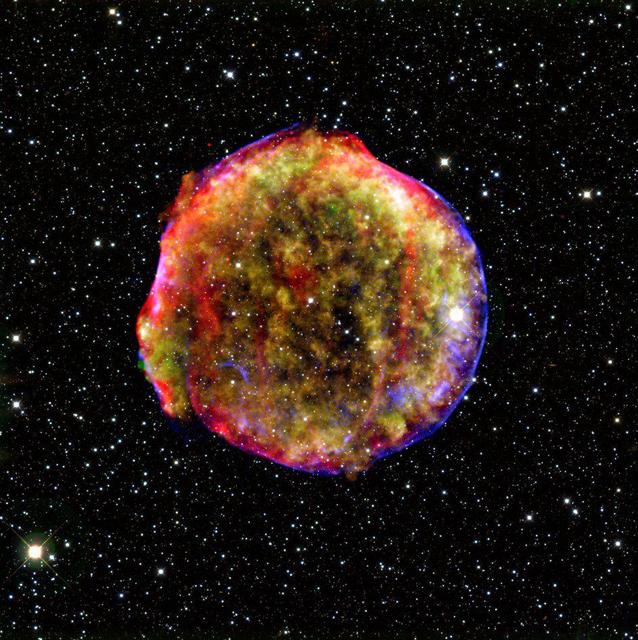
A supernova is an incredibly impressive and immense explosion that occurs at the end of the life cycle of a large star. During this explosion, the star gives everything it has and bids farewell to the world in spectacular fashion.
The Key Facts at a Glance
- A supernova occurs when a massive star reaches the end of its life and can no longer carry out nuclear fusion.
- The explosion of a supernova releases enormous amounts of energy and matter and can, for a brief time, shine as brightly as an entire galaxy.
- Supernovae are the most important source for the formation of heavy elements in the universe, including gold, silver and platinum.
- There are two main types of supernovae: Type Ia, which are caused by the explosion of a white dwarf, and Type II, which are triggered by the core collapse of a massive star.
- Some supernovae can also cause gamma-ray bursts, which are the most energetic events in the universe.
- A supernova can also produce a neutron star or a black hole, depending on the mass of the original star.
- The nearest known star that will explode as a supernova in our galaxy is Betelgeuse, but it is unclear when this will happen.
What Is a Supernova?
A supernova is an immense stellar explosion that occurs at the end of the life cycle of a massive star. The term “nova” comes from the Latin word for “new,” because the outburst suddenly and seemingly out of nowhere makes a new, bright star appear in the sky.
During the outburst, the star releases enormous amounts of energy and matter, which can make it shine for a short time as brightly as an entire galaxy. The outburst often lasts only a few weeks before the star returns to its original, fainter form.
How Does a Supernova Form?
A stellar explosion is the final chapter in the story of a star. However, this spectacular explosion only occurs in massive stars.
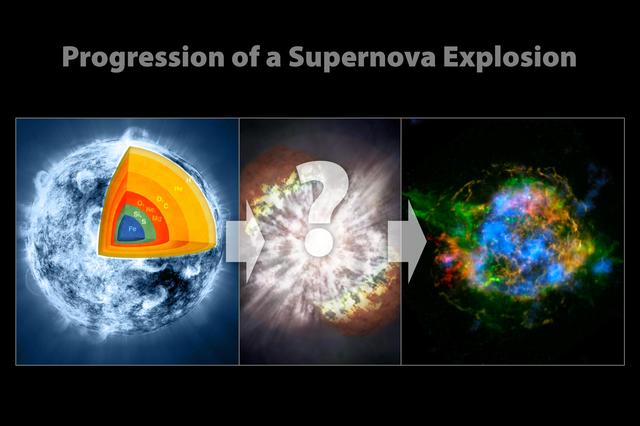
Such stars burn through their hydrogen supply in a relatively short time, and once it is used up, the star collapses under its own gravity.
As a result, the remaining stellar remnant ignites in a gigantic explosion that suddenly makes the star shine billions of times brighter than before. In fact, for a brief moment the star can even outshine an entire galaxy in brightness!
What Remains After a Supernova?
When a star explodes in a supernova, it sheds its outer layers and hurls them far out into space. These layers keep expanding and are made to glow by the energy pulse of the explosion.
That is why we can observe the remnants of the stellar explosion with a telescope. Various things can emerge from the star’s remaining core, such as a pulsar, a neutron star or even a black hole.
But that is not all that happens during a supernova. Nuclear fusion also creates new chemical elements such as iron, gold, lead and uranium.
These elements are absorbed by the resulting gas cloud and can later be incorporated into the formation of new stars and planets.
Even our own planet and the Sun contain many elements that could only have formed through the explosion of a star. Thus every stellar death is also linked to the formation of new stars and planets, and ultimately we are all made of stardust, the remnants of earlier supernovae!
Famous Supernovae: Now and From the Past
Supernovae have always caused a stir, whether consciously or unconsciously. Here are a few examples of interesting supernovae.
Past:
Supernova 1006
This stellar explosion occurred in the year 1006 and was visible in the sky for several weeks. It was the brightest supernova ever recorded.
Tycho’s Supernova
This supernova, named after the Danish astronomer Tycho Brahe, occurred in the year 1572 and was visible in the sky for several months. It was the first stellar explosion seen with the naked eye.
Kepler’s Supernova
This supernova, named after the German astronomer Johannes Kepler, occurred in the year 1604 and was visible in the sky for several months. It was the last stellar explosion seen with the naked eye in our Milky Way.
Recent:
SN 1987A
This supernova occurred in 1987 in the Large Magellanic Cloud, a neighboring galaxy of our Milky Way. It was the first stellar explosion that could be extensively observed with modern telescopes.
SN 2011fe
This supernova occurred in the galaxy M101 in 2011 and was one of the brightest supernovae observed in recent decades.
SN 2014J
This supernova occurred in the galaxy M82 in 2014 and was likewise one of the brightest supernovae in recent years.
When Is the Next Supernova?
A supernova is the result of the explosion of a massive star at the end of its lifetime. Typically, stars with a mass of about 8 to 20 solar masses are considered candidates for a stellar explosion.
These stars have a sufficiently high mass to burn enough nuclear fuel over the course of their lives to generate the energy and temperature required to produce heavy elements and ultimately trigger a supernova explosion.
The exact criteria that determine whether a star actually triggers a supernova, however, are complex and not fully understood. There are many factors that can influence the evolution of a massive star, including its mass, its chemical composition, its rotational speed and other variables.
As for the “when,” it is difficult to predict when a supernova will actually take place, since many of the factors that influence the evolution of a massive star are not yet fully understood.
Some massive stars may trigger a supernova within the next decades or centuries, while others may take several million more years before they end their lifespan and explode.
Here is a list of some stars that are considered candidates for future supernova explosions:
- Betelgeuse
- Eta Carinae
- WR 104
- Spica (Alpha Virginis)
- Rigel
- Antares
- IK Pegasi
- VY Canis Majoris
Are Supernovae Dangerous to Us or the Earth?
When a star explodes in a supernova, an enormous amount of radiation is released, some of which also contains harmful X-rays and gamma rays. This radiation can consequently damage the genetic material of living beings and lead to death by radiation.
A violent shock wave forms around the dying star, sweeping up the star’s outer layers and carrying them out into space. If this wave were to strike an inhabited planet, it would very likely mean the end of life there.
Supernovae can only be triggered by very massive stars, which fortunately are not in our immediate vicinity. Our own Sun is too small to end in a supernova and will pass away in a different manner at the end of its life.
Our recommendation for getting started: the Apertura AD8 8″ DobsonianSkywatcher Dobson Telescope N 200/1200 Skyliner Classic offers a large aperture, easy operation and a fair price at $699.95€ 479. Not ready to buy yet? Our telescope buying guide walks you through aperture, mount and budget first.