By Alexander Merz · Updated on · Details checked on 9 October 2026
The idea that what telescopes had detected outside our own solar system might actually be exoplanets was first discussed among astronomers in the 1980s. At first, instead of terrestrial planets in potentially habitable zones, researchers found »only« brown dwarfs and multiple-star systems that orbited their star in a way deceptively similar to a planet.
⚡ The quick answer: Exoplanets are planets that orbit foreign stars outside our solar system. More than 6,400 exoplanets have been officially confirmed (NASA Exoplanet Archive, as of October 2026) – and researchers estimate that our Milky Way alone is home to billions more. They are usually detected indirectly via the transit and radial velocity methods.

A few years later, the real explosion of »genuine« exoplanet discoveries began, increasingly including super-Earths. Since the 2010s, confirmed observations have made it clear that the estimated frequency of planetary systems in our Milky Way alone must be revised sharply upward.


What Are Exoplanets?
Exoplanets (extrasolar planets) are planets outside the gravitational field of our Sun. They do, however, lie within the gravitational field of another star.
How Are Exoplanets Detected [Detection Methods]
Various techniques are suitable for detecting exoplanets. Here is a brief characterization of a selection of methods:
- Direct observation
- Transit method
- Radial velocity method
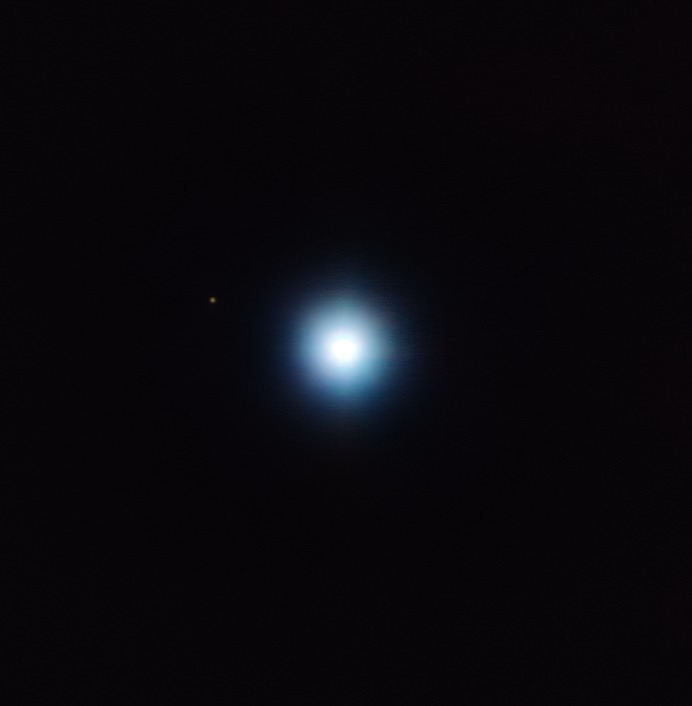
Direct observation through a telescope across various wavelength ranges is very complex and error-prone, so only a small proportion of the known exoplanets have been discovered this way.
If the orbit is parallel to our observation axis, the star is partially dimmed by the planet passing in front of it.
Strictly speaking, the planet does not orbit the star; rather, star and planet orbit a common center of mass. This usually lies within the massive star, however. Even so, the star’s rotation around this point can be measured, allowing conclusions to be drawn about the planet. This method is suitable for extrasolar planetary systems oriented perpendicular to us.
Types of Exoplanets
Exoplanets are classified in much the same way as those in our solar system:
- Rocky planets
- Gas giants
With increasingly precise measurement methods, the diameters of the exoplanets being discovered are becoming ever smaller.
While almost exclusively gas giants similar to Jupiter were discovered at first, so-called super-Earths (up to 14× Earth’s mass) are now being described more and more often. The number of exoplanets of an Earth-like size is also growing steadily.
More Exoplanets Than Stars?
According to the current state of research, more than 6,400 exoplanets have been confirmed (NASA Exoplanet Archive, as of October 2026). Many of them were identified together as companions of the same star; the »hot Jupiters« predominated at first.
With the latest generation of telescopes (James Webb Telescope), a new super-Earth is discovered practically every month – that is, a possible or actual rocky planet with one, or five to at most ten or fourteen times Earth’s mass (depending on the definition).
Even the estimate of how many stars might have companions in the habitable zone was recently revised from »exceptional cases« to »more than one per planetary system« (currently estimated at 1.6).
Studies exploiting the »gravitational lensing effect« (a phenomenon of spacetime curvature) revealed this effect – and thus the existence of further potential super-Earths or »hot Jupiters« – around 500 times among 3,000 observed stars.
Despite the criticism of this uncertain »hunting« method, a truism can be calculated from the studies so far: if every star is orbited by more than one exoplanet – more than there are »lone suns« – then in our Milky Way alone there are significantly more planets than stars, and thus at least one habitable zone per system.

This mathematical feat remains valid even when multiple-star systems are included in the calculations and these binary stars share a common planetary system.
Promising New Findings Despite Uncertain Determinations
For now, every method of investigating stars still has its scientific handicaps. In a very short time, mere assumptions have almost always turned out to be actual discoveries of exoplanets.
That is why the critics of the gravitational lensing method at least acknowledge that proof of the above estimates for the Milky Way could be provided in the near future.
This means that, with better investigation methods, more super-Earths in planetary systems than »hot Jupiters« would soon be discovered, and perhaps the term »habitable« would be redefined according to more comprehensive criteria.
Is There Life on Exoplanets?
The question remains unresolved to this day. If one is thinking of more complex life like that on Earth, searching for Earth-like planets makes sense. With increasing measurement accuracy, ever smaller planets have been found over time.
While at first these were mainly large gas giants (hot Jupiters), increasingly smaller terrestrial planets similar to Earth are now being found. If these exoplanets lie in the habitable zone of their central star, some of the foundations for life are in place.
Hope for detecting life is currently placed in identifying special biomarkers in the atmospheres of exoplanets. These biomarkers, which are said to arise only in connection with organic life, could be detected through a characteristic absorption spectrum of the planet’s atmosphere.
Fascinating Facts About Selected Exoplanets
Here are some fascinating facts about selected exoplanets:
Proxima Centauri b
- This exoplanet is the nearest known Earth-like planet outside our solar system.
- It orbits the star Proxima Centauri, which is part of the Alpha Centauri system.
- The planet was discovered in 2016 and is about 1.3 times the size of Earth.
- Its distance from the star is so small that the planet is probably exposed to strong radiation and may have no atmosphere.
Trappist-1d
- The planet orbits the ultracool dwarf star Trappist-1, which has only about 8% of our Sun’s mass.
- The planet is about 0.8 times the size of Earth and could have a dense atmosphere.
- Trappist-1d is part of a system of seven planets in total, some of which may be habitable.
- The planet has an orbital period of just 4.05 days.
Kepler-186f
- The exoplanet was discovered in 2014 and is about 1.1 times the size of Earth.
- It orbits the star Kepler-186, which is about 500 light-years from Earth.
- Kepler-186f is the first Earth-like planet discovered in the habitable zone of a star.
- The planet has an orbital period of about 130 days and could have liquid water on its surface.
HD 209458b
- A gas giant located very close to its star, orbiting it once in just 3.5 days.
- The planet has an atmosphere containing hydrogen and helium, as well as a significant amount of water vapor.
- HD 209458b was the first exoplanet whose atmosphere was directly detected through observations of the star’s light.
Kepler-438b
- Located about 640 light-years from Earth
- Has a size similar to Earth and an orbital period of 35.2 days
- Lies in the habitable zone, where liquid water could exist
- Because of its proximity to a red dwarf star, it is assumed to receive strong radiation that could affect its atmosphere
WASP-12b
- Located about 600 light-years from Earth
- Is a hot Jupiter that orbits its star in just 1.1 days
- Has an extremely high surface temperature of about 2,500 degrees Celsius
- Because of its proximity to its star, it is assumed that it could evaporate completely in about 10 million years
As of 2026: Over 6,000 Confirmed Worlds – and JWST Is Reading Their Atmospheres
In September 2025, the NASA Exoplanet Archive cracked the mark of 6,000 confirmed exoplanets – in 1992 the counter still stood at zero, and in October 2026 it passed 6,400. And the pace is picking up: those in charge of the archive consider 100,000 exoplanets within the next few years realistic, if missions such as PLATO (ESA, launch in late 2026) and the Nancy Grace Roman Telescope deliver.
The real turning point, however, comes from the James Webb Space Telescope: it can spectroscopically “read” the atmospheres of distant worlds and has, among other things, searched several Trappist-1 planets and the Hycean candidate K2-18b for water vapor, methane, and other molecules. The question is no longer whether Earth-like worlds exist – but when we will find the first one with a biosignature.
🔭 Observing Exoplanet Stars Yourself
The planets themselves remain invisible – but you can find their home stars! 51 Pegasi, the star around which the first exoplanet orbiting a Sun-like star was detected in 1995, climbs high in the Square of Pegasus in autumn. At magnitude 5.5 it is just about a naked-eye object: you need a reasonably dark site and you need to know where to look.
A rotating star chart is all it takes: set date and time, hold it up, and it shows exactly the sky above you – no battery, no network, no screen glare. High Point: Orion Telescope Observer’s Guide*, $7.95 (checked 31 Aug 2026). Check availability* →In Europe we use the Orion Star Target PlanisphereOculum Swivelling Sky Map 29 cm for $7.95€ 19.90. Check availability* →
Or you can get straight to the practical side: with a telescope from our beginner’s guide.
*Affiliate link: If you buy through it, we receive a small commission – the price does not change for you.