By Alexander Merz · Updated on · Details checked on 6 October 2026
⭐ In short: Deep sky objects are everything that lies outside our solar system and is not a single star – star clusters, nebulae and galaxies. Around 30 of them are within reach of binoculars, roughly a hundred with a 130 mm telescope. The three easiest ones to start with: the Pleiades, the Orion Nebula and the Andromeda Galaxy – under a dark sky all three are visible even to the naked eye.
What deep sky objects are
The term comes from amateur astronomy and is purely a matter of demarcation: anything that is not the Sun, the Moon, a planet or a comet – anything, in other words, that does not belong to the solar system – and that does not appear as a single point of light counts as a deep sky object. “Deep” here does not mean low over the horizon, but deep in space.
In practice they fall into four classes. The difference is not academic – it decides what you can realistically expect to see in the eyepiece.
| Class | What it is | Through the telescope | Example |
|---|---|---|---|
| Open cluster | Young stars from the same gas cloud, still loosely together | The most rewarding sight: individual stars, sparkling, often visible in binoculars | Pleiades (M45), Owl Cluster (NGC 457) |
| Globular cluster | Hundreds of thousands of old stars, bound together in a sphere | From 100 mm a grainy ball, from 200 mm resolved into individual stars right into the core | M13, M22, M55 |
| Nebula | Clouds of gas and dust – stellar nurseries or the remains of stars | Pale grey veils; the eye sees no colour, the camera does | Orion Nebula (M42), Ring Nebula (M57) |
| Galaxy | Star systems in their own right, millions of light years away | Usually just a diffuse smudge; spiral arms only from 200 mm and under a dark sky | Andromeda (M31), M81/M82 |
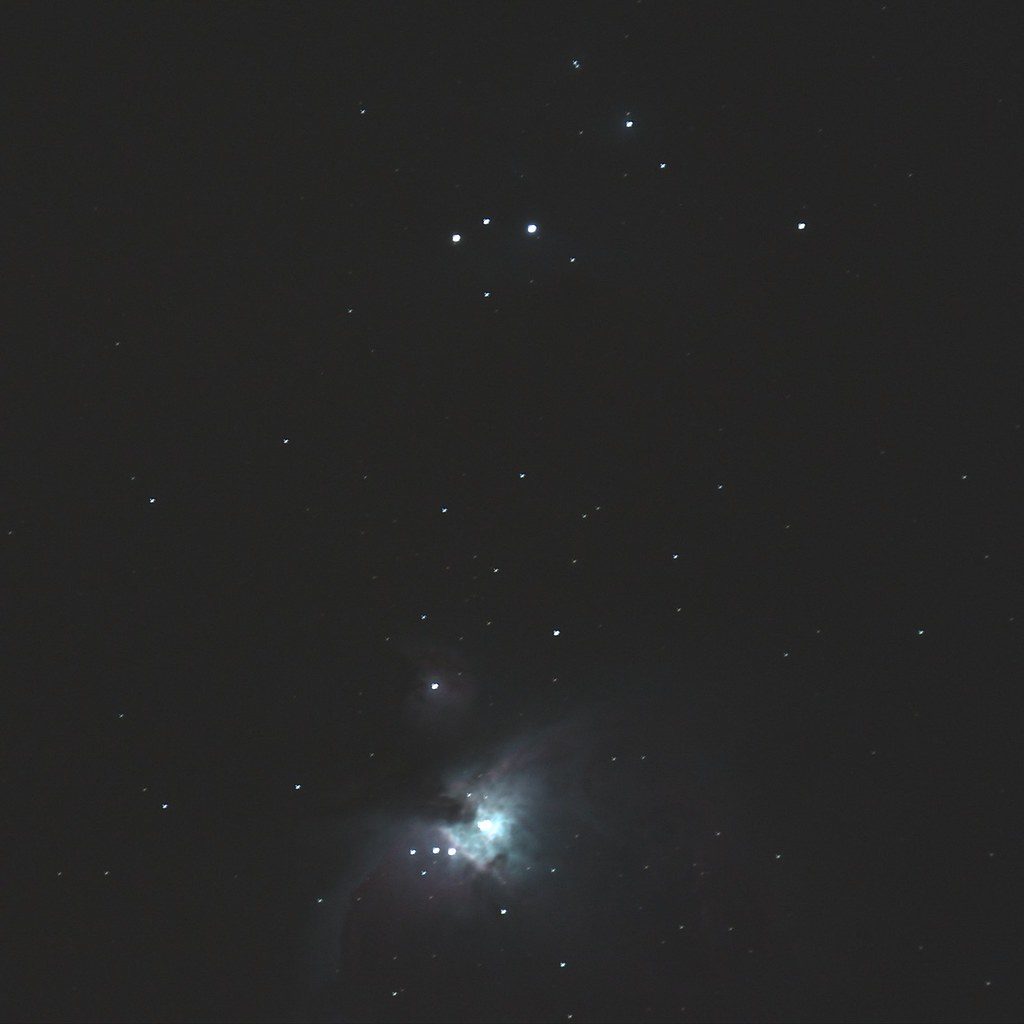
The deep sky catalogue: which object, when and with what
The overview below lists the objects we describe in detail here – sorted by the season in which they stand highest in the evening. The magnitudes are approximate values: with extended objects the light is spread out, so an 8 mag nebula looks considerably fainter than an 8 mag star.
Autumn: Andromeda and Cassiopeia
| Object | Constellation | Type | Brightness | Minimum optics |
|---|---|---|---|---|
| M31 Andromeda Galaxy | Andromeda | galaxy | 3.4 mag | naked eye |
| M32 | Andromeda | companion galaxy | 8.1 mag | 80 mm |
| NGC 752 | Andromeda | open cluster | 5.7 mag | binoculars |
| NGC 891 | Andromeda | edge-on galaxy | 9.9 mag | 200 mm |
| M52 | Cassiopeia | open cluster | 6.9 mag | binoculars |
| M103 | Cassiopeia | open cluster | 7.4 mag | binoculars |
| NGC 457 “Owl Cluster” | Cassiopeia | open cluster | 6.4 mag | binoculars |
| NGC 559 | Cassiopeia | open cluster | 9.5 mag | 100 mm |
Winter: Taurus
The brightest deep sky object of this season is not in Taurus but next door: the Orion Nebula M42 in the sword of Orion. It is not part of this table – but it is still the one you should start with.
| Object | Constellation | Type | Brightness | Minimum optics |
|---|---|---|---|---|
| M45 Pleiades | Taurus | open cluster | 1.6 mag | naked eye |
| NGC 1647 and NGC 1746 | Taurus | open clusters | 6.4 / 6.1 mag | binoculars |
| NGC 1807 and NGC 1817 | Taurus | open clusters | 7.0 / 7.7 mag | binoculars |
| Theta and Sigma Tauri | Taurus | double stars in the Hyades | 3.4 mag | naked eye |
| Tau, Phi and Delta Tauri | Taurus | multiple stars | 4.3 mag | binoculars |
Spring: galaxy season
In spring the evening view looks out of the plane of the Milky Way – no dust in the way, but galaxies one after another instead. That is why observers call the weeks around April “galaxy season”. The focus is on Ursa Major, plus one target each in Virgo and Lynx.
| Object | Constellation | Type | Brightness | Minimum optics |
|---|---|---|---|---|
| M81 Bode’s Galaxy | Ursa Major | spiral galaxy | 6.9 mag | binoculars |
| M82 Cigar Galaxy | Ursa Major | starburst galaxy | 8.4 mag | binoculars |
| M101 Pinwheel Galaxy | Ursa Major | face-on spiral galaxy | 7.9 mag | 100 mm, dark sky |
| M108 | Ursa Major | spiral galaxy | 10.0 mag | 150 mm |
| M109 / NGC 3992 | Ursa Major | barred spiral | 9.8 mag | 150 mm |
| NGC 2841 | Ursa Major | spiral galaxy | 9.2 mag | 150 mm |
| M40 | Ursa Major | double star (Messier’s mistake) | 9.6 mag | 80 mm |
| M49 | Virgo | elliptical galaxy | 8.4 mag | 100 mm |
| Abell 576 | Lynx | galaxy cluster | very faint | photographic only |
Summer: Sagittarius, Ophiuchus, Scorpius
The summer sky is the richest region of all – looking towards Sagittarius means looking into the centre of the Milky Way. The catch for observers in central and northern Europe: these objects stay close to the horizon, where haze and turbulent air get in the way. A clear southern horizon matters more than any optics.
| Object | Constellation | Type | Brightness | Minimum optics |
|---|---|---|---|---|
| M22 and M28 | Sagittarius | globular clusters | 5.1 / 7.7 mag | binoculars |
| M23 and M25 | Sagittarius | open clusters | 6.9 / 6.5 mag | binoculars |
| M24 and NGC 6522 | Sagittarius | star cloud, globular cluster | 4.6 / 8.6 mag | binoculars |
| M18 and M21 | Sagittarius | open clusters | 7.5 / 6.5 mag | binoculars |
| M54 and M55 | Sagittarius | globular clusters | 7.6 / 6.3 mag | 100 mm |
| M69 and M70 | Sagittarius | globular clusters | 7.6 / 7.9 mag | 150 mm |
| M14, M19 and M62 | Ophiuchus | globular clusters | 7.6 / 6.8 / 6.4 mag | binoculars to 100 mm |
| NGC 6366 and NGC 6633 | Ophiuchus | globular and open cluster | 9.5 / 4.6 mag | NGC 6633 binoculars, NGC 6366 from 150 mm |
| Delta Scorpii (Dschubba) | Scorpius | variable multiple star | approx. 2 mag | naked eye |
| NGC 6822 Barnard’s Galaxy | Sagittarius | dwarf galaxy | 8.1 mag | 200 mm, very dark sky |
Southern sky only
| Object | Type | Brightness | Visible from |
|---|---|---|---|
| Large Magellanic Cloud | dwarf galaxy | 0.9 mag | south of about 20° north latitude |
| Small Magellanic Cloud | dwarf galaxy | 2.7 mag | south of about 15° north latitude |
What you see at which aperture
With deep sky objects it is not the magnification that counts but the aperture – the diameter of the lens or the mirror. It determines how much light arrives. High magnification on a small instrument only makes the image bigger and darker, not more detailed.
| Aperture | What is realistically possible |
|---|---|
| 10×50 binoculars | Around 30 objects: all the bright open clusters, M31, M13 and M22 as a round patch. The best value for money in the sky. |
| 70–80 mm refractor | About 50 objects. Globular clusters stay grainy balls; the brighter galaxies become visible as oval patches. |
| 130 mm reflector | Around 100 objects. M13 resolves into individual stars at the edge, the Orion Nebula shows structure, M81 and M82 sit in the field together. |
| 200 mm Dobsonian | The complete Messier catalogue plus the brighter NGC objects. Globular clusters resolved right into the core, and the spiral arms in M51. |
If you are still at the very beginning, our telescope guide for beginners will help you choose; if you are specifically after galaxies and nebulae, telescopes for galaxies lists the right instruments.
The way in: around 30 deep sky objects without a telescope: Omegon Brightsky 10x50 Binoculars

Bright, high-contrast binoculars: perfect for the Moon, star clusters and Milky Way fields, handheld.
Price: € 289
The deep sky machine: 200 mm of aperture: Skywatcher Dobson Telescope N 200/1200 Skyliner Classic
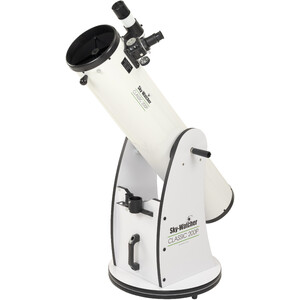
200 mm of aperture — the most sky for your money. Set it on the ground, point by hand: nebulae, clusters and galaxies for years to come.
Price: € 479
The star clusters of Cassiopeia
Seen from central and northern Europe, the celestial W stays above the horizon all year round, and it sits right on the band of the Milky Way. Open clusters are correspondingly dense there. Four of them are especially worthwhile – and three of those are already an experience in binoculars.
NGC 457 – the Owl Cluster
The finest of the four, and of all the objects here it is the one Charles Messier missed. Two strikingly bright stars form the “eyes”, and a band of stars below them the body with outspread wings. American observers therefore call it the E.T. Cluster – the resemblance is uncanny.
The two bright stars are Phi Cassiopeiae (5 mag) and HD 7902 (7 mag). Whether they really belong to the cluster is an open question: if Phi Cassiopeiae were a member, it would be one of the most luminous stars we know of. The cluster itself is around 21 million years young, roughly 7,900 light years away, and gathers a good 150 stars.
M52 and M103 – Messier’s Cassiopeia finds
Messier came across M52 in 1774 while hunting for comets. In binoculars it is a hazy patch; in a telescope from about 100 mm it becomes a dense swarm of some hundred individual stars. For M52 the figures diverge widely: depending on the study, age estimates range from around 35 to 160 million years, and distance estimates from 3,000 to 7,000 light years. With open clusters both are notoriously difficult to pin down, because interstellar dust reddens the light and dims it.
M103 lies directly on the band of the Milky Way and shows itself as a small, fan-shaped wedge. Its apparently brightest star, Struve 131, is a multiple star system – but it does not belong to the cluster; it simply happens to lie in the same line of sight.
NGC 559 – the one for the patient
At 9.5 mag it is the faintest of the quartet, and easy to overlook next to its bright neighbours. From about 100 mm of aperture it resolves into a delicate scattering of stars. In the Caldwell catalogue, which the British astronomer Patrick Moore compiled in 1995 as a supplement to Messier, it carries the number 8.
M69 and M70 – the mix-up candidates in Sagittarius
Charles Messier discovered both on the same night, on 31 August 1780 – and even then it was unclear which description belonged to which object. The problem has not changed for today’s observers: two globular clusters, similar in brightness, similar in size, in the same corner of the sky.
M69, at around 7.6 mag, is the slightly brighter of the two and lies about 28,700 light years away in the direction of the galactic centre. Among globular clusters it is an exception: it contains an unusually high proportion of heavy elements – it is metal-rich, as astronomers put it. That suggests it formed from material which had already been through one generation of stars.
M70 sits around 1,800 light years further on and looks a shade fainter and less dense in the eyepiece. Both show the typical structure: denser and denser towards the centre, fraying out towards the edge.

Far more rewarding in the same constellation are M22 and M28: at 5.1 mag, M22 is one of the brightest globular clusters in the entire sky. An overview of the constellation as a whole can be found on our page about the constellation Sagittarius.
NGC 752 – the underrated cluster in Andromeda
Caroline Herschel described it in 1783 as a “nebulous little patch” that can be glimpsed with the naked eye under good conditions; her brother William added it to his catalogue in 1786. It had, however, already been seen in 1654 by the Italian astronomer Giovanni Battista Hodierna – as so often, the earlier discovery was forgotten.
At 5.7 mag and a distance of around 1,400 light years, NGC 752 is one of the closer open clusters – only a few lie nearer, among them the Hyades at 150 and the Pleiades at 440 light years. At a good 1.3 billion years it is also one of the oldest. Open clusters normally disperse after a few hundred million years; this one holds together remarkably well. Recent studies count more than 300 member stars.
You will find it about five degrees south of Almach, the easternmost bright star of Andromeda – halfway to Triangulum. A few degrees further on stands M31, the most prominent deep sky object of the autumn sky.
Messier, NGC, Caldwell – the three catalogues
Almost every deep sky object carries several numbers. That is not chaos but history: three catalogues came about, each with a different purpose.
| Catalogue | Origin | Size | What it is good for today |
|---|---|---|---|
| Messier (M) | Charles Messier, from 1774 | 110 objects | The beginner’s list. Messier was looking for comets and noted down whatever got in his way – and of all things, that produced the best selection of bright objects in the northern sky. |
| NGC / IC | J. L. E. Dreyer, 1888 | around 7,840 (+ 5,386 in the IC) | The standard work. Anyone observing beyond Messier works with NGC numbers. |
| Caldwell (C) | Patrick Moore, 1995 | 109 objects | The supplement: bright objects that Messier left out – among them the southern sky, which he never saw from France. |
Incidentally, the number after the M says nothing about brightness or beauty, only about the order in which the objects were recorded. And Messier did get things wrong: M40 is not a nebula at all, but a simple double star.
Most Messier objects are within reach of a small telescope – if it has enough aperture and a steady mount.
Six short questions, an honest answer by email – even when binoculars are the better choice.
Frequently asked questions about deep sky objects
What are deep sky objects?
All celestial objects outside the solar system that are not single stars: open clusters, globular clusters, nebulae and galaxies. The term comes from amateur astronomy and sets them apart from the Moon, the planets and comets.
Which deep sky objects can you see with the naked eye?
Under a dark sky, about half a dozen: the Pleiades (M45), the Orion Nebula (M42) as a hazy patch in the sword of Orion, the Andromeda Galaxy (M31), the Double Cluster in Perseus, M13 as a hint of light and – with a little practice – NGC 752. From the southern hemisphere the Magellanic Clouds are added to the list.
Which telescope do I need for deep sky?
What matters is the aperture, not the magnification. From 130 mm around a hundred objects become accessible, from 200 mm the complete Messier catalogue. A Dobsonian gives you the most aperture per pound. Details in the guide to telescopes for galaxies.
Why don’t I see the colours shown in photographs?
Because in dim light the human eye uses only the colour-blind rods of the retina. Cameras collect light over minutes and therefore show colours that are in principle unreachable visually. The exceptions are a few double stars and the Orion Nebula, which shimmers greenish in large telescopes.
When is the best time for deep sky observing?
On the nights around new moon, at least 90 minutes after sunset, and with at least 20 minutes of dark adaptation without a glance at your phone. The season decides what is on offer: winter brings star clusters and nebulae, spring the galaxies, summer the galactic centre, autumn the Andromeda region.
What does the brightness figure in mag mean?
The apparent magnitude – the smaller the number, the brighter the object. With extended objects, though, it is misleading: the 3.4 mag of the Andromeda Galaxy is spread over an area several full moon diameters across, which is why it looks fainter than a 3.4 mag star. With nebulae and galaxies it is the surface brightness that counts.
How do I find a particular deep sky object?
By star hopping: working your way along in small steps from a bright star you have identified for certain. We explain the technique step by step under recognising constellations.
Further reading
* Affiliate link: if you buy through this link we may earn a small commission from Astroshop or High Point Scientific, at no extra cost to you.