By Alexander Merz · Updated on · Details checked on 14 September 2026
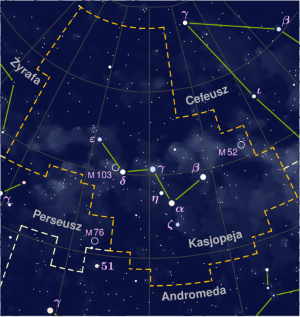
Right on the spiral arm of our Milky Way sits the constellation Cassiopeia, whose stars are known as the “Celestial W” of the northern sky. Indeed, the five brightest stars form the shape of a flat, wide, scrawled letter W.
⚡ The quick answer: Cassiopeia is the striking “Celestial W” in the northern sky – five bright stars in a W shape. The constellation is circumpolar, so it is visible on every clear night from northern latitudes, and sits directly opposite the Big Dipper: between the two lies the North Star.
The central point of the W points almost directly at the North Star. This orientation aid makes Cassiopeia a much sought-after circumpolar constellation. In addition, the “zero meridian” of the sky – that is, 0° right ascension (the colure) – runs near the easternmost star, Caph (Beta Cassiopeiae).
Key facts at a glance
- Cassiopeia is a striking constellation in the northern sky, made up of five bright stars that form a W-shaped pattern.
- The brightest stars in Cassiopeia are Schedar (Alpha Cassiopeiae) and Caph (Beta Cassiopeiae).
- The constellation Cassiopeia is named after the mythological queen Cassiopeia, who in Greek mythology was the wife of King Cepheus and the mother of Princess Andromeda.
- Cassiopeia is home to several interesting celestial objects, such as the open cluster Messier 52, the reflection nebula IC 59 and the emission nebula IC 63.
- Cassiopeia also contains Cepheid variables, for example SU Cassiopeiae. Watch out for a common mix-up: Delta Cephei, the prototype of this class, belongs to neighbouring Cepheus, not to Cassiopeia.
- The constellation Cassiopeia belongs to the Milky Way galaxy and lies close to the galactic equator.
- Cassiopeia is a conspicuous constellation and can be observed from most locations in the northern hemisphere, especially in autumn and winter.
- In some cultures, Cassiopeia was depicted as a kind of throne or seat on which the gods and celestial beings took their place.
A myth of vanity: how the constellation came to be, according to Greek legend
According to Greek tradition, the mythological model of the circumpolar constellation Cassiopeia was Andromeda’s mother and the wife of Cepheus. When this vain woman believed her own beauty to be greater than that of the Nereids, those daughters of the sea god Nereus begged Poseidon for redress. In revenge, he sent out his sea monster, which from then on ravaged shores, land and property.
The vain queen was to sacrifice her daughter – the royal couple’s only heir – to end the calamity. When Perseus slew the monster and freed the girl from her chains, he was given Andromeda as his wife in gratitude.
All those involved in the legend were immortalised as constellations in the northern sky, among them Cassiopeia, right at the edge of the Milky Way.


Ptolemy already described the constellation Cassiopeia among the 48 ancient constellations. Perhaps the shape of the W on the ribbon of the Milky Way has always drawn many observers’ eyes to this region of the northern sky. It is also possible that the myth stirred curiosity about this circumpolar orientation aid.
In the 17th century, there were theological attempts to turn Cassiopeia into a constellation called “Mary Magdalene”. But the classical name prevailed, including in the currently recognised catalogue of 88 constellations.
Cosmic phenomena observed by chance
In 1572, a supernova so powerful occurred in the constellation Cassiopeia that Tycho Brahe recorded the event in the circumpolar night sky. The remnant of a supernova from 1680, Cassiopeia A, can be measured from Earth today.
On 16 August 1680, John Flamsteed catalogued a star “3 Cassiopeiae” near the Milky Way for the northern sky, which later observers were, however, no longer able to find. Using a light echo, the Hubble Space Telescope reconstructed the course and type of the supernova.
The Chandra X-ray telescope has since found the X-ray source at the centre of the event. Spectral analyses show it to be a neutron star with a temperature of around 2.8 million kelvin.
Where can I find Cassiopeia in the night sky?
Cassiopeia is a clearly visible and conspicuous constellation made up of five bright stars that form a W- or M-shaped figure.
It is circumpolar, which means it never sets and can therefore always be found in the sky. Cassiopeia lies near the North Star and rotates around it.
The constellation is part of the Milky Way and offers a view of a dense carpet of stars behind the bright ones. One star in Cassiopeia, Rho Cassiopeiae, is a candidate for a supernova explosion that could occur at some point in the future.
Cassiopeia is a fascinating and rewarding target for stargazing and offers many interesting celestial objects to discover.
The celestial W you can find without any equipment. What lies inside it, you cannot.
Six short questions, an honest answer by e-mail – including when binoculars would do.
What can you observe in Cassiopeia
Cassiopeia is a constellation that offers many interesting celestial objects to observe. This way, before you decide to buy a telescope, you know what there is to see. Some of them are:
- Open cluster Messier 52: A relatively young open star cluster made up of more than 100 stars and easy to see with a telescope.
- Emission nebula IC 63: A glowing nebula illuminated by the surrounding stars, forming like a ring around a dark patch in the centre.
- Reflection nebula IC 59: A nebula that reflects the light of nearby stars and appears as a bluish cloud.
- SU Cassiopeiae: A Cepheid variable in Cassiopeia whose pulsation period reveals its true luminosity and therefore its distance. The prototype of the class, Delta Cephei, lies in Cepheus instead.
- Supernova candidate Rho Cassiopeiae: A star that may explode as a supernova in the future and could then appear as a bright point in the sky.
These celestial objects can be observed with a telescope or binoculars and offer a fascinating opportunity to explore the beauty and complexity of the Universe.
🔭 Exploring Cassiopeia: our recommendations
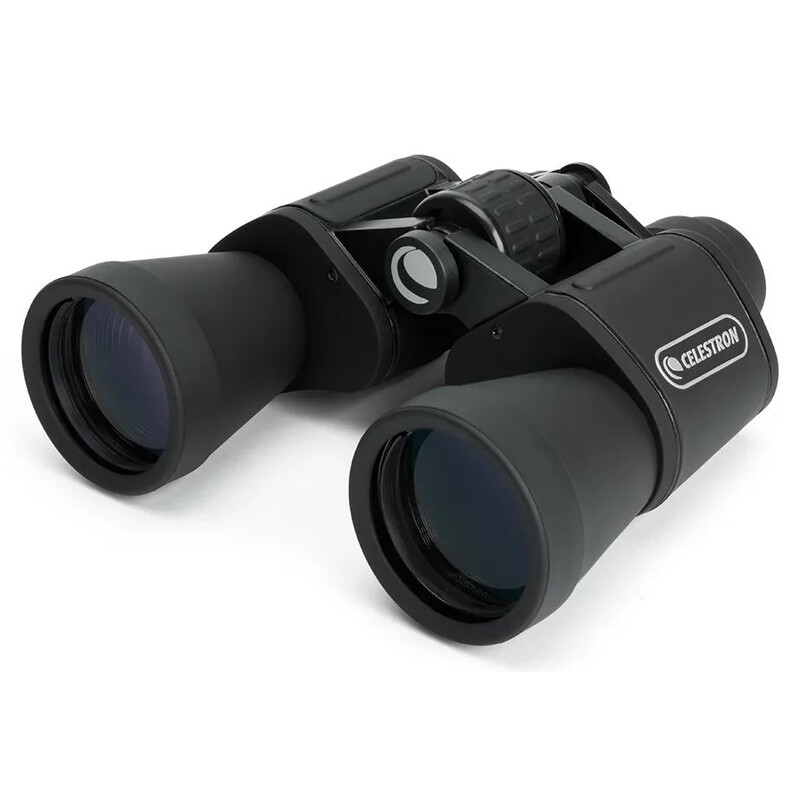 Cassiopeia sits right in the middle of the Milky Way – through binoculars, the region teems with star clusters (M52, NGC 457, the “Owl Cluster”). A great starter pair: the Celestron UpClose G2 10x50 Porro Binoculars (€ 62).
Check availability* →
To find it: a planisphere – set date and time, hold it up, and Cassiopeia’s W is where the card says it is. High Point sells the Celestron Sky Maps & Planisphere* for $30.95 (checked 12 Sep 2026).In Europe we use the Oculum Swivelling Sky Map 29 cm at € 19.90. Or start with our guide to the Big Dipper.
Check availability* →Check availability* →
*Affiliate link: if you buy through it, we receive a small commission – the price stays the same for you.