By Alexander Merz · Updated on · Details checked on 14 October 2026
Once celebrated as the ninth planet, Pluto was reclassified as a dwarf planet back in 2006. This tiny, icy world on the frozen edge of the solar system still captivates amateur astronomers: spotting it in a telescope is considered one of the toughest challenges in the night sky. Here’s everything you need to know about Pluto, the dwarf planet.
More in our overview: Planets of Our Solar System.
⚡ The quick answer: Since 2006, Pluto has officially been a dwarf planet, not a planet — it never managed to “clear” its orbit of the other objects that share it. At just 1,477 miles (2,377 km) across, it’s smaller than our own Moon. Through a telescope it stays a tiny point of light, even at 8 inches of aperture, which is why “Pluto hunting” is regarded as a rite of passage for amateur astronomers.

Pluto fact sheet
- Dwarf planet of rock and ice
- 5 moons, including Charon
- Diameter: 2,377 km
- Orbital period: 248 years
- Length of day: 6.4 days
- Distance from the Sun: 5.9 billion km
- Temperature: −230 °C
Why Isn’t Pluto a Planet Anymore?
The rapid progress of astronomy turned once-tidy catalogs into an almost unmanageable jumble within just a few decades. Scientific bodies pushed for clearer classifications, and the most famous of these debates concerned the status of a planet in the solar system. In 2006, the International Astronomical Union (IAU) adopted a formal definition of a planet — one that remains controversial to this day. Ever since, Pluto has no longer counted as a full-fledged planet.
To qualify as a planet, a body must meet three criteria: it must orbit the Sun, have enough mass to be nearly spherical, and — crucially — have “cleared the neighborhood” around its orbit. Pluto fails that last test, since it shares its region with countless objects in the Kuiper Belt. It’s now one of five recognized dwarf planets in the solar system, alongside Ceres, Makemake, Haumea, and Eris, cataloged as minor planet number 134340.
An Extreme Orbit on the Edge of the Solar System
This former ninth wanderer is small and travels along a steeply inclined, highly elliptical orbit. A single year on Pluto lasts 247.68 Earth years and is far more eccentric than most other planetary paths. Its orbital tilt reaches 17°, pulling it well off the plane on which the classical planets travel.
Surprisingly for such a small body, its rotation period is long. A Pluto day lasts about 6.4 Earth days, and Pluto spins in a retrograde direction on its axis. The reason is Charon, its large moon, whose tidal forces act on Pluto — just as the dwarf planet tugs back on the moon in return.
The Discovery: A Trans-Neptunian Sensation in 1930
In the early 20th century, the Lowell Observatory in Arizona searched the sky for 25 years, hunting for a suspected ninth planet. In 1930, photographic plates finally revealed the object — though not where it had been predicted. The world’s press seized on the discovery at once. The name “Pluto,” picked from a flood of suggestions, was proposed by an eleven-year-old girl from Oxford, England, who had the mythological instinct to name this distant, dark world after the god of the underworld.
Shortly after its discovery, astronomers estimated Pluto to be about the size of Earth, based on its assumed albedo and apparent brightness. After several downward corrections, the media joked that further research might make the “shrinking” world vanish altogether. Only in the late 1970s, with the discovery of Charon, could its true size finally be pinned down.
Pluto Fact Sheet
| Property | Value |
|---|---|
| Type | Dwarf planet (icy) |
| Diameter | ≈ 1,477 mi (2,377 km) — smaller than the Moon |
| Average distance from the Sun | ≈ 3.7 billion mi (5.9 billion km) |
| Surface temperature | ≈ −400 °F (−240 °C) |
| Length of year | ≈ 248 years (247.68) |
| Length of day | ≈ 6.4 Earth days (retrograde) |
| Orbital inclination | 17° |
| Known moons | 5 (Charon, Nix, Hydra, Kerberos, Styx) |
| Apparent magnitude | ≈ +14.4 mag |
| Minor planet number | 134340 |
Charon, Pluto’s Remarkable Big Moon
The Pluto–Charon setup is exceptional. Astronomers believe the two bodies didn’t form together; instead, Charon was likely blasted off a once-much-larger parent body in a colossal collision. Traces of cryovolcanism and the low degree of weathering on the surface ice, confirmed in 2007, support that theory. Charon, however, has no measurable atmosphere.
Pluto and its relatively massive companion form the only known dwarf-planet binary system in our solar system. Charon’s rocky core is far smaller than Pluto’s, while its icy crust is at least 10 to 15 percent thicker. NASA’s New Horizons probe, launched in early 2006, swept past Pluto at just 7,800 miles (12,500 km) on July 14, 2015, sending back detailed images of the dwarf planet, Charon, and the small moons Nix and Hydra.
Can You See Pluto Yourself?
At a faint magnitude of about +14.4, Pluto is one of the most demanding targets in amateur astronomy. It’s invisible through binoculars or a beginner scope: you’ll need at least 8 to 10 inches (20 to 25 cm) of aperture, a genuinely dark rural sky, and a precise star chart. Even then, Pluto shows up only as a minuscule point of light that gives itself away solely by its slow drift among the stars over several nights.
Best value: Skywatcher Dobson Telescope N 200/1200 Skyliner Classic
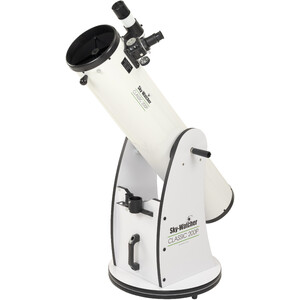
200 mm of aperture — the most sky for your money. Set it on the ground, point by hand: nebulae, clusters and galaxies for years to come.
Price: € 479
* Affiliate link: if you buy through this link we may earn a small commission from Astroshop or High Point Scientific, at no extra cost to you.
Let’s be honest: even with a big 8-inch Dobsonian, Pluto will never be more than a barely perceptible speck. Catching it is far more realistic through photography — modern smart telescopes and long-exposure astrophotography bring Pluto within reach of patient amateurs.
Pluto is only for large telescopes and patient observers – for everything else in the solar system, a smaller one is enough.
Six short questions, an honest answer by email – even when binoculars are the better choice.
Frequently Asked Questions
Why was Pluto reclassified as a dwarf planet?
Since 2006, the IAU definition requires a planet to have cleared its orbit of other objects. Pluto shares its region with many Kuiper Belt objects, so it was reclassified as a dwarf planet.
How long does Pluto take to orbit the Sun?
About 248 years. Since its discovery in 1930, it hasn’t even completed half of one full orbit.
How big is Pluto?
At roughly 1,477 miles (2,377 km) across, Pluto is smaller than our Moon (2,159 mi / 3,474 km).
Can you see Pluto with a normal telescope?
Visually, you need at least 8 to 10 inches of aperture under a very dark sky. Photographically, it’s reachable with more modest gear and long exposures.
How many moons does Pluto have?
Five known moons: Charon (the largest), Nix, Hydra, Kerberos, and Styx.
Read next:
- Best beginner telescopes: how to choose
- The planets of the solar system
- Getting started with astrophotography
This article in other languages: Deutsch · Français · Italiano