By Alexander Merz · Updated on · Details checked on 14 October 2026
Sunspots are the visible fingerprints of a colossal magnetic engine that constantly reshapes itself across the surface of our star. These dark patches have fascinated astronomers for centuries because they tell the story of the Sun‘s magnetic field and drive what we now call space weather. To understand sunspots is to understand the very heart of solar activity.
⚡ The quick answer: Sunspots are darker, cooler regions of the Sun’s photosphere caused by intense concentrations of magnetic field that suppress convection. They follow a roughly 11-year cycle, appear mostly near the solar equator, and can trigger flares and coronal mass ejections. Never view them with the naked eye or an unfiltered instrument — you must use a certified solar filter mounted in front of the objective.
What Sunspots Really Are
Solar research is chiefly concerned with the causes and evolution of sunspots. These dark regions appear as the outward sign of a deep reorganization of the Sun’s magnetic field. While Earth’s magnetic field changes only sluggishly — a single polarity-reversal cycle takes about a quarter of a million years — the Sun’s magnetic alignment completely restructures itself in just 11 years.
That dramatic difference becomes easier to grasp when you picture the sheer matter-to-energy conversion at work: roughly 4.3 million tons of matter, made up of various elements, are turned into pure energy every single second. This furnace powers the magnetic storms that sunspots make visible.
Our Sun Is a Magnetic “Pressure Cooker”
The plasma inside the Sun is so electrically conductive that it behaves like a giant dynamo: it “burns” all of its kinetic energy into electrical energy, which in turn becomes a magnetic field. Across most solar regions, the strength of that field stays in balance.
But in the most intense parts of the photosphere (the lowest atmospheric layer), especially near the equator, convection is severely disrupted. Sunspots then hurl enormous amounts of matter out into space. The formation and distribution of these disturbed regions is the central topic of solar research.
The Life Cycle of a Sunspot
At first, only a few isolated shadows appear on the Sun. Within just a few hours they can grow into an entire belt of cooler sunspots. Half of these disturbances vanish after two days at most, while another ten percent or so do not “survive” beyond eleven days.
At the peak of the process — reconnection, the reconnecting of magnetic fields of opposite polarity — vast masses of energy burst out of the affected regions and shoot far into space. These observations are used not only to study current solar activity but also to model what comes next.
What You’ll See: Key Sunspot Data
| Feature | Value / observation |
|---|---|
| Solar cycle | ≈ 11 years (min → max → min activity) |
| Location | Photosphere, mostly near the solar equator |
| Sunspot temperature | ≈ 3,500–4,500 K (vs. ≈ 5,500 K surroundings) |
| Lifespan | 50% gone within 2 days; ≈ 10% last beyond 11 days |
| Matter converted to energy | ≈ 4.3 million tons per second |
| Observation safety | Certified solar filter REQUIRED over the objective |
How to Observe Sunspots Safely
⚠️ Safety warning: Never look directly at the Sun with the naked eye, binoculars, or an unfiltered telescope — you can suffer permanent eye damage in a fraction of a second. Sunspots can only be observed with a certified solar filter (ISO 12312-2 for eclipse glasses, or approved solar film/glass mounted IN FRONT of the objective) or by projecting the image. Never use a filter that screws onto the eyepiece.
With the right protection, sunspots are among the most rewarding daytime targets in all of astronomy: their number and position shift from day to day, letting you track the Sun’s rotation and the ebb and flow of its activity in real time. For a step-by-step guide to cutting solar film to size and choosing the right filter for every device — from binoculars to the Seestar — see our guide How to Observe the Sun Safely.
The standard for white-light observing is solar film mounted in front of the aperture, never in the eyepiece. It holds back more than 99.999 percent of the light before it ever enters the instrument, and Baader AstroSolar OD 5.0 has been the reference for decades because it can be cut to any aperture. What matters just as much is the cell: it has to sit tight enough that no gust of wind can lift it off.
The standard for safe solar observing: Baader AstroSolar Safety Film OD 5.0
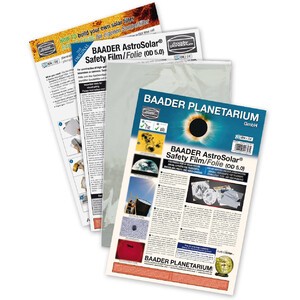
The standard film for safe solar observing: OD 5.0 passes just 1/100,000 of the light. Cut it, mount it – and sunspots snap into razor-sharp view.
Price: € 29
A small telescope from about 60 mm of aperture already separates umbra and penumbra; from roughly 100 mm the granulation around the spots shows up. Mornings are the better half of the day — later on the ground heats up, the air starts to boil and the image goes soft.
* Affiliate link: if you buy through this link we may earn a small commission from Astroshop or High Point Scientific, at no extra cost to you.
Space Weather: A Field of Its Own
The goal of modern solar research is to build forecast models for the hazards these events pose to Earth. During quieter periods, only electronic components near the poles are affected, where our own magnetic field does less to keep solar storms away from us. Thanks to a sharper understanding of how sunspots evolve, individual eruptions can now be predicted to within a few hours.
The strength and danger to Earth’s ionosphere are then rated, and warnings are issued for air traffic, satellite operations, and other critical infrastructure. This forecasting field now has a name all its own: alongside the everyday terrestrial weather report, there are now regular space weather reports.
Sunspot FAQ
Why are sunspots darker than the rest of the Sun?
They look dark because they are cooler than the surrounding surface: the intense magnetic field suppresses the convective flow of heat, lowering the temperature by roughly 1,000–2,000 degrees.
How long is the sunspot cycle?
The solar cycle averages about 11 years between activity minimums. Sunspot numbers rise to a maximum, then fall back down again.
Can you observe sunspots with a telescope?
Yes, but only with a certified solar filter fitted in front of the objective, or by projection. Without approved protection, observing the Sun is extremely dangerous to your eyes.
Do sunspots affect Earth?
Yes. The flares and coronal mass ejections tied to sunspots can disrupt satellites, radio communications, and power grids — and produce spectacular auroras.
When are sunspots most numerous?
During solar maximum, the peak of the 11-year cycle, when magnetic activity and sunspot counts reach their height.