By Alexander Merz · Updated on · Details checked on 4 October 2026
Just before midnight on April 6, 2002, a blindingly bright fireball tore across the sky over southern Bavaria. Thousands of startled witnesses flooded police hotlines and newsroom phones. The Neuschwanstein meteorite had just made history — not only in science, but in the courtroom, too.
More in our overview: Meteorites.
⚡ The quick answer: The Neuschwanstein meteorite is a fireball that fell on April 6, 2002, in southern Bavaria near the famous castle. Three fragments were recovered — Neuschwanstein I, II, and III. Its orbit resembled that of the Příbram meteorite, but analysis ruled out a shared origin. The third fragment sparked a five-year legal battle with a disputed value of about $200,000€200,000.
What is the Neuschwanstein meteorite?
On the night of April 6, 2002, a cosmic body entered Earth’s atmosphere at high speed. Its descent rattled windowpanes, unleashed rolling thunder, and produced deep booming sounds that jolted residents awake. Named after the fairy-tale castle that towers over the region, the Neuschwanstein meteorite is now one of the best-documented falls in Europe.
Neuschwanstein I, II, and III: what do the names mean?
By reconstructing the flight path, researchers pinned the impact zone to southern Bavaria: around Neuschwanstein, in the Füssen area, and in the Ammergau mountains. Roughly six seconds before it burned out, the fireball broke into several fragments that kept glowing during their parabolic “rain” toward the ground.
Once the fall zone was narrowed down, meteorite hunters combed the terrain like a German Colorado. The fragments were numbered in the order they were found: Neuschwanstein 1, 2, and 3. Winds that night had nudged the pieces off the calculated trajectory, making precise recovery harder.
A relative of the Příbram meteorite?
Reconstructing its pre-entry orbit suggested a shared parent body with the Příbram meteorite, which fell 43 years earlier in the former Czechoslovakia. Analysis, however, disproved the connection: the Neuschwanstein meteorite is about 26 million years older, making a common origin impossible.
The Neuschwanstein meteorite lawsuit
German courts have long entertained some of the quirkiest disputes imaginable. After its third fragment turned up, the meteorite became a genuine “case” — in both the legal and astronomical sense. Over five years of claims and appeals across several German and Austrian courts, the third and largest piece reached a disputed value of roughly $200,000200,000 euros before it was finally allowed to stay with its German finder.
Treasure or mineral?
Under German law, an object can be classified as “treasure-like” if it once had an owner or lay hidden for a long time. No one could identify the owner of a stone tens of millions of years old — yet for a time two fragments were treated as “treasure trove” under modern rules. Austrian law takes the opposite view: a meteorite lying in open nature counts as a mineral, which anyone may collect and keep, provided no excavation equipment is used.
Why this fall mattered to astronomy
What made the event a sensation for astronomers was the ability to pinpoint the fall areas using simultaneous photographic records from the European fireball network. Neuschwanstein is only one of about a dozen observed and documented falls in Germany, but it remains a textbook case for studying meteorite orbits.
Frequently asked questions
When did the Neuschwanstein meteorite fall?
On the night of April 6, 2002, just before midnight, over southern Bavaria.
How many fragments were found?
Three main fragments, named Neuschwanstein 1, 2, and 3 in the order of their discovery.
What type of meteorite is it?
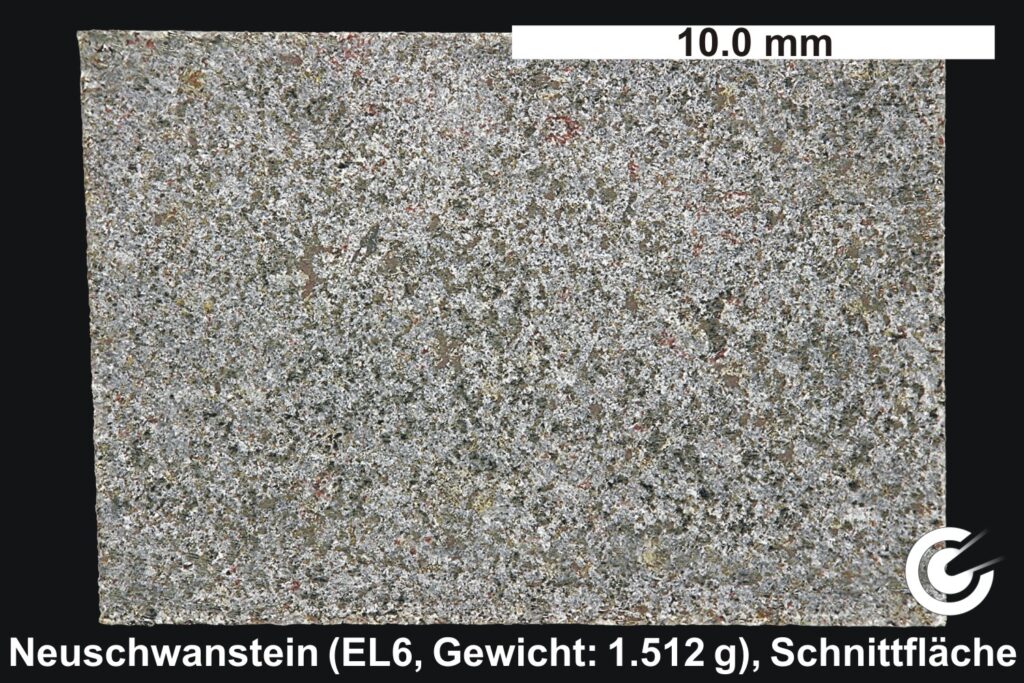
Neuschwanstein is an enstatite chondrite (type EL6), a relatively rare class of stony meteorite.
Why did it end up in court?
The legal status of the largest fragment — treasure, mineral, or the finder’s property — pitted several parties against each other for five years in German and Austrian courts.
Read next: