By Alexander Merz · Updated on · Details checked on 8 October 2026
Halley’s Comet (1P/Halley) is the best-known periodic comet: it orbits the Sun about every 76 years on a long, retrograde orbit and becomes visible to the naked eye at every return.
More in our overview: Comets.
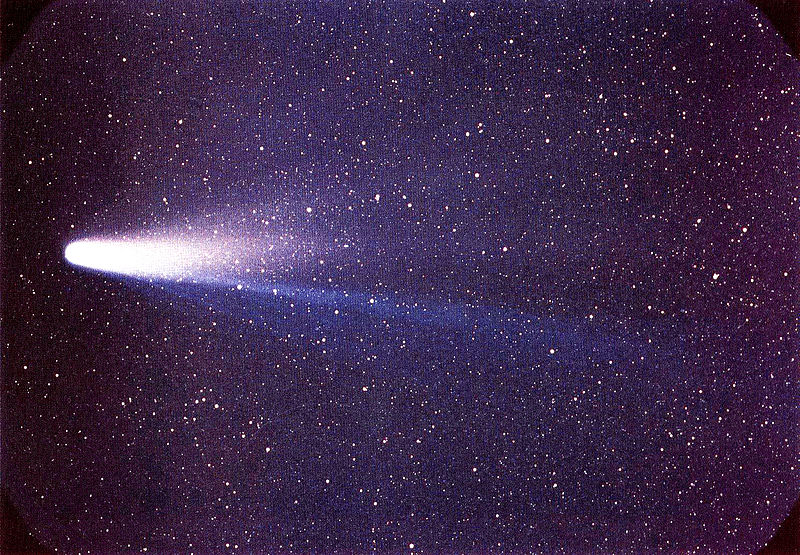
When will Halley’s Comet return?
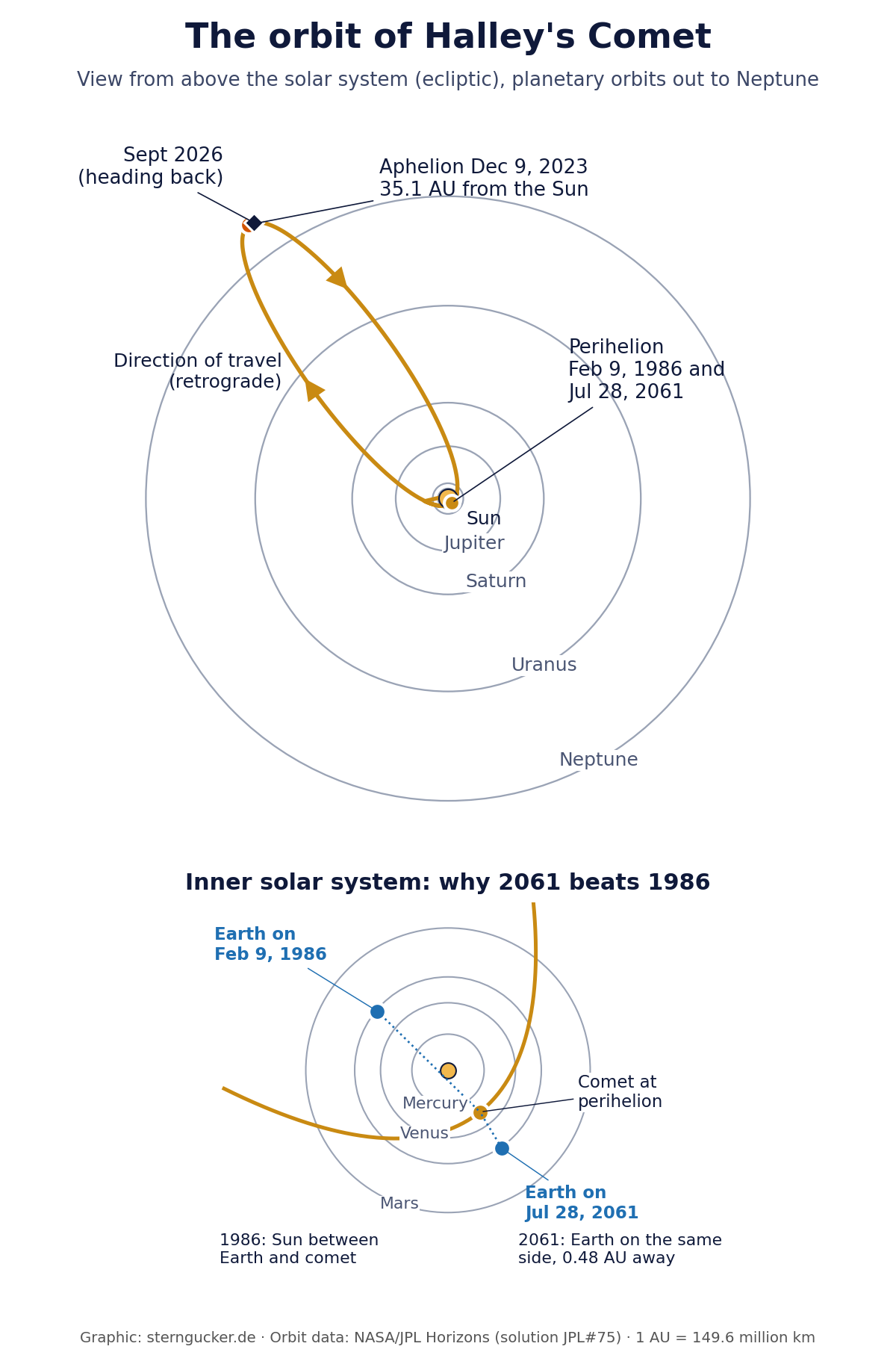
Halley’s Comet reaches its closest point to the Sun, the perihelion, on July 28, 2061. That is the result of the orbit calculation by NASA’s Jet Propulsion Laboratory. One day later, on July 29, 2061, it passes closest to Earth at 0.48 AU, about 72 million kilometers (45 million miles).
It has already passed the turning point of its orbit. On December 9, 2023, it reached aphelion, its farthest point from the Sun, 35.1 AU out – beyond Neptune. Since then it has been slowly falling back toward the inner solar system.
How well you can see it from the US in 2061
In 2061, Earth and the comet are on the same side of the Sun – that is the big difference from 1986. In July the comet moves through Taurus, Perseus and Auriga, constellations that sit in the northeast before dawn in summer. We calculated the values below from JPL orbit data for the central United States (39° north, Kansas).
| Period in 2061 | Where and when | Altitude | Brightness (forecast) |
|---|---|---|---|
| Late June | mornings around 5:30 a.m., northeast (Taurus) | 20–24° | around mag 6, binoculars |
| Mid-July | mornings around 5:30 a.m., northeast (Perseus, Auriga) | up to 30° | mag 4 to 3, naked eye; new Moon on July 16 |
| July 24 to 28 | mornings low in the northeast; evenings around 9:30 p.m. only very low in the northwest | 10–18° | around mag 2, possibly brighter |
| Early August | evenings around 9:30 p.m., west-northwest (Leo Minor, Leo) | around 15° | mag 2 to 3, full Moon around August 1 interferes |
| Mid to late August | evenings in the west (Virgo) | 15–20° | mag 4 to 5, fading |
To be honest: 35 years ahead, the brightness can only be roughly predicted. The standard model in the JPL database gives about mag 2 at closest approach to Earth, other forecasts arrive at about mag 0. In 1986, after perihelion, the comet was roughly two magnitudes brighter than this model expects.
One drawback remains: at its brightest, the comet sits low in the twilight, and short summer nights make the sky less dark. Do not expect a tail stretching across half the sky like in 1910.
When was Halley’s Comet last seen?
Halley’s Comet was last seen in 1985/86, reaching perihelion on February 9, 1986. This return is considered the least favorable in about 2,000 years. The graphic shows why: at perihelion, the Sun stood right between Earth and the comet.
From the US, the comet was only a faint fuzzy patch in 1985/86. In November and December 1985 it stood high in the evening sky, but at about mag 6 you needed binoculars to find it. In January 1986 it grew brighter but sank ever lower into the evening twilight.
It looked best in March and April 1986 at around mag 2. By then it was so far south that it was well placed only for the Southern Hemisphere; from the continental US it hung low in the southeast before dawn. On April 11, 1986, it passed closest to Earth at 0.42 AU.
Since then it has only been within reach of the largest telescopes. In March 2003, astronomers photographed it with ESO’s Very Large Telescope at magnitude 28.2 – about 26 magnitudes fainter than in 1986.
All returns from 1835 to 2134
How well the comet can be seen depends almost entirely on where Earth happens to be. The table shows the most recent and the next returns with the dates of perihelion and closest approach to Earth.
| Perihelion | Closest to Earth | Visibility |
|---|---|---|
| Nov. 16, 1835 | Oct. 13, 1835, 0.19 AU | good: high in the sky in October and visible to the naked eye |
| Apr. 20, 1910 | May 20, 1910, 0.15 AU | spectacular: around mag 0, long tail, Earth inside the tail on May 19 |
| Feb. 9, 1986 | Apr. 11, 1986, 0.42 AU | poor: well placed only from the Southern Hemisphere |
| July 28, 2061 | July 29, 2061, 0.48 AU | ⭐ Next returndecent: naked eye in July, but low in the twilight |
| Mar. 27, 2134 | May 7, 2134, 0.09 AU | very close: should get much brighter than in 2061 |
The intervals between returns are not equal: from 1910 to 1986 it was 75.8 years, from 2061 to 2134 it will be only 72.7 years. The reasons are the gravity of Jupiter and Saturn and the recoil of gases streaming off the nucleus.
Orbit and key facts
Halley’s Comet orbits the Sun backwards, opposite to the direction in which all the planets move. Its orbit is tilted about 18° to Earth’s orbit, formally 162°, because it is “upside down”.
| Property | Value |
|---|---|
| Designation | 1P/Halley, the first comet recognized as periodic |
| Orbital period | about 76 years, varies by a few years |
| Closest distance to the Sun (perihelion) | 0.59 AU (about 88 million km), between the orbits of Mercury and Venus |
| Farthest distance from the Sun (aphelion) | 35.1 AU (about 5.3 billion km), beyond Neptune’s orbit |
| Eccentricity | 0.97 |
| Inclination | 162° (retrograde) |
| Speed | about 55 km/s at perihelion, under 1 km/s at aphelion |
| Nucleus | about 15 × 8 km (9 × 5 miles), dark as coal (reflects 4 % of sunlight) |
Because the orbit is so elongated, the comet spends almost its entire period far out. Only for one to two years is it close enough to the Sun to grow a tail – the rest of the time it is a dark, frozen lump. Read more about this type of comet in our article on short-period comets.
Giotto and Vega: the space probes of 1986
In 1986, spacecraft flew past a comet for the first time – five of them at once. The Soviet Vega probes measured the comet first, and their data were used to steer the European probe Giotto more precisely to its target.
| Probe | Operator | Flyby | Distance from nucleus |
|---|---|---|---|
| Vega 1 | Soviet Union | March 6, 1986 | about 8,900 km |
| Suisei | Japan | March 8, 1986 | about 150,000 km |
| Vega 2 | Soviet Union | March 9, 1986 | about 8,000 km |
| Sakigake | Japan | March 11, 1986 | about 7 million km |
| Giotto | ESA | March 14, 1986 | 596 km |
Giotto returned the first close-up images of a comet nucleus: a dark, potato-shaped lump of ice about 15 × 8 km in size. Jets of gas and dust broke out of the crust only on the sunlit side. Shortly before closest approach, a dust particle hit the probe and briefly sent it wobbling.
Edmond Halley and his prediction
The comet owes its name to the English astronomer Edmond Halley. In 1705 he calculated the orbits of several comets using Newton’s law of gravitation and found that the comets of 1531, 1607 and 1682 had almost the same orbit.
Halley concluded that it was the same comet and predicted its return for late 1758. He died in 1742 and did not live to see the proof. On December 25, 1758, the Saxon farmer and amateur astronomer Johann Georg Palitzsch recovered the comet near Dresden, and perihelion followed on March 13, 1759.
From the Bayeux Tapestry to the panic of 1910
The oldest certain observation comes from China in 240 BC. Since then the comet has turned up in chronicles at every return, usually as a harbinger of doom.
It is famously depicted on the Bayeux Tapestry, which tells the story of the Norman conquest of England in 1066. The painter Giotto di Bondone saw the comet in 1301 and a few years later painted it as the Star of Bethlehem in his fresco “Adoration of the Magi” in Padua. The Giotto space probe is named after him.
In 1910 the comet set off a genuine panic. Astronomers had detected poisonous cyanogen compounds in its tail, and Earth was due to pass through that tail on May 19, 1910. Hucksters sold “comet pills” – yet the gas was so thinly spread that nobody noticed a thing.
Mark Twain was born on November 30, 1835, two weeks after the comet’s perihelion. He predicted that he would go out with the comet as well – and died on April 21, 1910, one day after the next perihelion.
Shooting stars from Halley’s Comet
You can see a piece of Halley’s Comet twice every year – as shooting stars. Along its orbit it has left a trail of dust that Earth crosses in May and in October.
| Meteor shower | Peak | Hourly rate (ideal) | From the US |
|---|---|---|---|
| Eta Aquariids | around May 6 | about 50 | modest, shortly before dawn; better in the southern states |
| Orionids | around October 21 | about 20 | good, in the second half of the night |
Watching comets without waiting for 2061
Comets for binoculars come along almost every year, naked-eye ones about every one to two years. Our page Comet tonight shows which comets are visible right now, updated every hour.
For comets, binoculars are often better than a telescope because they show a wide field of sky. A pair of 10×50 binoculars is the classic starting point – more in our guide to astronomy binoculars.
For comets: Celestron UpClose G2 10x50 Porro Binoculars
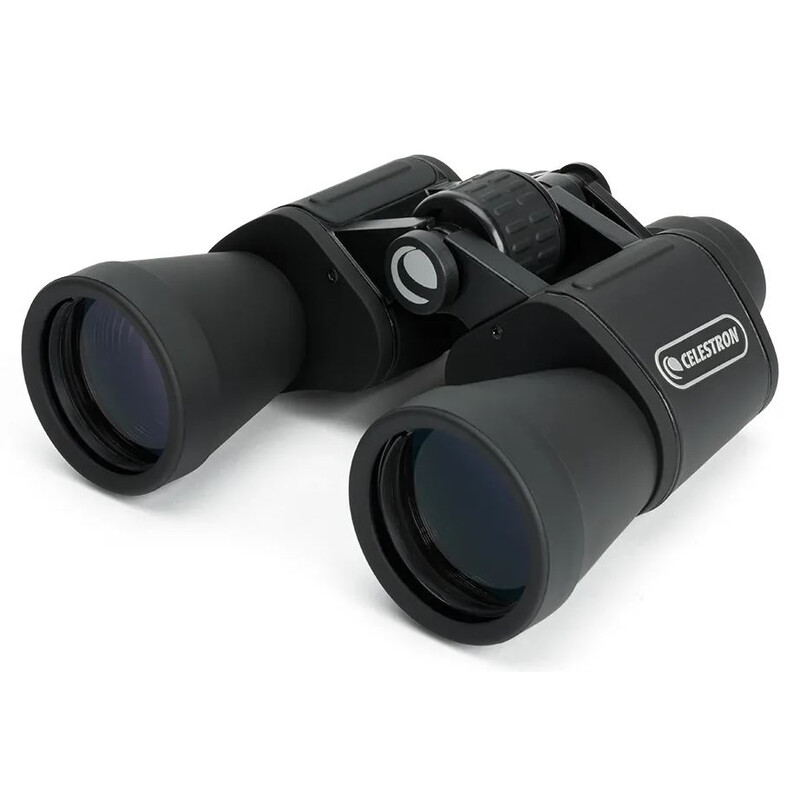
The honest entry point: 10x50 with a 5 mm exit pupil, rubber-armoured, under 80 euros. Shows the Moon, the Pleiades and Jupiter’s moons.
Price: € 62
Frequently asked questions about Halley’s Comet
When is the next Halley’s Comet?
Halley’s Comet returns in the summer of 2061. It reaches perihelion on July 28, 2061, and is closest to Earth on July 29, 2061. It should be visible to the naked eye from about early July to early August.
When was the last Halley’s Comet?
It was last visible in 1985/86, with perihelion on February 9, 1986. From North America this return was disappointing, because at its brightest the comet was well placed only from the Southern Hemisphere.
When was Halley’s Comet visible in the US?
Most recently from November 1985 to January 1986 in the evening sky, and again low before dawn in March 1986, but only faintly and mostly in binoculars. It was an impressive sight with a long tail in April and May 1910.
Which comet was visible in 1997?
In 1997 it was Comet Hale-Bopp, not Halley’s Comet. Hale-Bopp was visible to the naked eye for months, even from brightly lit cities.
Where is Halley’s Comet right now?
In fall 2026 it is about 35 AU from the Sun, roughly 5.2 billion kilometers (3.3 billion miles). It passed its farthest point from the Sun on December 9, 2023, and has been on its way back ever since.
Can Halley’s Comet hit Earth?
No. Its orbit never comes closer to Earth’s orbit than about 0.07 AU, around 11 million kilometers. All Earth ever gets from it is its dust, as shooting stars.
How often does Halley’s Comet come around?
On average every 76 years, but the exact period varies between about 73 and 79 years. If you see it in 2061, chances are it will be a once-in-a-lifetime experience.
* Affiliate link: if you buy through this link we may earn a small commission from Astroshop, High Point Scientific or another linked retailer, at no extra cost to you.