By Alexander Merz · Published on · Details checked on 11 October 2026
A model of the universe is the picture, valid at any given time, of how the universe is built and what place the Earth takes within it. From the geocentric model of Ptolemy through the heliocentric one of Copernicus to today’s picture of an expanding universe, that idea has changed fundamentally several times – and it keeps changing as soon as new observations come in.
More on this in the overview: Our planets.
The most important models of the universe at a glance
| Model | At the centre | Proponents | Period |
|---|---|---|---|
| Geocentric | Earth | Aristotle, Ptolemy | 4th century BC to 17th century |
| Tychonic | Earth, but the planets orbit the Sun | Tycho Brahe | from 1588 |
| Heliocentric | Sun | Copernicus, Kepler, Galileo, Newton | from 1543, established in the 17th century |
| Today’s model | no centre: the Sun is one star among billions | Hubble, Einstein and many others | since the 20th century |
The key points in brief
- The geocentric model according to Ptolemy and Tycho Brahe
- The discovery of the heliocentric model by Copernicus in the 16th century
- The confirmation of the heliocentric model by Galileo Galilei in the 17th century
- The development of the theory of gravity by Isaac Newton in the 17th century
- The discovery of Uranus (1781), Neptune (1846) and Pluto (1930)
- The discovery of galaxies and black holes in the 20th century
- The realisation that the universe is expanding, in the 20th century
- The discovery of countless asteroids and moons in the 21st century
Geocentric models
Of particular importance here are the geocentric models of Ptolemy and Tycho Brahe. In these views of how the Earth and the celestial bodies are arranged, the Earth sits at the centre.
The model according to Ptolemy
The model of Ptolemy (also known as the Ptolemaic system or the geocentric system) was a model of the universe developed by the Greek astronomer Claudius Ptolemaeus in the 2nd century AD.

Here are some of the most important facts:
- Geocentric model: The Ptolemaic model starts from the assumption that the Earth is the centre of the universe. All other celestial bodies, including the Sun, the Moon, the stars and the planets, orbit the Earth.
- Epicycles: Ptolemaeus recognised that the planets do not move in perfect circles around the Earth, but sometimes change direction or appear to go backwards. He explained this by assuming epicycles, smaller circles that the planets run through along their orbits in order to balance out these irregularities.
- Aristotelian physics: Ptolemaeus relied on Aristotelian physics, which held that celestial bodies were perfect and unchanging. As a result he thought that the motion of the celestial bodies had to be perfect and circular, and he rejected the idea of an elliptical orbit.
- Star catalogue: Ptolemaeus compiled a catalogue of more than 1000 stars, known as the Almagest. It contained detailed observations and descriptions of the celestial bodies and became the standard work of astronomy until the 16th century.
- Influence: The Ptolemaic model had an enormous influence on astronomy and on the understanding of the universe until the 16th century. It was eventually refuted, however, by the models of Copernicus and Galileo, which placed the Sun at the centre of the universe (the heliocentric system).
The Tychonic model
The Tychonic model is a compromise between the two views: the Earth stands motionless at the centre, the Sun orbits the Earth – and all the other planets orbit the Sun. With this, Tycho Brahe explained the observed planetary paths without having to set the Earth in motion.
Tycho Brahe was a Danish astronomer of the 16th century who carried out precise observations of the celestial bodies.
In 1572 he observed a “new star”, in truth a supernova, and he measured the planets and comets for decades. Johannes Kepler later used his measurements to prove the heliocentric model.
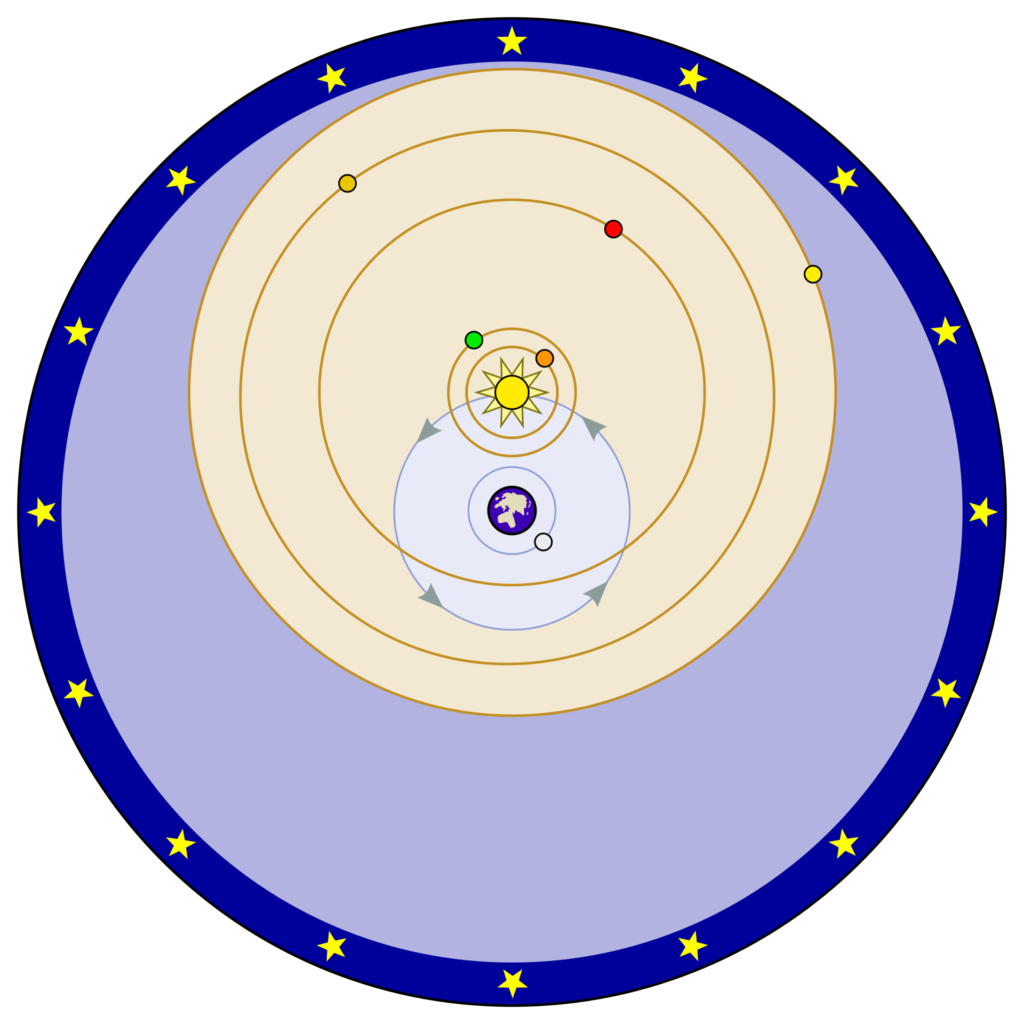
The essential features of his model are:
- Earth at the centre of the cosmos
- The planets Mercury and Venus orbit the Sun
- The Sun and the planets Mercury and Venus orbit the Earth
- The Moon orbits the Earth
- The planets Mars, Jupiter and Saturn orbit the Sun and the Earth
- The planets move on perfect circular paths
- The planets are perfectly spherical
- The stars sit on an outer sphere just beyond Saturn
- Solid crystal spheres do not exist: the comet of 1577 passed right through the planetary orbits
- Comets are celestial bodies beyond the Moon, not phenomena of the atmosphere
Heliocentric models
The heliocentric model assumes that the Sun stands at the centre of the solar system and that the planets and other celestial bodies orbit around it.
As an idea it goes back to Aristarchus of Samos, as a worked-out model to Nicolaus Copernicus (1543). It was established by Johannes Kepler, Galileo Galilei and Isaac Newton – the whole story is in the article on the heliocentric model.
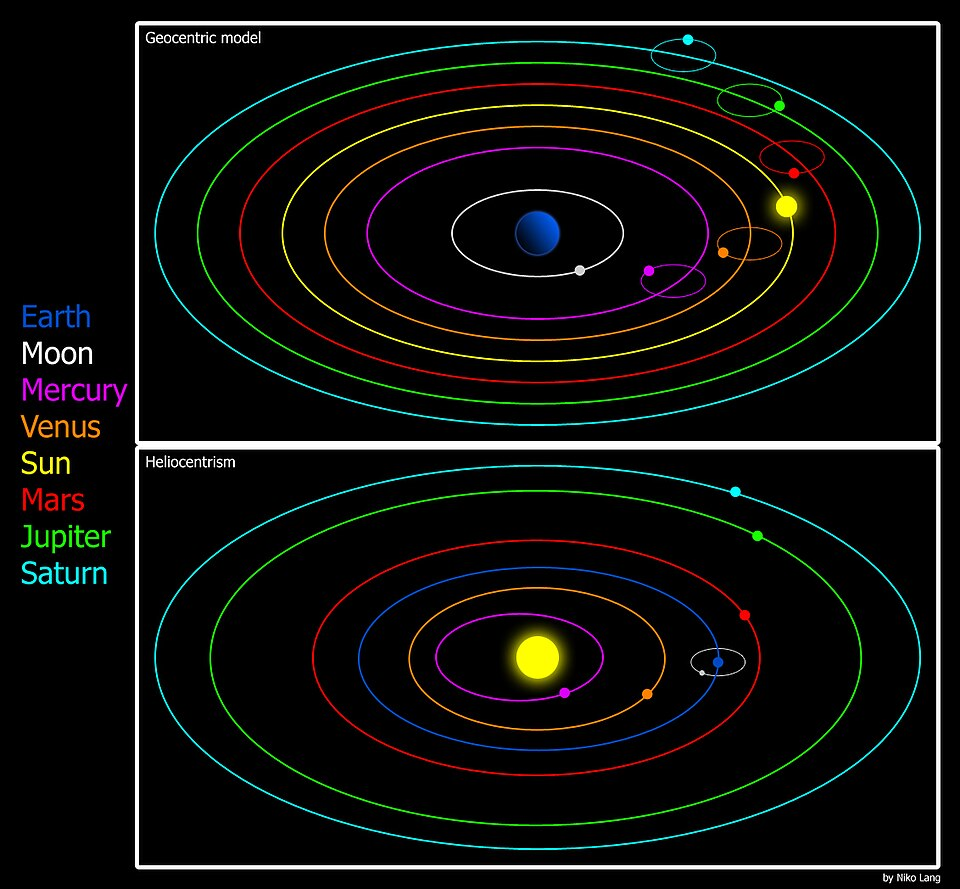
The heliocentric model according to Johannes Kepler and Galileo Galilei
- The Sun at the centre of the planetary system
- The Sun rotates on its own axis, recognisable from sunspots
- 6 planets (Mercury, Venus, Earth, Mars, Jupiter, Saturn) orbit the Sun
- The Moon orbits the Earth
- Mercury and Venus show phases
- Jupiter is orbited by moons
- Planetary orbits are ellipses
- The stars are at different distances
- The apparent motion of the stars comes from the rotation of the Earth
- Comets can cross the entire planetary system


Our model of the universe today
Today’s model of the universe is a heliocentric one.
- The Sun at the centre of the solar system
- The planets move on elliptical orbits around the Sun
- Gravity as the driving force behind the motion of the celestial bodies
- Celestial bodies such as stars, planets and comets are built from materials that we also find on Earth
- The Milky Way is one of billions of galaxies
- The universe came into being with the Big Bang
- Evolution as the cause of the origin and development of life on Earth
- The existence of black holes and dark matter
- The use of telescopes and space probes to explore the universe
- The development of modern physics with theories such as relativity and quantum mechanics.
What gaps does our model of the universe still have?
Although today’s model of the universe is very advanced and comprehensive in many areas, there are still gaps and open questions. Here are some examples:
- The existence of dark energy, which is responsible for the accelerated expansion of the universe, is not yet fully understood.
- The nature of dark matter, which exceeds the visible matter in the universe many times over, is unknown.
- Uniting quantum mechanics and relativity, which describe physics on very small (quantum mechanics) and very large (relativity) scales, has so far not fully succeeded.
- Although we know that extraterrestrial life could exist, we have not yet found any proof of it.
- The question of the origin of life on Earth and elsewhere in the universe is not yet fully settled.
- It is unclear how the so-called “arrow of time” arises in physics, that is, the fact that time runs in one particular direction
All in all there is still a great deal to discover and learn for future generations.
What influence do models of the universe have on society?
Models of the universe have a strong influence on society, because they form the basis for how we perceive the world and how we understand nature, society and ourselves. Here are some examples:
- Models of the universe shape how we look at nature and how we deal with it. For example, a model that regards nature as a resource can lead to the exploitation of nature, whereas a model that regards nature as a living being is more likely to lead to sustainable use and to the protection of nature.
- Models of the universe also shape how we see ourselves and how we position ourselves in society. For example, a model that regards human nature as selfish and competitive can lead to a mindset of competition, whereas a model that regards human nature as cooperative and solidary can lead to stronger cohesion in society.
- Models of the universe also shape our values and convictions. For example, a religious model can lead to certain moral values, whereas a secular model can lead to other moral values.
- Models of the universe also shape our political decisions. For example, models based on nationalism or on globalism can lead to different political goals and priorities.
All told, models of the universe therefore have a major influence on our outlook, our values and our decisions, and with that they can also influence society in various areas.
Frequently asked questions about models of the universe
What is the difference between the geocentric and the heliocentric model?
In the geocentric model the Earth stands at the centre, and the Sun, the Moon and the planets orbit it. In the heliocentric model the Sun stands at the centre, and the Earth is one of several planets orbiting it. The switch between the two ideas took place from the 16th into the 17th century.
Who developed the heliocentric model?
Nicolaus Copernicus proposed it in the 16th century. It was later confirmed and extended by Galileo Galilei and by Johannes Kepler, who described the planetary orbits as ellipses. In the 17th century Isaac Newton supplied the physical explanation behind it with his theory of gravity.
What is the Tychonic model?
An intermediate model by Tycho Brahe: the Earth stays motionless at the centre, the Sun orbits the Earth, and the remaining planets orbit the Sun. It explained the observational data without setting the Earth in motion – and was therefore easier for many contemporaries to accept than the model of Copernicus.
Which model is valid today?
A heliocentric one – but only with respect to our solar system. The Sun is one of many stars in one of countless galaxies, the universe began in the Big Bang and has been expanding ever since. The Sun therefore stands at the centre of our planetary system, not at the centre of the universe.
Why did the geocentric model last so long?
Because it fits what we see: from the Earth it really does look as if the sky were moving above us. On top of that, the Ptolemaic system predicted planetary positions usefully for centuries – a model is rarely given up as long as it works.
What does astronomy still not know today?
Quite a lot. Dark energy, which drives the accelerated expansion of the universe, is not understood. The same holds for the nature of dark matter. The question of life beyond the Earth is open too. Our model of the universe is therefore not finished – it is the current state of knowledge.
Want to buy your first telescope? Here is the quick check.