By Alexander Merz · Published on · Details checked on 30 September 2026
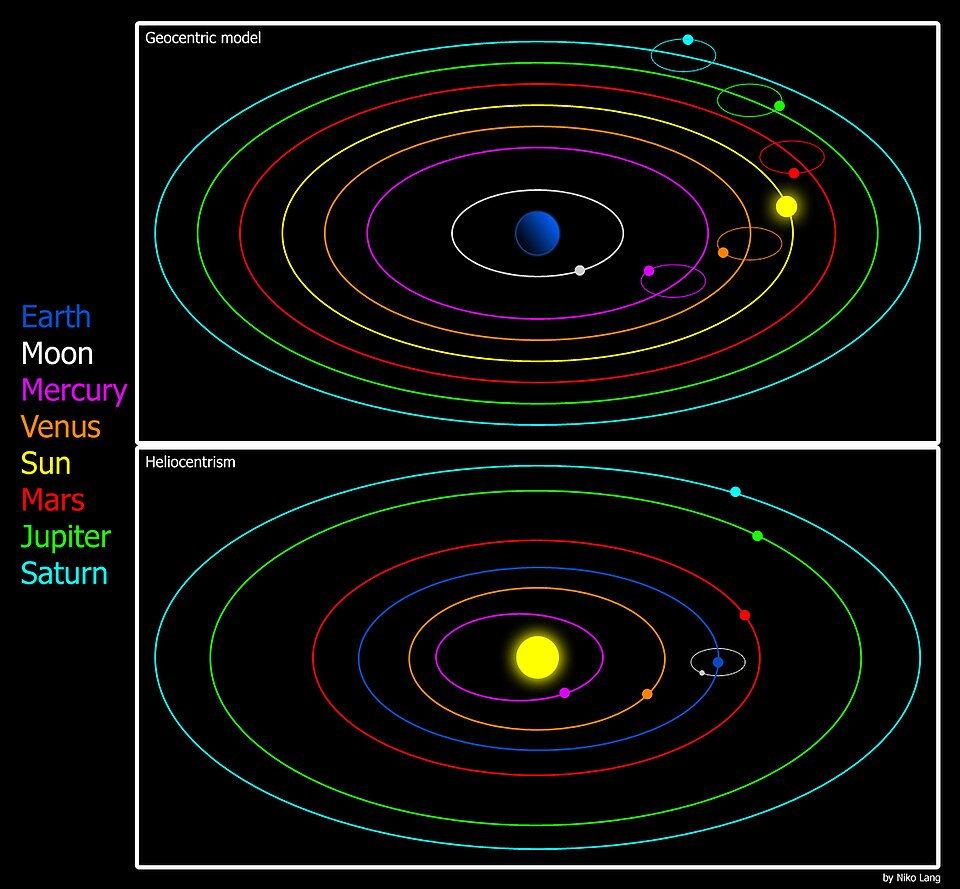
The heliocentric model is the picture of the universe in which the Sun sits at the center and Earth circles it as one of several planets. Earth travels around the Sun once a year and spins on its own axis once a day.
The heliocentric model explained simply
“Helios” is the Greek word for Sun. So heliocentric simply means: the Sun at the center. Mercury, Venus, Earth, Mars, Jupiter and Saturn travel around it, and the Moon circles Earth.
From the ground, it looks exactly the other way around. We can’t feel Earth moving, but every day we watch the Sun cross the sky. That’s why, for thousands of years, putting Earth in the middle seemed like the obvious choice.
The counterpart is called the geocentric model (“geo” = Earth). Both models are milestones in the history of how we picture the cosmos, from Babylon all the way to today’s view of the Milky Way.
Geocentric vs. heliocentric model compared
In the 16th century, both models could predict planetary positions about equally well. The difference wasn’t accuracy but simplicity – and what you had to assume about nature.
| Geocentric model | Heliocentric model | |
|---|---|---|
| Center | Earth, at rest | Sun |
| Earth | stands still | orbits the Sun in one year and spins on its axis daily |
| Day and night | the whole sky turns around Earth every day | Earth’s rotation |
| Planetary loops | recreated with extra circles (epicycles) | happen naturally when Earth overtakes an outer planet |
| Best-known supporters | Aristotle, Ptolemy (Almagest, around AD 150) | Aristarchus, Copernicus, Galileo, Kepler, Newton |
| Status | dominant until the 17th century | still holds for our solar system today |
The table shows the new model’s strongest point: the puzzling loops Mars traces across the sky no longer need extra circles. They’re an overtaking illusion, just like a slower car on the highway seems to drift backward as you pass it.
Supporters of the heliocentric model
| Who | When | Contribution |
|---|---|---|
| Aristarchus of Samos | around 280 BC | first known idea of a Sun at the center, found few followers |
| Nicolaus Copernicus | 1543 | “De revolutionibus orbium coelestium”: the fully worked-out model |
| Tycho Brahe | 1588 | hybrid model and the most precise measurements before the telescope |
| Johannes Kepler | 1609 and 1619 | elliptical orbits, Kepler’s three laws |
| Galileo Galilei | 1610 | Jupiter’s moons and the phases of Venus through the telescope |
| Isaac Newton | 1687 | law of gravitation: the physical explanation |
Aristarchus of Samos
Some 400 years before Ptolemy, the Greek astronomer Aristarchus suggested that Earth and the planets orbit the Sun. His idea found few followers in antiquity and faded into the background for almost 1,800 years.
Nicolaus Copernicus and the Copernican model
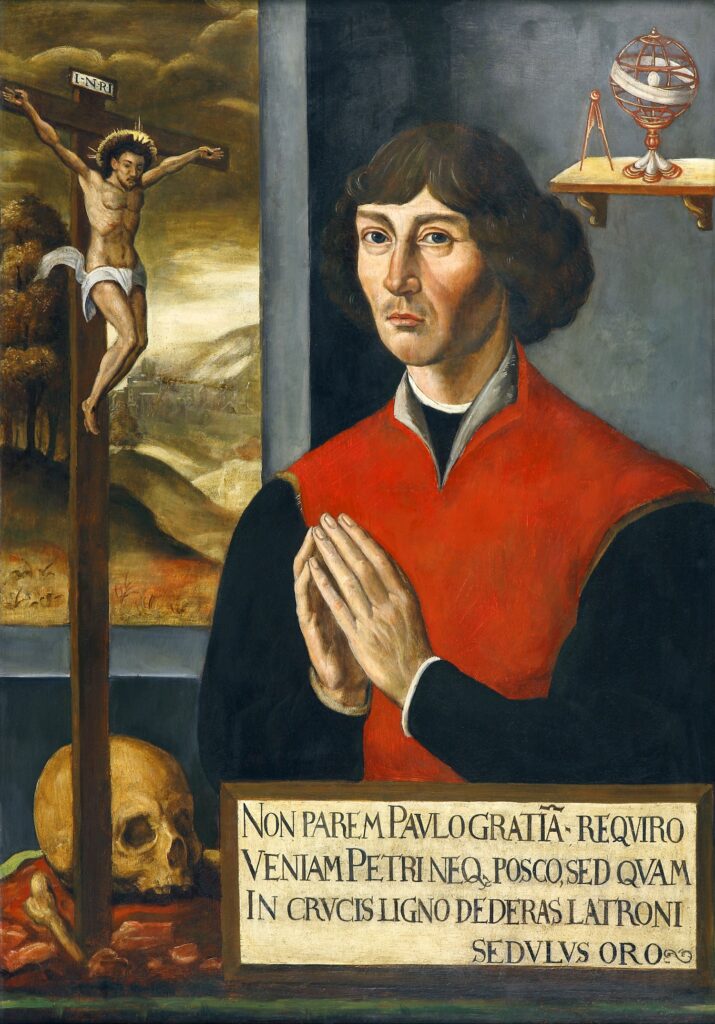
Nicolaus Copernicus (1473–1543) sketched his idea in a short manuscript as early as around 1510. His major work, “De revolutionibus orbium coelestium,” wasn’t published until 1543, shortly before his death. He had spent about three decades on the calculations.
The Copernican model is the original version of the heliocentric model. The Sun sits in the middle, the planets move on circular orbits, and an outer sphere of fixed stars closes off the universe.
Copernicus held on to circular orbits because the circle had been considered the perfect shape since Aristotle. That meant he needed small extra circles again, too – otherwise his predictions wouldn’t match the observations.
Tycho Brahe: the compromise
In 1588, the Danish astronomer Tycho Brahe had the planets orbit the Sun – but the Sun still orbit a motionless Earth. Geometrically this was equivalent, and it sidestepped the question of why we can’t feel Earth moving. His real legacy is his series of measurements, which Kepler later used for his calculations.
Johannes Kepler
Johannes Kepler (1571–1630) spent years crunching Tycho’s data on Mars. In 1609 he showed that the planets move on ellipses, with the Sun at one focus. The extra circles disappeared, and predictions suddenly became far more accurate.
His second law says that a planet moves faster when it’s closer to the Sun. The third (1619) links orbital period and orbit size: if you know how long a planet takes to go around, you can work out its distance from the Sun.
Galileo Galilei
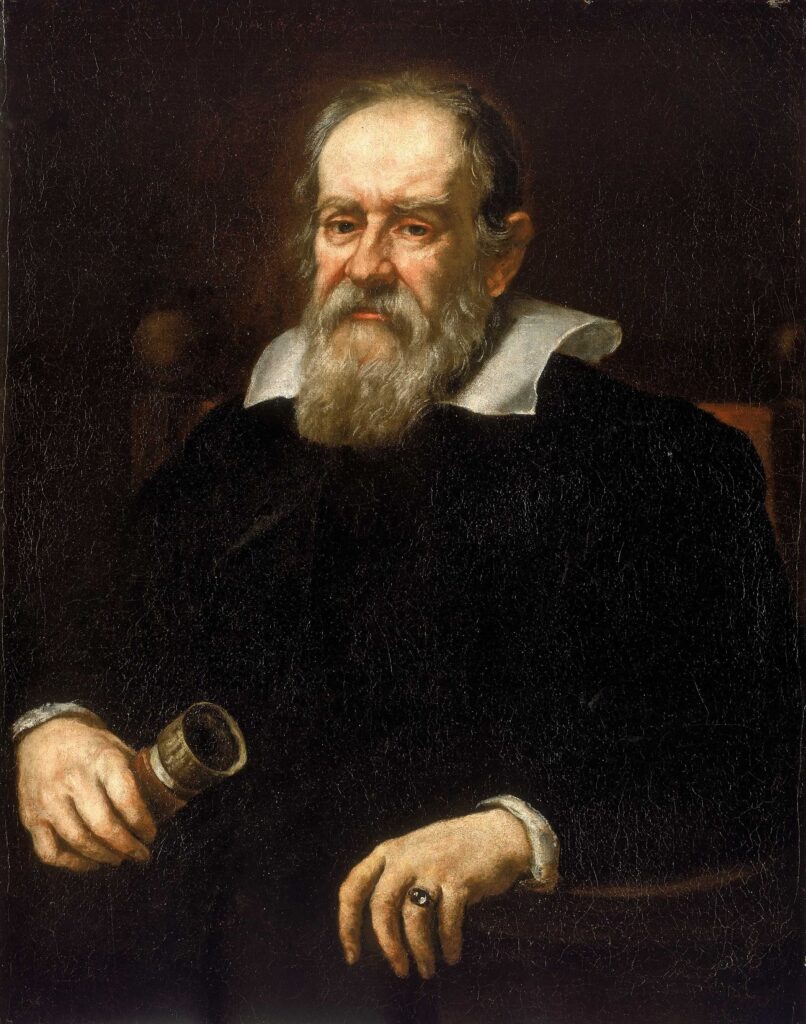
In 1609, Galileo Galilei (1564–1642) was one of the first people to point a telescope at the sky. In January 1610 he discovered four moons orbiting Jupiter – so not everything circles Earth. In late 1610 he saw that Venus shows phases just like the Moon.
The full sequence of Venus phases could not be reconciled with Ptolemy’s model. Tycho’s model explained it too, though, so it wasn’t final proof yet.
Isaac Newton
Isaac Newton (1643–1727) supplied the physics in 1687. His law of gravitation explains why planets have to move on Kepler’s ellipses. From then on, the heliocentric model was no longer just a calculating aid but a law of nature.
Why the heliocentric model was rejected for so long
People often say the Church alone held back the new model. In reality, its opponents also had solid scientific objections. Three of them carried real weight:
- No stellar parallax: If Earth orbits the Sun, nearby stars should shift back and forth slightly over the year. Nobody saw it, because the stars are much farther away than anyone thought.
- No motion you can feel: According to Aristotle’s physics, a racing Earth should have left clouds, birds and falling stones behind.
- No better predictions: Until Kepler, the new model wasn’t more accurate than the old one.
Knowing this makes it easier to understand people at the time. The switch required distrusting what your own eyes told you – and without solid proof.
When was the heliocentric model accepted?
Among astronomers it won out after Kepler and Newton, so over the course of the 17th century. The direct proof of Earth’s motion came even later.
| Year | Evidence | What it shows |
|---|---|---|
| 1609/1619 | Kepler’s laws | ellipses around the Sun describe every planet exactly |
| 1610 | Jupiter’s moons, phases of Venus (Galileo) | not everything circles Earth |
| 1687 | Newton’s law of gravitation | the physical reason for the orbits |
| 1728 | aberration of light (James Bradley) | first direct evidence that Earth is moving |
| 1838 | stellar parallax of 61 Cygni (Friedrich Wilhelm Bessel) | the long-missing proof, and the first measured distance to a star |
| 1851 | Foucault pendulum | shows Earth spinning on its axis |
You can find the star 61 Cygni in the constellation Cygnus. Its shift is only about 0.3 arcseconds – about the size of a dime seen from more than 6 miles (10 km) away.
The heliocentric model and the Church
Copernicus’s book appeared in 1543 without much resistance at first. In 1616 the Church placed it on the Index of forbidden books “until corrected”, because the idea of a moving Earth contradicted how the Bible was interpreted at the time.
Galileo defended the model in 1632 in his “Dialogue.” In 1633 the Inquisition convicted him and forced him to recant, and he lived under house arrest until his death in 1642.
Giordano Bruno was burned at the stake in Rome in 1600. He was charged mainly for his theological teachings, not primarily for putting the Sun at the center.
| Year | The Church’s step |
|---|---|
| 1616 | “De revolutionibus” placed on the Index until corrected |
| 1633 | trial of Galileo |
| 1757 | Pope Benedict XIV lifts the general ban on heliocentric books |
| 1822 | permission to print works teaching Earth’s motion |
| 1835 | Copernicus and Galileo removed from the Index |
| 1992 | Pope John Paul II acknowledges the wrong done to Galileo |
Is the heliocentric model still correct today?
For our solar system, yes. Strictly speaking, the Sun and planets orbit their common center of mass, which – because of Jupiter – sometimes lies just inside and sometimes just outside the Sun.
But the Sun isn’t the center of the universe. It orbits the center of the Milky Way itself, and one lap takes about 230 million years. According to what we know today, the universe has no center at all.
Frequently asked questions
What does the heliocentric model say?
The Sun sits at the center, and Earth is one of several planets orbiting it. In the geocentric model, by contrast, Earth stood still in the middle.
Who came up with the heliocentric model?
The idea goes back to Aristarchus of Samos (around 280 BC). Nicolaus Copernicus worked it out in 1543, and Kepler, Galileo and Newton made it stick.
What’s the difference between the geocentric and heliocentric model?
Geocentric means Earth rests at the center and everything circles it. Heliocentric means the Sun is the center, and Earth moves around it while spinning on its axis.
What is the Copernican model?
That’s the name for Nicolaus Copernicus’s 1543 version of the heliocentric model. It still used circular orbits and an outer sphere of fixed stars.
When was the heliocentric model accepted?
Among astronomers in the 17th century, after Kepler (1609) and Newton (1687). Earth’s motion was directly proven in 1728 and 1838. The Church took Copernicus off the Index in 1835.
Why was the heliocentric model rejected?
It contradicted everyday experience, Aristotle’s physics and the biblical interpretation of the time. On top of that, stellar parallax – the proof – was missing for a long time.
Is the heliocentric model still valid today?
At its core, yes, for our solar system. But the Sun isn’t the center of the universe – it orbits the center of the Milky Way.