By Alexander Merz · Published on · Details checked on 6 November 2026
The exit pupil is the diameter of the beam of light that leaves the eyepiece of a telescope or binocular and enters your eye. You calculate it as aperture divided by magnification, so 5 mm for a 10×50 binocular.
It helps decide which eyepiece suits your telescope – and how bright the image arrives in your eye.
⭐ In short: Everything that makes sense in the night sky lies between 7 mm and 0.5 mm. Large exit pupils (4–7 mm) for the Milky Way and nebulae, medium ones (2–3 mm) for galaxies and star clusters, small ones (0.5–1 mm) for the Moon, planets and double stars. Above 7 mm you waste light – from around age 50, already above 5 mm.
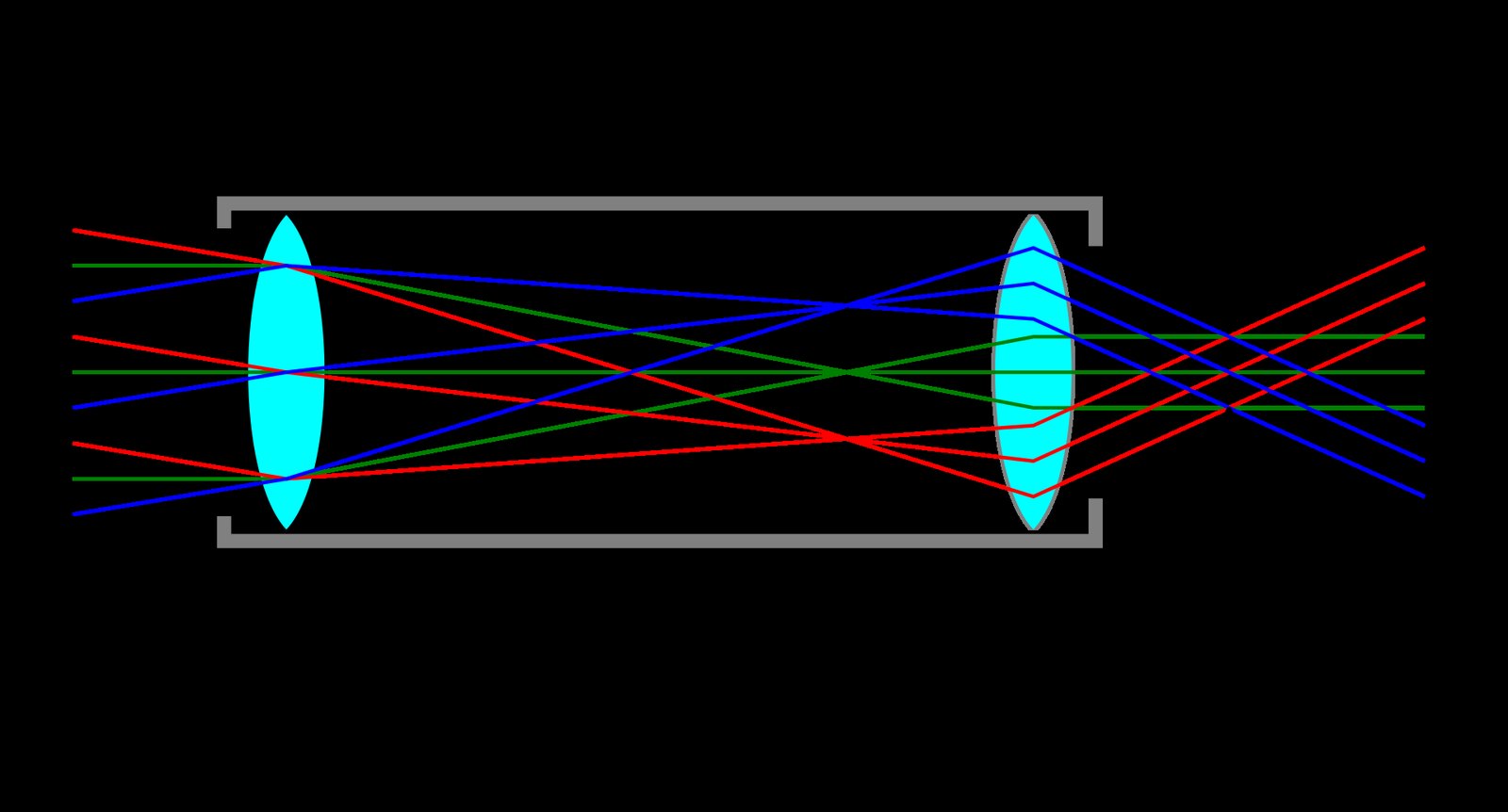

How to calculate the exit pupil: two formulas, one result
On a binocular, everything you need is printed on the body. Divide the second number by the first: 10×50 gives 5 mm, 7×50 gives 7.1 mm, 15×70 gives 4.7 mm.
For a telescope there is a quicker route than going via the magnification. Exit pupil = eyepiece focal length ÷ focal ratio. A 25 mm eyepiece on an f/5 telescope therefore delivers 5 mm – no matter how large the telescope is.
650 mm ÷ 25 mm
= 26×
130 mm aperture ÷ 26
= 5.0 mm
25 mm ÷ f/5
= 5.0 mm
The focal ratio is listed on every spec sheet, for example “f/5” or “1:5”. If it is missing, divide the focal length by the aperture: 650 mm ÷ 130 mm = 5. Our telescope calculator works out all the key figures at once.
Exit pupil and the eye: why 7 mm is the limit
Your eye’s pupil acts like a stop behind the eyepiece. If the beam of light is wider than your pupil, the edge simply misses it. The image does not get brighter; you only use part of the telescope’s aperture.
A dark-adapted pupil opens to about 7 mm in young people, but often only to 5 mm at 50 (our binocular table). For 60-year-olds the Astroshop magazine gives 4–5 mm (Astroshop, exit pupil – in German). The values vary a lot from person to person.
| Age | Pupil in the dark (guide value) | Largest useful exitpupil |
|---|---|---|
| up to about 30 | around 7 mm | 7 mm |
| around 50 | often around 5 mm | 5–6 mm |
| around 60 | 4–5 mm | 5 mm |
An exit pupil that is too large does no harm, it just wastes aperture. In a German-language astronomy forum, owners of 8×56 binoculars even describe an advantage: the image stays in the eye longer when the binocular shakes, and it is easier to hand around (forum.astronomie.de, 22 Aug 2023, in German).
⚠️ The black spot in a Newtonian: With a large exit pupil you often see a dark spot in the centre of the field on bright objects. It is the shadow of the secondary mirror, visible as soon as your pupil contracts in bright light – not a defect (forum.astronomie.de, March 2025, in German). The fix: use more magnification or observe in the dark.
Which exit pupil for which object?
Every celestial object has a range in which it looks its best. Faint, extended nebulae need a lot of light per area of retina, fine planetary detail needs magnification. The exit pupil sums up both in one number.
| Exitpupil | Used for | What you see |
|---|---|---|
| 5–7 mm | Milky Way fields, large nebulae, finding objects | widest field, brightest background |
| 2–4 mm | ⭐ The all-rounderGalaxies, open star clusters, most deep-sky objects | darker sky, the object stands out better |
| 1–2 mm | Globular clusters, small planetary nebulae | clusters resolve into individual stars |
| 0.5–1 mm | Moon, planets, close double stars | finest detail, the image gets darker |
Going below 0.5 mm is almost never worth it. That corresponds exactly to the rule of thumb “maximum useful magnification = 2 × aperture in mm”: a 130 mm telescope at 260× gives 0.5 mm. Beyond that the image just gets bigger and darker, not sharper.
Tip from the forum: Whether 1.0 or 0.7 mm is the “right” lower limit has been argued by experienced observers for years (forum.astronomie.de, in German). What decides it is the seeing on the night: in turbulent air stay above 1 mm, on steady nights you can go lower.
Choosing eyepieces by exit pupil
With the shortcut “eyepiece focal length ÷ focal ratio” you can plan a set of eyepieces in two minutes. For a target exit pupil, simply multiply the other way round: exit pupil × focal ratio = eyepiece focal length.
| Eyepiece | Heritage 130/650 (f/5) | Dobsonian 200/1200 (f/6) |
|---|---|---|
| 32 mm | 20× · 6.4 mm | 38× · 5.3 mm |
| 25 mm | 26× · 5.0 mm | 48× · 4.2 mm |
| 15 mm | 43× · 3.0 mm | 80× · 2.5 mm |
| 10 mm | 65× · 2.0 mm | 120× · 1.7 mm |
| 6 mm | 108× · 1.2 mm | 200× · 1.0 mm |
| 4 mm | 163× · 0.8 mm | 300× · 0.7 mm |
A sensible beginner’s set covers three ranges: a large exit pupil for finding objects, a medium one for deep sky and a small one for the Moon and planets. On an f/5 telescope that means roughly 25, 10 and 5 mm eyepiece focal length.
Matching eyepiece set: Omegon Eyepiece Starter Kit
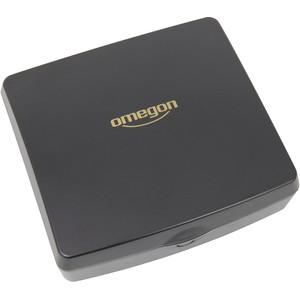
Several focal lengths in one case – on a typical beginner telescope this covers large, medium and small exit pupils without buying eyepieces one by one.
Price: € 89
Eyepieces longer than a 7 mm exit pupil bring nothing. On an f/5 telescope the limit is 35 mm, on an f/6 telescope 42 mm. A 40 mm eyepiece such as the Orion 40 mm Sirius Plossl 1.25" EyepieceOmegon Super Plössl 40 mm Eyepiece therefore suits f/6 and slower better than an f/4 Newtonian, where it would deliver 10 mm.
Exit pupil in binoculars
For the night sky, 4 to 7 mm is ideal. A 10×50 (5 mm) suits almost every age, a 7×50 (7.1 mm) is worthwhile mainly for young eyes under a dark sky.
Relative brightness is the exit pupil squared. A 10×50 reaches 25, a 10×25 only 6.25 – that is why a pocket binocular looks so dark at night. Which sizes exist is shown in our binocular magnification guide with table.
Astronomy binocular: Omegon Nightstar 15x70 Binoculars
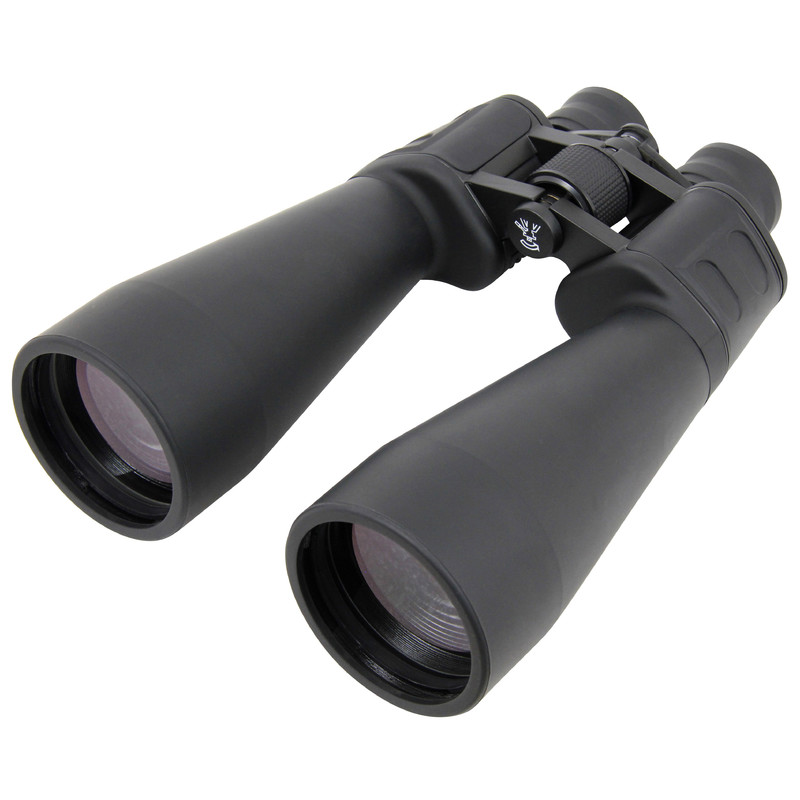
70 mm aperture at 15× gives a 4.7 mm exit pupil – suits almost every eye and gathers twice as much light as a 50 mm binocular. Best braced or on a tripod.
Price: € 119
Tip: Hold the binocular, or the telescope with eyepiece, towards the bright daytime sky and look at the eyepiece from about 30 cm away. The bright little disc in it is the exit pupil – you can roughly measure it with a ruler. If it is square-edged rather than round, undersized prisms are clipping the light.
Exit pupil, eye relief, entrance pupil: what is what
The exit pupil is a diameter, eye relief is a distance. Eye relief tells you how far behind the eyepiece your eye can be and still see the whole field – for eyeglass wearers the more important number.
The entrance pupil is the counterpart on the sky side: on a telescope it is practically the clear aperture of the objective lens or primary mirror. The exit pupil is its reduced image behind the eyepiece (Wikipedia, Pupille (Optik), in German).
| Term | What it is | Matters for |
|---|---|---|
| Exit pupil | Diameter of the light beam behind the eyepiece | Brightness, choice of eyepiece |
| Eye relief | Distance from eyepiece to eye for the full field | Eyeglass wearers, comfort |
| Entrance pupil | Clear aperture at the front of the instrument | Light-gathering power |
FAQ about the exit pupil
How do you calculate the exit pupil?
Aperture divided by magnification; for a telescope, alternatively eyepiece focal length divided by focal ratio. A 10×50 binocular has 5 mm, and a 25 mm eyepiece on an f/5 telescope also gives 5 mm.
Is a larger exit pupil always better?
No. Up to the size of your eye’s pupil, extended objects get brighter; beyond that, light goes past your eye. For planets you need small exit pupils, that is high magnification, anyway.
What is the smallest useful exit pupil?
About 0.5 mm, which corresponds to a magnification of twice the aperture in millimetres. In practice many observers stay at 0.7–1 mm, because below that the image gets dark and soft.
Which exit pupil matters for eyeglass wearers?
For eyeglass wearers, eye relief matters more than the exit pupil. With glasses, your eye stays further away from the eyepiece; we recommend at least 16 mm, better 18 mm of eye relief. More in our guide to binoculars for eyeglass wearers.
Why is the image blotchy with a large exit pupil?
In reflectors with a secondary mirror, its shadow becomes visible when the exit pupil is larger than your eye’s pupil, which has just contracted. This happens mainly on the bright Moon or in daylight and disappears at higher magnification.
Read more: Eyepiece guide · Telescope calculator · Binocular magnification
Links marked with an asterisk (*) are affiliate links. If you buy through them, we receive a small commission – the price stays the same for you.