By Alexander Merz · Updated on
Binoculars for eyeglass wearers are binoculars with long eye relief – at least 16, ideally 18 mm – and eyecups that fold or twist down, so you can see the complete field of view with your glasses on.
For an overview of binoculars for the night sky, see Astronomy Binoculars.
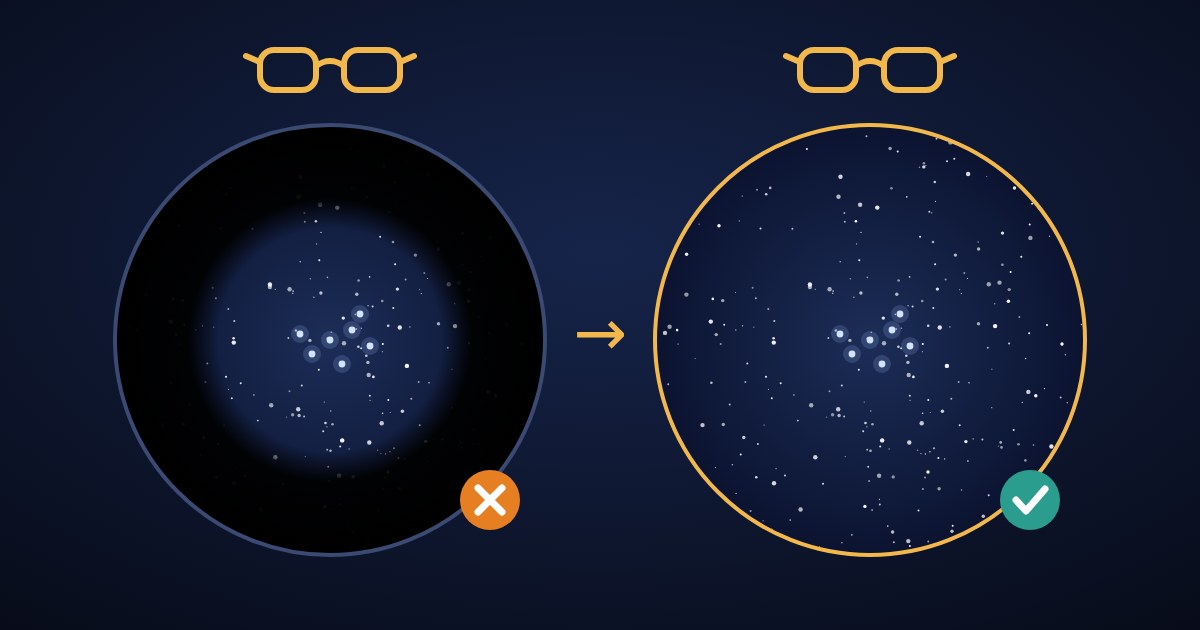
Eye relief: the key number for eyeglass wearers
Eye relief is the distance between the last eyepiece lens and the point where your eye sees the whole image. Without glasses you simply rest your eye against the eyecup, and a few millimetres are enough.
With glasses, the lens sits roughly 12 to 14 mm in front of your eye, and you cannot get any closer to the eyepiece. If the eye relief is shorter, you lose the edge of the field – it is like looking through a keyhole.
| Eye relief | With glasses | Suits |
|---|---|---|
| under 14 mm | field clearly cut off | only without glasses |
| 14–15 mm | tight, edge often missing | flat, thin lenses |
| 16–17 mm | full field with most glasses | most eyeglass wearers |
| 18 mm and more | comfortable, even with thick lenses | strong prescriptions, long nights |
Stated versus usable eye relief
The spec-sheet value is usually measured from the lens surface. If the lens sits deep inside the housing, you get less of it, because the eyepiece rim keeps your glasses at a distance.
Two binoculars with the same stated value can therefore feel different. Treat the figure as a minimum, not a guarantee – and allow a millimetre of reserve.
Too much eye relief without glasses
Very long eye relief above 20 mm has a catch for anyone observing without glasses: your eye finds the right position less easily, and the image blacks out with small head movements. Fully extended eyecups help.
Eyecups: fold down, twist in, pull out
The eyecup sets the right distance for observers without glasses. For eyeglass wearers it must get completely out of the way, otherwise you waste eye relief.
- Fold-down rubber eyecups: typical of affordable porro binoculars such as the Omegon Brightsky or Nightstar. They work, but are fiddlier to fold in the dark.
- Twist-up eyecups: click into steps and stay in position. Twist fully in with glasses, fully out without.
- Pull-out eyecups: simply slide out or in – quick, but without fixed intermediate positions.
Glasses on or off? Short sight, long sight and astigmatism
Binoculars compensate for short and long sight themselves: the focus wheel simply brings the image into focus for your eye. If your eyes differ, you correct that with the dioptre adjustment, usually a ring on the right eyepiece with about ±3 to ±4 dioptres.
Without glasses you see the whole field, however short the eye relief. In return you keep taking your glasses off and on at night to read a star chart, your phone or the path.
| Vision | Take glasses off? | Why |
|---|---|---|
| Short-sighted | yes, usually no problem | the focus wheel compensates |
| Long-sighted | yes, usually | with very strong long sight the focus travel may run out |
| Reading glasses only | yes | in the sky you look into the distance |
| Different eyes | yes | dioptre adjustment on the eyepiece |
| Mild astigmatism | usually yes | barely visible below about 1 dioptre |
| Stronger astigmatism | no | from about 1 to 1.5 dioptres stars turn into lines |
Astigmatism under the night sky
No focus wheel can correct astigmatism – only glasses or a contact lens can. Under the stars it is more noticeable than in daylight, because stars are points and show any distortion at once.
Add to that the wide pupil at night: the larger the beam of light leaving the eyepiece, the stronger the effect of astigmatism. A 7×50 with a 7 mm exit pupil shows it more clearly than a 15×70 with 4.7 mm.
Varifocals and binoculars
With varifocal glasses you look into the eyepiece through the upper distance zone. It is often easier to take them off if you only have age-related long sight – you focus the binoculars on the distance anyway.
Setting up binoculars with glasses: step by step
Once set up properly, you only need to turn the focus wheel later. Practise in daylight on a distant rooftop and fine-tune at night on a bright star.
- Fold or twist the eyecups fully in.
- Rest your spectacle lenses gently against the eyepiece rims – as close as possible without pressing.
- Set the interpupillary distance: bend the two halves at the hinge until you see a single round image.
- Close your right eye and focus for the left eye with the central wheel.
- Close your left eye and focus with the dioptre ring on the right eyepiece. With glasses it usually sits close to zero.
- Open both eyes and note the position of the dioptre ring, for example with a small dot of paint.
Field of view: what you lose with glasses
If the eye relief is not enough, a whole ring of the field is missing. Under the night sky that is especially annoying, because you want to see large objects such as the Pleiades or the Andromeda Galaxy with some sky around them.
Wide-angle binoculars with a very large field often have shorter eye relief. For eyeglass wearers a slightly smaller field that you see completely is better than a huge field of which you only see the centre.
Glasses at night: four practical tips
- ✅ Avoid fogging: breathe out downwards and carry an anti-fog cloth – cold spectacle lenses fog up with the first breath.
- ✅ Keep the eyepieces dry: they can get damp too when you lean in close. Turn them away briefly, don’t wipe them with your sleeve.
- ✅ Red light instead of white: use a red torch to put on your glasses and read charts, so your eyes stay dark-adapted.
- ✅ Brace yourself: with glasses you hold the binoculars a little further away. Rest your elbows on a wall or chair back to reduce shaking.
Binoculars for eyeglass wearers compared
We have not tested these binoculars ourselves. We looked up the eye relief of every model in Astroshop’s spec sheet – the assessment is based on these figures and on reports from astronomy forums.
| Model | Eye relief | Eyecups | Exit pupil | Price | Assessment |
|---|---|---|---|---|---|
| Omegon Brightsky 7×50 | 23 mm | fold-down | 7 mm | about $279€ 279 | Milky Way and wide fields, even for thick lenses – a little fiddly without glasses |
| Celestron SkyMaster Pro ED 7x50 BinocularsOmegon Brightsky 10x50 Binoculars | 18,5 mm | fold-down | 5 mm | $219.95€ 289 | very comfortable with glasses, sharp to the edge ● Currently unavailable (Product can be shipped as of 15.11.2026) |
| Celestron SkyMaster Pro ED 7x50 BinocularsOmegon Hunter 2.0 10x50 ED Binoculars | 18,1 mm | twist-up | 5,1 mm | $219.95€ 359 | roof prism with ED glass, twist-up eyecups, tripod thread |
| Nikon Action 10×50 CF | 17,3 mm | twist-up | 5 mm | about $149€ 149 | ⭐ Our recommendationrobust porro classic, twist-up eyecups, tripod thread |
| Celestron 15 x 70 SkyMaster Pro Waterproof BinocularsOmegon Nightstar 15x70 Binoculars | 18 mm | fold-down | 4,7 mm | $279.95€ 119 | more light for star clusters and nebulae, best on a tripod |
| Celestron 15 x 70 SkyMaster Pro Waterproof BinocularsOmegon Nightstar 20x80 Binoculars | 18 mm | fold-down | 4 mm | $279.95€ 149 | maximum aperture, only makes sense on a tripod |
| Omegon Hunter 2.0 8×56 ED | 22,5 mm | twist-up | 6,9 mm | about $289€ 289 | dusk, wildlife and the starry sky with a large exit pupil |
| Omegon Hunter 2.0 8×42 ED | 18,4 mm | twist-up | 5,2 mm | about $269€ 269 | light nature binocular, also usable for the sky |
| Nikon Monarch M5 8×42 | 19 mm | twist-up | 5,25 mm | about $332€ 332 | very long eye relief, popular with birdwatchers |
| ZEISS Conquest HDX 8×56 | 18 mm | twist-up | 7 mm | about $1,440€ 1,440 | premium for dusk and night |
Links marked with an asterisk are affiliate links.
Our recommendation for eyeglass wearers: Nikon Action 10x50 CF Binoculars
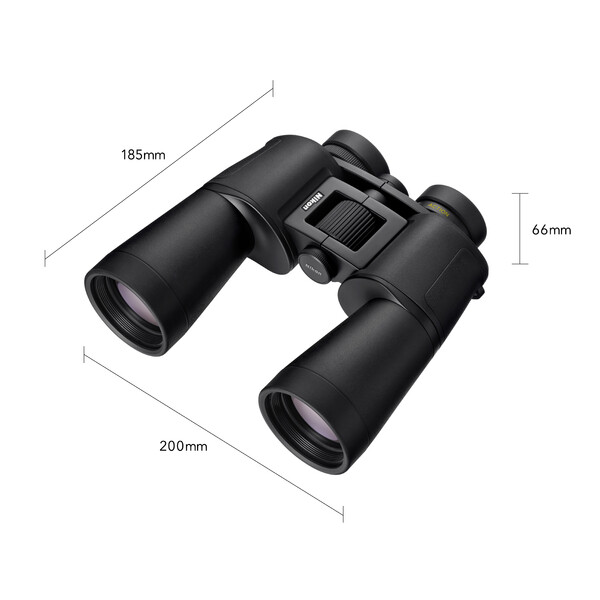
17.3 mm eye relief, twist-up eyecups and a 5 mm exit pupil: with most glasses you see the full field, and in the sky this 10×50 shows star clusters, lunar craters and Jupiter’s moons. To be honest: with very thick lenses, models with 18 mm or more are more comfortable.
Price: € 149
Too tight for glasses: good binoculars with short eye relief
Some popular, affordable binoculars are optically good but too tight for eyeglass wearers. They are only worth it if you can take your glasses off.
| Model | Eye relief | Note |
|---|---|---|
| Celestron 7x50 Cometron BinocularsCelestron UpClose G2 10x50 Porro Binoculars | 12 mm | budget entry – clearly cut off with glasses |
| Celestron 7x50 Cometron BinocularsCelestron Cometron 7x50 Binoculars | 13 mm | bright 7×50 – ideal without glasses, tight with them |
| Canon 10×30 IS II | 14,5 mm | image-stabilised – only with thin lenses |
| Canon 12×36 IS III | 14,5 mm | image-stabilised – only with thin lenses |
For nature and the night sky: 8×42 and 8×56
Looking for binoculars for birds and hiking that also work at night? Then an 8×42 or 8×56 with twist-up eyecups is the best compromise. Which magnification suits what is shown in our binocular magnification table.
For nature and night: Omegon Hunter 2.0 8x56 ED
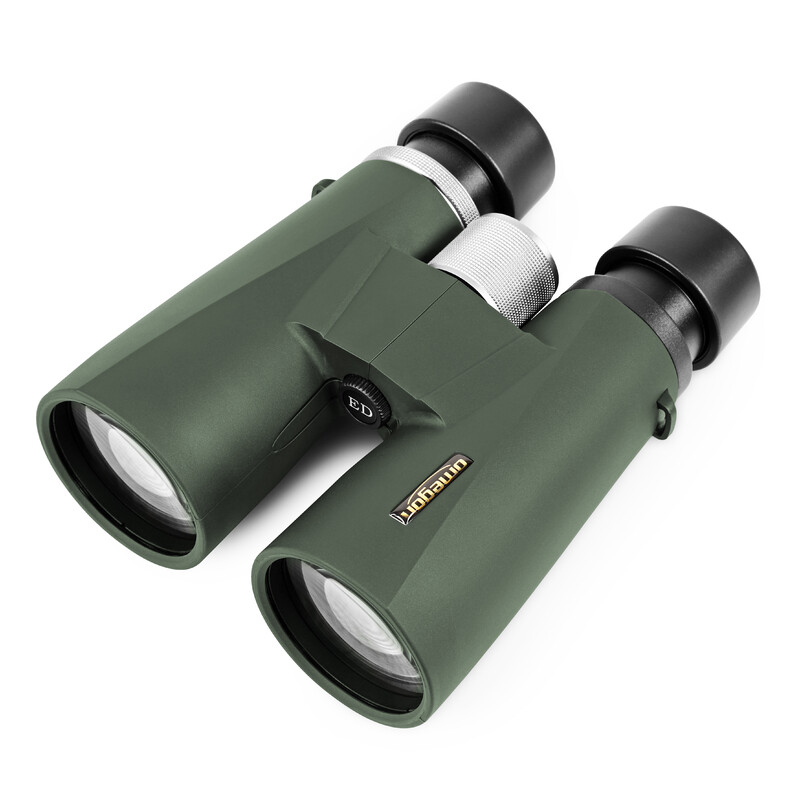
22.5 mm eye relief, twist-up eyecups and an exit pupil of almost 7 mm: bright at dusk, comfortable with glasses and a good wide-field binocular under the stars. At 8x, however, it shows less detail on the Moon and Jupiter than a 10×50.
Price: € 289
Buying binoculars for eyeglass wearers: checklist
- Eye relief of at least 16 mm, ideally 18 mm – check the spec sheet, don’t rely on “suitable for glasses”.
- Eyecups that fold or twist fully in.
- Dioptre adjustment for eyes that differ, usually on the right eyepiece.
- Exit pupil of 5 to 7 mm for the night sky.
- Interpupillary distance: with a narrow face, check that the binoculars fold close enough.
- Try them with your own glasses if at all possible – or use the right of return.
For advanced observers: the telescope as the next step
At the telescope, glasses are often less of an issue: you look with one eye and focus it yourself, so with short or long sight usually without glasses. In return it shows far more of the Moon, Jupiter and Saturn than any binocular.
For advanced observers: Skywatcher Dobson Telescope N 130/650 Heritage FlexTube
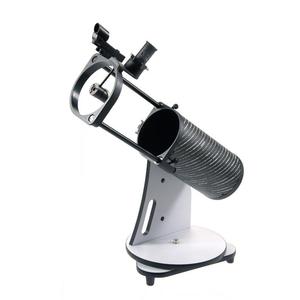
130 mm aperture on a stable tabletop Dobsonian mount – more light than any binocular and enough magnification for Saturn’s rings and Jupiter’s belts. Needs a table or stool as a base.
Price: € 265
Frequently asked questions about binoculars for eyeglass wearers
Which binoculars are suitable for eyeglass wearers?
Any binocular with at least 16, ideally 18 mm of eye relief and eyecups that fold or twist down. For the night sky a 10×50 with 17 to 18 mm is a good all-rounder, such as the Nikon Action 10×50 CF.
Can you use binoculars with glasses?
Yes, if the eye relief is long enough. Fold in the eyecups and rest your lenses gently against the eyepieces – then you see the full field.
How do I set up binoculars correctly for glasses?
Fold in the eyecups, adjust the interpupillary distance at the hinge, then focus with the central wheel for the left eye and with the dioptre ring for the right eye. With glasses the dioptre ring usually sits close to zero.
Should I take my glasses off for stargazing?
With short or long sight you can, because the focus wheel compensates. With astigmatism from about 1 to 1.5 dioptres it is better to keep them on, otherwise stars turn into lines.
What does “eyeglass-friendly eyepieces” mean?
The term is not protected. What matters is the eye relief in millimetres – if it is not in the spec sheet, ask the dealer.
Is there a test winner for eyeglass wearers?
We don’t know of a serious test winner specifically for eyeglass wearers. Our overview of astronomy binoculars shows which models are worth it under the night sky.
Links marked with an asterisk (*) are affiliate links. If you buy through them, we receive a small commission – the price stays the same for you.