By Alexander Merz · Published on · Details checked on 9 November 2026
A Cassegrain telescope is a reflecting telescope with two mirrors: a concave primary mirror with a central hole collects the light, and a small convex secondary mirror sends it back through that hole to the eyepiece. This fits a long focal length into a short tube.
More in our overview: Observatories in Germany.
How a Cassegrain works
Light travels down the tube and back again. The primary mirror at the rear focuses it forward, and the secondary mirror, placed just before that focus, intercepts it and sends it back. The image forms behind the primary mirror, where the eyepiece or camera sits.
The convex secondary mirror multiplies the focal length three to five times. A primary mirror with a 40 cm (16-inch) focal length becomes a 2 m (80-inch) system. The NexStar 8SE has 203 mm (8-inch) aperture and 2,032 mm focal length, yet its tube is only just over 40 cm (16 inches) long.
In the classical Cassegrain, the primary mirror is parabolic and the secondary is hyperbolic. The focus of the primary coincides with one focus of the hyperbola; the other lies behind the primary mirror. That is where the image forms.
Compared with the older designs: the Newtonian telescope sends the light to the side with a flat secondary mirror, the Gregorian telescope sends it back with a concave elliptical mirror. The Gregorian needs a longer tube for this, because its secondary sits beyond the focus. The Cassegrain secondary sits in front of it, and that makes it shorter.
History: Laurent Cassegrain, 1672
In 1672 the description of the telescope appeared in the Paris scholarly journal “Journal des Sçavans”. Its author was named as a “Sieur Cassegrain”. For a long time it was unclear who that even was; today Laurent Cassegrain, a Catholic priest and teacher from the Chartres area, is considered the man meant.
Whether he also invented the design is disputed to this day. Marin Mersenne had already described similar two-mirror designs in 1636, the Gregorian telescope had been published since 1663, and Newton had built his reflecting telescope in 1668. Newton publicly criticized the Cassegrain design in 1672 as inferior to his own.
A usable Cassegrain was not built until much later. In the 17th century, curved mirrors could not be ground accurately enough. Today, however, the design is the basis of almost all large research telescopes.
The Cassegrain variants
Today “Cassegrain” stands for a whole family. All variants fold the light with a secondary mirror back through the primary mirror. They differ in how they correct the aberrations of the simple form.
| Design | Primary / secondary mirror | Special feature | Typical for |
|---|---|---|---|
| Classical Cassegrain | parabolic / hyperbolic | sharp in the center, coma at the edge | older observatories, radio antennas |
| Schmidt-Cassegrain | spherical / hyperbolic | thin corrector plate at the front, usually f/10 | amateurs: Celestron NexStar SE |
| Maksutov-Cassegrain | spherical / aluminized spot | thick meniscus lens at the front, f/12 to f/15 | Moon and planets, travel scopes |
| Ritchey-Chrétien | hyperbolic / hyperbolic | free of coma, large sharp field | Hubble, VLT, Keck, astrophotography |
| Dall-Kirkham | elliptical / spherical | easy to make, coma off-center | planets, telescope making |
For amateur astronomers, Schmidt- and Maksutov-Cassegrains are what matter. Both use a spherical primary mirror that is cheap to make and cancel its errors with a lens at the aperture. The difference lies in the correction: a thin aspheric plate versus a thick meniscus lens.
The closed tube keeps out dust and air currents. Which of the two designs suits you is covered in detail in Maksutov vs Schmidt-Cassegrain.
Pros and cons
A Cassegrain trades field of view for compactness. The table compares it with the Newtonian reflector and the lens refractor.
| Feature | Schmidt-/Maksutov-Cassegrain | Newtonian | Lens refractor |
|---|---|---|---|
| Tube length | very short | long | long |
| Focal ratio | f/10 to f/15 | f/4 to f/8 | f/5 to f/15 |
| Field of view | small | large | medium to large |
| Moon and planets | very good | good | very good |
| Large nebulae, Milky Way | limited | very good | good |
| Collimation | rarely (Maksutov almost never) | regularly | never |
| Cool-down | 30 to 60 minutes | 15 to 30 minutes | short |
| Price per mm of aperture | high | low | very high |
The secondary mirror blocks about a third of the diameter. That costs a good tenth of the light and some contrast on planets. This is why defocused stars in a Cassegrain look like small rings with a dark hole; that is normal and not a defect.
Cassegrain telescopes for beginners
The best-known beginner Cassegrain is Celestron’s NexStar SE series. It comes with a GoTo fork mount and tripod and finds planets and galaxies at the push of a button. If you only want to see the Moon and planets, a small Maksutov is the cheaper option.
| Model | Design | Aperture / focal length | Price |
|---|---|---|---|
| Skywatcher Maksutov Telescope MC 102/1300 Starquest DX EQ | Maksutov, StarQuest mount | 102 mm / 1,300 mm | about $399€ 399 |
| Celestron NexStar 4SE Computerized TelescopeCelestron NexStar 4SE GoTo | Maksutov, GoTo | 102 mm / 1,325 mm | $649.00€ 979 |
| Celestron NexStar 5 SE GoTo | Schmidt-Cassegrain, GoTo | 125 mm / 1,250 mm | about $1,329€ 1,329 |
| Celestron NexStar 6SE Computerized TelescopeCelestron NexStar 6 SE GoTo | Schmidt-Cassegrain, GoTo – ⭐ our recommendation | 152 mm / 1,500 mm | $1,039.00€ 1,549 |
| Celestron NexStar 8SE Computerized SCTCelestron NexStar 8 SE GoTo Telescope | Schmidt-Cassegrain, GoTo | 203 mm / 2,032 mm | $1,499.00€ 2,149 |
Our Cassegrain pick: Celestron NexStar 6 SE GoTo
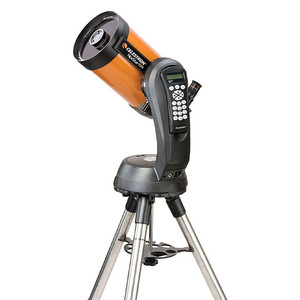
150/1500 Schmidt-Cassegrain on a single-arm GoTo – short tube, long focal length, set up in minutes. Only limited use for long-exposure imaging.
Price: € 1,549
The 6SE is the best compromise between light, weight and price. The 8SE shows more, but it is noticeably heavier and vibrates longer on the single-arm fork. You will find the 6SE in detail in our Celestron NexStar 6SE guide.
Cassegrains in research
Almost all of the world’s large telescopes are descendants of the Cassegrain. The Hubble Space Telescope with its 2.4 m mirror is a Ritchey-Chrétien, as are the four 8.2 m telescopes of ESO’s VLT in Chile and the two 10 m Keck telescopes in Hawaii.
Large observatories often use the Nasmyth focus for this. A third, flat mirror diverts the light sideways through the altitude axis of the mount. Heavy instruments sit firmly on a platform there and do not have to follow the telescope’s movement.
Satellite dishes and radio telescopes also often work on the Cassegrain principle. The receiver then sits protected behind the dish instead of out front at the focus. What professionals use today is shown in our overview of professional telescopes.
Frequently asked questions
What is the difference between a Cassegrain and a Newtonian?
The Newtonian sends the light to the side with a flat secondary mirror, the Cassegrain sends it back with a curved secondary. The eyepiece of a Cassegrain therefore sits at the rear, and at the same focal length its tube is about three times shorter. The Newtonian, in turn, offers more aperture for the money and a wider field of view.
Is a Schmidt-Cassegrain good for deep sky?
For small, bright objects such as globular clusters, planetary nebulae and galaxy cores, yes. For large nebulae such as the whole Orion Nebula or the Andromeda Galaxy, the field of view at f/10 is too small. A reducer to f/6.3 helps, but does not replace a short-focus telescope.
Does a Cassegrain telescope need collimation?
Rarely. On a Schmidt-Cassegrain, three screws on the secondary mirror are sometimes all it takes after transport. A Maksutov stays collimated practically permanently.
Who invented the Cassegrain telescope?
It was published in 1672 under the name Cassegrain, today usually attributed to the priest Laurent Cassegrain. Marin Mersenne, however, had already described similar two-mirror ideas in 1636. Whether Cassegrain devised the design himself is therefore disputed.