By Alexander Merz · Published on · Details checked on 14 September 2026
An Earth globe sits in every second living room. A Moon globe gets noticed straight away – and it’s one of the few astronomy gifts that still works when the sky stays overcast for weeks.
The choice is manageable, the price range is not: from 30 euros for a small relief globe to 400 euros for a hand-mounted piece of furniture. The difference lies less in accuracy than in build quality.
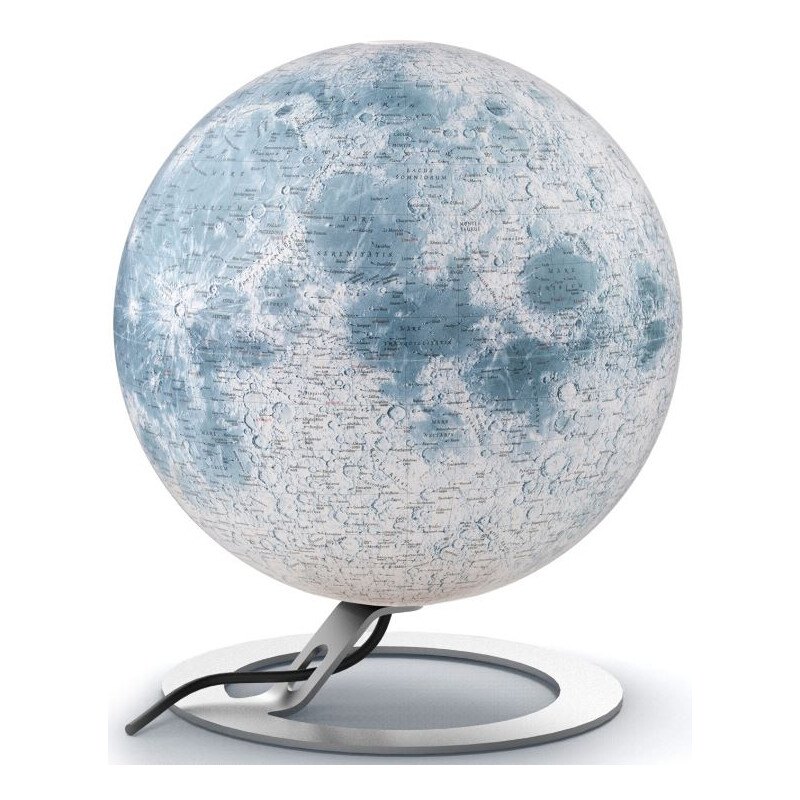
For most people the National Geographic Moon globe at 30 cm is the right choice: big enough for labelled lunar maria and the Apollo landing sites, and at € 139 still within gift range. If you’re after a piece of interior design, go for a Columbus globe. And if you’d rather give the sky than a celestial body, take a constellation globe – bear in mind it shows the constellations mirrored, seen from the outside.
Moon globe or celestial globe: two different things
These get mixed up often, and the disappointment comes after unwrapping. A Moon globe shows a celestial body – its surface, its craters, its seas.
A celestial or constellation globe, by contrast, shows the night sky, painted onto the inside of an imaginary sphere – except that you are looking at it from the outside.
That has a consequence worth knowing: the constellations appear mirrored. Anyone wanting to learn the sky with one has to think in reverse; as an object and as a talking point, a celestial globe is still wonderful.
What size makes sense
With globes, the diameter decides what stays readable. Below 20 centimetres the labels disappear and the Moon becomes a grey ball.
From 30 centimetres upwards, maria, large craters and the Apollo landing sites are easy to make out. 34 to 40 centimetres is furniture format – lovely, but it needs a permanent spot to stand.
| Size | What you can see | Where it belongs |
|---|---|---|
| 10–15 cm | Surface texture, no labels | Desk, small gift |
| 30 cm | Maria, large craters, landing sites readable | Shelf, child’s room |
| 34–40 cm | Smaller craters too, elaborate cartography | Living room, study |
Our recommendations by budget
| Budget | Globe | Why | Price |
|---|---|---|---|
| up to 30 € | AstroReality relief globe Pluto | Small, with real relief texture – a little gift, not a piece of furniture. | € 29.90 |
| up to 80 € | Räthgloben constellation globe 30 cm | The cheapest way to a celestial globe, with the constellation lines drawn in. | € 79 |
| up to 150 € | National Geographic Moon globe 30 cm | ⭐ Our recommendationThe right size at a sensible price, with Apollo landing sites and labelled lunar maria. | € 139 |
| up to 300 € | Columbus Moon globe 34 cm | Hand-mounted, illuminable, wooden base – furniture quality rather than toy. | € 279 |
| up to 300 € | Columbus night sky globe 34 cm | The same thing in celestial form, with the classic constellation figures. | € 279 |
| from 400 € | Columbus Moon globe 40 cm | The largest format – an eye-catcher that needs a corner of its own. | € 399 |
Our recommendation: National Geographic “The Moon” globe, 30 cm
Moon globe with the Apollo landing sites and named lunar seas – the best balance of size, detail and price.
Price: € 139
Why this one? Because it hits the threshold at which a Moon globe explains something instead of merely decorating. The Apollo landing sites are marked, and that turns the sphere into a map with a history.
For children it’s often the first moment when the Moon stops being a picture in the sky and becomes a place where people have stood.
And what about Mars?
Mars globes are rarer, but they exist – and they have one advantage over the Moon: the surface is colourful and the names are an adventure in themselves. Valles Marineris, Olympus Mons, Hellas Planitia.
For Mars fans: Columbus Mars Globe 40 cm
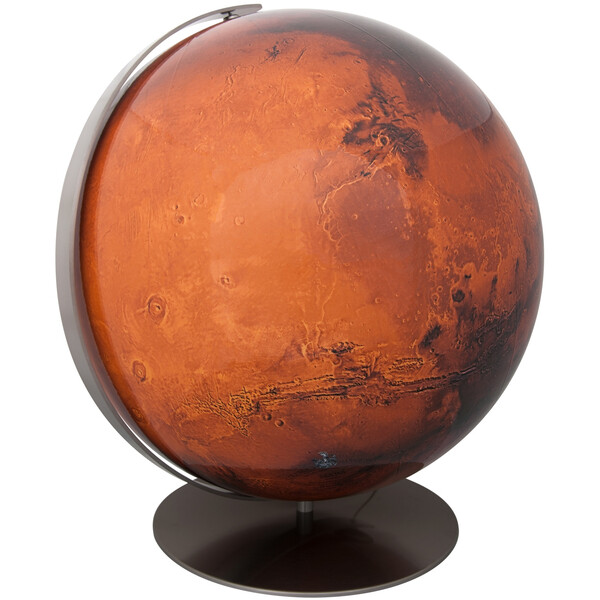
40 cm Mars globe based on current probe data - for everyone dreaming of the Red Planet.
Price: € 399
If you want to know when Mars is next well placed for observing, you’ll find it in our overview of Mars.
If you want more: the globe in furniture quality
For the more advanced: Columbus Moon globe 40 cm
What separates this from the 30 cm National Geographic globe isn’t the map but the execution: a hand-mounted sphere instead of printed plastic, a metal meridian, a wooden base and – depending on the model – internal lighting that turns the globe into a lamp in the evening.
The extra cost is worth it if the globe is meant to stand on show in a living space rather than on a shelf. For a child’s room it’s too good and too delicate.
The next step up: Columbus Moon Globe 40 cm (hand-finished)
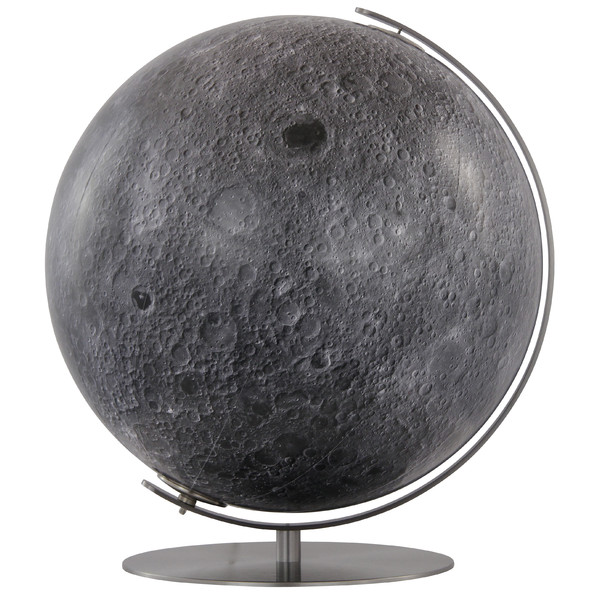
Hand-finished 40 cm Moon globe - an eye-catcher in the living room and a gift for life.
Price: € 399
Frequently asked questions about Moon and celestial globes
Does a Moon globe show the far side as well?
Yes, all current models map the complete surface, including the far side that is never visible from Earth. The mapping comes from space probes, above all the Lunar Reconnaissance Orbiter.
Why are the constellations mirrored on a celestial globe?
Because you’re looking from outside at a sphere whose pattern really belongs on the inside – we stand in the middle of the celestial sphere, after all. For recognising things under the real sky, a planisphere is the better tool.
What size suits a child’s room?
Thirty centimetres is the best compromise: big enough for the labels to stay readable, and robust enough for everyday life. The hand-mounted 40-centimetre models are too delicate for a child’s room.
Are illuminated globes worth it?
With Earth globes yes, because the light lets you switch between the political and the physical map. With Moon globes the lighting is pure atmosphere – pretty, but it adds nothing to the content.
Read on
- The Moon: phases, craters and observing tips
- Exploring the sky with a star chart
- Astronomy gifts: ideas from 15 to 500 euros
- Home planetarium: the night sky in your living room
Links marked with * are affiliate links. If you buy through them, we earn a small commission – the price stays the same for you.