By Alexander Merz · Updated on
The Askar N160 is a Newtonian astrograph with a 160 mm aperture and a carbon-fiber tube: 576 mm focal length at f/3.6, or 544 mm at f/3.4 with the included corrector, designed for cameras up to APS-C.
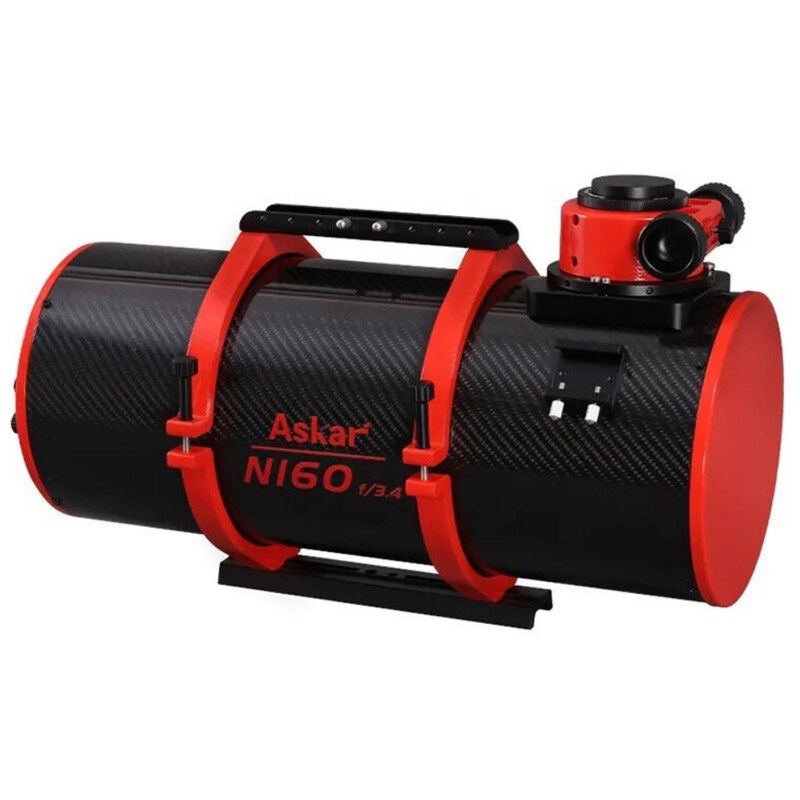
Askar is the brand of Chinese manufacturer Sharpstar, and the N160 hit the market in July 2026. It plays in the same league as the other fast telescopes in our astrophotography overview.
Askar N160: specs at a glance
Dealer listings contradict each other on several figures. The table follows Sharpstar’s own data sheet and manual; where shops differ, we note it below.
| Feature | Value |
|---|---|
| Design | Newtonian with parabolic primary mirror, borosilicate glass |
| Aperture | 160 mm |
| Native focal length | 576 mm (f/3.6) |
| With corrector | 544 mm (f/3.4), 0.95× corrector included |
| Image circle | 28 mm (APS-C) |
| Secondary mirror | 61 mm minor axis – about 38 % obstruction |
| Focuser | 2″ rack and pinion, dual speed (1:10), rotatable, EAF-ready |
| Backfocus | 55 mm from the corrector’s M48 thread |
| Tube | Carbon fiber, Ø 193 mm, length 467 mm |
| Weight | 3.97 kg tube, 5.2 kg with rings, handle, dovetail and corrector |
| Price | $1,099.00€ 1,162 |
We calculated the obstruction ourselves because no source lists it. 38 % by diameter is normal for a fast imaging Newtonian: the large secondary is needed to illuminate the image circle all the way into the corners. For visual use that would be a drawback, but for imaging it only costs about 15 % of the light.
What f/3.4 gets you: fewer nights for the same image
The focal ratio determines how quickly extended objects like nebulae and galaxies build up in your image. The exposure time you need grows with the square of the f-number.
With a typical APS-C camera (3.76 µm pixels), the N160 gives you a field of roughly 2.5 ° × 1.7 ° at 1.4 arcseconds per pixel. That’s a good fit for the whole Andromeda Galaxy, the North America Nebula or the Pleiades with their surroundings.
For small galaxies, the focal length is too short. The N160 is a light-hungry wide-field instrument, not a galaxy hunter – for that you’d want 1,000 mm or more, as we explain in our guide to deep-sky astrophotography.
Askar N160 owner reviews: what the first owners report
We haven’t tested the N160 ourselves. Instead, we collected and tallied every report from actual owners we could find in German and English-language forums.
| Source | Scope | Owners |
|---|---|---|
| Cloudy Nights | 3 threads, approx. 60 posts | 2 |
| 3 posts, 28 comments | 1 | |
| forum.astronomie.de (German) | 4 threads, dealer announcements only | 0 |
| astrotreff.de (German) | no thread | 0 |
Period: June 22 to September 29, 2026. We only counted people who show their own images or measurements taken with the scope. Three owners isn’t much – this is an early trend, not statistics.
| Finding | Mentions | Verdict |
|---|---|---|
| Collimation holds or is spot-on out of the box | 3 of 3 | ✅ Strength |
| Mechanics and focuser free of play | 2 of 3 | ✅ Strength |
| Backfocus is finicky (corners, coma, tilt) | 3 of 3 | ⚠️ Main issue |
| Mirror clamped too tightly from the factory | 2 of 3 | ⚠️ Fixable |
| Long cool-down time | 2 of 3 | ⚠️ Plan for it |
| Soft stars, scope returned | 1 of 3 | 🔴 Isolated case |
Two owners are keeping their scopes and are happy once everything is dialed in. One sent his N160 back because the stars stayed bloated despite verified collimation. Whether that was a lemon or a series problem is impossible to tell from a single case.
The sticking points: backfocus, mirror clips, cool-down
Backfocus down to a tenth of a millimeter
At f/3.4, the tolerance is tiny. Even 0.2 mm off the 55 mm shows up as elongated stars in the corners. One owner had to use different spacers depending on the filter and ended up settling for a compromise.
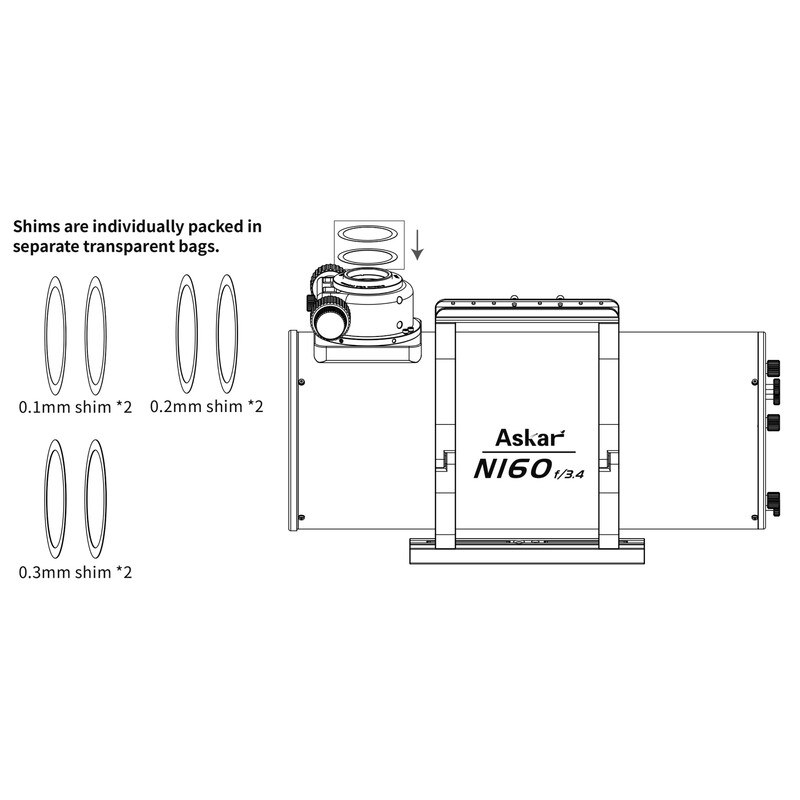
Factor in filter thickness: a filter in the light path lengthens the optical path by about one third of its glass thickness. If you swap filters often, it’s best to plan for a filter wheel with a fixed spacing.
Mirror clips too tight from the factory
Two of three owners initially saw triangular or frayed stars. The cause was overtightened clips on the primary mirror that put slight stress on the glass. Carefully loosening them solved the problem.
Cool-down time of up to two hours
The primary mirror needs time to reach the outside temperature. One owner reports more than two hours before the stars settled down. So set the scope out early – or use the first hour for flats and polar alignment.
Collimation with a laser and Cheshire
The good news: collimation holds for all three owners, even when slewing. You still need to check it, because at f/3.4 any misalignment shows immediately. A collimation laser like the Apertura 1.25" Laser CollimatorBresser Laser Collimator 1.25″ and a Cheshire eyepiece belong in your basic kit.
Matching camera, mount and accessories
Cameras with an APS-C sensor or smaller are ideal, such as the popular models with an IMX571 or IMX294 chip. The 28 mm image circle doesn’t cover full frame. Which camera suits which telescope is covered in our guide to choosing an astrophotography camera.
With camera, filter wheel and guide scope, you end up at about 7 kg. An HEQ5-class mount can carry that, while an EQ6-R has reserves for windy nights. Lightweight travel mounts are too marginal, and one owner explicitly advises against them.
| Accessory | What for | Price |
|---|---|---|
| HEQ5-R ProHEQ5-R Pro | Mount, enough for the N160 with camera | $1,695.00€ 1,679 |
| EQ6-R ProEQ6-R Pro | ⭐ Our pickMount with headroom – steadier in the wind | $2,250.00€ 1,799 |
| ZWO Electronic Automatic Focuser (2025)ZWO EAF-N | Motorized focuser – practically a must at f/3.4 | $199.00€ 275 |
| Collimation laserCollimation laser | Check collimation before every night | $59.95€ 74.90 |
Links marked with an asterisk are affiliate links.
One detail matters with filters: one owner saw strong halos around bright stars with broadband filters, but not with a 7 nm narrowband filter. Fast optics demand more from filters, which need to be designed for steep light cones.
Askar N160 vs. Quattro 150P, RASA 8 and Sharpstar HNT
| Model | Optics | Image circle | Corrector | Price |
|---|---|---|---|---|
| Askar N160Askar N160 | 160/544 mm, f/3.4 | APS-C | ⭐ Best speed for the moneyincluded | $1,099.00€ 1,162 |
| Sky-Watcher Quattro 150PSky-Watcher Quattro 150P | 150/600 mm, f/4 | APS-C | sold separately | $665.00€ 489 |
| Celestron RASA 8Celestron RASA 8 | 203/400 mm, f/2 | approx. 22 mm | built in | $2,199.00€ 2,449 |
| Sharpstar 15028HNT | 150/420 mm, f/2.8 | Full frame | included | from approx. $2,300€2,300 (dealer price) |
Links marked with an asterisk are affiliate links. Astroshop doesn’t carry the Sharpstar 15028HNT; the price is a dealer figure.
The Quattro 150P is the cheaper, more forgiving choice: f/4 is less sensitive, and the steel tube is heavier and shifts more with temperature changes. Even with a matching coma corrector, it still comes in well below the N160.
The RASA 8 is even faster, but it needs a small camera mounted in front of the aperture and costs more than twice as much. You’ll find the details in our write-up on the Celestron RASA 8.
The Sharpstar 15028HNT from the same manufacturer covers full frame. The N160 costs about half as much, offers more aperture and is slightly slower. If you’d rather work without collimation, the Askar SQA55 is a refractor from the same family.
Who is the Askar N160 right for?
| It’s a fit if … | Skip it if … |
|---|---|
| ✅ you’ve collimated a Newtonian before | ⚠️ this will be your first astrophotography telescope |
| ✅ you get few clear nights and want speed | ⚠️ you want to get started right away without tinkering |
| ✅ your camera is APS-C or smaller | ⚠️ you shoot full frame |
| ✅ you already have an HEQ5 or EQ6-R | ⚠️ you only have a lightweight travel mount |
If you’re wondering in general whether a reflector is right for you, you’ll find the basics in our guide to the Newtonian telescope.
Fast 6-inch Newtonian with corrector: Askar N160 Newtonian Astrograph 160/576 (f/3.4 with corrector)
160 mm aperture at f/3.4 for APS-C – lots of light for the money, but it demands careful collimation.
Price: € 1,162
Frequently asked questions about the Askar N160
Does the N160 come with a coma corrector?
Yes. The 0.95× corrector is included and turns 576 mm at f/3.6 into the advertised 544 mm at f/3.4. Without it, Newtonians show comet-shaped stars in the corners of the image.
Does the N160 work with a full-frame camera?
Not according to the manufacturer. The image circle measures 28 mm, which is enough for APS-C. Some shops promise full-frame coverage but don’t back it up.
Can you use the Askar N160 for visual observing?
Not really. The focuser is designed for cameras, and the large secondary mirror reduces contrast on planets. For eyepiece viewing, a classic Dobsonian is the better choice.
Which mount can safely carry the N160?
With camera and guiding, the whole package weighs around 7 kg. An HEQ5-class mount is enough, while an EQ6-R or a comparable direct-drive mount gives you headroom.
Askar N160 or an apo refractor to get started?
To get started, the refractor. It needs no collimation and no cool-down time. The N160 pays off once you’ve mastered Newtonian technique and want more light per hour.
What’s the difference between Askar and Sharpstar?
Askar is Sharpstar’s brand. The N160’s data sheet and manual come directly from Sharpstar.
Sources: Sharpstar N160 data sheet, Cloudy Nights: N160 or Carbonstar 150, Cloudy Nights: product launch, Reddit: N160 buying advice. Last updated: October 2026.
Links marked with an asterisk (*) are affiliate links. If you buy through them, we earn a small commission – the price stays the same for you.