By Alexander Merz · Published on · Details checked on 21 September 2026
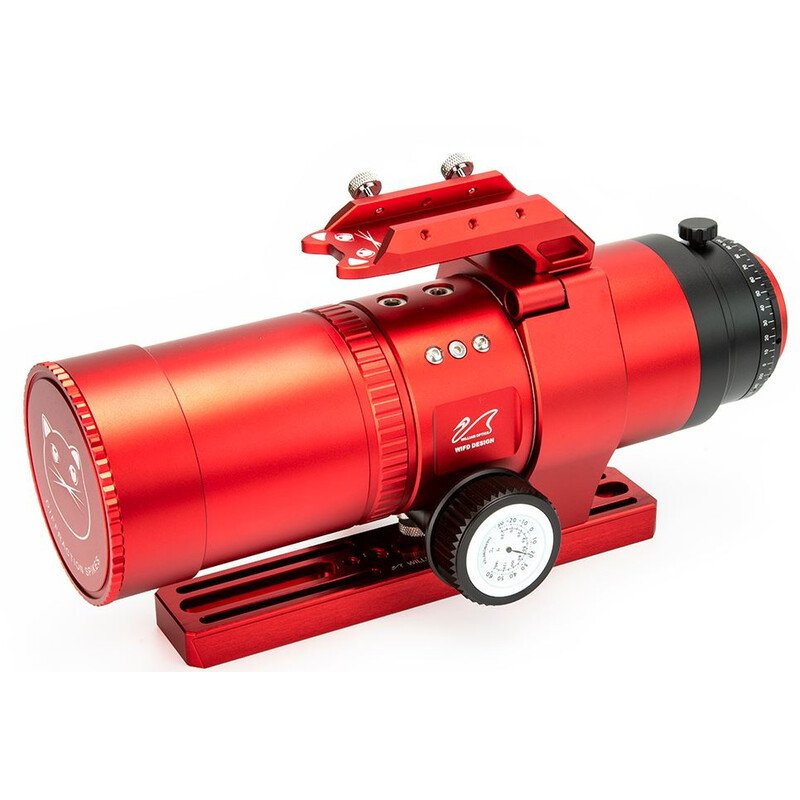
Few telescopes are as popular in beginner astrophotography as the William Optics RedCat 51. It’s the very definition of a “grab-and-go” astrograph: unpack it, attach a camera, and start shooting. AstroBackyard regularly recommends it, too.
This review explains honestly why it’s so good – and why it still isn’t the right first telescope for everyone. Because a pure astrograph is a tool built for a single purpose.
William Optics RedCat 51: the key specs
| Feature | Value |
|---|---|
| Design | Petzval apo (4 lenses, flat field built in) |
| Aperture / focal length | 51 mm / 250 mm (f/4.9) |
| Image circle | Full frame (up to 44 mm) |
| Focuser | WIFD – internal, digital/electronic, autofocus-capable |
| Weight | approx. 1.6 kg |
| Special feature | Bahtinov mask built into the lens cap |
| Price (Astroshop) | $878.00€ 1,190 |
Who is the RedCat 51 right for?
The RedCat is a wide-field astrograph for imaging large objects: the Andromeda Galaxy, the North America Nebula, the Pleiades, sweeping regions of the Milky Way. At 250 mm it captures large swaths of sky.
It is not a visual telescope. There’s no practical way to “just take a quick look” through it – it’s built from the ground up for the camera sensor.
Its big advantage over cheaper refractors is the built-in flat field. You save yourself buying, tuning, and fiddling with the back focus of a separate flattener – a real convenience win for beginners.
RedCat 51 or EvoStar 80ED – which is better?
That’s the most common question. Both are beginner favorites, but they solve different jobs.
| Criterion | RedCat 51RedCat 51 | Sky-Watcher Evostar EDX 80 APO Doublet TelescopeEvoStar 80ED |
|---|---|---|
| Flat field | ✅ built in | ⚠️ flattener required (~$170~€150) |
| Aperture | 51 mm | 80 mm (more detail) |
| Usable visually | no | yes (with accessories) |
| Weight | 1.6 kg | 3 kg |
| Price | $878.00€ 1,190 | $750.00€ 795 |
| Where to buy | RedCat 51RedCat 51 | Sky-Watcher Evostar EDX 80 APO Doublet TelescopeEvoStar 80ED |
What else you’ll need
Even the RedCat doesn’t take photos all by itself. You’ll still need a tracking mount and a camera (DSLR/mirrorless or a dedicated astro camera). At 250 mm, guiding is often still optional for short exposures – a big plus of the short focal length.
Premium grab-and-go for wide field: William Optics RedCat 51 WIFD Petzval Apo
Compact 51/250 Petzval astrograph with built-in flat field – grab-and-go for wide-field imaging.
Price: € 1,190
Frequently asked questions about the William Optics RedCat 51
Does the RedCat 51 need a flattener?
No. Thanks to the four-lens Petzval design, the field is already flat. There’s no need for a separate flattener – that’s one of its main advantages.
Can you observe visually with the RedCat 51?
Not really. It’s a pure astrograph made for the camera. If you also want to look through the eyepiece, choose a different refractor.
Which camera fits the RedCat 51?
Any mirrorless camera, DSLR, or dedicated astro camera up to full frame. The image circle covers large sensors as well.
RedCat 51 or a smart telescope?
A smart telescope if you want instant results with no accessories or image processing. The RedCat 51 if you want full control with your own camera and higher image quality.
What does WIFD mean?
“William Optics Internal Focuser” – an internal, electronic focuser that you can adjust finely and repeatably, and automate for autofocus.