By Alexander Merz · Updated on
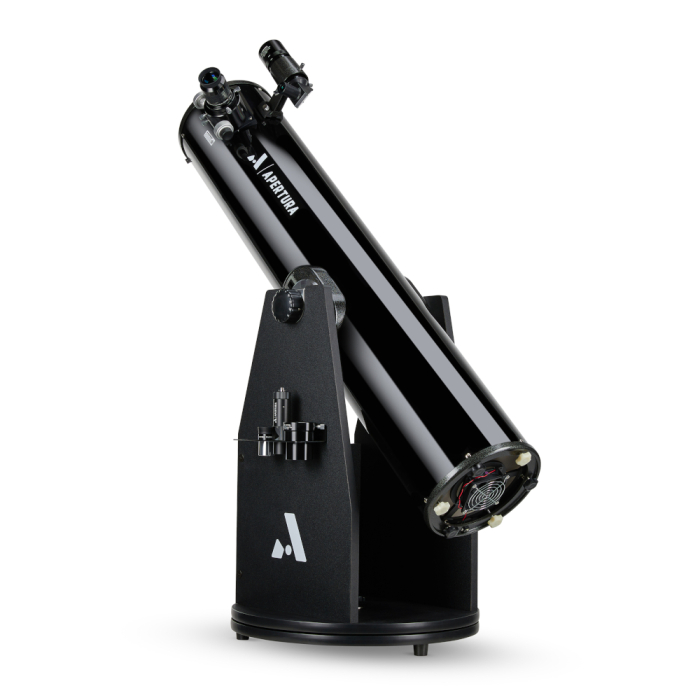
The Apertura AD8 is an 8-inch (203 mm) Newtonian reflector on a Dobsonian rocker base, sold in the US by High Point Scientific. 1200 mm focal length (f/5.9), 52 lb in two parts, bundled with a 2″ dual-speed focuser, a right-angle finder, a cooling fan and two eyepieces.
It is one of the most recommended beginner telescopes in the US, and the classic 8-inch Dobsonian.
⭐ In short: The AD8 ($699.95€ 499) is worth it if you want the most telescope for visual observing and have ground-level storage. In 170 owner reports we found not one complaint about the optics.
Skip it if you have to carry it up stairs or want to photograph galaxies: the weight is the most common reason owners use it less, and it does not track the sky.
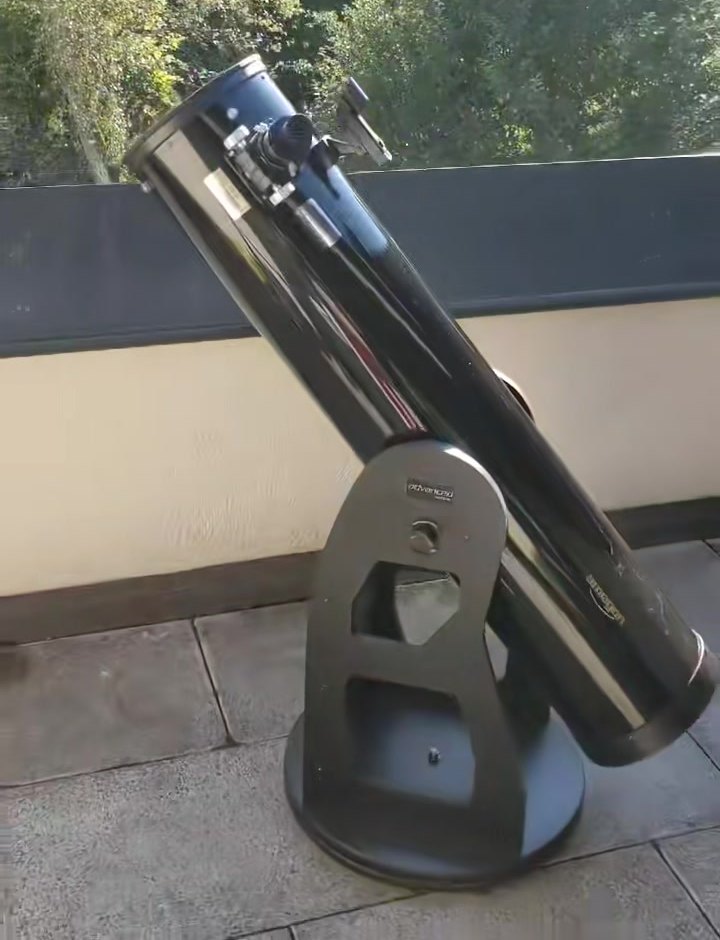
Transparency: we do not own an AD8. This guide combines the verified specs with a count of 170 real owner reports from Reddit and Cloudy Nights, plus our experience with our own 8-inch Dob. How we review telescopes.
Apertura AD8 specs at a glance
On paper the AD8 is a standard 8-inch f/6 Dob: what sets it apart is the bundle. Specs as listed by High Point Scientific in September 2026:
| Spec | Apertura AD8 |
|---|---|
| Aperture / focal length | 203 mm (8″) / 1200 mm, f/5.9 |
| Weight | Tube 24.5 lb, base 27.7 lb, total 52.2 lb |
| Tube length | 46.1 in |
| Focuser | 2″ Crayford, dual-speed 10:1 |
| Finder | 8×50 right-angle correct-image (RACI) |
| Eyepieces | 30 mm 68° (2″) and 9 mm Plössl (1.25″) |
| Also in the box | Laser collimator, moon filter, 35 mm extension tube, eyepiece tray |
| Cooling fan | Behind the mirror, runs on 8 AA (not included) |
| Bearings | Roller-bearing azimuth, sliding altitude balance |
| Price | $699.95€ 499 |
What High Point does not state: the mirror glass type and whether the primary is parabolic. We therefore make no claim about either.
What 170 owners report
We read 369 Reddit threads and 4 Cloudy Nights threads (January 2022 to September 2026) and counted only people who clearly own an AD8. That left 170 owners; each is counted once per topic.
| Topic | Owners | What they say |
|---|---|---|
| Happy, would recommend | 48+ | Including owners after four and five years |
| Optics praised | 23+ | Sharp Moon, Jupiter’s bands, Saturn’s rings. 0 reports of a bad mirror |
| Focus trouble on night one | 29+ | The biggest topic: extension tube and 30 mm eyepiece (fix below) |
| Weight and bulk | 18+ | 6 use it less or bought a smaller second scope |
| Altitude balance, nose-dives | 13+ | Mostly after adding a heavy eyepiece or finder |
| Collimation learning curve | 12+ | Typical for first-time Newtonian owners |
| Finder frustrating | 10+ | Right-angle view is hard to learn; many add a red-dot finder |
| 9 mm eyepiece weak | 9+ | The first part owners replace |
| Included laser out of alignment | 7+ | Only 1 owner said theirs was fine |
| Shipping damage | 0 | None reported in the sample |
How to read these numbers: they are minimums, not a survey. Help threads are over-represented, because people post when something goes wrong, so the problem counts run high compared with all owners.
The first-night focus puzzle and how to fix it
29 owners could not reach focus at first: that is not a defect, it is missing documentation. Only a quick-start guide ships in the box, and it does not explain the 35 mm extension tube.
Tip: For the 30 mm 2″ eyepiece, leave the extension tube off and pull the eyepiece out about half an inch. For the 9 mm and other 1.25″ eyepieces, add the extension tube. Try it on a distant streetlight in daylight or dusk first.
Weight and bulk: the real deal-breaker
52 pounds sounds manageable, but owners say the awkward shape matters more than the weight. The 46-inch tube and the 19-inch base are two separate trips through the door.
Six owners ended up using the AD8 less or bought a smaller second scope for this reason. If the scope lives on the ground floor or in a garage, this barely matters. If it has to go down stairs, look at a smaller beginner telescope first.
Common mistake: buying the bigger AD10 “because it is only $250 more”. The AD10 weighs 66 lb and has a 48.5-inch tube, and most AD10 and AD12 owners advise the AD8 if the scope gets carried or driven around.
Collimation and the included laser
Every Newtonian needs collimation, and 12 owners struggled with it at first. It takes about two minutes once you have done it a few times.
The surprise is the included laser collimator: 7 owners found the laser itself out of alignment, and only one said theirs was fine. Check the laser before trusting it, or use a simple Cheshire eyepiece, which cannot go out of alignment.
Check before first use: put the laser in the focuser and rotate it slowly. If the red dot on the secondary mirror draws a circle, the laser itself is off, and collimating with it will make things worse.
Apertura AD8 vs Sky-Watcher 8″ Classic, Zhumell Z8 and StarSense Explorer 8″
Owners agree: through the eyepiece, all 8-inch f/6 Dobs show the same. The AD8 shares its optical tube family with the Zhumell Z8, and it performs like any other 8″ f/6.
| Model | Difference to the AD8 | Choose it if |
|---|---|---|
| Apertura AD8Apertura AD8 | ⭐ Our pickMost complete bundle: RACI, fan, 2-speed focuser, 2″ eyepiece, laser | you want everything included from day one |
| Sky-Watcher 8″ Classic | Same views, simpler bundle | you already own eyepieces and a finder |
| Zhumell Z8 | Same optical tube family, bundle varies | you find it clearly cheaper |
| Celestron StarSense Explorer 8″ | Phone app guides you to objects, no fan | finding objects worries you more than hardware |
Links with an asterisk are affiliate links.
The extra money buys convenience, not better views. Owners of the simpler models point out that you can add the same upgrades for roughly $150 to $300.
AD8 or AD10?
The 10-inch shows about 56 % more light, but costs 14 more pounds and 2.4 inches of tube. Take the AD10 only if you can roll the scope out at ground level.
If you want more: a 10-inch Dobsonian
Ten inches of aperture pull more detail out of galaxies and globular clusters, and faint nebulae look noticeably brighter. It pays off for observers with a dark site nearby and storage on the same level, not for anyone carrying the scope far.
For advanced observers: Omegon Dobson Telescope Advanced X N 254/1250
10 inches of aperture for the price of many 8-inch scopes: the cheapest way to reach much fainter objects.
Price: € 622
What to buy with it
Owners replace the 9 mm eyepiece first, and add a red-dot finder second. Together that fixes the two most common complaints for around $100.
- A 6 mm and a 12–15 mm eyepiece (or a 2x Barlow) for planets and the Moon
- A red-dot or Telrad finder next to the RACI: about 40 owners use one
- A USB or 12 V power bank for the fan instead of 8 AA batteries
- A Cheshire collimation eyepiece, if your laser turns out to be off
Our recommendation
For a visual observer with a ground-level home for it, the AD8 is the best-equipped 8-inch Dobsonian package in the US. Just budget an evening for the focus trick and collimation.
Our pick for visual observing: Omegon Advanced X N 203/1200 Dobsonian
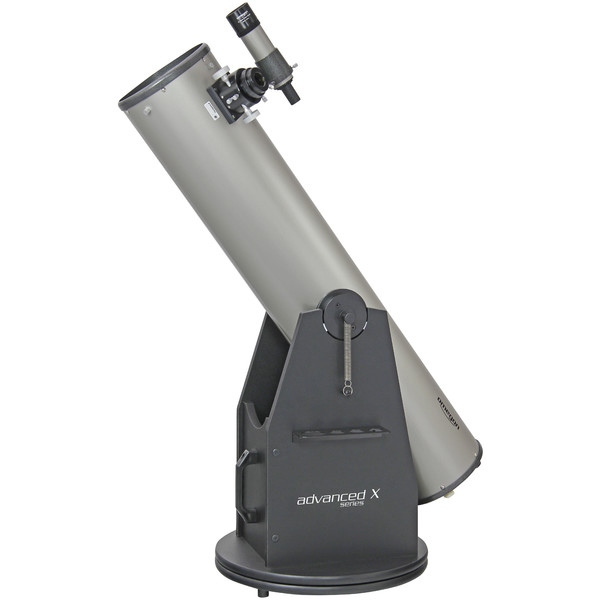
8-inch Dobsonian: maximum aperture for the money - no-frills deep-sky observing, set up in minutes.
Price: € 499
Want a second opinion for your budget? Our free telescope advice answers personally.
* Affiliate link: if you buy through this link we may earn a small commission from Astroshop or High Point Scientific, at no extra cost to you.
Frequently asked questions
Is the Apertura AD8 good for beginners?
Yes, if you can handle the size. It is simple to use and has no electronics to set up. The learning curve is finding objects by hand and collimating.
Why can’t I get focus with the AD8?
Almost always the extension tube. Leave it off for the 30 mm eyepiece and pull that eyepiece out a little; put it on for 1.25″ eyepieces and Barlows.
Can I see galaxies with the AD8?
Yes, the bright ones such as Andromeda, M81/M82 and the Whirlpool Galaxy, as grey smudges with some structure under dark skies. They will not look like photos.
Can I take photos with the AD8?
The Moon and planets with a phone adapter, yes. Deep-sky astrophotography, realistically no, because the Dobsonian base does not track. For that, a smart telescope is the better tool.
How heavy is the Apertura AD8?
52.2 lb in total: 24.5 lb for the tube and 27.7 lb for the base. Both parts are carried separately.
Which eyepiece should I buy first for the AD8?
A 6 mm for planets (200x) and a 12–15 mm for general use. A 2x Barlow is the budget alternative.
How do I power the cooling fan?
It takes 8 AA batteries, which are not included. Many owners run it from a power bank or a 12 V pack instead.
Is the AD8 better than the Zhumell Z8 or Sky-Watcher 8″ Classic?
Not optically: owners report the same views. The AD8 wins on the included accessories and the roller-bearing base.
Verdict: the complete 8-inch package
The AD8 is not better glass than other 8-inch Dobs, it is the most complete one out of the box. The optics earn praise across 170 owners, and the weaknesses are manageable: weight, a badly documented focus trick and a weak 9 mm eyepiece.

Who wrote this guide
Alexander Merz writes our telescope guides and answers the reader questions in our free telescope advice. He observes with his own 8-inch Dobsonian (Omegon Advanced 203) and a Unistellar eVscope 2 smart telescope.
Where we have not used a scope ourselves, we say so and show our sources: how we review telescopes.