By Alexander Merz · Published on
The Celestron Origin Mark II is a smart telescope for a permanent spot in the garden: 152 mm RASA optics at f/2.2, a Sony IMX678 camera and a GoTo fork mount, 18.9 kg in total. It costs $4,299.00€ 5,499 and is the fastest smart telescope you can buy today.
⭐ In short: The Origin shows small, faint galaxies and nebulae faster and in more detail than any other smart telescope. In return you pay with weight, a narrow field of view and a price that is several times that of the entry-level class. It’s worth it for anyone who can leave it standing in the garden – if you need to carry it, travel with it or are just getting started, the DWARFLAB DracoDWARFLAB Draco or the Seestar S50 ProSeestar S50 Pro will serve you better.
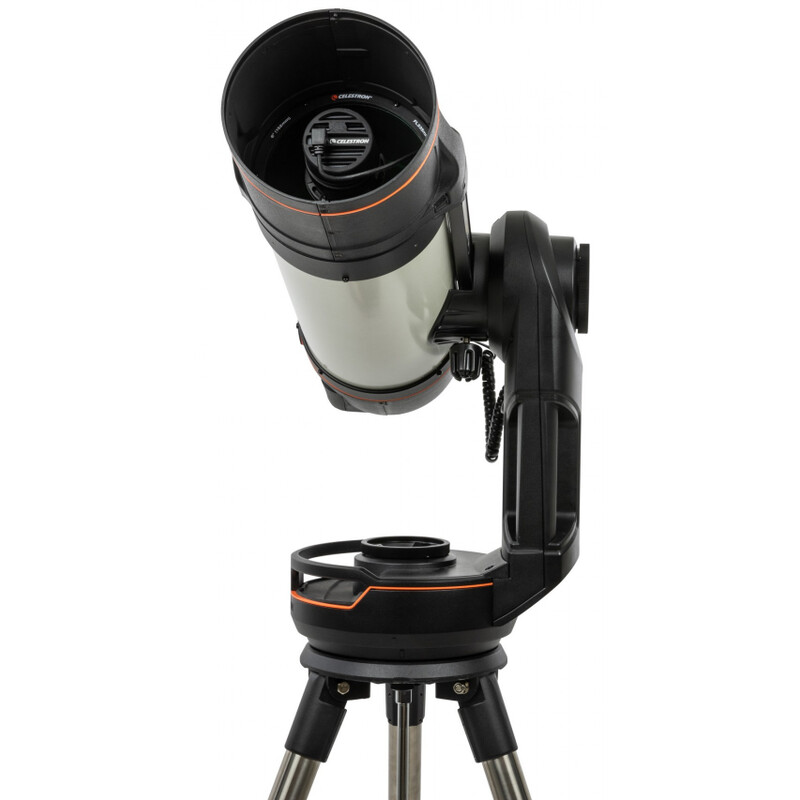
The fastest smart telescope: Celestron Origin Mark II Smart Telescope
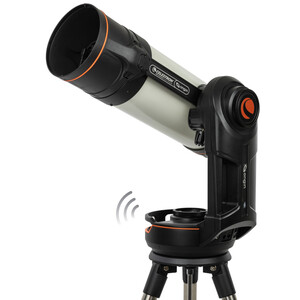
152 mm RASA optics at f/2.2, new camera with Sony IMX678, autofocus, dew heater and filter drawer for 1.25″ and 2″ filters. The device for a permanent observing spot – not for a backpack.
Price: € 5,499
Still unsure which class you need? The smart telescope finder takes you from your budget to the right device, and our free telescope advice answers you personally.
What is the Celestron Origin?
Celestron calls the Origin an “Intelligent Home Observatory” – a home observatory in three parts. That puts it in the garden observatory class rather than among travel devices such as the Seestar or DWARF. You set it up once and your phone does the rest: recognising stars, slewing to the target, focusing, exposing, stacking.
At its heart is a RASA, a Rowe-Ackermann Schmidt Astrograph – a reflecting telescope built purely for photography. Light passes through a corrector plate, hits the primary mirror at the back and is focused forwards, where the camera sits directly at the focal point.
The trick is the short focal length of 335 mm with 152 mm of aperture, which gives a focal ratio of f/2.2. The smaller this number, the faster an optical system collects light on the sensor. Just how radical that is is shown in our article on its big brother, the Celestron RASA 8.
Celestron Origin Mark II: specifications and what’s in the box
All figures come from the Celestron spec sheet and the Astroshop listing (as of 30/09/2026). We update the price automatically every day.
| Feature | Celestron Origin Mark II |
|---|---|
| Optics | RASA (Rowe-Ackermann Schmidt Astrograph), 152 mm / 335 mm, f/2.2 |
| Central obstruction | 77 mm (50.7 % of the diameter) from the camera |
| Camera | Sony IMX678, colour, 3856 × 2180 pixels (8.3 MP), 2.0 µm pixels |
| Field of view / image scale | 1.32° × 0.75° / 1.23″ per pixel |
| Mount | alt-azimuth GoTo fork (single-arm), EQ operation with optional equatorial wedge |
| Features | autofocus, dew heater on the front lens, filter drawer for 1.25″ and 2″, two fans (optics and electronics) |
| Control | Raspberry Pi 4 inside the device, Wi-Fi, Ethernet, “Celestron Origin” app (iOS/Android) |
| Battery | LiFePO4, 97.9 Wh, built in, “6+ hours” according to Celestron |
| Weight | tube 4.8 kg · mount 7.7 kg · tripod 6.4 kg = 18.9 kg |
| In the box | tube with camera, mount with battery, steel tripod, dew shield, power supply |
| Not included | solar filter, nebula filter, equatorial wedge, carrying bags |
| Price / delivery | $4,299.00€ 5,499 · ● Available to order |
The camera inside the device is not cooled – the two fans cool the optics and electronics, not the sensor. Among the smart telescopes in our comparison, only the DWARF Draco is cooled; uncooled sensors are noisier on warm summer nights.
Mark II vs. Mark I: what’s new?
The difference between the Mark I and Mark II (“Mark 2”) lies solely in the camera. According to Celestron, the optics, mount, tripod, battery and weight are identical. The Mark II has been on sale since the end of 2025.
| Feature | Origin (Mark I) | Origin Mark II |
|---|---|---|
| Sensor | Sony IMX178 | Sony IMX678 (Starvis 2) |
| Resolution | 3096 × 2080 (6.4 MP) | 3856 × 2180 (8.3 MP) |
| Pixel size | 2.4 µm | 2.0 µm |
| Image scale | 1.48″ per pixel | 1.23″ per pixel |
| Field of view | 1.27° × 0.85° | 1.32° × 0.75° (16:9) |
| Optics, mount, battery, weight | unchanged: 152 mm f/2.2, 97.9 Wh, 18.9 kg | |
The improvement is noticeable, but no quantum leap. More pixels, a finer image scale and a modern sensor; one upgrader on Cloudy Nights reports clearly better stars and colours. On Reddit, on the other hand, two Mark I owners call the old camera the weak point – and one finds even the new one only “barely better”.
What you really see with the Origin
How much light a telescope collects from an object depends on the area of its aperture – minus whatever is obstructed in the centre. With the Origin, the 152 mm leaves a net area equal to that of an unobstructed 131 mm aperture.
Per pixel, the Origin gathers about twice as much light as the Seestar S50 Pro – even though each pixel covers only just over a quarter as much sky (1.23″ instead of 2.30″). In other words: more detail and still less noise in the same time.
In practice, a recognisable image appears on your phone after just a few minutes, as Astroshop, Intercon Spacetec and BBC Sky at Night all report. One owner on Cloudy Nights shows galaxies fainter than magnitude 19 in the Coma Cluster after two hours of exposure under dark skies – that’s jargon for “extremely faint” and unusual for a smart telescope.
The downside: the narrow field of view
At 1.32° × 0.75°, the Origin has the smallest field of view in the premium class. The Moon (just over 0.5°) only just fits, while the Andromeda Galaxy (around 3° long) or the North America Nebula only fit as a mosaic.
Celestron only added the mosaic mode later via an update (firmware 1.5 with the current app); owners in the Cloudy Nights thread missed it for a long time. A mosaic spreads your exposure time across several panels – so large nebulae cost correspondingly more nights.
Planets: the honest weakness
The Origin isn’t built for planets. What matters is the image scale: at 1.23″ per pixel, Jupiter at opposition comes out at only around 35 to 40 pixels – almost twice as large as in the Seestar S50 Pro, but smaller than in the DWARF Draco.
A classic telescope with a planetary camera shows Jupiter at 100 to 200 pixels and costs a fraction of the price. The Origin captures the Moon well, planets at best as a side catch. If Saturn’s rings and Jupiter’s belts are your main interest, take a look at the long-focal-length Celestron telescopes.
Weight, setup and transport
The 18.9 kg is split across three parts: 4.8 kg tube, 7.7 kg mount, 6.4 kg tripod. Each part can be carried on its own, but together they weigh almost seven times as much as a Seestar S50 Pro.
The Origin won’t go on a plane, but it will go in a car. For the boot, Celestron offers carrying bags for the tube, mount and tripod. But if you have to fetch it from the cellar every evening, experience shows you’ll soon use it less often.
EQ mode: equatorial wedge and autoguider
In alt-azimuth mode, the field of view rotates during the exposure – that’s physics, not a flaw, and it affects every smart telescope on an alt-az mount. The result is blurred image edges that get cropped during stacking and, with some objects, ring-shaped patterns in the background.
Since the app update of June 2025, the Origin can work equatorially, i.e. tracking like an equatorial mount. For that you need an equatorial wedge that tilts the mount towards the celestial pole; for long exposures you also need the StarSense Autoguider.
Accessories for the Celestron Origin
What you need depends on your goal – none of it is necessary to get started. Prices change; where we mention them, they are recommended retail prices from Baader (Celestron’s distributor in Germany), given relative to the Origin Mark II price.
| Accessory | What for | Worth it for |
|---|---|---|
| Nebula filter (dual-band, e.g. Celestron or third party) | Emission nebulae under light-polluted skies | Almost everyone – according to the contents list, the filter isn’t included. |
| Second filter drawer (third party, 1.25″ or 2″) | Changing filters without screwing them in again | Anyone who often switches between galaxies and nebulae |
| NexStar Evo/SE Wedge | EQ mode without field rotation | Photographers who process raw data themselves (RRP about a tenth of the Origin price) |
| StarSense Autoguider V2 | Exposures well over one minute | Only together with the wedge (RRP about a sixth of the Origin price) |
| Origin accessory kit (wedge + autoguider + small parts) | Complete EQ conversion | Saves about a tenth versus buying the parts separately, according to Baader (RRP about a quarter of the Origin price) |
| Carrying bags | Protecting tube, mount and tripod | Anyone who transports the Origin by car |
| USB Wi-Fi dongle | More stable connection | If your phone is more than a few metres away |
With a standard filter, bright stars show halos at f/2.2 – glowing rings around the star. It’s the most common topic in both forums; how pronounced they are depends on the filter, and according to one German owner you can’t get rid of them completely even with a nebula filter.
Celestron Origin review roundup: what reviewers and owners report
We haven’t used an Origin ourselves. This assessment is based on four hands-on reviews (BBC Sky at Night on the Mark II, Astroshop, Intercon Spacetec and a Cloudy Nights user review of the Mark I) and on more than 400 forum posts that we read and counted by owner.
| Source | What we read | Verified owners |
|---|---|---|
| forum.astronomie.de (German) | 7 threads, around 60 posts (2024–2026) | 2 owners, 1 loan unit |
| Cloudy Nights | Sample from the 222-page owners’ thread (5 pages), 2 problem threads, 1 user review – around 100 posts | can’t be counted cleanly (many owners, Mark I and II mixed) |
| 23 threads with 263 comments (07/2024–08/2026) | 13 owners |
Of the 13 Reddit owners, six are thoroughly enthusiastic – easy operation, strong images even from the city. Two consider the old Mark I camera the weak point, one is disappointed by field rotation, one is selling theirs after about five sessions, and three are neutral.
Source bias: the Cloudy Nights thread is an owners’ thread dominated by image posts, with retailers joining in too; Reddit tends to be sceptical of expensive smart telescopes. We found no recurring hardware defects in any source – the problems concern software, Wi-Fi and image processing. No forum figure on this page is a rating in the sense of a review portal.
Origin, Draco, Vespera Pro II or Seestar S50 Pro?
The Origin has no direct rival in the premium class – the other premium devices focus on portability or price. Here are the four candidates buyers in this class choose between.
| Feature | Celestron Origin Mark II | DWARFLAB Draco | Vaonis Vespera Pro II | Seestar S50 Pro |
|---|---|---|---|---|
| Price | $4,299.00€ 5,499 | $1,399.00€ 1,499 | $2,990.00€ 2,990 | $999.00€ 999 |
| Aperture (net) | 152 mm (≈ 131 mm) | 90 mm (≈ 80 mm) | 50 mm | 50 mm |
| Focal ratio | f/2.2 | f/3.8 | f/4.9 | f/5.2 |
| Field of view | 1.32° × 0.75° | 1.65° × 1.24° | 1.65° × 1.65° | 2.45° × 1.38° |
| Image scale | 1.23″/pixel | 1.46″/pixel (binned) | 1.68″/pixel | 2.30″/pixel |
| Cooled sensor | no | yes | no | no |
| Weight | 18.9 kg | 5.5 kg | 5 kg | 2.8 kg |
| Battery | 6+ h | 5 h | 11 h | 9 h |
| Solar filter included | no | yes | no | yes |
| Delivery | ● Available to order | ● Currently unavailable (Product can be shipped as of 05.11.2026) | ● Available to order | ● Available to order |
| Product | Origin Mark IIOrigin Mark II | DWARFLAB DracoDWARFLAB Draco | Vaonis Vespera Pro 2 Smart TelescopeVespera Pro II | Seestar S50 ProSeestar S50 Pro |
Links marked with an asterisk are affiliate links. Specifications: manufacturers’ data, checked on 30/09/2026; net aperture and image scale recalculated by us.
The Draco is the only one that comes close to the Origin on faint objects – with just over a third of the light-collecting area, but a cooled sensor and long exposures. The Vespera Pro II is the travel device with the best battery, and the S50 Pro is the entry point where nobody goes wrong.
💡 The honest cheaper alternative: DWARFLAB Draco
The Draco costs $1,399.00€ 1,499, weighs 5.5 kg and is the only one to offer a cooled sensor and single exposures of up to 300 seconds. It collects considerably less light than the Origin, but shows the larger field of view and fits in any car boot.
The catch: it only ships from November, and there are no independent reviews yet. If you don’t want to wait or can’t set up the Origin permanently, take a look at the Draco in detail.
Premium class at just under a third of the weight: DWARFLAB Draco Smart Telescope
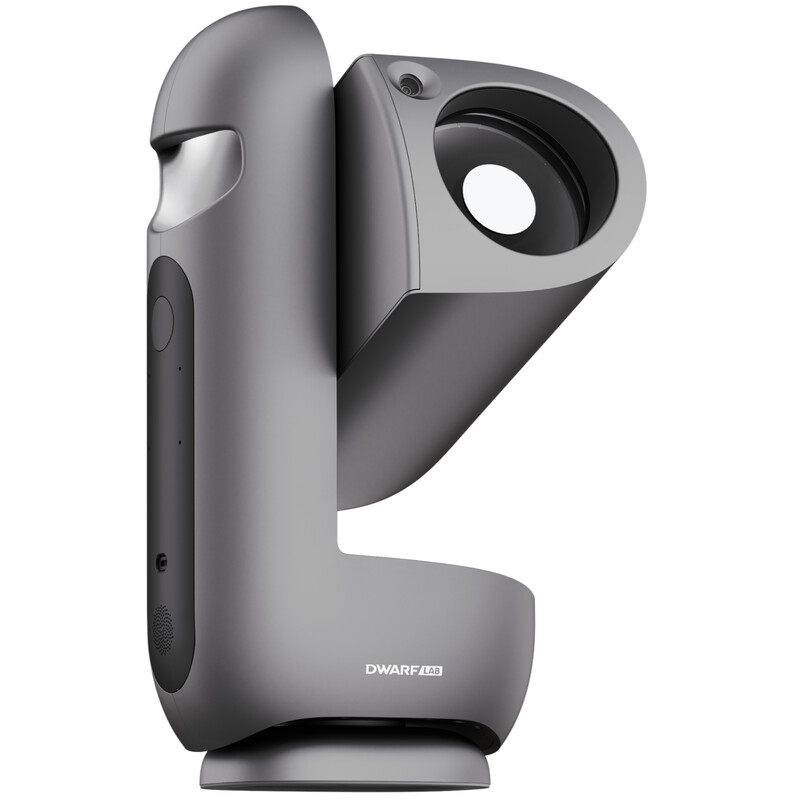
90 mm aperture, cooled sensor, built-in guide scope, 5.5 kg. The realistic alternative if the Origin is too heavy or too expensive.
Price: € 1,499
Who the Origin is worth it for – and who it isn’t
In short: the Origin is worth it if it can stay put. Everything else is a question of budget and patience.
| Your situation | Recommendation | Why |
|---|---|---|
| Permanent spot in the garden or on the patio, galaxies and small nebulae as targets | Celestron Origin Mark IICelestron Origin Mark II | ⭐ Built exactly for thisThe largest light-collecting area and the finest image scale of all smart telescopes. |
| Premium quality, but portable and considerably cheaper | DWARFLAB DracoDWARFLAB Draco | Cooled sensor, 5.5 kg – wait for the first reviews |
| Travel, mountains, holidays by the sea | Vaonis Vespera Pro 2 Smart TelescopeVaonis Vespera Pro II | 5 kg with tripod, 11 hours of battery, mosaic mode |
| First smart telescope | Seestar S50 ProSeestar S50 Pro | Mature, 2.8 kg, large field of view – the safe way in |
| You want to look through an eyepiece yourself or mainly see planets | not a smart telescope | A classic telescope from our guide Professional telescope |
Links marked with an asterisk are affiliate links.
If you want to learn astrophotography as a craft, you can spend the money differently: mount, camera and optics separately, with more flexibility and more work. The Origin is the shortcut – it takes the assembling, setting up and stacking off your hands.
Frequently asked questions about the Celestron Origin
How much does the Celestron Origin Mark II cost?
$4,299.00€ 5,499 at Astroshop (updated automatically every day). Its predecessor, the Mark I, is still listed there for $4,299.00€ 4,599; an equatorial wedge, autoguider and filters may come on top.
What is the difference between the Origin Mark I and Mark II?
Only the camera: Sony IMX678 with 8.3 MP and 2.0 µm pixels instead of the IMX178 with 6.4 MP and 2.4 µm pixels. Optics, mount, battery and weight are the same. Mark I owners can retrofit the new camera as the “Origin 678C”.
How heavy is the Celestron Origin?
18.9 kg: 4.8 kg tube, 7.7 kg mount and 6.4 kg tripod. The three parts can be carried separately, and setup takes about ten minutes.
Can you photograph planets with the Origin?
Only to a limited extent. At 1.23″ per pixel, Jupiter comes out at around 35 to 40 pixels – more than in the Seestar S50 Pro, but far from a classic telescope with a planetary camera. The Moon works well.
Can you look through the Origin?
No. The camera sits where the eyepiece would be on other telescopes. You see the image on a phone, tablet or screen.
Does the Origin have a mosaic mode?
Yes, since firmware 1.5 in combination with the current app. This lets you assemble objects such as the Andromeda Galaxy, which don’t fit into the 1.32° × 0.75° field of view, from several panels.
Do I need the equatorial wedge?
Not to get started. It makes sense if you process raw data yourself and want to get rid of the field rotation and ring patterns of alt-az mode. The right one is the NexStar Evo/SE Wedge, not the heavy-duty version.
How long does the battery last?
Celestron quotes “6+ hours” for the built-in 97.9 Wh battery. In frost the runtime drops considerably – BBC Sky at Night got around three hours. For long winter nights, a 12 V power supply helps.
Origin or DWARF Draco?
The Origin collects more light and has the finer image scale, but weighs more than three times as much. The Draco is cheaper, portable and cooled, but still untested. With a permanent spot in the garden: Origin; otherwise, the Draco is the better bet.
Verdict: a garden observatory at the push of a button
The Celestron Origin Mark II is the most powerful smart telescope you can buy – on small, faint objects it plays in a league of its own. The Mark II fixes the biggest criticism of its predecessor, the camera, without changing the basic concept.
You should only buy it if you have a permanent spot for it. If you need to carry it, go for the Draco or a Vespera; if you’re just starting out, the Seestar S50 Pro. Our smart telescope guide gives you an overview of all devices.
Is the Origin right for you?
- ✔ Yes, if it can stay set up in the garden or on the patio.
- ✔ Yes, if you want galaxies and small nebulae in the best smart-telescope quality without assembling a rig yourself.
- ✘ No, if you need to travel with it or carry it: the DWARFLAB DracoDWARFLAB Draco ($1,399.00€ 1,499) is the lighter premium choice.
- ✘ No, if you mainly want to see planets or look through an eyepiece yourself.
* Affiliate link: if you buy through this link we may earn a small commission from Astroshop or High Point Scientific, at no extra cost to you.