By Alexander Merz · Published on · Details checked on 14 September 2026
Short answer: Halley’s Comet orbits the Sun roughly every 76 years. It was last visible in 1986 – its next return is expected in 2061.
Whenever astronomers manage to match a supposedly newly discovered comet to earlier observations, it always sets off a chain of investigations.
The superstitious among them then suddenly link – once again – all the misfortunes of certain periods, in what they consider a coherent connection, to the « messengers of doom ». A rare and honourable exception here is the « star of Bethlehem », which artists later depicted as « Halley’s Comet ».
Halley’s Comet: discovery and history
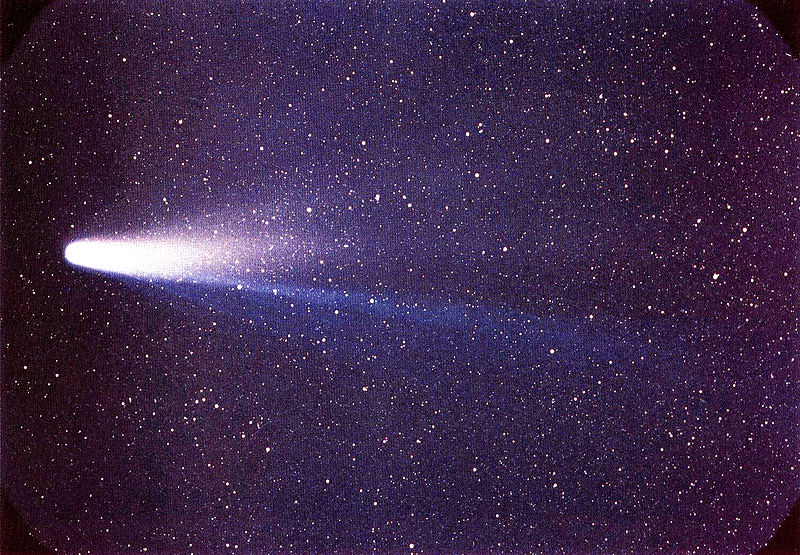
It was the British physicist Edmond Halley who first determined the orbit of this comet in 1705 by comparing it with earlier sightings. This is where its name, « Halley’s Comet », comes from.
Just as the scientist had predicted for around 1759, « Halley » returned – unfortunately only after the death of the man who had calculated its orbit. The amateur astronomers Johann Georg Palitzsch and Christian Gärtner were the first to observe the comet, on 25 December 1758.
More than the appearance of the comet itself, it was the discovery of a peculiarity in its tail that caused panic. When « Halley’s Comet » returned in 1910, astronomers detected in its tail the highly explosive toxic gas « cyanogen » (boiling point -21 °C).
They had also calculated that the Earth would pass through precisely this toxic tail on 19 May 1910. As history teaches us, this fortunately was not the end of the « blue planet ». Nor were there any human casualties to mourn.
A human lifetime long – the cycles of « Halley’s Comet »
The comet has a period (orbit around the Sun) of 75 to 77 years. It can already be observed with the naked eye from Earth over an extended period as it approaches its perihelion (the point closest to the Sun).
Astronomers explain the differing periods of « Halley’s Comet » by the influence of Jupiter as it moves towards aphelion (the point farthest from the Sun).
To date, the comet’s appearance has been linked to at least 25 historical records. The earliest pictorial depiction of « Halley’s Comet » is found in the « Bayeux Tapestry » from the year 1070; the most famous is the « star of Bethlehem » in the fresco « Adoration of the Magi » (c. 1301/2) by the painter Giotto di Bondone.
A famous « son » of the notorious comet was Mark Twain. The American writer was born 4 days after the appearance of « Halley’s Comet », on 30 November 1835.
Although his works do not deal exclusively with « his » star, he hoped to see it one last time before his death. On 20 April 1910 « Halley » returned visibly; one day later the writer passed away.
Sources
- NASA/W. Liller, Lspn comet halley, marked as being in the public domain, details on Wikimedia Commons, retrieved 24 Feb 2020