By Alexander Merz · Updated on · Details checked on 14 September 2026
The next full moon in June falls on Saturday, June 19, 2027 at 02:44 CEST.
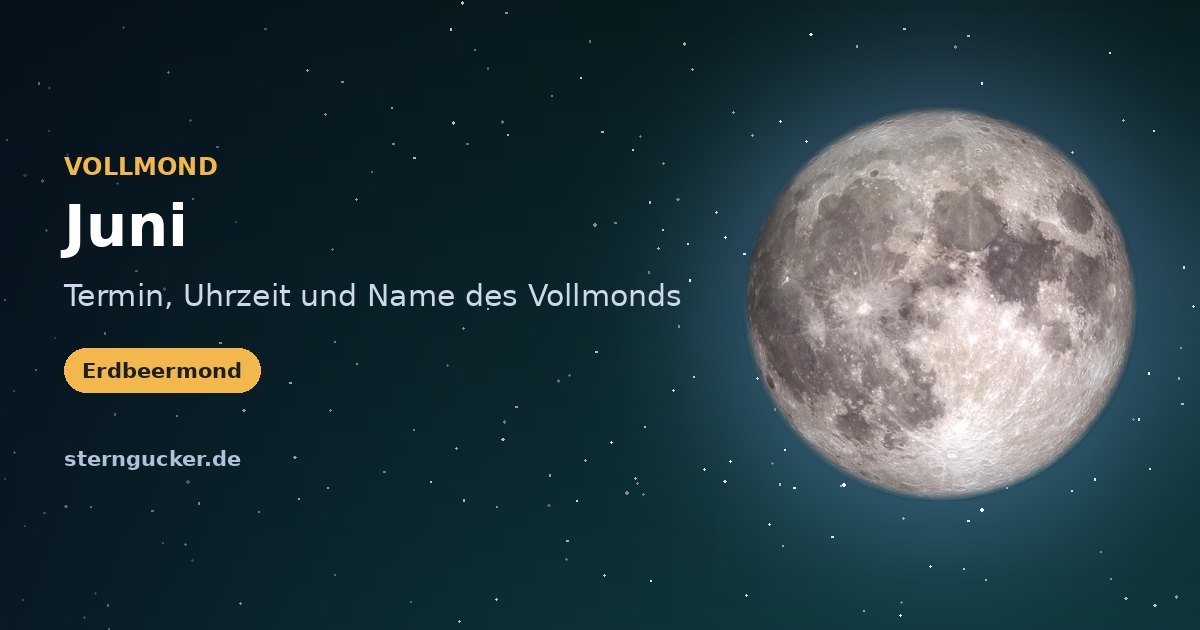
Name: Strawberry Moon – marking the strawberry harvest in June
Still 269 days to go.
Here you will find the exact date of the full moon in June – with the time for Germany, Austria and Switzerland, the traditional name of the month’s full moon and the dates for the coming years.
And if you want to see the Moon closer than with the naked eye: our buying guide for beginners explains which telescope makes sense to start with, what budget to plan for and which classic mistakes to avoid.
How the June full moon sits in the sky
The June full moon reaches its lowest position of the year – it mirrors the high position of the Sun at midsummer. Often it stays visible for only a few hours and looks yellowish because of the dense layer of air near the horizon.
Strawberry Moon – where the name comes from
The Strawberry Moon owes its name to the short strawberry harvest, which fell in these weeks among the Algonquian peoples. It is also the lowest full moon of the year and therefore often appears in a strong yellow or orange – not because of the strawberries, but because its light takes a long path through the atmosphere. In German, June was called Brachet, after the Brache, the fallow field.
Almost all the full moon names in common use today come from North America and were popularised by US almanacs. German-speaking Europe had its own names for the months: June was called Brachet or Brachmond. Both traditions mean the same thing – an attempt to tie the course of the year to what is actually happening outdoors.
What else is going on in the June sky
June has the shortest nights of the year; around the summer solstice it no longer gets properly dark in Germany. In return, this is the season of noctilucent clouds – a phenomenon that only occurs at midsummer.
Full moon in June: the dates for the coming years
| Year | Date | Time |
|---|---|---|
| 2024 | Saturday, June 22 | 03:07 CEST |
| 2025 | Wednesday, June 11 | 09:43 CEST |
| 2026 | Tuesday, June 30 | 01:56 CEST |
| 2027 | Saturday, June 19 | 02:44 CEST |
| 2028 | Wednesday, June 7 | 08:08 CEST |
| 2029 | Tuesday, June 26 | 05:22 CEST |
| 2030 | Saturday, June 15 | 20:40 CEST |
| 2031 | Thursday, June 5 | 13:58 CEST |
The interval from one full moon to the next averages 29 days, 12 hours and 44 minutes. Because our calendar months are longer, the date moves forward year by year – which is why the full moon in June never falls on the same date. All the coming dates are listed in the full moon calendar, and our page about the Moon explains how the phases come about.
The dates that are actually worth it are often months apart – and easily forgotten. So you do not miss one:
One short email, in good time – with the times and an honest take on whether it is worth getting up for.
You will get a confirmation email in a moment. Your address stays with us – no sharing, no third-party ads.
Observing the full moon – an honest note
As beautiful as the full moon is to the naked eye, in a telescope it is at its least interesting in exactly this phase. Because the Sun shines straight down onto the lunar surface, the shadows are missing and craters look flat. You see considerably more a few days before or after full moon along the day-night boundary, the so-called terminator.
If you do want to look at the full moon through a telescope, you should use a moon filter – without one it is uncomfortably glaring. For 1.25-inch eyepieces the Apertura 1.25" Moon FilterOmegon Premium Moon Filter 1.25″ is all you need (at $14.95€ 19.90) – spending more buys you nothing here. More on this in our buying guide to moon observation.
Making clever use of short nights: a rotating star chart: Oculum Swivelling Sky Map 29 cm

Set date and time, hold it up, find the constellations: the swivelling star chart shows exactly the sky above you at that moment. No battery, no signal, no screen glare.
Price: € 19.90