By Alexander Merz · Published on · Details checked on 2 October 2026
The Large Magellanic Cloud is an irregular dwarf galaxy in the immediate neighbourhood of the Milky Way and, like it, belongs to the Local Group. It was first mentioned in writing in the year 964, in the “Book of Fixed Stars” by the Persian astronomer Al-Sufi.
Many objects in space sit next to each other purely by chance. Others influence each other so strongly through gravity that they are grouped together into astronomical clusters or groups. One of the members discovered early on is the »Large Magellanic Cloud«, called »Große Magellansche Wolke« in German – a dwarf galaxy relatively close to our Milky Way. Like our galaxy, it is one of the members of the »Local Group«.
The Large Magellanic Cloud – an irregular dwarf galaxy
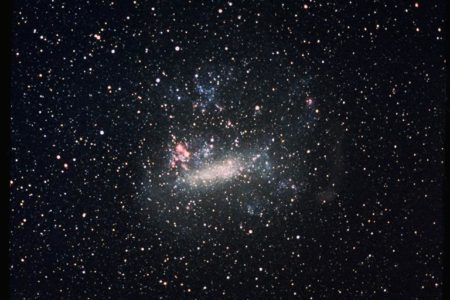
The first written mentions of our »neighbour« can be found in the »Book of Fixed Stars« by the Persian astronomer Al-Sufi from the year 964. So the Large Magellanic Cloud could already be seen with the naked eye from the Southern Hemisphere early in human history.
In 1519 Ferdinand Magellan set out on the first voyage around the world, and through his expedition the dwarf galaxy named after him became known in Europe. Today we know that it is made up of stars, star clusters, nebulae and other objects.
The Large Magellanic Cloud is a small galaxy. Within the »Local Group« it spans 14,000 light-years and is only 10% as »heavy« as the mass of the Milky Way. Still, it is well worth observing, because both young stars and old star clusters are very active there. The most famous event so far is »Supernova 1987A«, a stellar death in 1987 whose burst of neutrinos was registered by several observatories on Earth before the shock wave produced any measurable signal. But even before that, this dwarf galaxy had been studied thoroughly because of its relative closeness to Earth (»only« 160,000 light-years). A long catalogue of NGC objects describes star clusters, many glowing gas clouds and globular clusters of different ages.
News about the Large Magellanic Cloud’s role as a companion
Until now, astronomers had calculated a strong gravitational bond from the motions of the Large Magellanic Cloud in the »Local Group«. A research team from two institutes has now measured the three-dimensional velocity of both dwarf galaxies. It turned out that both Magellanic Clouds are moving almost twice as fast as previously assumed.
After analysing these data, there are two possible explanations for the higher speed: either our Milky Way is more massive than we previously thought, and its stronger gravitational pull accelerates both companion galaxies. Or our Milky Way may be too light to hold on to the Large Magellanic Cloud and the SMC. According to this explanation, the dwarf galaxies only accompany us by chance and, on galactic scales, are just passing through.
The Small Magellanic Cloud
The Small Magellanic Cloud (SMC) is the second of the two companion galaxies in the southern sky: an irregular dwarf galaxy around 200,000 light-years away that shines about 25 times more faintly than our Milky Way. Like its big sister, it can never be seen from Central Europe or the UK – you need to be in the Southern Hemisphere.
What sets it apart from the Large Magellanic Cloud is not just its size. Its star clusters are more loosely scattered, and it contains a striking number of young star-forming regions. The best known is NGC 602, which the Hubble telescope has captured as a true stellar nursery: young, massive stars have blown a cavity into the gas cloud, and the next generation of stars is forming along its edges right now. Because the SMC contains far fewer heavy elements than our Milky Way, conditions there resemble those in the early universe – which makes it especially valuable for research.
Is the SMC being torn apart?
In 2025 a study came to a surprising conclusion. A Japanese team analysed the motion of around 7,000 massive young stars in the SMC – all more than eight times the mass of the Sun – using data from the astrometry satellite Gaia. They had expected a rotation like the one we know from galaxies. What they found was something else: the SMC apparently does not rotate at all, but is being pulled apart along two axes at the same time.
Where the pulling forces come from is still open. Possible culprits are the Large Magellanic Cloud, the Milky Way itself or the after-effects of an earlier close encounter between the two Clouds. Only the direction of travel is certain: the Magellanic Clouds are moving towards the Milky Way and will merge with it in the distant future.
Both Magellanic Clouds lie near the south celestial pole, which you can easily find with the Southern Cross.
Sources
- NASA/Ames Research Center, Large.mc.arp.750pix, marked as public domain, details on Wikimedia Commons, retrieved 06/01/2020