By Alexander Merz · Published on · Details checked on 30 September 2026
The Southern Cross (Latin Crux) covers just 68 square degrees, which makes it the smallest of the 88 constellations and the best-known landmark of the southern sky. Its four brightest stars form a cross only 6 degrees long. From most of the United States it never climbs above the horizon.
At a glance
| Latin name | Crux (genitive Crucis), abbreviation Cru |
| Area | 68 square degrees (rank 88 of 88, the smallest constellation) |
| Brightest star | Acrux, magnitude 0.76 |
| Size of the figure | long axis 6.0°, crossbar 4.3° |
| Fully visible | south of about 27° N |
| Best time to observe | evenings in April and May |
| Peak altitude of Acrux | −14° in New York, +1° in Miami, +5° in Honolulu, 61° in Cape Town and Sydney |
| Neighbors | Centaurus (wraps around it on three sides), Musca |
| Best-known deep-sky object | Jewel Box NGC 4755, open star cluster, magnitude 4.2 |
How to find the Southern Cross
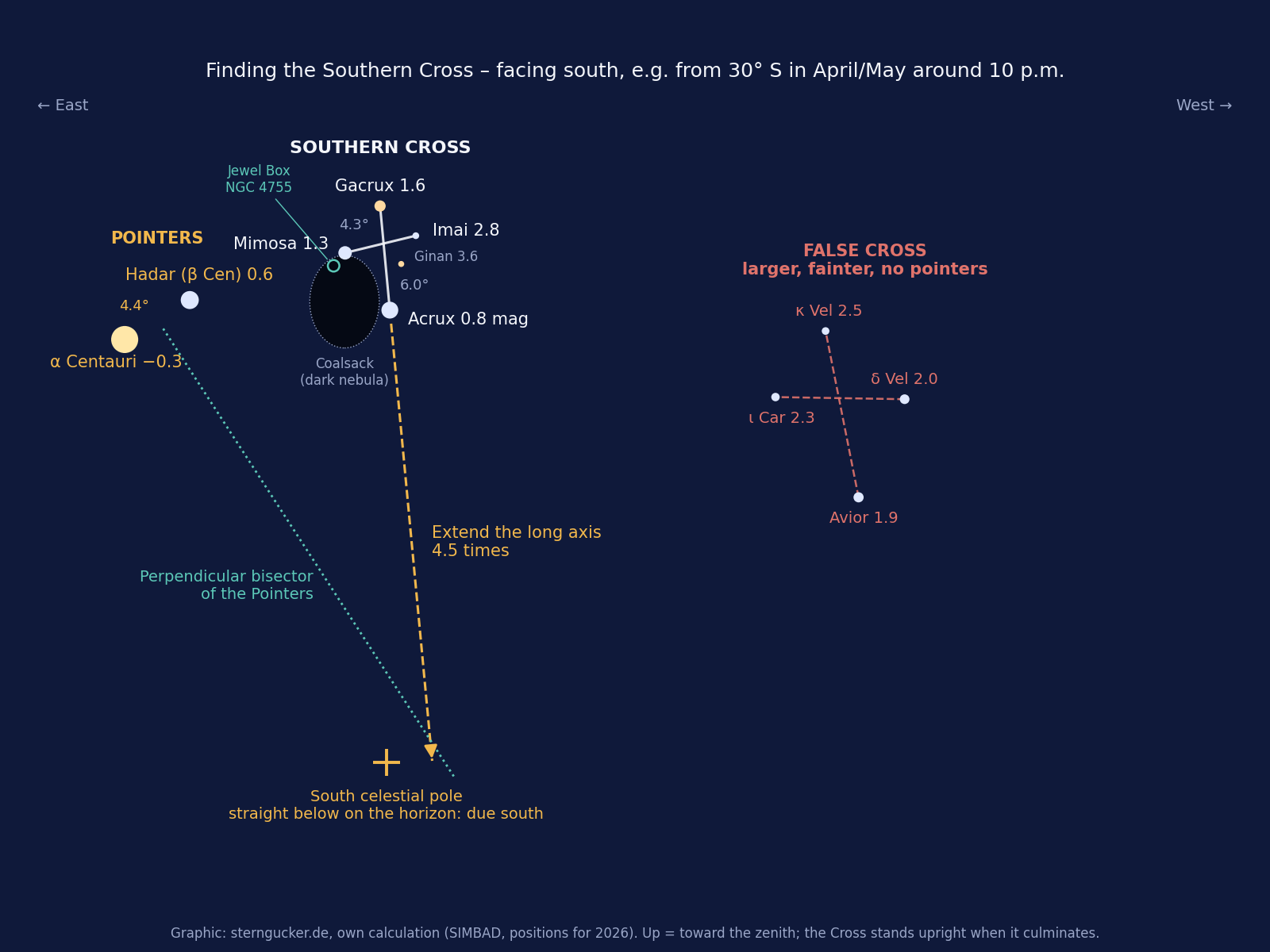
Beginners often look for something far too big. The long axis from Gacrux to Acrux measures only 6 degrees, a little more than half a hand’s width at arm’s length.
The Pointers are the surest way in. Alpha and Beta Centauri form a strikingly bright pair 4.4 degrees apart, just east of the Cross – the line through them points straight at it. At 4.34 light-years, Alpha Centauri is the nearest star system of all.
Under a dark sky, a second feature helps. Right next to Acrux lies the Coalsack, a conspicuous dark patch in the Milky Way.
How the Cross shows you due south
Sailors used the Cross as a compass for centuries. Extend the long axis from Gacrux past Acrux by four and a half times its length and you land close to the south celestial pole – just under 27 degrees from Acrux.
A second line makes it more precise. Where the perpendicular bisector of the Pointers crosses the extended axis, you are within about 3 degrees of the pole. Straight below it is due south – there is no bright counterpart to the North Star down there.
The stars of the Southern Cross constellation
| Star | Magnitude | Distance | Type |
|---|---|---|---|
| Acrux (α Cru) | 0.76 | about 320 light-years | multiple star of hot B-type stars (B0.5 IV + B1 V) |
| Mimosa (β Cru) | 1.25 | about 280 light-years | blue star B1 IV, slightly variable |
| Gacrux (γ Cru) | 1.64 | 89 light-years | red giant M3.5 III |
| Imai (δ Cru) | 2.75 | about 350 to 450 light-years | blue-white star B2 IV |
| Ginan (ε Cru) | 3.6 | about 230 light-years | orange giant K3 III |
Even with the naked eye you will notice a color difference. Gacrux at the head glows orange because it is a cool red giant – the other main stars are young, hot stars. At 89 light-years it is also more than three times closer than Acrux.
Acrux is a double star: a small telescope splits it into two bluish stars about four arcseconds apart.
How far south you need to be to see the Cross
Only your latitude matters. Acrux, the southernmost star, sits at a declination of −63.25 degrees, so it only clears the horizon south of 26.75 degrees north. Atmospheric refraction lifts it by a good half degree, which moves the real limit to about 27.3 degrees – roughly the latitude of Lake Okeechobee in Florida.
Gacrux at the top of the Cross sits about 6 degrees farther north. In theory you can catch it from about 33 degrees north – San Diego, Dallas or Savannah, but only hugging the southern horizon.
| City | Peak altitude of Acrux | Peak altitude of Gacrux |
|---|---|---|
| Seattle | −20.9° | −14.9° |
| Minneapolis | −18.2° | −12.2° |
| Boston | −15.6° | −9.6° |
| Chicago | −15.1° | −9.1° |
| New York | −14.0° | −8.0° |
| Denver | −13.0° | −7.0° |
| Washington, DC | −12.2° | −6.2° |
| San Francisco | −11.0° | −5.0° |
| Los Angeles | −7.3° | −1.3° |
| Dallas | −6.0° | 0.0° |
| Miami | +1.0° | +7.0° |
From Seattle to Washington, DC, the Southern Cross falls at least 6 degrees short of the horizon – no mountain and no crystal-clear night can make up for that. Only in Miami does the whole Cross make it above the horizon, and just barely.
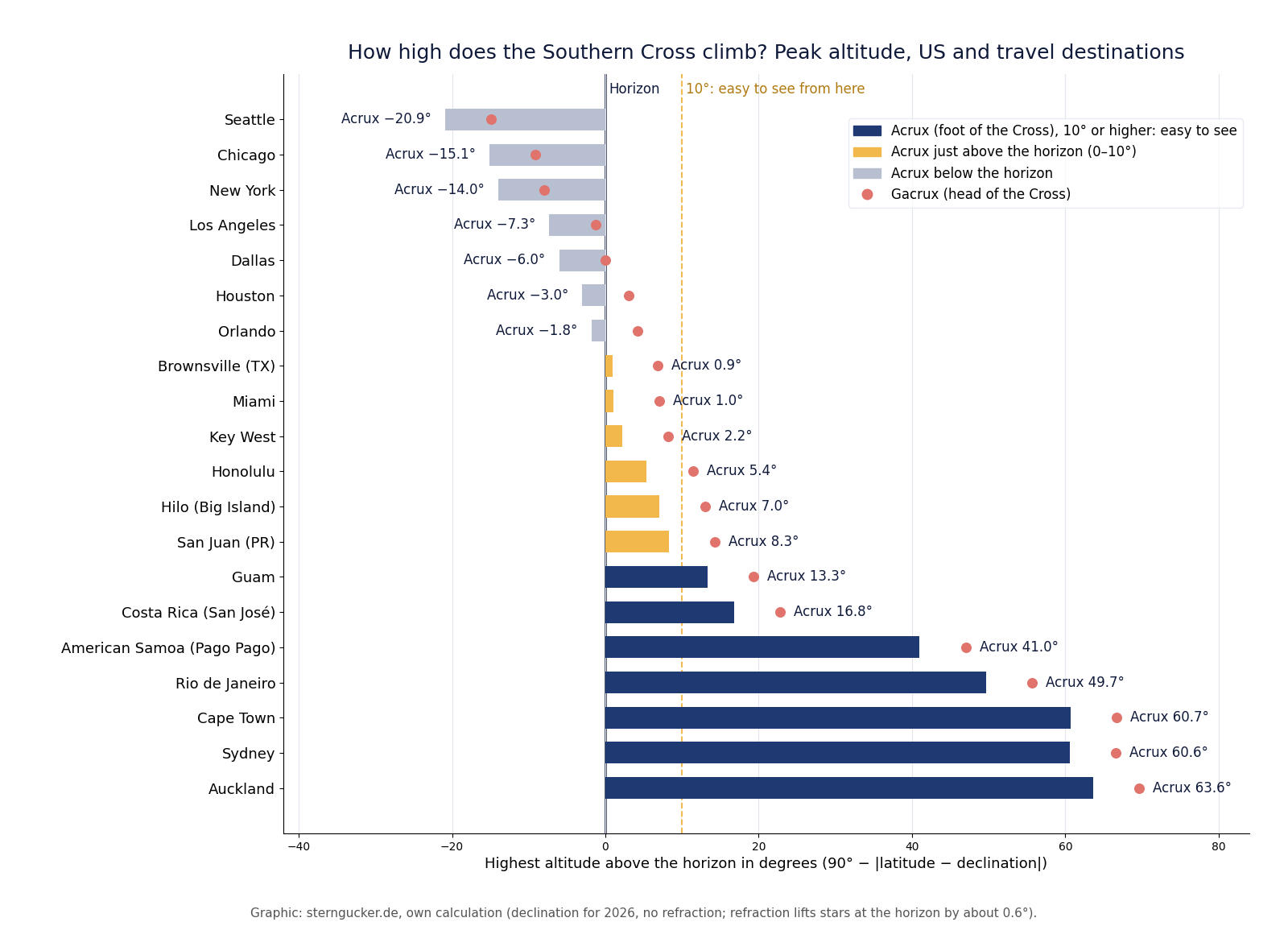
The Cross only becomes an easy sight once Acrux climbs at least 10 degrees – south of about 17 degrees north. That starts roughly at Guam, Barbados, Costa Rica or Bangkok.
In the Southern Hemisphere the Cross becomes a permanent resident. South of 32.7 degrees south it never sets at all – in Cape Town, Sydney and Auckland it is up every clear night, though at times close to the horizon.
Florida, South Texas, Hawaii: only part of the Cross
The southern edge of the US sits right on the boundary. In Houston, Gacrux reaches 3.0 degrees, Imai 1.3 and Mimosa 0.4 degrees – Acrux stays below the horizon at −3.0 degrees. In Orlando (Acrux −1.8°) even refraction cannot rescue it.
South Florida and the Rio Grande Valley just make it. In Miami and Brownsville, Acrux peaks at about 1 degree, in Key West at 2.2 degrees – with refraction, roughly half a degree more. You need a perfectly flat sea horizon to the south and very clear air.
Hawaii is the best spot in the 50 states. Acrux reaches 5.4 degrees in Honolulu and 7.0 degrees in Hilo, and on the summit of Haleakalā on Maui (3,055 m / 10,023 ft) the lowered sea horizon adds another 1.6 degrees. Up there, Acrux appears about 8 degrees high including refraction – as long as no ridge blocks your view due south.
In Key West the Cross culminates in April around 12:20 a.m. and in mid-May around 10:25 p.m. local time (EDT); in Honolulu around 11:25 p.m. and 9:30 p.m. (HST). Puerto Rico does better at 8.3 degrees, and on Guam Acrux climbs to 13 degrees – the only US territories north of the equator where the Cross is an easy sight.
When the Southern Cross is visible
At the end of March the Cross is highest at midnight; in April and May it peaks during prime evening hours. In October and November it hangs upside down close to the horizon in the evening.
| Month | Altitude of Acrux at 10 p.m. | Altitude of Gacrux at 10 p.m. |
|---|---|---|
| January | 22° | 18° |
| February | 35° | 34° |
| March | 47° | 49° |
| April | 56° | 61° |
| May | 55° | 61° |
| June | 46° | 48° |
| July | 33° | 33° |
| August | 19° | 17° |
| September | 9° | 5° |
| October | 4° | below the horizon |
| November | 4° | below the horizon |
| December | 11° | 6° |
Keep an eye on both columns. When Gacrux stands higher than Acrux, the Cross is upright, as on the chart above. In the southern winter it tilts to the right in the evening, and in the southern spring it hangs upside down low in the south.
The Sun never comes closer to the Cross than 53 degrees (early November) – Crux is not a zodiac constellation. And never point anything at the Sun without a certified front-mounted solar filter.
The Jewel Box and the Coalsack
About 1 degree southeast of Mimosa lies the constellation’s showpiece. The Jewel Box NGC 4755 is a young open star cluster of magnitude 4.2, visible to the naked eye under a dark sky as a fuzzy star. It is roughly 6,000 to 7,000 light-years away.
Its name comes from the color contrast. Among blue-white stars shines an orange-red supergiant – a bright knot in binoculars, a sparkling “A” in a small telescope.
The Coalsack next door needs no instrument at all. The dust cloud spans about 7 by 5 degrees, lies roughly 600 light-years away and looks best with the naked eye against the bright Milky Way – in binoculars it is bigger than the field of view.
Southern Cross: meaning and history
The constellation did not exist in antiquity. In the 2nd century, Ptolemy counted its stars as part of Centaurus. Cartographers first drew it as a constellation of its own in the late 16th century, based on reports from Portuguese and Spanish navigators.
The Greeks knew these stars because of precession, the slow wobble of Earth’s axis. Around the year 1, Acrux was still visible up to about 38 degrees north – from Alexandria, or from the latitude of today’s San Francisco. Today the limit is just under 27 degrees.
For navigators, the Cross became a signpost. It took over the role of the North Star in the southern sky, and its Christian cross shape made it a symbol as well. Much older is the interpretation of many Aboriginal Australians, for whom the Coalsack forms the head of the “Emu in the Sky”.
The Southern Cross on flags
No other constellation appears on so many national flags. Australia, New Zealand, Brazil, Samoa and Papua New Guinea all carry the Southern Cross on their flags. New Zealand shows only the four main stars in red, while Brazil shows an entire patch of sky over Rio de Janeiro.
Binoculars or telescope
From most of the US you will not need any gear for this one. On a trip south, binoculars are the clear winner: light to pack, a wide field of view, ideal for the Jewel Box and the star fields of the southern Milky Way. Our guide to astronomy binoculars helps you choose.
Perfect for your luggage: Celestron Cometron 7x50 Binoculars
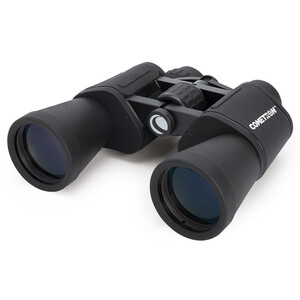
The astronomy classic among affordable binoculars: 7×50 with a large exit pupil for bright handheld views of the Moon and Milky Way – the ideal first step before a telescope.
Price: € 65
The Celestron 15 x 70 SkyMaster Pro Waterproof BinocularsOmegon Nightstar 15×70 gathers about twice as much light as a 10×50 and magnifies more: in the Jewel Box you resolve noticeably more individual stars, and faint stars pop up inside the Coalsack. The catch is the weight – without a tripod the image shakes. It pays off if you plan to observe on several nights at your destination.
For advanced observers: Omegon Nightstar 15x70 Binoculars
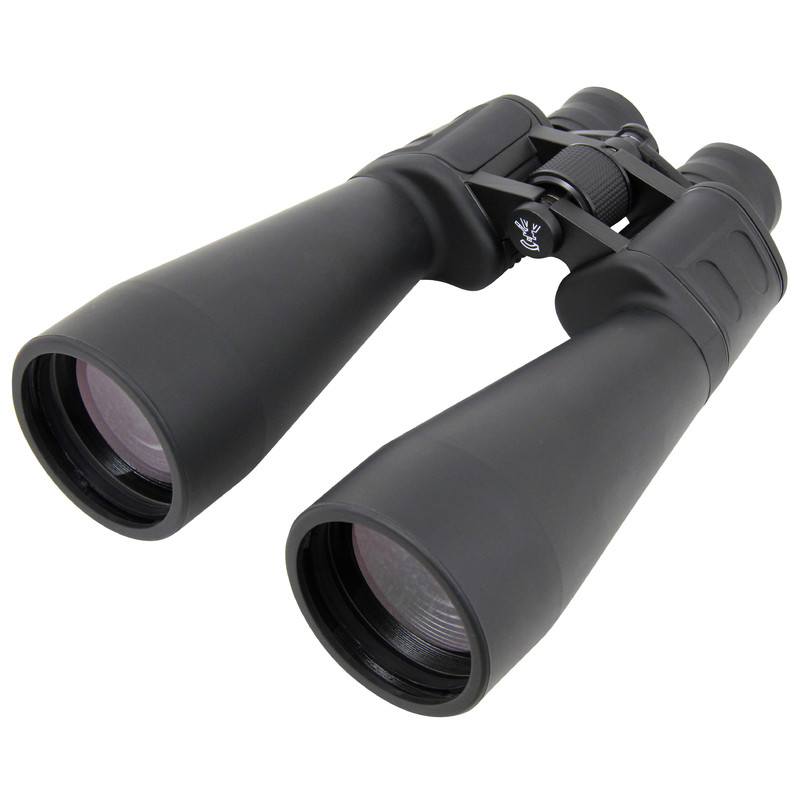
The classic astronomy binocular: 70 mm gathers twice the light of a 50 mm, and 1.5 kg is still manageable when braced.
Price: € 119
Frequently asked questions about the Southern Cross
Where can you see the Southern Cross?
In full south of about 27 degrees north, and well only south of about 17 degrees north. South Africa, Namibia, Australia, New Zealand and South America are ideal.
Can you see the Southern Cross from the US?
From most of the country, no – at no time of year or night. Even at its best, Acrux stays 14 degrees below the horizon in New York and 7 degrees below in Los Angeles. Only South Florida, the Rio Grande Valley, Hawaii and the US territories get a view.
Can you see the Southern Cross from Hawaii or Florida?
From Hawaii, yes, low in the south: Acrux reaches 5 to 7 degrees, and about 8 degrees from the summit of Haleakalā. In Florida only south of Lake Okeechobee, with Acrux just 1 to 2 degrees above the sea horizon. The best time is March to May around midnight.
How do you find the Southern Cross?
First look for the bright Pointers, Alpha and Beta Centauri – their line points to the small Cross west of them. A cross without such pointers is usually the larger False Cross made of Avior, Aspidiske, Markeb and Delta Velorum.
What does the Southern Cross mean?
For navigators it was the signpost to the south and a Christian symbol; today it stands for the Southern Hemisphere and its countries.
Which flags show the Southern Cross?
The national flags of Australia, New Zealand, Brazil, Samoa and Papua New Guinea.
What is the Southern Cross called in Latin? (crossword)
CRUX – four letters, genitive Crucis. The brightest star is ACRUX (five letters), the red star at the head GACRUX (six letters).
Keep reading
- Alpha Centauri – the nearest star and brightest of the Pointers
- Galaxies – from the Milky Way to the Magellanic Clouds
- Scorpius constellation – high above the Cross in the southern winter
- All constellations – our catalog at a glance
- Identify constellations – the method that actually works
* Affiliate link: if you buy through this link we may earn a small commission from Astroshop or High Point Scientific, at no extra cost to you.