By Alexander Merz · Updated on · Details checked on 14 September 2026
⚡ The short version
The constellation Cygnus (the Swan) is the most striking figure of the summer and autumn sky: five bright stars form a large cross, which is why it is also called the “Northern Cross”. It lies right in the middle of the band of the Milky Way.
The brightest star in Cygnus is Deneb at 1.25 mag – it marks the tail and is at the same time the northern corner of the Summer Triangle. At the beak stands Albireo, the most colourful double star in the entire sky: golden-yellow and blue, split even in a small telescope.
Best visibility: July to October. In mid-September, around 10 p.m., Deneb stands at 84°, almost exactly at the zenith. It never sets – throughout Central Europe, Cygnus is circumpolar.
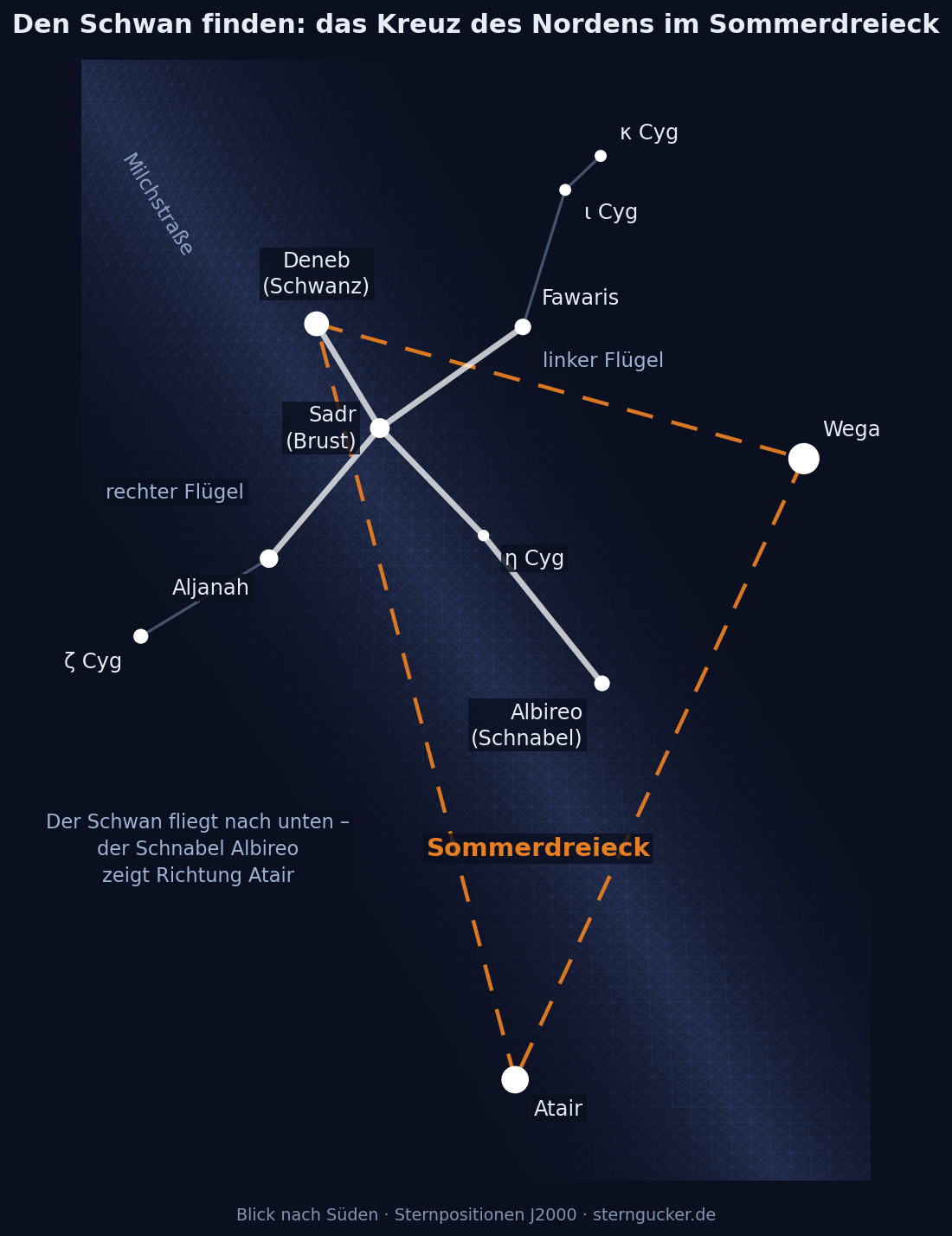
Anyone who looks up in August sees a cross of bright stars standing almost vertically overhead – and behind it, if the sky is dark enough, the milky band of our galaxy. Cygnus is therefore to summer what Orion is to winter: the constellation you orient yourself by throughout the whole season. Except that it doesn’t disappear after a few months – it stays above the horizon all year round.
On this page you’ll find everything about the constellation: how to find it in seconds, what its stars are and how far away they lie, which nebulae and star clusters are worth it, what the deal is with the first known black hole – and, because people search for it particularly often, the answers to the crossword clue too.
Cygnus at a glance: fact file with all the key figures
| Feature | Value |
|---|---|
| Latin name | Cygnus (genitive: Cygni) |
| Abbreviation | Cyg |
| English name | Cygnus, the Swan, colloquially the “Northern Cross” |
| Area | 804 square degrees – rank 16 of 88 constellations |
| Brightest star | Deneb (α Cygni), 1.25 mag |
| Stars brighter than 3 mag | 4 |
| Right ascension | 19h 07.3m to 22h 02.3m |
| Declination | +27.73° to +61.36° |
| Midnight culmination | 29 June |
| Best visibility | July to October in the evening sky |
| Visibility in Central Europe | all year round – circumpolar |
| Neighbouring constellations | Cepheus, Draco, Lyra, Vulpecula, Pegasus, Lacerta |
| Best-known objects | North America Nebula NGC 7000, Veil Nebula (Cirrus), Albireo, Cygnus X-1 |
At 804 square degrees, Cygnus is one of the large constellations – it takes up about two per cent of the entire celestial sphere. More important than its area, however, is its position: the figure lies exactly on the Milky Way, that is, in the plane of our own galaxy. That’s why so many gaseous nebulae, star clusters and dark clouds are packed into such a small space here as almost nowhere else in the northern sky.
How to find Cygnus: from the Summer Triangle to the cross
Finding Cygnus is surprisingly easy, because you don’t have to search for it – it stands out on its own. A systematic approach helps nonetheless, especially if you’re not yet familiar with the sky.
To the Northern Cross in four steps
- Choose the time. Between July and October, from about an hour after sunset. In high summer in northern Germany, it hardly gets properly dark before 11 p.m.
- Look up. Look south to south-east, then tilt your head far back – in late summer Cygnus stands almost at the zenith.
- Identify the Summer Triangle. Three very bright stars form a widely stretched triangle: Vega (the brightest, in the west), Altair (the southernmost) and Deneb. Deneb is the faintest of the three – remember that, it’s the quickest test.
- Trace the cross starting from Deneb. From Deneb a chain of fainter stars extends to the south-west: first Sadr in the middle, then on to Albireo. Crossways to it stand Fawaris and Aljanah – and the cross is complete.
The most important distances in the cross
All the following values are calculated using the stars’ own J2000 coordinates. For orientation: the full Moon is 0.5° wide, an outstretched hand’s width in the sky corresponds to about 20°.
| Stretch | Angular distance | What you see |
|---|---|---|
| Deneb → Sadr | 6.13° | tail to breast – a good dozen full Moons |
| Sadr → Albireo | 16.24° | breast to beak, the long neck |
| Deneb → Albireo | 22.29° | the entire long axis of the cross |
| Fawaris → Aljanah | 16.19° | the wingspan |
| Sadr → Fawaris | 8.39° | left wing from the breast |
| Sadr → Aljanah | 7.89° | right wing from the breast |
| Deneb → Vega | 23.85° | the short side of the Summer Triangle |
| Deneb → Altair | 38.01° | the long side of the Summer Triangle |
The long axis of the cross, at a good 22°, is therefore about as long as an outstretched hand’s width plus the thumb. That’s the reason Cygnus never quite fits into the field of view of binoculars – and why it works so well with the naked eye.
The most reliable identification test
You can really only confuse Cygnus with the Summer Triangle itself. Two features make it unmistakable: first, the Milky Way, which runs exactly through the long axis of the cross – no other bright cross in the northern sky lies like that. Second, the direction of flight: the tail (Deneb) is always at the top, the beak (Albireo) at the bottom towards Altair. So the swan flies downwards across the sky, neck first.
Visibility over the course of the year: when Cygnus stands highest
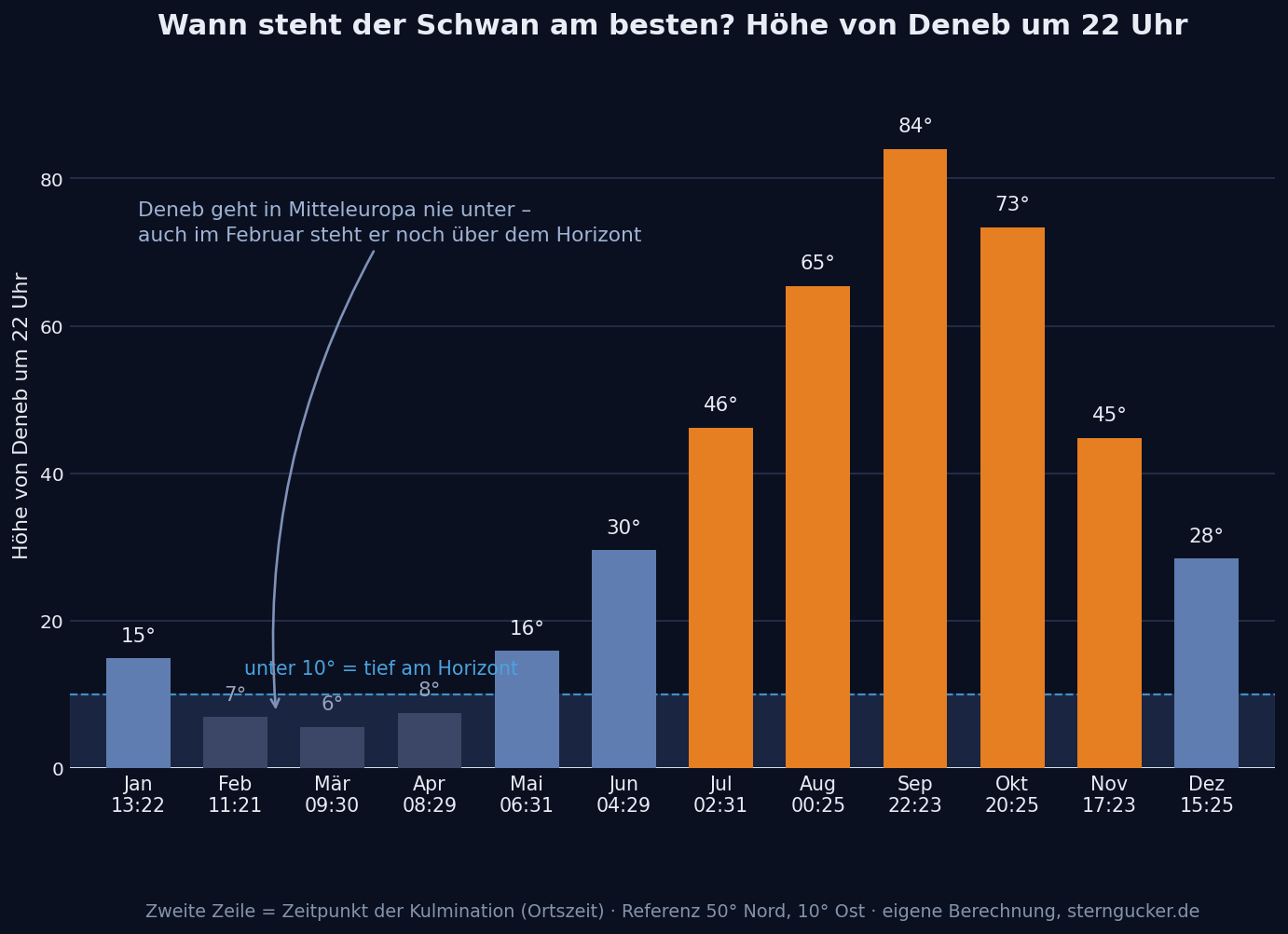
The altitude of Deneb month by month
The table shows how high Deneb stands on the 15th of each month at 10 p.m. local time, calculated for 50° North (roughly Frankfurt/Mainz) and 10° East. Along with the time at which it reaches its highest point on that day.
| Month | Deneb at 10 p.m. | Sadr at 10 p.m. | Culmination of Deneb | Assessment |
|---|---|---|---|---|
| January | 14.9° | 8.8° | 1:22 p.m. | low in the north-west, in the evening |
| February | 6.9° | 1.3° | 11:21 a.m. | unfavourable – just above the horizon |
| March | 5.6° | 1.0° | 9:30 a.m. | annual minimum in the evening sky |
| April | 7.5° | 3.7° | 8:29 a.m. | low in the north, barely usable |
| May | 15.9° | 13.6° | 6:31 a.m. | rises again on the north-east horizon |
| June | 29.6° | 28.8° | 4:29 a.m. | in the north-east, but bright nights |
| July | 46.2° | 46.5° | 2:31 a.m. | good – the season begins |
| August | 65.4° | 66.0° | 0:25 a.m. | very good, high in the east |
| September | 84.0° | 80.3° | 10:23 p.m. | optimal – almost at the zenith |
| October | 73.4° | 67.9° | 8:25 p.m. | very good, dark early |
| November | 44.8° | 39.0° | 5:23 p.m. | good, stands vertically in the west |
| December | 28.4° | 22.3° | 3:25 p.m. | sinks towards the north-west horizon |
The best date follows directly from this calculation: on 20 September Deneb culminates at 10:03 p.m. local time – Cygnus then stands at its highest point at the most comfortable time, and it is already completely dark. Anyone observing in August simply waits until midnight; in July until about half past two.
November is interesting too: Deneb then stands at 44.8° in the west-north-west – and precisely vertically above Albireo. In late autumn, therefore, the cross stands upright above the western horizon, beak pointing down. It’s the most impressive sight of the whole year, even if the altitude is no longer the best.
Culmination altitudes for eleven cities
How high Cygnus stands at most where you are depends only on the geographical latitude. The values apply to the upper culmination, that is, the highest point of the day.
| City | Deneb | Sadr | Aljanah | Albireo | Deneb at lowest point |
|---|---|---|---|---|---|
| Hamburg | 81.7° | 76.7° | 70.4° | 64.4° | 8.8° |
| Berlin | 82.8° | 77.7° | 71.5° | 65.4° | 7.8° |
| Dresden | 84.2° | 79.2° | 72.9° | 66.9° | 6.3° |
| Cologne | 84.3° | 79.3° | 73.0° | 67.0° | 6.2° |
| Frankfurt | 85.2° | 80.1° | 73.9° | 67.8° | 5.4° |
| Stuttgart | 86.5° | 81.5° | 75.2° | 69.2° | 4.1° |
| Vienna | 87.1° | 82.0° | 75.8° | 69.8° | 3.5° |
| Munich | 87.1° | 82.1° | 75.8° | 69.8° | 3.4° |
| Zurich | 87.9° | 82.9° | 76.6° | 70.6° | 2.7° |
| Graz | 88.2° | 83.2° | 76.9° | 70.9° | 2.4° |
| Bern | 88.3° | 83.3° | 77.0° | 71.0° | 2.2° |
In Bern and Graz, Deneb misses the zenith by less than two degrees – there, in September, Cygnus stands practically vertically overhead. For the observer that’s a double-edged pleasure: the layer of air is minimal and the images are pin-sharp, but the neck protests. With Cygnus, a deckchair is not a comfort but a piece of equipment.
Why Cygnus never sets completely
The last column of the table is the real punchline: it shows how high Deneb still stands at its lowest point. In Hamburg that’s 8.8°, in Bern still a full 2.2° – but everywhere in Central Europe the value stays positive. So Deneb never sets. It is, just like the Little Dipper or Cassiopeia, circumpolar.
The same applies to Sadr, Fawaris and κ Cygni. Only the more southerly parts of the figure dip below the horizon: at 50° North, Aljanah stays above the horizon 19 hours 07 minutes per day, Albireo 17 hours 14 minutes. So Cygnus doesn’t really disappear in spring – it just stands so low in the north and during such short nights that no one pays it any attention.
The stars of Cygnus: from Sadr to the record sprinter
| Star | Designation | Brightness | Distance | Type | Position in the figure |
|---|---|---|---|---|---|
| Deneb | α Cygni | 1.25 mag | around 2,600 ly | A2 Ia – blue supergiant | tail |
| Sadr | γ Cygni | 2.20 mag | around 1,800 ly | F8 Ib – yellow supergiant | breast |
| Aljanah | ε Cygni | 2.48 mag | 72 ly | K0 III – red giant | right wing |
| Fawaris | δ Cygni | 2.87 mag | 165 ly | A0 IV – subgiant | left wing |
| Albireo | β Cygni | 2.92 mag | 328 / 389 ly | K3 II + B8 Ve – double star | beak |
| 61 Cygni | 61 Cyg | 5.21 / 6.03 mag | 11.4 ly | K5 V + K7 V – dwarfs | vicinity |
| χ Cygni | χ Cyg | 3.2 to 14.2 mag | around 600 ly | Mira variable | neck |
| P Cygni | 34 Cyg | 3 to 6 mag | 5,000–6,000 ly | luminous blue variable | breast area |
Sadr, the heart of the cross
Sadr (γ Cygni) sits exactly at the intersection and is thus the anchor point for everything you look for in Cygnus. The name comes from Arabic and means “breast of the hen” – in the Arabic tradition, the constellation was long a hen, not a swan.
Astronomically, Sadr is a yellow supergiant of type F8 at a distance of around 1,800 light-years. It is thus even farther away than Deneb and yet shines at 2.2 mag – an indication of the amounts of energy involved in this class of star. For observers, Sadr is above all one thing: the best starting point. The Crescent Nebula lies 2.73° away, the star cluster M 29 only 1.77°.
Albireo, the most colourful double star in the sky
If a constellation has a flagship, it’s Cygnus with Albireo. In binoculars it is a single star of 2.92 mag; from about 30× magnification it splits into two – and into two stars of strikingly different colour at that: the brighter component (3.1 mag, spectral type K3 II) golden-yellow to orange, the fainter one (5.1 mag, B8 Ve) distinctly bluish.
The separation is 34.6 arcseconds (position angle 54°, as of 2020) – that’s so wide that even a very small telescope is enough and you don’t even need to focus particularly sharply. Albireo is therefore the classic first object you show your guests.
Is Albireo even a genuine double star?
Probably not. The Gaia DR2 measurements gave 328 ± 21 light-years for the bright component, but 389 ± 8 light-years for the blue one. So the two stand a good 60 light-years apart, one behind the other, and are most likely an optical double star – two independent stars that happen to lie in almost the same direction. That changes nothing about the view in the eyepiece, but it’s a nice example of how much our picture of the sky has shifted thanks to precise distance measurement.
Fawaris and Aljanah, the wingtips
Fawaris (δ Cygni, 2.87 mag) marks the left wingtip and is a close double star: the companion has 6.33 mag and orbits the main star in 780 years at a mean distance of 157 astronomical units. For amateur telescopes it is a real challenge, because the difference in brightness is so great.
Aljanah (ε Cygni, 2.48 mag) on the other side is, at 72 light-years, the nearest bright star of the figure. Its name was only officially fixed by the IAU in 2017 – before that it usually went by “Gienah”, which, however, was also used for a star in Corvus. That’s why both still turn up to this day in older star charts and in crosswords.
61 Cygni, the star with record speed
An inconspicuous little star of 5.2 mag, which you can only just make out with the naked eye under a very dark sky – and yet one of the most important stars in the history of astronomy. 61 Cygni stood out as early as the 18th century because of its enormous proper motion: 5.28 arcseconds per year. That sounds like little, but it adds up to 8.8 arcminutes in a century; to cover the distance of a full-Moon diameter, the star needs about 341 years.
This conspicuousness gave Friedrich Wilhelm Bessel the idea that the star must be nearby. In 1837/38 he succeeded in making the first successful parallax measurement ever, on 61 Cygni: 0.31 ± 0.02 arcseconds. For the first time, the distance of a star had thus been measured directly – the starting point for everything we express today in light-years. The modern value is 11.4 light-years; 61 Cygni is thus one of the nearest star systems of all. In binoculars, the two orange dwarfs are cleanly separated.
Variable stars in Cygnus
χ Cygni in the neck is a Mira star and fluctuates between 3.2 and 14.2 mag – that’s one of the largest brightness ranges of all known variables. At maximum it is visible to the naked eye; at minimum you need a larger telescope.
P Cygni belongs to the rare class of luminous blue variables. It had suddenly brightened in the 17th century and has fluctuated between 3 and 6 mag ever since. And then there’s also KIC 8462852, which became known in the media as “Tabby’s Star”: the F3 star, 1,400 light-years away, showed irregular dips in brightness in the Kepler data set that were briefly even discussed as a hint of an extraterrestrial megastructure. Today, dust is regarded as the far more plausible explanation.
The brightest star in Cygnus: a portrait of Deneb
The brightest star in the constellation Cygnus is Deneb, with an apparent magnitude of 1.25 mag. It thus takes 19th place in the ranking of the brightest stars in the entire sky. The name comes from the Arabic ḏanab ad-dajāja – “tail of the hen”.
What makes Deneb special is not its apparent brightness but the distance from which it delivers it. Vega in the Summer Triangle stands 25 light-years away, Altair 17 – Deneb, by contrast, around 2,600 light-years. This value is not certain: the parallax from the Hipparcos satellite gives only about 1,400 light-years, and Deneb is too bright for Gaia.
Deneb in figures
- Spectral type A2 Ia – a blue-white supergiant of the highest luminosity class
- 20 to 25 solar masses
- around 200 solar diameters – if it stood in the Sun’s place, it would reach almost to the Earth’s orbit
- 100,000 to 250,000 solar luminosities
- prototype of the Alpha Cygni variables: non-radial pulsations cause its brightness to fluctuate by a few hundredths of a magnitude
If Deneb stood at Vega’s position, it would be about as bright as the crescent Moon – you could read by its light. Stars of this mass live only a few million years and end as a supernova. For Deneb that’s the most likely outcome, even if no one can say when. We present it in detail in its own portrait of Deneb.
Star in Cygnus with 5 letters: all the crossword answers
“Star in Cygnus” is one of the most frequent crossword clues from astronomy. The answer sought depends on the number of letters – here are all the common solutions at a glance.
| Letters | Solution | Explanation |
|---|---|---|
| 4 | SADR | γ Cygni, the star in the breast of the swan |
| 5 | DENEB | α Cygni, the brightest star in Cygnus – the most frequent solution |
| 6 | GIENAH | older name of ε Cygni (today officially Aljanah) |
| 6 | CYGNUS | the Latin name of the constellation itself |
| 4 | SWAN | the constellation is wanted, not the star |
| 7 | ALBIREO | β Cygni, the colourful double star in the beak |
| 7 | ALJANAH | ε Cygni, the official IAU name since 2017 |
| 7 | FAWARIS | δ Cygni at the left wingtip |
For five letters the answer is practically always DENEB. If the clue asks for the “brightest star in the constellation Cygnus”, it’s Deneb too. If, however, the crossword asks for a “double star in Cygnus”, the solution is ALBIREO. If you need still more star names: our constellation overview lists the main stars of all the large figures.
Deep-sky in Cygnus: nebulae, star clusters and the Milky Way
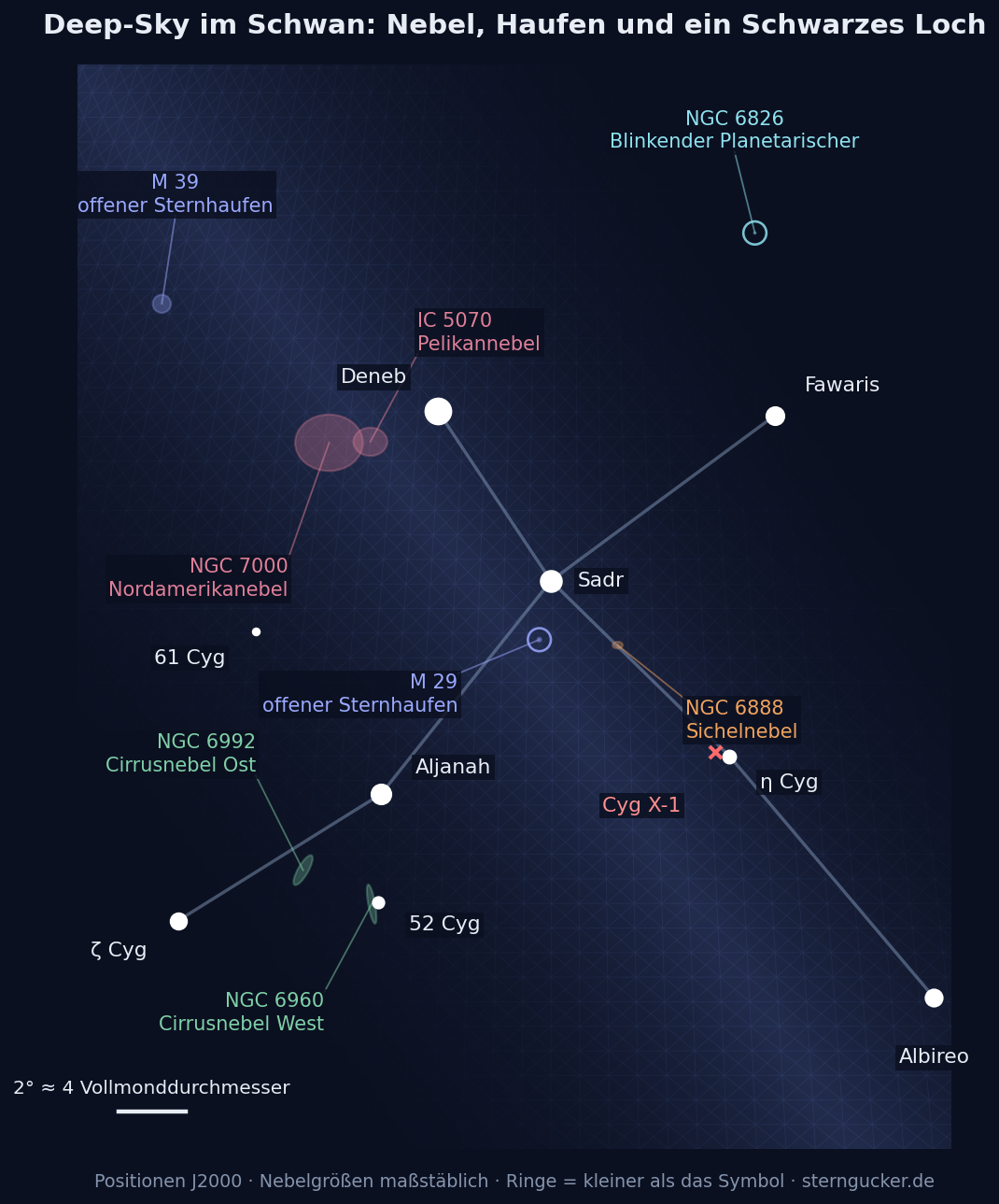
No other constellation in the northern sky offers so much in such a small area. The reason is its position in the plane of the Milky Way: here we look directly into the Orion Arm of our galaxy and gaze through thousands of light-years of gas, dust and star-forming regions.
NGC 7000, the North America Nebula
The most famous nebula in Cygnus lies only 3.22° east of Deneb. Its total brightness of 4.0 mag sounds impressive, but is misleading: it is spread over 120 × 100 arcminutes – an area larger than four full Moons side by side. The surface brightness is correspondingly low.
It was discovered by Wilhelm Herschel on 24 October 1786; its characteristic shape, however, only revealed itself in 1891 on the photographic plates of Max Wolf, who also gave it its name. The dark bay that forms the “Gulf of Mexico” is a dust cloud in the foreground. Distance: 2,000 to 3,000 light-years. Right next to it stands the Pelican Nebula (IC 5067/5070), separated from the North America Nebula only by this same dark cloud.
Visually: under a truly dark sky, NGC 7000 can be guessed at with the naked eye as a brightening. In binoculars it is one of the most rewarding objects of all – provided the field of view is large enough. In a telescope at high magnification, by contrast, you see almost nothing, because you only catch a section of it. A classic case of dark sky doing more than aperture.
The Veil Nebula, a supernova remnant
The Veil Nebula (also known as the Cirrus Nebula) is what remains of a supernova about 8,000 years ago. The explosion cloud has since expanded to 230 × 160 arcminutes – almost four degrees, that is, eight times the diameter of the full Moon. Distance about 2,500 light-years.
The complex bears several catalogue numbers, because it was initially thought to be separate nebulae: NGC 6960 (the western arc, right by the star 52 Cygni), NGC 6992/6995 (the eastern arc, often called “Witch’s Broom”) as well as NGC 6974, NGC 6979 and IC 1340 as connecting pieces. Wilhelm Herschel discovered the first part on 5 September 1784.
Without a filter, nothing will come of it
The Veil Nebula is the prime example of an object where a narrowband filter makes the difference between “nothing to see” and “spectacular”. It radiates almost all its light in a few narrow emission lines; a UHC or OIII filter lets exactly these through and blocks out the rest of the sky background.
An affordable entry point is the Omegon Pro UHC 1.25″ for around € 59*. On the same evening it also shows considerably more on the North America Nebula and the Crescent Nebula.
NGC 6888, the Crescent Nebula
Only 2.73° from Sadr stands the Crescent Nebula – a bubble of gas that the Wolf-Rayet star WR 136 shed in its final phases of life and that its stellar wind is now inflating from within. Distance 4,700 light-years, discovered by Wilhelm Herschel on 15 December 1792. Visually it is demanding and likewise needs a filter; photographically it is one of the most popular subjects of the summer sky.
M 39 and M 29, the two star clusters
M 39 is an open star cluster of 4.6 mag, a good 9.16° north-east of Deneb. At 32 arcminutes in diameter it is as large as the full Moon and consists of about 80 stars at a distance of around 1,000 light-years; its age is 230 to 300 million years. Messier entered it in his catalogue on 24 October 1764. Because it is so spread out, it looks better in binoculars than in any telescope.
M 29, by contrast, is compact: 6.6 mag, only 7 arcminutes across, at a distance of 4,000 light-years – and, at 1.77° south of Sadr, very easy to find. Because of the arrangement of its brightest members, it is occasionally called the “little Pleiades”, which, however, flatters its appearance.
NGC 6826, the Blinking Planetary
A small planetary nebula at a distance of 3,600 light-years with a remarkable effect: if you look directly at the central star, the nebulous shell disappears; if you look just off to the side, it jumps back into view. This is because the sharper vision at the centre of the retina is less sensitive to light than indirect vision. The effect can be switched back and forth within seconds and is one of the finest demonstrations of indirect vision of all. A little farther south stands, with NGC 7027 (3,000 light-years), a second, even smaller planetary.
Cygnus OB2 and the Milky Way
Behind all this lies one of the most massive star-forming regions in our galaxy. Cygnus OB2, at a distance of 4,500 light-years, contains around 30,000 solar masses and between 60 and 120 stars of the hottest O class – except you see hardly any of it, because dust clouds in the foreground swallow the light. The entire Cygnus X region measures 7° × 7° and contains about four million solar masses of gas.
For us at the eyepiece, that simply means: anyone who slowly sweeps binoculars across the Milky Way in Cygnus sees an unbroken succession of star fields, dark clouds and brightenings. That’s one of the most rewarding observations of the year, even without an object list – and a perfect subject for Milky Way photography. Incidentally, Cygnus is also home to Cygnus A, the second-strongest radio source in the sky: an active galaxy at a distance of 650 million light-years, but out of reach for optical telescopes.
Cygnus X-1 in the constellation Cygnus: the first black hole
Six and a half degrees south-west of Sadr, near an inconspicuous 9th-magnitude star, lies the site of one of the most important discoveries of modern astrophysics. Cygnus X-1 was the first object generally recognised as a black hole.
What you see in the telescope is the companion star HDE 226868, a blue supergiant of type O9.7 with 27 solar masses and 200,000 solar luminosities. It became conspicuous because it moves in only 5.6 days around something that itself does not shine – but emits intense X-rays. Tom Bolton demonstrated in 1972 that the invisible component is too massive to be a neutron star. The current VLBA measurements from 2021 give a distance of 7,200 light-years and a mass of 21.2 ± 2.2 solar masses.
The bet that Stephen Hawking lost
In 1975 Stephen Hawking bet Kip Thorne that Cygnus X-1 was not a black hole. Hawking himself later described the bet as an insurance policy: he had worked for years on the theory of black holes – had they not existed, at least the winnings from the bet would have consoled him. In 1990 he conceded defeat and settled the stake, a year’s subscription to a magazine.
Which instrument for Cygnus: binoculars or telescope
With Cygnus, the answer turns out differently from most constellations – and in favour of the cheaper device at that. The reason is the class of objects: the North America Nebula, the Veil Nebula and the Milky Way fields are large and extended. What counts here is a wide field of view, not magnification.
| Instrument | What you see in Cygnus | Price range |
|---|---|---|
| Naked eye | the cross, the Summer Triangle, the band of the Milky Way, χ Cygni at maximum | free |
| 10×50 binoculars | M 39, NGC 7000 as a brightening, 61 Cygni separated, endless star fields | from around €100 |
| Telescope 100–130 mm | Albireo split in colour, M 29, NGC 6826 with the blinking effect | from around €250 |
| Telescope 200 mm + UHC | the Veil Nebula with structure, the Crescent Nebula, NGC 7027 | from around €500 |
Why binoculars actually come out ahead here
A pair of 10×50 binoculars shows a field of view of about 6° – that’s the whole Veil Nebula plus surroundings in a single image. A telescope with 130 mm aperture reaches, even with the widest-angle eyepiece, perhaps 2°. For the North America Nebula that means: the binoculars show the shape, the telescope shows a bright star cluster with no recognisable context. Add to that the fact that binoculars are binocular, ready to use in ten seconds, and can be used lying down – which, with Cygnus close to the zenith, is no small advantage.
The first choice for Cygnus: Celestron Cometron 7x50 Binoculars
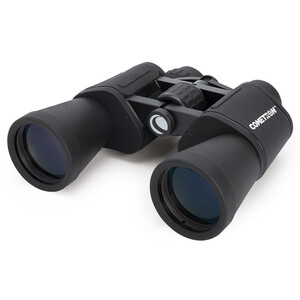
The astronomy classic among affordable binoculars: 7×50 with a large exit pupil for bright handheld views of the Moon and Milky Way – the ideal first step before a telescope.
Price: € 65
Two things matter with astronomy binoculars: 50 mm aperture as the lower limit and a proper coating of the prisms. Cheap glasses from the supermarket show colour fringes on bright stars and considerably less contrast – and it is precisely with the extended nebulae in Cygnus that this makes the difference.
When the telescope is worth it after all
As clear as the advantage of binoculars is: there are several objects in Cygnus that they simply cannot show. Albireo remains a single point in binoculars – the colour effect it is famous for only appears from about 30× magnification. The Blinking Planetary NGC 6826 is just one star among many in binoculars. And M 29 only resolves into individual stars in the telescope.
If you already have the binoculars, or if in the long run you want more than large nebular fields, a compact beginner’s telescope is the sensible addition. The Skywatcher Heritage 130 costs about as much as a good pair of binoculars and, with 130 mm aperture, brings in enough light for Albireo, M 29 and – with a filter – the brightest parts of the Veil Nebula.
If it really has to be magnification: Skywatcher Dobson Telescope N 130/650 Heritage FlexTube
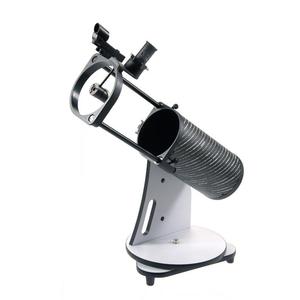
A compact tabletop Dobson with a true parabolic mirror. Folds down, fits in a bag: the Moon, planets and the bright deep-sky classics.
Price: € 265
For the more advanced: Skywatcher Dobson Telescope N 200/1200 Skyliner Classic
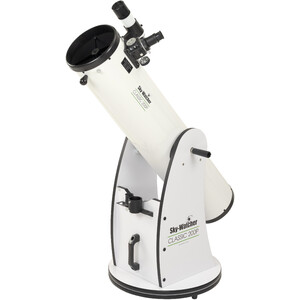
200 mm of aperture — the most sky for your money. Set it on the ground, point by hand: nebulae, clusters and galaxies for years to come.
Price: € 479
The honest order of priority for Cygnus is therefore: first the binoculars, then the filter, then the telescope. If you want to weigh the two against each other, you’ll find the arguments in detail in our direct comparison of telescope vs. binoculars.
* The links marked with an asterisk are affiliate links. If you buy through them, we receive a small commission. The price does not change for you.
Cygnus in mythology: Zeus, Cycnus and Troy
Unlike with Orion, there is not one story about Cygnus but at least four – the Greeks read quite different tales into the same figure.
Zeus and the transformation
The best-known version: Zeus transformed himself into a swan to approach Leda, queen of Sparta. From this encounter came, among others, Helen and the twins Castor and Pollux. In this reading, the swan in the sky is therefore not an animal but a disguised god – a motif taken up countless times in the history of art.
Cycnus and Phaethon
The second tale is the sadder one. Phaethon, son of the sun god, lost control of the sun chariot and plunged into the river Eridanus. His friend Cycnus dived for days in search of the body so that he could bury it. The gods were so moved by this that they transformed him into a swan and placed him in the sky. A third variant tells of a Trojan warrior named Cygnus, whom Neptune transformed into a swan after his death at the hands of Achilles.
Why the Arabs saw a hen
It gets interesting when you look beyond the Greek cultural sphere. In the Arabic tradition the figure was a hen – hence the star names: Deneb means “tail of the hen”, Sadr “breast of the hen”. Both names survived the reinterpretation into Greek and Latin and appear in the star charts to this day. You’ll find more about the names and boundaries of the 88 modern constellations in our constellation catalogue.
Is Cygnus a zodiac sign: the honest answer
No. Cygnus is a constellation, but not a zodiac sign – and that is not a matter of interpretation but a matter of geometry.
Zodiac signs are the twelve segments of the ecliptic, that is, the apparent annual path of the Sun. Only constellations through which this path runs can be zodiac signs at all. Cygnus lies, with declinations of +27.7° to +61.4°, far in the north – the ecliptic reaches at most +23.4°. So the Sun cannot travel through Cygnus at all.
Anyone searching for a “Cygnus zodiac sign” therefore almost always means one of two things: either the constellation itself, or a swan symbol from another system – for example from the Celtic tree or animal zodiac, which has nothing to do with astronomy. How constellations and zodiac signs drifted apart, and why they are now shifted by almost a whole segment, we explain under Zodiac signs and constellations.
Deneb as a future pole star: precession explained
The Earth’s axis wobbles like a spinning top and describes a complete cone in about 25,800 years. The celestial north pole thereby migrates across the starry sky – and with it the answer to the question of which star is the “pole star” at any given time. Cygnus lies exactly on this path.
| Year | Deneb | Fawaris | Vega | What happens in the sky |
|---|---|---|---|---|
| 2026 (today) | 44.6° | 44.8° | 51.2° | Polaris is closest to the pole |
| 8000 | 15.5° | — | — | Deneb moves visibly closer |
| 9800 | 7.9° | — | — | Deneb becomes the guiding star of the north |
| 10000 | 7.6° | — | — | smallest distance for Deneb |
| 11250 | 9.9° | 3.9° | — | Fawaris reaches its minimum |
| 13000 | — | — | 8.0° | Vega takes over the role |
Deneb therefore never comes as close to the pole as Polaris does today – at 7.6° it remains a “pole star” only in the broader sense. Fawaris nonetheless manages 3.9° around the year 11250, and the north pole only becomes truly bright around the year 13000, when Vega takes over the role. For the people of those epochs, Cygnus will be what the Little Dipper is today: the figure you orient yourself by.
The Kappa Cygnids: shooting stars from Cygnus
Cygnus has its own meteor shower, even if it stands in the shadow of its more famous neighbours. The Kappa Cygnids are active from 3 to 25 August, the maximum falls around 17/18 August; their radiant lies about 5° north of the star κ Cygni on the north-western wing.
The fall rates are modest: the ZHR is normally about 3 meteors per hour; in the years 2000 and 2014 up to 6 were reached. What makes up for the Kappa Cygnids is their character – they are strikingly slow and produce an above-average number of bright fireballs.
In practice this means: anyone out in August for the Perseids sees the Kappa Cygnids into the bargain. You recognise them by the fact that their trails come from a different direction and cross the sky considerably more leisurely. All the dates of the year are in our shooting-star calendar.
The Kepler field in Cygnus: the hunt for exoplanets
When NASA launched the Kepler space telescope in 2009, it had to decide on a single patch of sky that the instrument was to stare at continuously for four years. The choice fell predominantly on Cygnus – for two reasons: the field lies far enough from the ecliptic that the Sun never interferes, and, owing to its position in the plane of the Milky Way, it contains an exceptional number of stars in a small area.
The result was more than 2,700 confirmed exoplanets. Among the best-known finds are the compact six-planet system Kepler-11 and Kepler-22b, the first confirmed planet in the habitable zone of a Sun-like star. So if you look up at Cygnus in September, you are gazing at the most thoroughly surveyed region of the sky there is – named after Johannes Kepler, whose laws still underpin every one of these orbital determinations to this day.
Frequently asked questions about the constellation Cygnus
What is the name of the brightest star in the constellation Cygnus?
Deneb, also called α Cygni, at 1.25 mag. It is the 19th-brightest star in the entire sky and marks the tail of the swan. Its name means “tail of the hen” in Arabic.
Why is Cygnus called the “Northern Cross”?
Because its five brightest stars form a distinct cross: Deneb, Sadr and Albireo lie on a 22° axis, Fawaris and Aljanah stand crossways to it. The name sets the figure apart from the Southern Cross, which remains invisible to observers in the northern hemisphere – the Northern Cross being considerably larger, moreover.
When can the constellation Cygnus be seen best?
From July to October in the evening sky, optimally in mid-September around 10 p.m., when Deneb stands at 84°, almost at the zenith. Fundamentally, however, Cygnus is above the horizon all year round in Central Europe, because it is circumpolar.
What animal is the constellation Cygnus meant to represent?
A swan in flight – Latin cygnus. In Arabic astronomy, by contrast, the same figure was interpreted as a hen, which is where the star names Deneb (“tail of the hen”) and Sadr (“breast of the hen”) go back to, to this day.
How far is Deneb from Earth?
Around 2,600 light-years, with estimates ranging from about 1,400 to 2,600. So the light we see from it today left it, depending on the value, in ancient Greek times or in the early Middle Ages. For comparison: Vega in the same Summer Triangle is only 25 light-years away.
Can you see the North America Nebula without a telescope?
Under a very dark sky, yes – it then appears as a faint brightening next to Deneb. Binoculars show it much better than a telescope, because at two degrees in extent it is larger than the field of view of most telescopes. From an urban location it is practically invisible.
How do I split Albireo into its two stars?
From about 30× magnification. The separation of 34.6 arcseconds is so wide that any small telescope, and even some strongly magnifying binoculars, is enough. A moderate magnification is important – at too high a magnification the colours lose saturation.
Does Deneb belong to the constellation Cygnus or to the Summer Triangle?
To both. Deneb is the main star of Cygnus and at the same time one of the three corners of the Summer Triangle, together with Vega in the constellation Lyra and Altair in Aquila. The Summer Triangle is not a constellation but an asterism – a helpful memory figure with no official status.
What is visible to the naked eye in Cygnus?
The cross of five stars, the band of the Milky Way running right through it, under a very dark sky the North America Nebula as a brightening, and at maximum also the variable χ Cygni. For everything else you need at least a pair of binoculars.
Why does Cygnus stand vertically in November?
Because the figure rotates with the Earth’s rotation around the celestial pole. In late autumn Deneb stands high in the west-north-west in the evening, Albireo directly below it – the long axis of the cross then points almost vertically downwards. In summer, by contrast, the same axis lies at an angle above the eastern horizon.
Further reading on Sterngucker
- Deneb – the detailed portrait of the main star
- Summer Triangle – the memory figure in which Cygnus is nestled
- Constellation Lyra – the western neighbour with Vega and the Ring Nebula
- The Milky Way – why there is so much to see in Cygnus
- Black holes – the physics behind Cygnus X-1
- Deep-sky objects – nebulae, clusters and galaxies at a glance
- The night sky in September – when Cygnus stands at the zenith
- Working with a star chart – for everything that comes next
- All constellations at a glance – the entry point to our catalogue