By Alexander Merz · Published on · Details checked on 14 October 2026
Johannes Kepler (1571–1630) was a German astronomer and mathematician who discovered that the planets travel around the Sun on ellipses. His three laws of planetary motion still describe those orbits today.
More on this topic: the planets of our solar system.
| Born | 27 December 1571 in Weil der Stadt (Württemberg) |
| Died | 15 November 1630 in Regensburg |
| Occupation | astronomer, mathematician, optician, court astrologer |
| Famous for | the three Keplerian laws of planetary motion |
| Main works | Astronomia nova (1609), Harmonices mundi (1619), Rudolphine Tables (1627) |
| Employers | Emperors Rudolf II, Matthias and Ferdinand II, from 1628 Wallenstein |
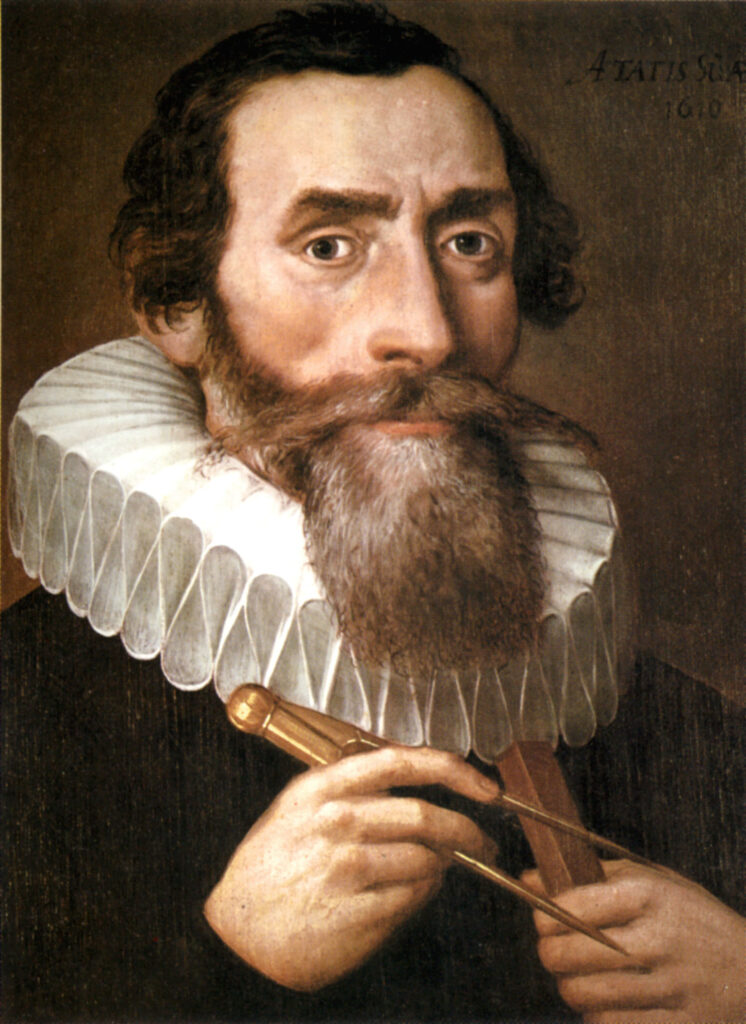
Johannes Kepler explained for kids
A good 400 years ago many people still thought every planet had to move on a perfect circle. Kepler spent years calculating and found out that the orbits are slightly stretched, like a flat egg. A shape like that is called an ellipse.
He also noticed that a planet speeds up when it comes closer to the Sun. With his rules it became possible for the first time to predict exactly where a planet would stand on a given day.
Kepler’s life: the key milestones
| Year | Milestone |
|---|---|
| 1571 | born in Weil der Stadt |
| 1591 | master’s degree at the University of Tübingen, where he first encounters the world view of Copernicus |
| 1594 | teacher of mathematics in Graz |
| 1596 | first book, “Mysterium Cosmographicum” |
| 1600 | expelled from Graz as a Protestant, moves to Tycho Brahe in Prague |
| 1601 | imperial court mathematician after Tycho’s death |
| 1609 | “Astronomia nova” with the first and second law |
| 1612 | provincial mathematician in Linz |
| 1615–1621 | defends his mother in her witch trial |
| 1619 | “Harmonices mundi” with the third law |
| 1627 | the Rudolphine Tables appear |
| 1628 | in Wallenstein’s service in Sagan (Silesia) |
| 1630 | dies in Regensburg while travelling |
Kepler found the key to his life’s work in Prague. The Dane Tycho Brahe had collected the most accurate planetary measurements of his time, above all of Mars.
Tycho died in 1601, and Kepler inherited both the data and the post of court mathematician. He spent roughly six years calculating the orbit of Mars before it became clear to him that no circle fits the measurements.
Kepler’s three laws
| Law | What it says | What it means |
|---|---|---|
| 1st law (1609) | planets move on ellipses, with the Sun in one focal point | farewell to the perfect circles |
| 2nd law (1609) | the line from the Sun to the planet sweeps over equal areas in equal times | close to the Sun a planet moves faster |
| 3rd law (1619) | the square of the orbital period is proportional to the cube of the orbital radius | the orbital period gives you the distance from the Sun |
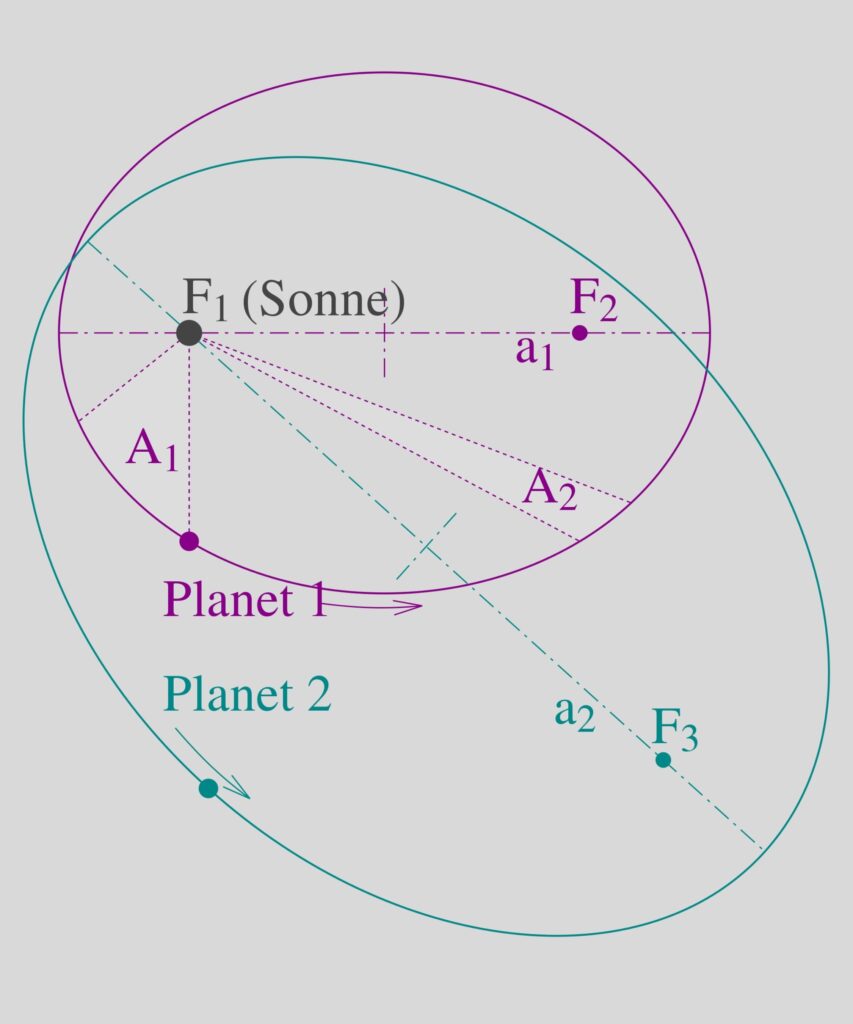
One number makes the third law tangible. Jupiter stands about 5.2 times as far from the Sun as Earth does, so it needs 5.2 to the power of 1.5 ≈ 11.9 years for one orbit. That is exactly what we observe.
With these laws the heliocentric model became superior as a calculation. The physical reason for it only arrived with Isaac Newton’s law of gravitation in 1687.
Kepler’s discoveries and inventions
Besides the laws of planetary motion, Kepler advanced optics and mathematics. The most important items at a glance:
| Year | Discovery or work | What it is about |
|---|---|---|
| 1604 | Kepler’s Star | describes a supernova, the last one in the Milky Way seen with the naked eye |
| 1611 | the Keplerian telescope (“Dioptrice”) | two converging lenses: the image is upside down, but the field of view is wide – the principle behind every astronomical refractor |
| 1611 | treatise on snowflakes | the first to ask why snow crystals are always six-sided |
| 1615 | Kepler’s barrel rule | an approximation formula for the volume of wine barrels |
| 1624 | “Chilias logarithmorum” | his own tables of logarithms, which speed up calculations in astronomy |
| 1627 | Rudolphine Tables | planetary tables, about 30 times more accurate than anything before them |
| 1629 | prediction of the transits of Mercury and Venus in 1631 | the transit of Mercury was indeed observed in 1631 |
| 1634 | “Somnium” (posthumous) | a dream journey to the Moon, counted among the first works of science fiction |
He was right about the tides as well. Kepler suspected an attraction exerted by the Moon; Galileo considered that nonsense.
Kepler as an astrologer: emperors and Wallenstein
As court mathematician Kepler cast horoscopes for Rudolf II, Matthias and Ferdinand II. More than 800 horoscopes in his own hand survive. He had already become known for them in Graz in 1595, when his calendar predictions of cold weather and Turkish incursions came true.
For Albrecht von Wallenstein he drew up a first horoscope in 1608 and a revised version in 1624/25. From 1628 he was in Wallenstein’s service and lived in Sagan, mainly in order to continue work on the Rudolphine Tables.
Kepler himself was critical of reading the stars. He called it astronomy’s “foolish little daughter”, which had to feed its mother, and he refused to give Wallenstein overly precise predictions of the future.
Kepler’s family: wives and children
In 1597 Kepler married Barbara Müller in Graz. The couple had five children; only Susanna and Ludwig reached adulthood. Barbara died in Prague in 1611.
In 1613 he married Susanna Reuttinger from Eferding in Linz. Six children came from this marriage, three of whom died young. His son Ludwig later published Kepler’s “Somnium”, and his daughter Susanna married the astronomer Jakob Bartsch.
From 1615 Kepler’s mother Katharina was accused of being a witch. Kepler took over her defence himself and secured her acquittal in October 1621 after 14 months in custody. She died a few months later, in April 1622.
Faith and expulsion
Kepler was a convinced Lutheran but lived mostly in Catholic countries. In 1600 he had to leave Graz because he refused to convert. In Linz his own Lutheran congregation barred him from communion because he went his own way in matters of faith.
He did not see his work as a contradiction of his faith. For him the mathematical order of the planets was evidence of the Creator’s plan.
What commemorates Kepler today
- The Kepler space telescope (2009–2018): found more than 2,600 confirmed exoplanets, among them Kepler-22b.
- Kepler’s Star (SN 1604): its remnant is a popular target of X-ray astronomy today.
- Places: the Kepler Museum in his birthplace in Weil der Stadt and the Kepler Memorial House in Regensburg.
- Grave: the cemetery in Regensburg was devastated in 1633 during the Thirty Years’ War, and Kepler’s grave has been lost ever since.
Frequently asked questions
Who was Johannes Kepler?
A German astronomer and mathematician (1571–1630). He discovered the elliptical orbits of the planets and formulated the three Keplerian laws.
What did Johannes Kepler discover?
The three laws of planetary motion, the Keplerian telescope, Kepler’s barrel rule and the supernova of 1604. He also created the Rudolphine Tables.
How many children did Johannes Kepler have?
Eleven: five with Barbara Müller and six with Susanna Reuttinger. Many of them died in childhood.
Who was Wallenstein’s astrologer?
Johannes Kepler cast horoscopes for Wallenstein in 1608 and 1624/25 and was in his service from 1628. Later Giovanni Battista Seni was his court astrologer.
Where did Johannes Kepler die?
In Regensburg, on 15 November 1630. His grave was lost during the Thirty Years’ War.
What does Kepler’s third law say?
The square of a planet’s orbital period is proportional to the cube of its mean distance from the Sun. If you know the orbital period, you can calculate the distance.