By Alexander Merz · Published on · Details checked on 14 September 2026
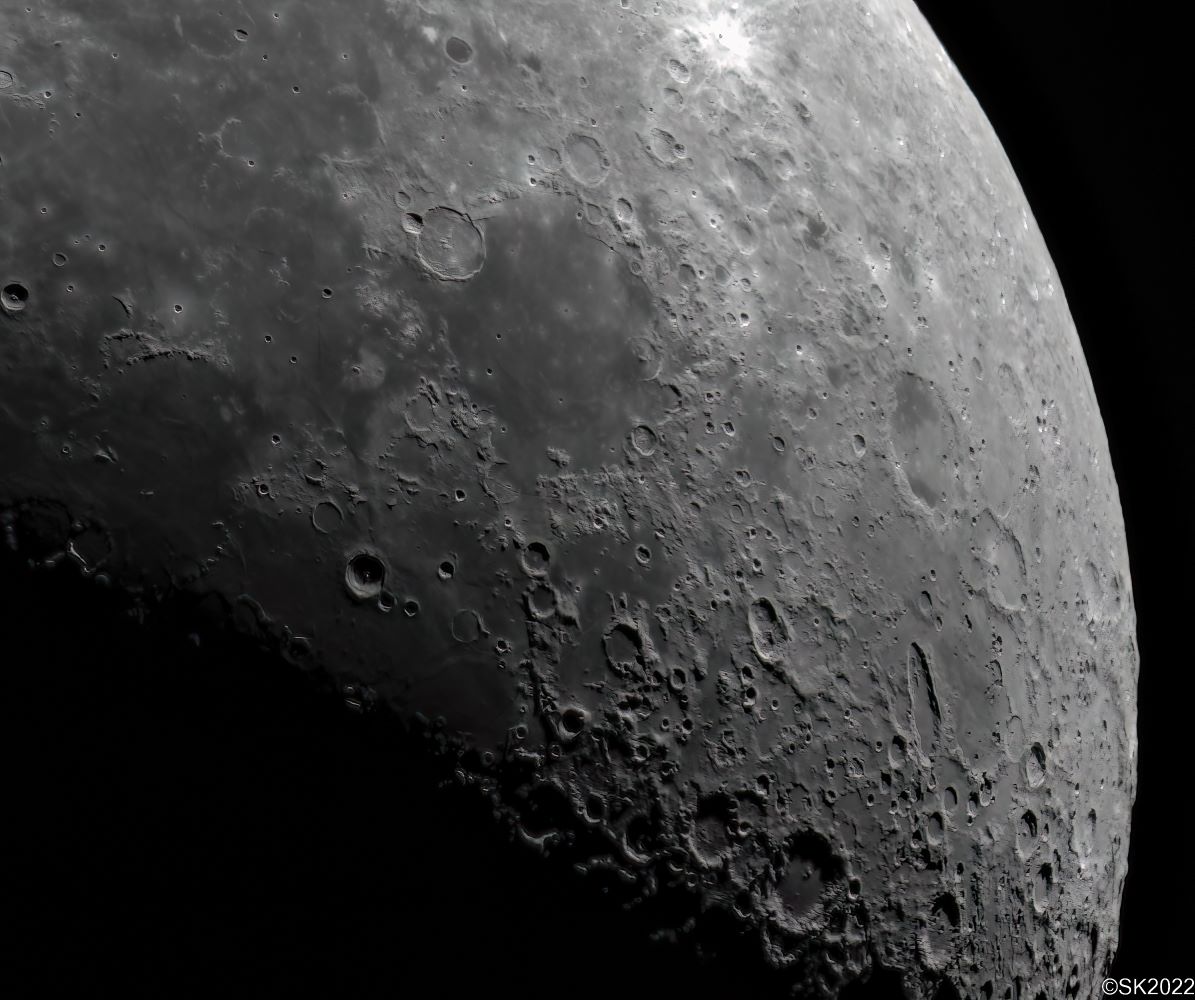
The fascination with the Moon is as old as humanity itself. As our nearest cosmic neighbour, Earth’s satellite has always held a special attraction for us. In this article we turn to a fascinating aspect of the Moon: the Moon’s surface.
The key facts at a glance
- Geology of the Moon’s surface: craters, maria, mountains and regolith
- Formation of the Moon’s surface: theories of origin, impacts and volcanic activity
- Exploration of the Moon’s surface: Luna and Apollo missions, Lunar Reconnaissance Orbiter, Chang’e programme
- Future missions: Artemis programme, Lunar Gateway, international cooperation
- Resources on the Moon’s surface: helium-3, water deposits, in-situ resource utilisation (ISRU)
- Technology development: life-support systems, autonomous robotics, habitat structures
- Science communication: documentaries, books, social media
- Inspiration for future generations: the fascination of the Moon’s surface as a driver of scientific interest and careers in spaceflight and astronomy
- International cooperation and competition: joint projects, space agencies, private space companies
The formation of the Moon and its surface
Theories of the Moon’s origin
The exact origin of the Moon is still a riddle that fascinates scientists. The most widespread and accepted theory is the so-called “giant-impact hypothesis“. According to it, the Moon formed about 4.5 billion years ago, when a roughly Mars-sized celestial body, often called Theia, collided with the young Earth. This enormous collision flung debris into space, which later coalesced under its own gravity and thus formed the Moon.
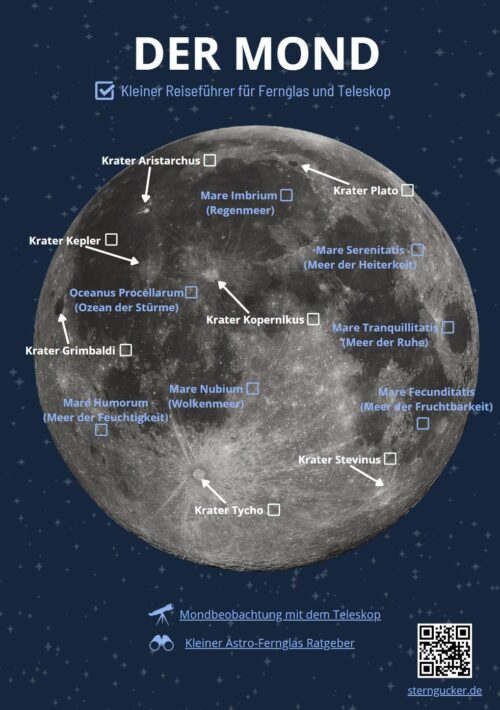
Click the image to download.
The composition and structure of the Moon’s surface
The Moon’s surface is characterised by a multitude of different formations, defined by their history and composition. The main constituents of the Moon’s surface are rocks such as basalt and anorthosite as well as a thin layer of fine, dusty material called regolith. These rocks form the basis for the varied geological formations found on the Moon.
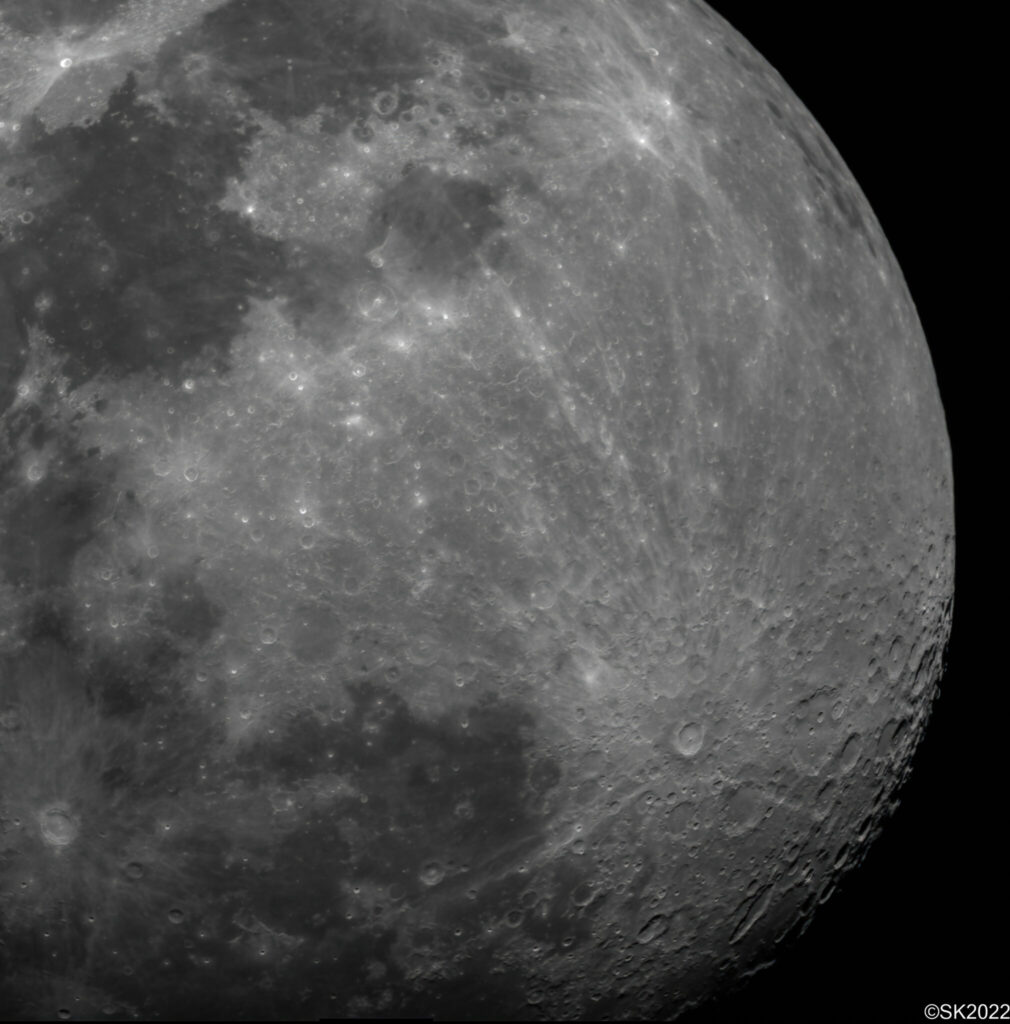
Courtesy of the astrophotographer Stefan Kühn.
The Moon’s surface is divided into two main regions: the highlands and the maria. The highlands are older and lighter in colour, while the maria, which consist of solidified lava seas, are younger and darker. The maria are found mainly on the near side of the Moon, facing Earth.
The formation of lunar craters and mountains
A striking feature of the Moon’s surface are the countless craters, created by meteorite impacts. These craters can have diameters ranging from a few metres to several hundred kilometres.
Among the best-known craters are Tycho (named after Tycho Brahe), Copernicus and Aristarchus. Owing to the lack of an atmosphere and the absence of tectonic activity, the Moon’s craters are preserved over long periods and are only slowly worn down by the action of micrometeorites.
Besides the craters, mountain ranges are also found on the Moon’s surface. They arose above all from the enormous forces that acted during the formation of the maria. The extensive lava seas caused the lunar crust to be pushed apart and mountain ranges to form.
Among the best-known mountain ranges on the Moon are the Apennines, the Alps and the Carpathians, named after their terrestrial counterparts.
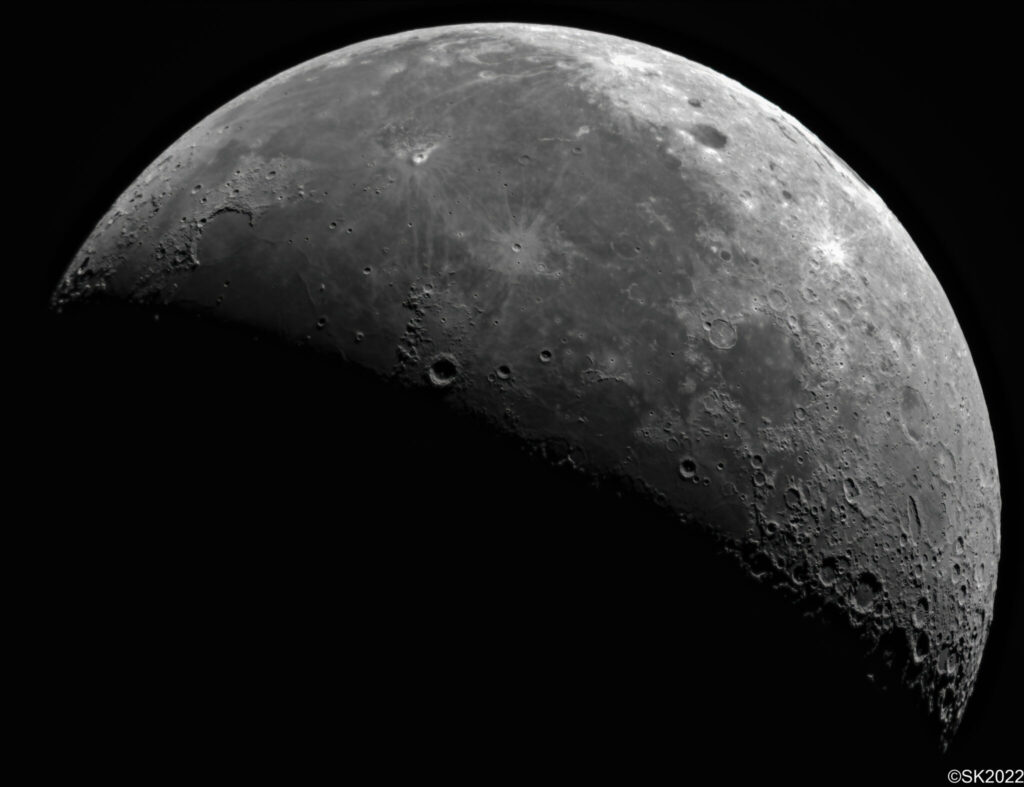
Courtesy of the astrophotographer Stefan Kühn.
The formation of the Moon’s surface is a fascinating chapter in the history of our natural satellite. The varied geological formations and the different types of rock bear witness to the Moon’s complex past and offer unique insights into the processes that led to the
formation of our cosmic companion. Studying the formation and composition of the Moon’s surface not only contributes to our understanding of the Moon, but also helps us to better understand fundamental geological processes throughout the Solar System.
The Moon’s surface is a fascinating and diverse geological archive that preserves the history of the Moon’s formation and development. The countless craters and mountain ranges bear witness to a long and eventful past, shaped by meteorite impacts and volcanic activity.
This history is of interest not only to scientists, but also to astronomy enthusiasts who want to be enchanted by the beauty and mysteries of the Moon’s surface.
The geology of the Moon’s surface
Rock types on the Moon: basalt, anorthosite and regolith
The Moon’s surface consists of a multitude of lunar rocks that reflect different geological processes. Among the most important rock types are basalt and anorthosite.
Basalt is a volcanic rock found mainly in the mare regions. It formed when magma from the Moon’s interior rose to the surface and cooled there. The mare basalts have a dark colour and contain mainly silicates as well as small amounts of iron and titanium.


Anorthosite is a plutonic rock that formed from slowly cooling magma in the Moon’s interior. It makes up the older and lighter highlands of the Moon’s surface. Anorthosite consists predominantly of plagioclase feldspar, a silicate mineral, and, owing to its lower density than basalt, is characteristic of the highlands.
Regolith is a thin layer of fine, dusty material that covers the Moon’s surface. It forms through the constant action of micrometeorites and the breakdown of rock by temperature fluctuations and solar radiation. Regolith consists of tiny rock fragments, minerals and glass beads produced by meteorite impacts.
The maria and highland regions
The Moon’s surface is divided into two main regions: the maria and the highlands. The maria are solidified lava seas found mainly on the near side of the Moon, facing Earth. They formed about 3 to 4 billion years ago, when magma from the Moon’s interior rose to the surface and spread across large basins. The maria have a dark colour, caused by the basaltic rocks of which they consist.
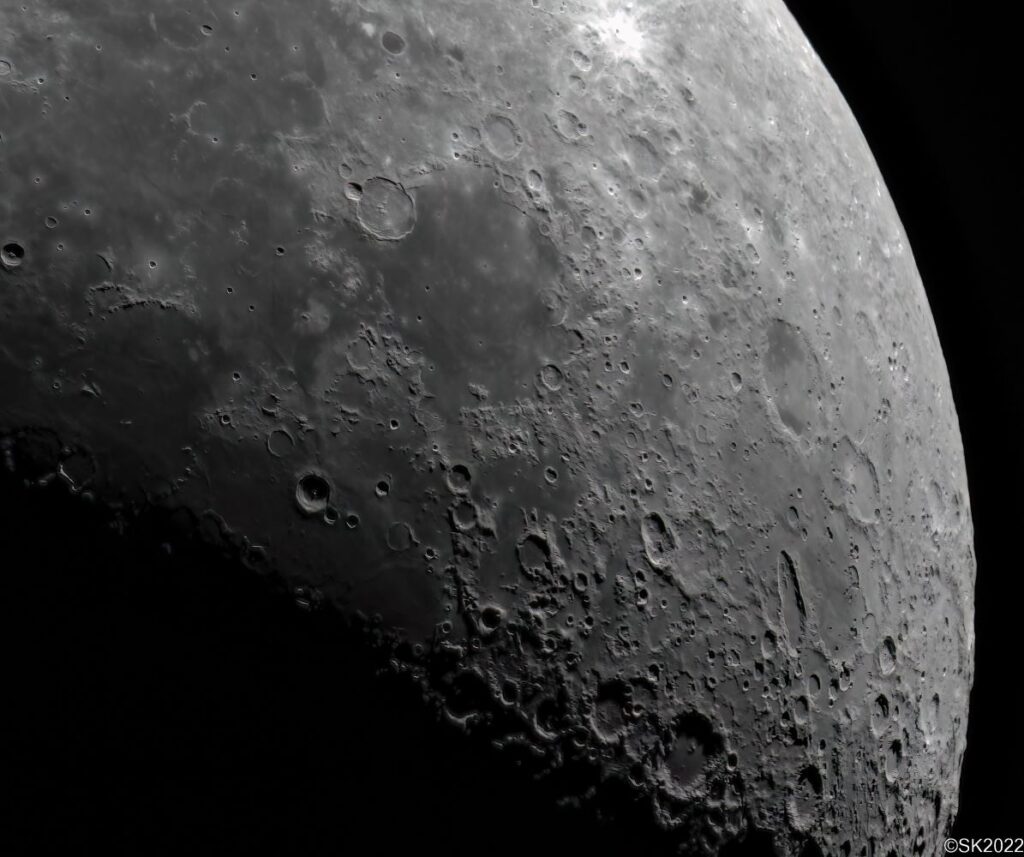
Courtesy of the astrophotographer Stefan Kühn.
The highlands are older and lighter in colour. They consist predominantly of anorthosite and were shaped by the slow cooling of the magma in the Moon’s interior. The highlands are dotted with numerous craters created by meteorite impacts. These craters are less numerous in the mare regions, since the younger basalt flows covered many of the older craters.
Of interest to you:
Unique geological formations: rilles, domes and central peaks
The Moon’s surface features a range of unique geological formations that arouse both scientific interest and aesthetic fascination. These include rilles, domes and central peaks.
Rilles are narrow, elongated channels that stretch across the Moon’s surface. They formed through tectonic processes, volcanic activity or a combination of both. Among the best-known rilles are the Hadley Rille, the Schröter Rille and the Rima Hyginus.
Domes are slightly arched elevations on the Moon’s surface that formed through volcanic activity. They are usually a few kilometres in diameter and have a shallow curvature. Domes are found in both the mare and the highland regions and offer an insight into the Moon’s volcanic past.
Central peaks are elevations inside larger lunar craters. They formed during the impact events that created the craters. The enormous forces released in these impacts caused the rock at the centre of the crater to be pushed upward, thus forming a central peak. A well-known example of such a central peak is Mons Pico in the crater Plato.
Exploration of the Moon’s surface by space missions
Historic missions: Soviet Luna programmes and Apollo missions
The exploration of the Moon’s surface began in the 1950s and 1960s with the first uncrewed space probes of the Soviet Union and the USA. The Soviet Luna programme sent several probes to the Moon, some of which returned important scientific data and images to Earth. Luna 2, for example, was the first probe to impact the Moon’s surface in 1959, while Luna 3 delivered the first images of the far side of the Moon in the same year.
The Apollo missions of the USA were the pinnacle of crewed lunar exploration and brought a total of twelve astronauts to the Moon’s surface between 1969 and 1972. The Apollo missions delivered a wealth of information about the geology, composition and structure of the Moon’s surface.
The astronauts collected rock and soil samples, carried out scientific experiments and photographed the Moon’s surface extensively. The findings from the Apollo missions revolutionised our understanding of the Moon and contributed significantly to the development of planetary science and geology. For the first crewed lunar flight since Apollo, head here: the Artemis programme timeline.
Current missions: Lunar Reconnaissance Orbiter and Chang’e programme
In recent years, various space missions have been launched to explore the Moon’s surface further. One important mission is NASA’s Lunar Reconnaissance Orbiter (LRO), which has been orbiting the Moon since 2009 and collecting detailed data and images of the Moon’s surface.
The information obtained helps to expand our knowledge of the geology, topography and composition of the Moon’s surface and supports the planning of future lunar missions.
 Our partner shop: a trusted US astronomy retailer – telescopes, binoculars & accessories.Visit High Point Scientific* →
The Chinese space programme Chang’e has also made significant progress in exploring the Moon’s surface. The Chang’e missions have sent both orbiters and landers and rovers to the Moon. Chang’e 4 was the first mission to land successfully on the far side of the Moon and carry out scientific experiments there.
Future missions on the Moon’s surface and their significance
The exploration of the Moon’s surface will continue to play an important role in spaceflight in the future. Both national space agencies and private companies are planning missions to gain further knowledge about the Moon and to explore the possibilities for future crewed Moon landings and Moon bases.
NASA’s Artemis missions aim to bring astronauts back to the Moon’s surface by the end of the decade and to establish a permanent presence on the Moon in the long term.
Other space agencies such as ESA and Roscosmos have similar plans and are working together on projects such as the Lunar Gateway, a space station in lunar orbit intended to serve as a base for future Moon missions.
The significance of the Moon’s surface for future space projects
The Moon as a stepping stone for exploring the Solar System
The Moon’s surface plays an important role for future space projects, as it can serve as a stepping stone for exploring the wider Solar System. A permanent presence on the Moon could serve as a base for crewed Mars missions and other interplanetary ventures.
Thanks to the Moon’s lower gravity compared with Earth, spacecraft could be launched more easily, thus saving valuable resources.
Resource extraction and in-situ resource utilisation (ISRU)
The Moon’s surface holds potential raw materials that could be of great importance for future space projects and Earth’s energy supply. Helium-3, which occurs in small quantities in the lunar regolith, is considered a promising fuel for nuclear fusion – a technology that could represent a clean and almost unlimited source of energy.
Water, discovered in the form of ice in the permanently shadowed craters at the lunar poles, could be used for crewed Moon missions or space stations. The water could not only be used for human consumption, but also split into its components, hydrogen and oxygen, to provide rocket propellant and breathable air.
In-situ resource utilisation (ISRU) refers to the use of resources obtained directly on the Moon, instead of transporting them from Earth. This can help to significantly reduce the costs and logistical effort of space missions. Lunar regolith could, for example, be used as a building material for Moon bases or as a raw material for the manufacture of solar panels.
Development and testing of new technologies on the Moon’s surface
The Moon’s surface offers a unique environment in which new technologies for spaceflight and the exploration of other celestial bodies can be developed and tested. The extreme temperature fluctuations, the low gravity and the increased radiation pose particular challenges that call for innovative solutions.
Examples of such technologies are advanced life-support systems, autonomous robotics and habitat structures that can withstand the extreme conditions on the Moon’s surface. The successful testing and application of these technologies on the Moon could also help to make future crewed missions to Mars and other celestial bodies safer and more efficient.
International cooperation and competition
The exploration and use of the Moon’s surface also offer opportunities for international cooperation while at the same time fuelling competition between different space agencies and companies. Joint projects such as the Lunar Gateway, in which NASA, ESA, Roscosmos and other space agencies are involved, offer opportunities to exchange knowledge, technologies and resources.
🔭 Which telescope suits you?
Answer a few questions and get a recommendation tailored to you.
To the telescope advisor →