
By Alexander Merz · Updated on · Details checked on 14 September 2026
⚡ The quick answer: With today’s technology, a flight to Mars takes six to nine months. The fastest probe so far, Mariner 4, needed about 228 days for its flyby in 1964/65; the Perseverance rover was underway for a good seven months in 2020/21. A launch window opens only every 26 months. So far, no human has ever been on the way to Mars.
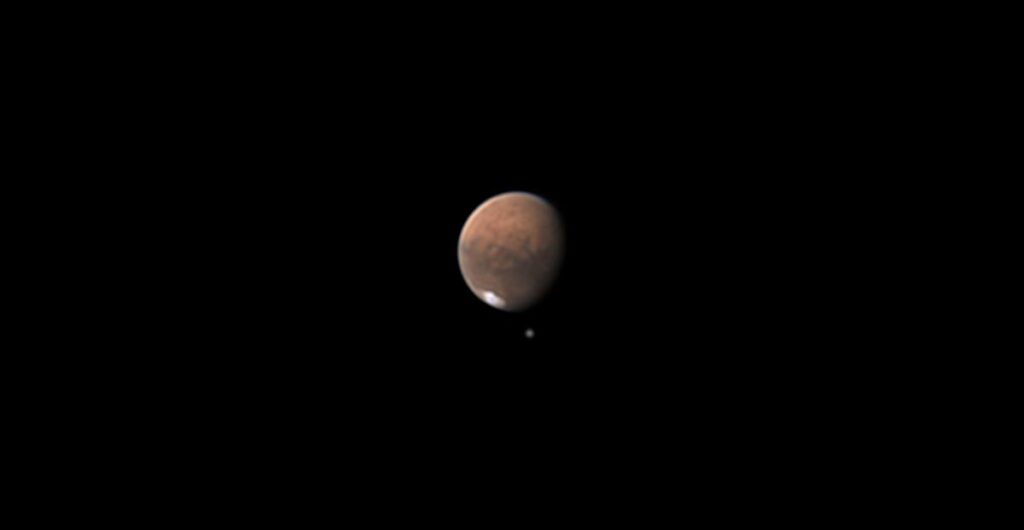
Why the journey takes so long
At best, Mars is around 56 million kilometres away, at worst more than 400 million. Even the smaller figure could be covered in a few weeks at a rocket’s launch speed – if you could fly in a straight line. But that is precisely what you cannot do.
Space probes do not fly in straight lines, but follow elliptical orbits around the Sun. After leaving Earth, a probe keeps moving on a solar orbit – just a larger one than Earth’s. The most energy-efficient option is the Hohmann transfer: half an ellipse that touches Earth’s orbit at the starting point and Mars’s orbit at the destination. This trajectory takes, in theory, around 259 days, i.e. about eight and a half months. Anyone who wants to be faster has to carry significantly more fuel – and fuel is the scarcest resource in spaceflight.
On top of that: both planets are moving. A probe never aims at the position where Mars stands at launch, but at the point where it will be in seven to nine months. If the configuration is wrong, you miss the target by millions of kilometres.
The launch window: every 26 months
Earth and Mars are only aligned every 779 days – just under 26 months – in a way that lets a Hohmann transfer work with an acceptable fuel budget. This launch window is only a few weeks wide. Miss it, and you wait more than two years for the next one. That is why Mars missions from all spacefaring nations set off conspicuously in clusters: in the summer of 2020, the USA, China and the United Arab Emirates each launched a mission within twelve days.
The launch windows are directly linked to Mars opposition: a favourable launch typically falls a few months before an opposition, because the probe catches up with the planet where it comes closest to Earth.
Travel times compared
The actual flight times of the Mars missions flown so far are remarkably close to one another – between a good seven and eleven months. For comparison, it is worth looking at other destinations in the Solar System:
| Mission / Destination | Travel time |
|---|---|
| Moon (Apollo 11, crewed) | a good 3 days |
| Mariner 4 – first Mars flyby (1964/65) | 228 days |
| Mars Express, ESA (2003) | about 6.5 months |
| Perseverance / Mars 2020, NASA | 203 days – just under 7 months |
| Curiosity / Mars Science Laboratory | about 8.5 months |
| Viking 1 (1975/76) | about 10 months |
| Mercury (BepiColombo, with flybys) | about 7 years |
| Jupiter (Juno) | just under 5 years |
| Pluto (New Horizons, fastest launch ever) | 9.5 years |
A curiosity is hidden in this table: the trip to an inner destination can take longer than to an outer one. BepiColombo needs seven years to reach Mercury, because the probe has to brake continuously against the Sun’s pull – a manoeuvre that costs more energy than the outward flight to Jupiter.
How fast does a space probe actually fly?
On leaving Earth orbit, Mars probes typically reach 11 to 12 km/s relative to Earth – around 40,000 km/h. Relative to the Sun it is considerably more, because Earth itself moves at nearly 30 km/s and « gifts » this speed to the probe. New Horizons left Earth in 2006 at over 58,000 km/h, holding the launch record.
It does not accelerate continuously along the way. After the upper stage’s engine cut-off, a probe coasts for months without propulsion; only small correction manoeuvres keep it on course. Only at the destination does it brake to enter orbit – or it plunges in a controlled way through the thin Martian atmosphere, which NASA engineers call, because of the nerve-racking radio delay, the « seven minutes of terror ».
And crewed flights to Mars?
Important for context: so far, no human has ever been on the way to Mars. All figures on crewed flight times come from mission studies, not from experience.
The worked-out profiles distinguish two variants. The conjunction-class mission plans six to nine months for the outbound trip, around 500 days on Mars – until the return window opens – and again six to nine months back. Total duration: about two and a half to three years. The opposition-class mission shortens the stay to a few weeks, but pays for it with a more energy-intensive trajectory and a longer total radiation exposure.
The hurdles lie less in propulsion than in biology: the radiation detector aboard the Curiosity rover measured a combined outbound-and-return dose on the order of 0.66 sieverts – a considerable share of what space agencies allow a person over an entire lifetime. Add to this muscle and bone loss in weightlessness, plus years of supplies without resupply.
Until humans actually set off, the Red Planet remains a rewarding target for the telescope. When it is well placed is shown by our Mars guide and the overview Which planets are visible today?
Seeing Mars for yourself – and when it is worth it
As long as no human sets off, the telescope remains the only way to see Mars not in a picture but for yourself. Only it is not a year-round target: outside the months around opposition it stays a disappointingly small dot, and expensive optics change nothing about that.
The next favourable stretch is already fixed. At the opposition on 19 February 2027 the Martian disc measures 13.8 arcseconds. Roughly speaking, the view is worth it from December 2026 to April 2027 – hardly at all before or after.
What you see then depends almost entirely on aperture. 10×50 binoculars show an orange dot, a 70 mm refractor a tiny disc. Only from around 130 mm do the white polar cap and the large dark feature Syrtis Major become recognisable.
Two more things cost nothing and do more than any accessory: wait for steady air, and put the telescope outside half an hour beforehand so it cools down. A warm instrument shows nothing but shimmer at high magnification.
Anyone who wants to see something in February 2027 should not start in February. A first telescope takes a few evenings before setting up, focusing and tracking come naturally – and until then the Moon and Jupiter make the more rewarding practice targets.
The starting point: polar cap and Syrtis Major: Skywatcher Dobson Telescope N 130/650 Heritage FlexTube
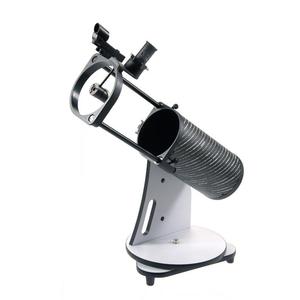
A compact tabletop Dobson with a true parabolic mirror. Folds down, fits in a bag: the Moon, planets and the bright deep-sky classics.
Price: € 265
This is the same instrument our Mars guide puts in first place; it also covers what larger apertures show in addition. How to pick the right magnification is explained in Observing Mars With a Telescope. And if you are right at the beginning, start with the beginner’s guide.
* Affiliate link: if you buy through this link we may earn a small commission from Astroshop or High Point Scientific, at no extra cost to you.
Frequently asked questions
How long does it take to travel to Mars?
With today’s technology, six to nine months. The range comes from the chosen trajectory and the positions of the planets relative to each other – a Hohmann transfer as the most economical route takes, in theory, around 259 days.
How long does a rocket take to reach the Moon?
The crewed Apollo missions took a good three days. Uncrewed probes on fuel-saving trajectories are sometimes underway for weeks to months.
How far is Mars from Earth?
Between around 56 million kilometres at a very favourable opposition and over 400 million kilometres when both planets are on opposite sides of the Sun. Radio signals accordingly take 3 to 22 minutes – a real-time conversation is impossible.
Why can’t you fly straight to Mars?
Because a straight line in the Solar System would be the most expensive solution in energy terms. Probes use Earth’s orbital speed and fly on an ellipse around the Sun to the point where Mars will be months from now.
When is the next Mars mission launching?
Launch windows open every 26 months. Missions from several spacefaring nations traditionally cluster around such dates – a single window is only a few weeks wide.
Has a human ever been to Mars?
No. So far only uncrewed probes, orbiters, landers and rovers have reached Mars. A crewed flight is planned, but not scheduled.
🔴 See Mars live: On 19 February 2027, Mars reaches opposition and stands in the sky all night long – all the observing tips in the Mars guide.