By Alexander Merz · Published on · Details checked on 22 September 2026
Mercury is the planet closest to the Sun: it orbits at an average distance of 57.9 million kilometres (0.39 AU) and needs only 88 days for one lap.
⭐ In short: The answer is clearly Mercury, followed by Venus and Earth. The more surprising part of the story: on average, Mercury is also closer to Earth than Venus is – we checked it over 150 years.
You can only see it for a few weeks a year, low in the twilight. The next good window: mornings from 13 to 30 November 2026, low in the east-southeast.
Mercury, the innermost planet: distance, orbit and speed
Mercury’s distance from the Sun varies more than that of any other planet. At perihelion, its closest point, it is only 46.0 million kilometres away, at aphelion 69.8 million – a difference of more than a third.
That is why the Sun does not always look the same size from Mercury. It appears 2.1 to 3.3 times as large as it does from Earth, depending on where Mercury is on its orbit.
| Parameter | Mercury |
|---|---|
| Mean distance from the Sun | 57.9 million km (0.39 AU) |
| Closest point (perihelion) | 46.0 million km (0.31 AU) |
| Farthest point (aphelion) | 69.8 million km (0.47 AU) |
| Orbital period | 88 days |
| Mean orbital speed | 47.4 km/s (Earth: 29.8 km/s) |
| Sunlight needs | approx. 3 minutes 13 seconds (to Earth: 8 min 19 s) |
| Surface temperature | −173 °C at night to +427 °C at noon |
Mercury is also the fastest planet. At 47.4 kilometres per second it races around the Sun about one and a half times as fast as Earth. Structure, craters and space probes are covered in our Mercury fact sheet.
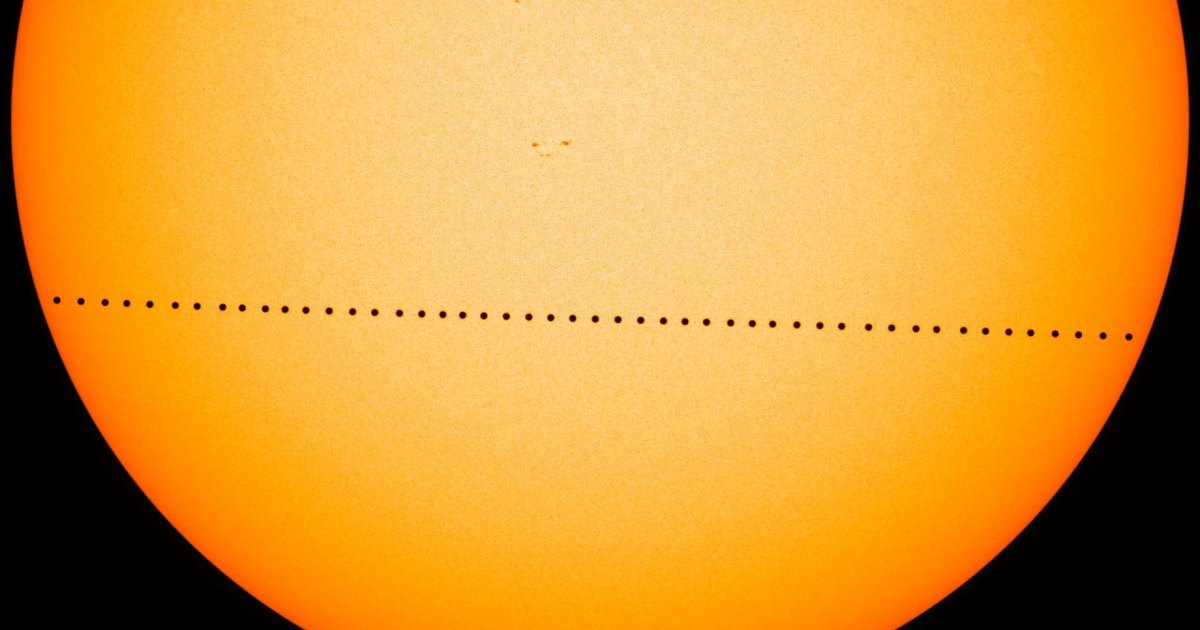
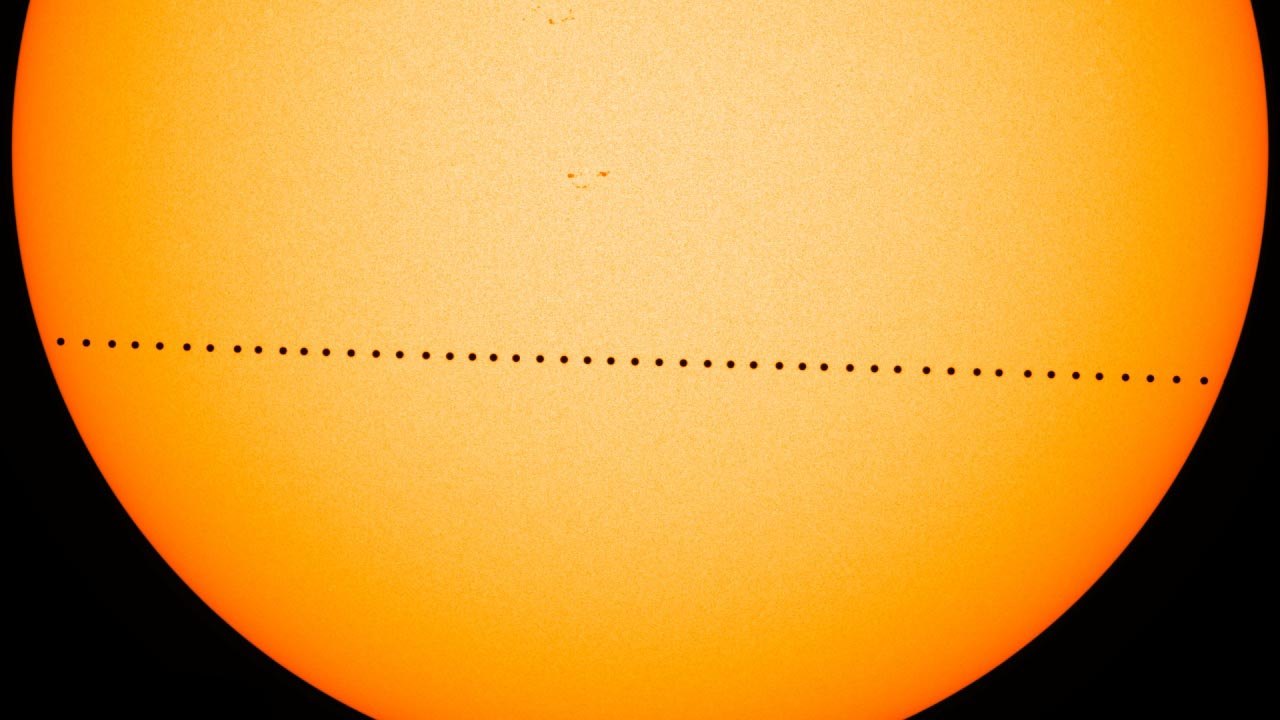
Tip: You can see the proof of Mercury’s closeness to the Sun yourself – at the next transit of Mercury on 13 November 2032. You absolutely need a certified solar filter in front of the optics, because looking at the Sun without one causes blindness.
Order by distance from the Sun: all eight planets
From the inside out, the order is Mercury, Venus, Earth, Mars, Jupiter, Saturn, Uranus, Neptune. So the second closest planet to the Sun is Venus, the third closest is Earth. If you can’t remember the order, use a planet mnemonic.
| Planet | Mean distance from the Sun | Orbital period |
|---|---|---|
| 1. Mercury | 57.9 million km (0.39 AU) | 88 days |
| 2. Venus | 108.2 million km (0.72 AU) | 225 days |
| 3. Earth | 149.6 million km (1.00 AU) | 365 days |
| 4. Mars | 227.9 million km (1.52 AU) | 1.9 years |
| 5. Jupiter | 778.5 million km (5.20 AU) | 11.9 years |
| 6. Saturn | 1,432 million km (9.58 AU) | 29.5 years |
| 7. Uranus | 2,867 million km (19.19 AU) | 84 years |
| 8. Neptune | 4,515 million km (30.07 AU) | 165 years |
The distances are averages, meaning the semi-major axis of each orbit. 1 AU, the astronomical unit, is the mean Earth–Sun distance of 149.6 million kilometres. Source of the orbital data: NASA Planetary Fact Sheet.
The outer edge: Neptune and the dwarf planets beyond
The planet farthest from the Sun is Neptune, at about 4.5 billion kilometres. Its light takes just over four hours to reach the Sun, and one orbit lasts 165 years.
Since 2006, Pluto no longer counts as a planet but as a dwarf planet. It orbits the Sun at an average of 39.5 AU (5.9 billion kilometres), the dwarf planet Eris even at around 68 AU. The dwarf planet closest to the Sun is Ceres in the asteroid belt between Mars and Jupiter, 2.8 AU from the Sun.
Which planet is closest to Earth? On average, Mercury
Almost everywhere you read that Venus is our nearest neighbour. That is only true at the moment of closest approach: Venus comes closer to Earth than any other planet, on 25 October 2026 to about 40.8 million kilometres.
Afterwards, however, Venus moves to the far side of the Sun and is then up to 260 million kilometres away. Mercury, by contrast, circles the Sun so tightly that it never gets very far from it – and therefore never extremely far from us either.
We calculated the positions for every single day from 1900 to 2050. On average, Mercury is 155 million kilometres away from us, Venus 170 million and Mars 255 million. Mercury is our nearest planet on 46 per cent of all days, Venus on only 36 per cent.
| Planet | Mean distance | Minimum | Maximum | Nearest planet on |
|---|---|---|---|---|
| Mercury | 155 million km (1.04 AU) | 82 million km | 217 million km | 46 % of days |
| Venus | 170 million km (1.14 AU) | 40 million km | 260 million km | 36 % of days |
| Mars | 255 million km (1.71 AU) | 56 million km | 400 million km | 18 % of days |
The result matches a widely noticed calculation by Tom Stockman, Gabriel Monroe and Samuel Cordner in the journal Physics Today (2019). They showed that, averaged over time, Mercury is even the nearest neighbour of every other planet.
In our 150-year window this holds for Venus, Earth, Mars, Jupiter, Saturn and Neptune. Only for Uranus are Venus and Mercury practically level (19.302 versus 19.307 AU) – the time window is too short for that, Uranus alone needs 84 years for one lap.
How we calculated it: positions from the NASA JPL ephemeris DE421 using the Python library Skyfield, one value per day, 54,788 days from 1900 to 2050. We averaged the real distance between the planets, not the difference between their orbital radii.
That is exactly the flaw in the Venus answer: it only compares the orbits, as if all planets were always on the same side of the Sun.
For Mars, the question of when it comes closest to Earth can be answered with a date. The next close approach is on 20 February 2027 at 101.4 million kilometres, one day after opposition – rather far by Mars standards. Why this varies so much is explained on the page about the planet Mars.
Why Mercury is so rarely seen: at most 28 degrees from the Sun
Because Mercury circles the Sun so tightly, we always see it close beside the Sun from Earth. Its greatest angular distance, the greatest elongation, is only 18 to 28 degrees depending on its position in orbit. For comparison: Venus reaches up to 47 degrees.
Whether it is then actually visible depends mainly on the angle of the ecliptic to the horizon. From mid-northern latitudes the ecliptic is steep on spring evenings and autumn mornings, so Mercury climbs higher above the horizon. On autumn evenings and spring mornings it lies flat, and Mercury stays stuck in the haze even at a large elongation.
On top of that comes the twilight itself. At −0.5 to 0 mag Mercury is as bright as the brightest stars, but it stands only 5 to 10 degrees high in a still bright sky. A clear view down to the horizon is therefore essential.
Caution: Only search for Mercury with binoculars or a telescope when the Sun is completely below the horizon. In the morning that means: stop before sunrise, because an accidental sweep into the Sun causes permanent eye damage.
Mercury visibility 2026/27: the dates for Central Europe
We calculated for central Germany (51° north, 10° east) how high Mercury stands at the end of civil twilight, when the Sun is 6 degrees below the horizon. The best window this autumn is the morning apparition in November 2026. Across Central Europe the times shift by only a few minutes; at other latitudes the altitude changes by a few degrees.
| Window | Best days | Where and when | Altitude | Brightness |
|---|---|---|---|---|
| Evening, October 2026 | greatest elongation 12 October (25°) | – | below 3° | practically invisible |
| Morning, November 2026 | 13–30 November, best around the 20th | east-southeast, around 7:00 CET | up to 10.6° | −0.5 mag |
| Evening, February 2027 | 28 January – 10 February, best around the 4th | west-southwest, around 17:50 CET | up to 9.5° | −0.4 mag |
| Morning, March 2027 | greatest elongation 17 March (28°) | – | below 3° | practically invisible |
| Evening, May 2027 | 13 May – 3 June, best around the 22nd | west-northwest, around 21:55 CEST | up to 10.1° | 0.0 mag |
The table shows the elongation trap. In October 2026 and March 2027 Mercury stands particularly far from the Sun at 25 and 28 degrees and still cannot be seen, because the ecliptic then lies flat. Times are CET, in May CEST.
On November mornings, look for it about a hand’s width above the horizon in the east-southeast. Start around 45 minutes before sunrise and scan the horizon with binoculars; once you have found it, you can usually see it with the naked eye too. Which other planets are currently visible is shown on the page planets visible tonight.
Seeing Mercury yourself: binoculars to find it, a telescope for the phase
To be honest up front: Mercury is no eye-catcher in a telescope. In November 2026 its disc measures just under 7 arcseconds and is a little more than half lit – you see a small half-moon shape shimmering low on the horizon, but no surface detail.
An ordinary pair of binoculars is perfectly adequate for finding it. A 10×50 shows Mercury as a bright dot in the twilight long before the naked eye picks it up.
For finding it: Celestron UpClose G2 10x50 Porro Binoculars
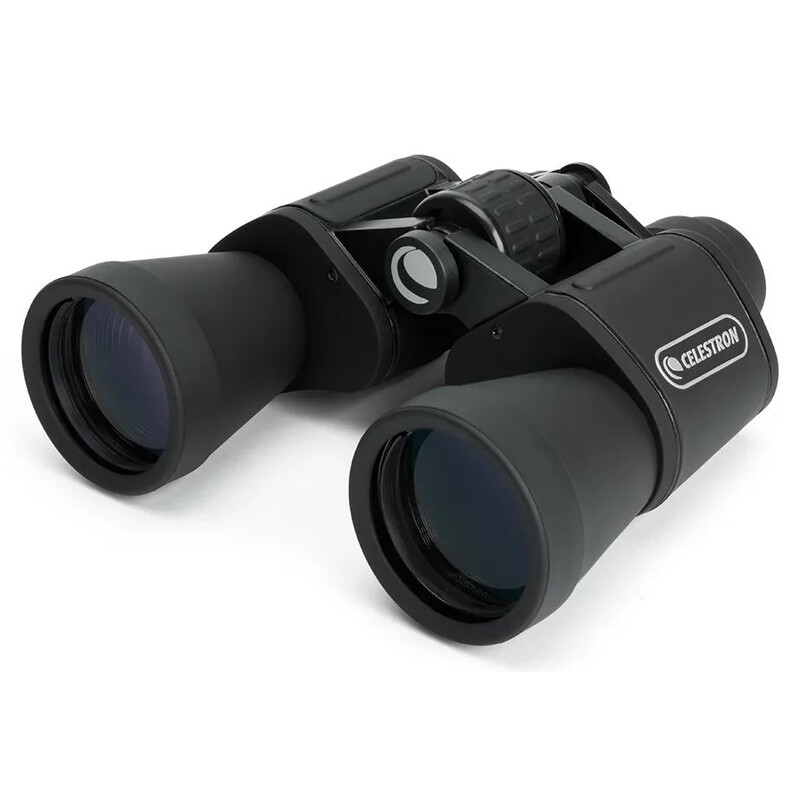
A 10x50 is enough to track down Mercury in the twilight. Affordable, ready to use at once and also the right choice for the Moon, the Pleiades and comets.
Price: € 62
A telescope is not worth buying for Mercury alone. If you are looking for one anyway for the Moon, Saturn’s rings and Jupiter’s cloud bands, you get Mercury’s phase as a bonus. Which designs suit the planets is explained in the guide telescope for planets.
For all planets: Skywatcher Dobson Telescope N 130/650 Heritage FlexTube
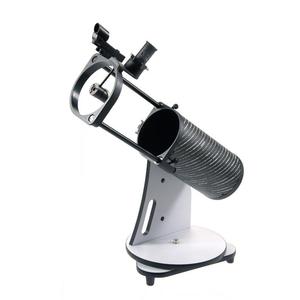
Compact tabletop Dobsonian with a 130 mm parabolic mirror: shows Saturn's rings, Jupiter's moons and the crescent of Venus – Mercury remains a tiny half disc here too.
Price: € 265
* Affiliate link: if you buy through this link we may earn a small commission from Astroshop or High Point Scientific, at no extra cost to you.
Frequently asked questions about the innermost planet
Which planet is second closest to the Sun?
Venus. It orbits the Sun at a distance of 108.2 million kilometres, almost twice as far out as Mercury. Its orbit is nearly circular, so the distance only varies between 107.5 and 109 million kilometres.
Which planet is farthest from the Sun?
Neptune, at an average of 30 AU or 4.5 billion kilometres. Pluto is farther out, but since 2006 it has been classed as a dwarf planet rather than a planet.
Is Mercury also the hottest planet?
No. The hottest planet is Venus at around 465 °C, day and night. Its dense carbon dioxide atmosphere traps the heat like a greenhouse. Mercury has practically no atmosphere, so its night side cools down to −173 °C.
When is Mars closest to Earth?
Around its opposition, which happens every 26 months. The next one is on 19 February 2027, with the closest approach following on 20 February at 101.4 million kilometres. At best, Mars comes within about 56 million kilometres, as it did in 2003.
Is there a planet inside Mercury’s orbit?
No. In the 19th century astronomers searched for a planet called “Vulcan” because Mercury’s orbit turns mysteriously slowly. In 1915 Albert Einstein explained this perihelion precession with general relativity – no extra planet was needed, and none was ever found.
How long does sunlight take to reach Mercury?
About 3 minutes and 13 seconds on average. To Earth it takes 8 minutes and 19 seconds, to Neptune just over four hours.