By Alexander Merz · Published on · Details checked on 14 September 2026
The northern autumn sky bears, only slightly above the celestial equator, a striking constellation with bold main stars. The astronomers and seafarers of antiquity already knew the Pegasus constellation. The brightest stars form a square that represents the body of the winged horse. The horse’s neck, head and muzzle point directly to a deep-sky object of the same constellation, the star-rich globular cluster M15.
Myth and stars of Pegasus
Since antiquity, the Pegasus constellation has trotted across the northern autumn sky. The winged horse of the imagination, so the ancient Greek myths report, once sprang from the neck of Medusa and became Bellerophon’s mount.
After the rider’s fall, the animal rose to Olympus, where it has since carried the thunderbolts of Zeus. Unlike most ancient constellations, the poets, whose symbolic animal Pegasus has always been, contented themselves with just one myth.
All the more worth describing are the main stars and the numerous deep-sky objects that the head and body of the constellation harbour.
No fewer than ten stars of the Pegasus constellation shine brighter than 4 mag. Each of the main stars displays further peculiarities. Thus the horse’s nostril – symbolised by Epsilon Pegasi (“Enif”) – “shines” with an apparent 2,38 mag.
Besides the many deep-sky objects in the immediate vicinity, observing this brightest star is particularly interesting too. The brightness of the orange-red supergiant, which is at the same time an irregular variable, sometimes flares up markedly.
Moreover, it consists of three components. Enif’s fainter companions lie at a considerable distance from the main star.1
Meteor showers and deep-sky objects in Pegasus
The globular cluster M15 is not part of the direct “body structure” of the Pegasus constellation. Rather, the horse’s “nose”, that is the main star Enif (Epsilon Pegasi), points directly to this deep-sky object, as if a morsel of feed were laid out there.
For observers, M15 is already visible through binoculars as a small nebulous patch; from telescope apertures of 15 cm the individual stars of the cluster become apparent.
Shooting stars from the Pegasus constellation were visible to night owls between 07 and 13 July 2006. In 1979 W. Bradfield identified the comet C/1979 Y1 as the parent body of the Pegasids.
But the comet’s trail was faint when the Earth crossed it. The fall rate at the peak of the Pegasids was 3 meteors per hour. Central European observers of deep-sky objects were, with a great deal of luck, rewarded by chance with a shooting star in the second half of the night of 9 July.
The individual galaxies of “Stephan’s Quintet”
The proximity to one another accelerates the individual deep-sky objects, which at least explains the high relative velocities of 6.500 to 7.000 km per second. The quintet in the Pegasus constellation is about 300 million light-years away. From a telescope aperture of at least 20 cm, “Stephan’s Quintet” reveals to earthly observers its five-figure structure as well as the deformed spiral arms of the individual group members.
The deep-sky object NGC 7317 is among the galactic giants. This elliptical galaxy in the Pegasus constellation is less rich in structure than the other spiral galaxies. Its “best millions of years” are long gone. The elliptical galaxy NGC 7318A is right in the middle of a cosmic collision with the barred spiral galaxy NGC7318B. The “Spitzer Space Telescope” shows a green band between the galaxies of “Stephan’s Quintet”. This phenomenon arises because the shock wave of the crash heats the hydrogen atoms.
NGC 7319 and NGC7320C – doubts and errors
A far more fundamental question is raised by a discovery in the deep-sky object NGC 7319 in the Pegasus constellation. Right in the centre of this barred spiral galaxy (galaxy with two “arms”), only 300 million instead of several billion light-years away, a quasar with high redshift appeared. Its unexpected proximity shakes fundamental theories about the theory of the expansion of the universe. Unless, so the sceptics say, the observation in “Stephan’s Quintet” is an optical-mathematical illusion.
NGC 7320 was originally regarded as a deep-sky object of the galaxy group in the Pegasus constellation. Instead, it is a foreground galaxy at too great a distance from the group, comparable to asterisms that belong together only optically but do not actually interact. Instead, the barred spiral galaxy NGC 7320C moves within the group’s forces. The discovery was a stroke of luck for the astronomers: by correcting the error, “Stephan’s Quintet” remains a scientifically correct designation to this day.
Barred spiral galaxy NGC 7479
In astrophotographic images this deep-sky object appears very elongated. On each side a “bar” seems to fade away. Among the galaxies in the Pegasus constellation, NGC 7479 belongs to the “Seyfert galaxies”. As the source of the great brightness of the galactic core, astronomers suspect supermassive black holes. Herschel, the discoverer of this barred spiral galaxy, certainly saw the distribution of brightness and the spiral arms far more indistinctly with his telescope, and yet he discovered this object as early as 1984. Today’s images taken with amateur telescopes show his view of NGC 7479.
This rather faint deep-sky object lies about 105 million light-years from Earth. Like many other galaxies in the Pegasus constellation, NGC 7479 too is undergoing an astonishingly active development process. Thus supernovae were observed in the barred spiral galaxy in 1990 and 2009. In the bright core and in the “dusty”-looking galactic arms, many new, hot stars are forming. In their investigations, astronomers established that a smaller merger must have taken place there quite recently.
NGC 7673: beacon of the starbursts
Far more intensely than the rather small and pale Seyfert galaxy, another deep-sky object shines in the Pegasus constellation. International media describe the luminosity of the spiral galaxy as the “flames” of an interstellar “nursery”. Using 3 colour filters (red, green, UV), the “Hubble Space Telescope” created the image of this galaxy of (as the media put it) “ragged appearance”. Scientists see far more exciting things going on in the glittering object.
No comparable deep-sky object is as hot as NGC 7673. Millions of gigantic blue stars illuminate this part of the Pegasus constellation 100 times more brightly than the brightest star clusters of the Milky Way. Astronomers are now trying to find out what triggered the starburst and how NGC 7673 will develop over the coming decades. Such massive stars usually go through an active development process that ends after just a few million years in a supernova.
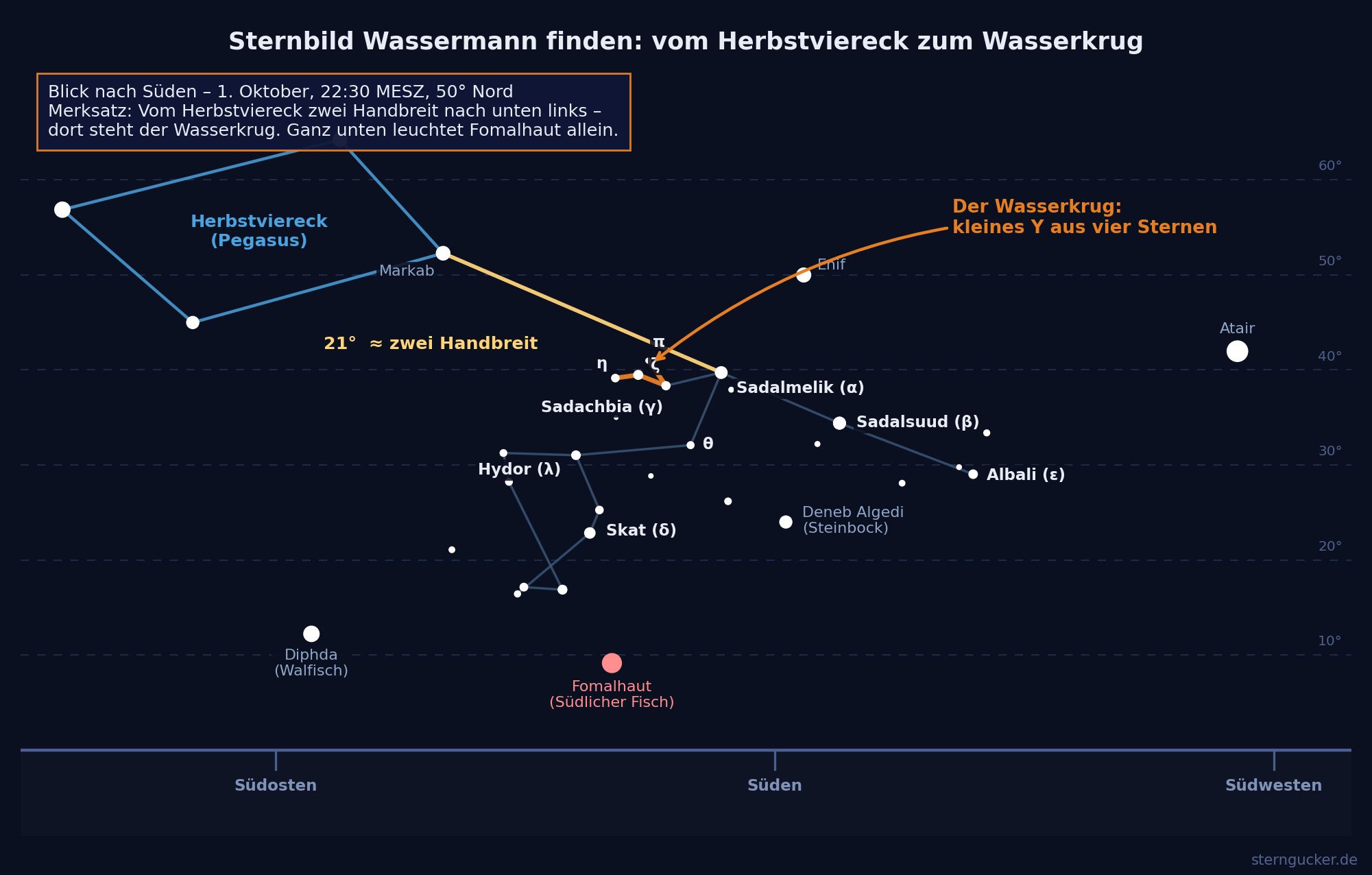
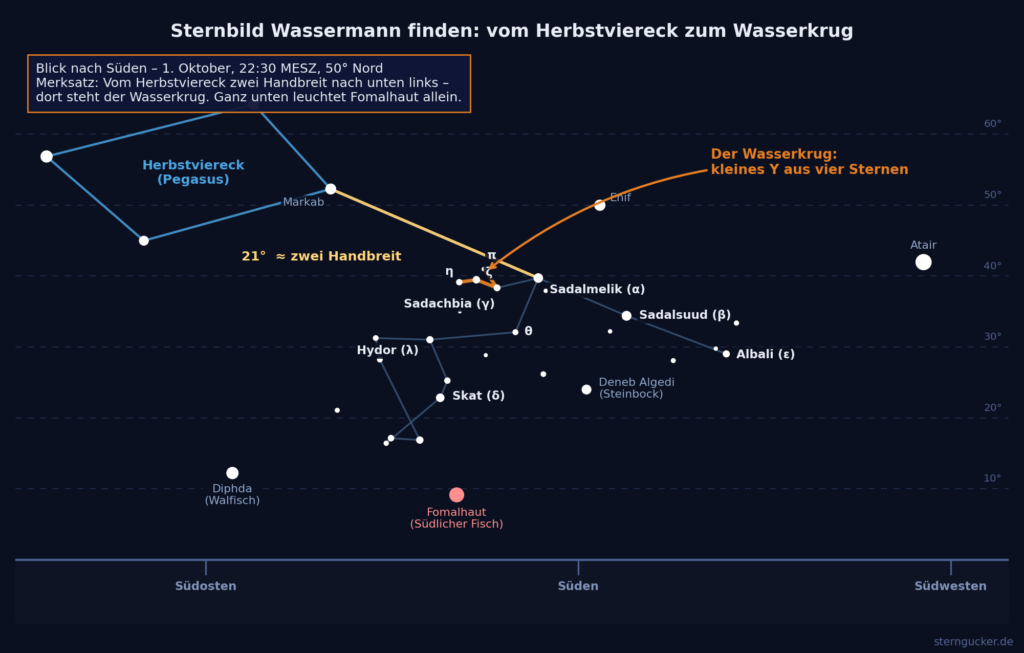
Anyone who continues south from the Square of Pegasus lands in the Aquarius constellation: extending the western edge of the square downwards leads directly to the Water Jar, the little Y made of four stars. There the Helix Nebula NGC 7293 and the globular cluster M 2 await.
Frequently asked questions about the Pegasus constellation
Who was the mother of the winged horse Pegasus?
Pegasus (Greek: Pegasos) means the “winged horse” and describes a constellation in the night sky. In Greek mythology, the sea god Poseidon was its father and the Gorgon Medusa its mother.
When can you see the Pegasus constellation?
Best on autumn evenings from September to November, when Pegasus stands high in the south after dark. It is easy to find thanks to the large square of four similarly bright stars known as the Great Square of Pegasus.
Which stars form the Great Square of Pegasus?
Markab, Scheat and Algenib, which belong to Pegasus, plus Alpheratz, which officially belongs to the neighbouring constellation Andromeda. In the past Alpheratz was also counted as part of Pegasus.
Sources
- Wikipedia, 30.12.2019: https://de.wikipedia.org/