By Alexander Merz · Published on · Details checked on 14 September 2026
There are constellations that jump out at you, and there is Aquarius. It is the tenth-largest constellation in the whole sky, it bears one of the most famous names of all – and yet most people find themselves puzzled in front of an empty patch of sky. The reason is simple: not a single one of its stars is brighter than 2.9 mag. Anyone who wants to find Aquarius in the sky should therefore not look for a bright pattern, but work their way in from two conspicuous neighbours. And once you know where to look, there is plenty to find: the largest planetary nebula in the sky, one of the finest globular clusters of the northern hemisphere, and a planetary system with seven rocky worlds.
⚡ The quick answer: Aquarius (Latin Aquarius, “the water carrier”) is an autumn constellation. You find it by going from the Great Square of Pegasus downward (south): halfway to the very bright star Fomalhaut stands the small Y-shaped Water Jar – the only figure in Aquarius you truly recognise at a glance.
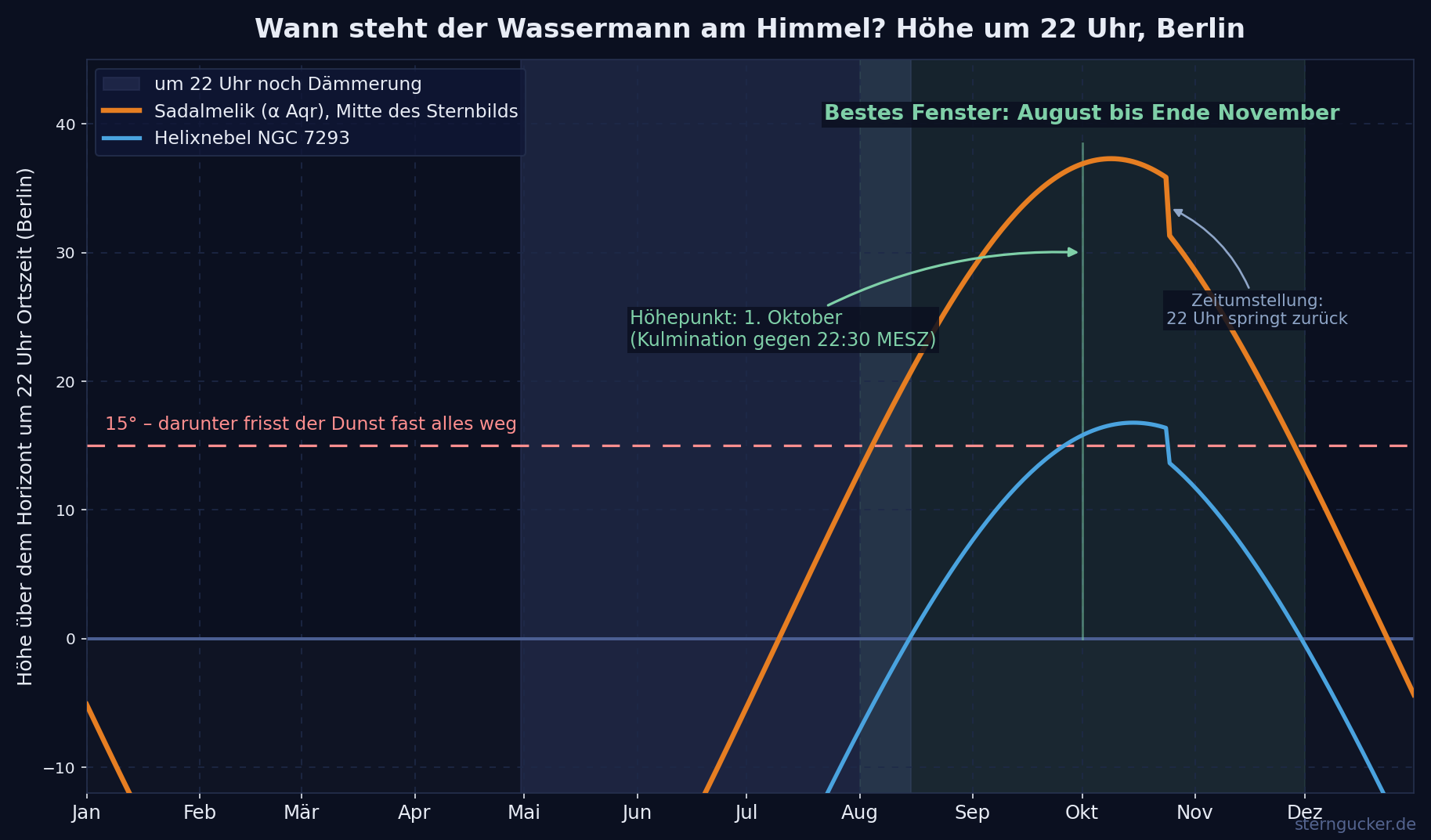
Best time: August to late November. On 1 October the constellation stands highest at around 22:30. Even then its main star reaches only 36° (Hamburg) to 42° (Zurich) above the horizon.
The highlight: The Helix Nebula NGC 7293 – the “Eye of God” – is the closest large planetary nebula to us. Add to that the globular cluster M 2, the Saturn Nebula NGC 7009, and the dwarf star system TRAPPIST-1 with its seven rocky planets.
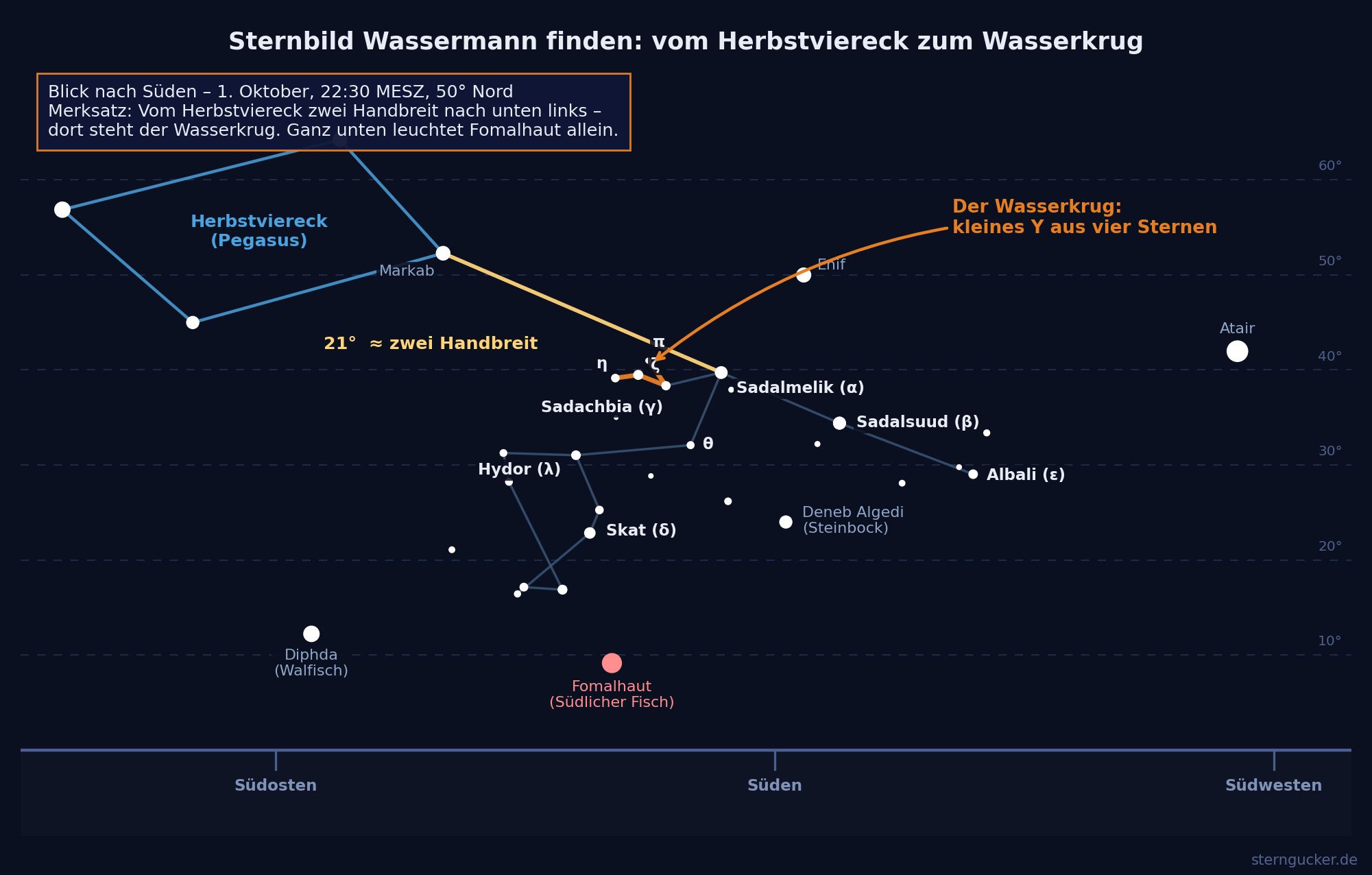
Finding the constellation Aquarius: the route from the Great Square of Pegasus
With Aquarius the usual method doesn’t work. You can’t “search for the shape”, because the shape is too faint to stand out – its brightest stars sit at 2.9 and 3.3 mag, about as bright as the fainter stars of the Big Dipper. In a city you generally see none of it. What does work is the reverse approach: first fix two reliable anchor points, then scan the space between them.
The northern anchor: the Great Square of Pegasus as a starting point
In October the Great Square of Pegasus stands high in the south in the evening – four stars forming an almost perfect, very large square that is impossible to miss. From the lower edge of this square you continue downward. Aquarius begins roughly two hand-widths (about 20 degrees) below the square.
This direction matters more than it sounds: Aquarius lies exactly in the stretch of sky that often looks “empty”, between Pegasus above and the southern horizon below. Once you deliberately store this area as “the water region” – home to Aquarius, Pisces, Capricornus, Cetus, and Piscis Austrinus, all close together – you’ll never lose your bearings there again.
The southern anchor: Fomalhaut as the brightest point
Deep in the south, well below Aquarius, a single, very bright star shines at 1.16 mag: Fomalhaut in the constellation Piscis Austrinus. In autumn it is by far the brightest star in this part of the sky and stands there completely alone – which is why it carries the nickname “the lonely star of autumn”. It is hard to mistake for anything else.
That narrows the search: Aquarius lies between the Great Square of Pegasus and Fomalhaut. Fomalhaut stands about 30 degrees below the constellation, so a good three fist-widths at arm’s length. Whatever faint stars you see within that band very likely belong to Aquarius.
🧭 The three steps in practice
Step 1: Find the Great Square of Pegasus in the south – the large, unmistakable square high in the sky.
Step 2: Looking down from the square, identify Fomalhaut as the brightest point deep in the south.
Step 3: About halfway between the two, look for a small Y made of four stars – that’s the Water Jar, the heart of the constellation.
A rotating star chart or an app helps more here than with any other zodiac constellation, simply because there is no striking lead figure.
The Water Jar: the small Y made of four stars
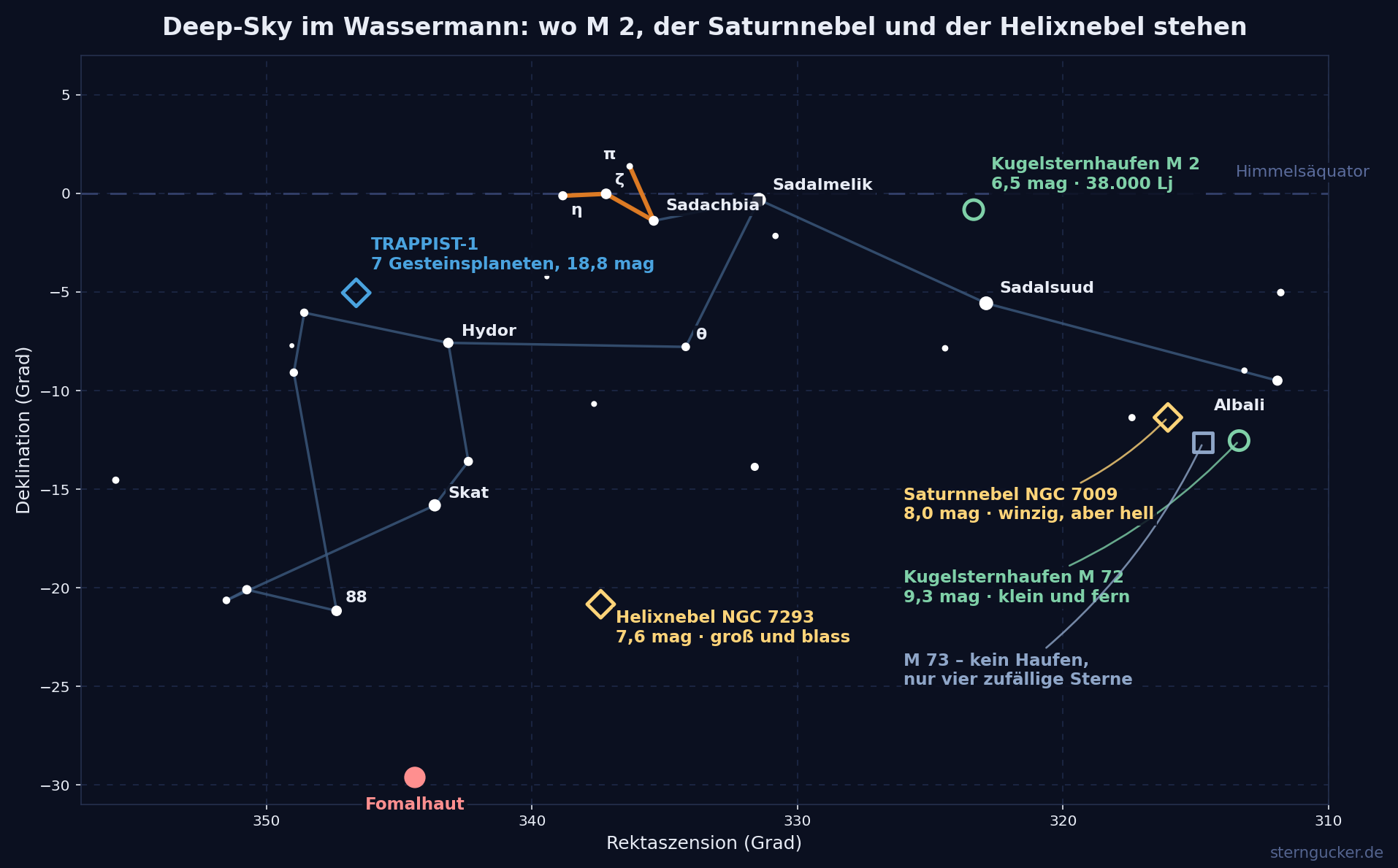
The Water Jar is the only asterism in Aquarius that you truly recognise at once – and it is the key to the whole constellation. Four stars form a small, slightly skewed Y, or a three-leafed clover: γ (Sadachbia) at the centre, with ζ, η and π around it.
| Star | Proper name | Brightness | Role in the Water Jar |
|---|---|---|---|
| γ Aqr | Sadachbia | 3.84 mag | centre of the Y |
| ζ Aqr | – | 3.65 mag | true binary star, about 2.5″ separation |
| η Aqr | – | 4.04 mag | eastern arm |
| π Aqr | Seat | 4.66 mag | northern arm, faintest of the four |
Size is what matters here: from γ to η the Water Jar spans only 3.7 degrees. A pair of 10×50 binoculars has a field of view of roughly 5 to 6.5 degrees – so the whole figure fits into a single view. That’s exactly how to approach Aquarius: don’t scan for patterns with the naked eye, instead sweep the area between Pegasus and Fomalhaut slowly with binoculars until the Y slides into the field.
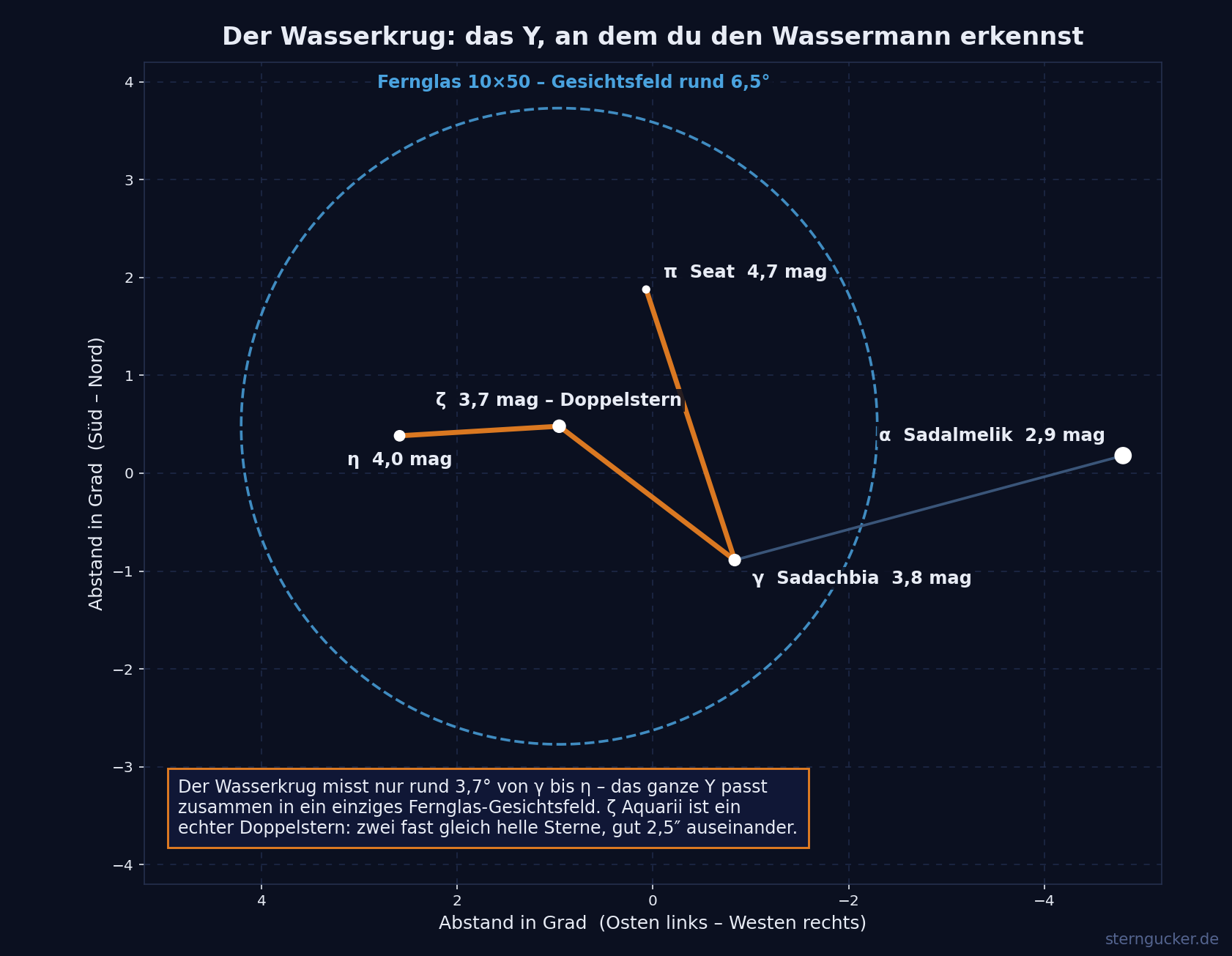
Once you’ve found the Water Jar, the rest falls into place almost by itself. About 10 degrees down to the right stands Sadalsuud, the brightest star of the constellation, with Sadalmelik right beside it. From γ a long, curving chain of stars also stretches southeast – the “waterfall”, which in the ancient depiction pours from the jar and ends in the mouth of Piscis Austrinus, right at Fomalhaut.
Aquarius at a glance: area, boundaries and neighbours
| Feature | Value |
|---|---|
| Latin name | Aquarius (genitive: Aquarii) – “the water carrier” |
| Abbreviation (IAU) | Aqr |
| English name | Aquarius (8 letters) |
| Area | 979.9 square degrees – rank 10 of 88 |
| Right ascension | 20h 38m to 23h 56m |
| Declination | −24.9° to +3.3° |
| Brightest star | β Aqr (Sadalsuud), 2.87 mag |
| Stars brighter than 3 mag | 2 – and both only just |
| Messier objects | 3 (M 2, M 72, M 73) |
| Best visibility | August to late November |
| Culmination at 22:30 | 1 October |
| Sun in the constellation | 16 February to 11 March |
| Neighbours | Pegasus, Pisces, Cetus, Sculptor, Piscis Austrinus, Capricornus, Aquila, Delphinus, Equuleus |
Two lines of this table explain the whole problem with Aquarius. At 979.9 square degrees it is the tenth-largest constellation of all – bigger than Orion, bigger than the Big Dipper as part of Ursa Major. Yet it contains only two stars brighter than 3 mag. Among the zodiac constellations, the ratio of area to brightness is the worst there is: a lot of sky, very little light.
The second notable feature is the declination. With a northern boundary at +3.3 degrees, Aquarius only just crosses the celestial equator, and most of it lies below. For observers in Central Europe that means: the constellation stays permanently in the lower half of the sky, and anything further south than that vanishes into the horizon haze.
The stars of Aquarius: faint, but with grand names
The Arabic names of the Aquarius stars are among the loveliest in the whole sky – and they all tell the same story. “Sa’d” means “luck”, and no fewer than four stars carry it in their name: Sadalsuud, Sadalmelik, Sadachbia, Sadalachbia. The reason lies in the calendar: when these stars reappeared at dawn in spring, the mild season began on the Arabian Peninsula. You can find more on star names and brightness in our overview of stars.
Sadalsuud: the brightest star of the constellation
β Aquarii is called “Sa’d as-su’ud”, the “luck of lucks”. At 2.87 mag it is the brightest star of Aquarius – remarkably faint for a star of its calibre. Because Sadalsuud is no ordinary star, but a yellow supergiant of spectral class G0 Ib, about 540 light-years away. It shines roughly 2,200 times as brightly as our Sun. If it stood where Sirius does, it would be a dazzling point of light, brighter than Venus.
Sadalmelik: the star on the celestial equator
α Aquarii (“Sa’d al-malik”, the “luck of the king”) is, at 2.94 mag, only marginally fainter – a curiosity, since the alpha star of a constellation is normally the brightest. It, too, is a yellow supergiant, spectral class G2 Ib, about 520 light-years away and roughly 3,000 times as luminous as the Sun.
Its real claim to fame is its position: Sadalmelik stands less than one degree from the celestial equator, making it one of only two bright stars with an ancient proper name for which that is true. In practice that means it rises due east and sets due west – a useful compass once you’ve identified it.
Skat, Hydor and Albali: the other named stars
| Star | Proper name | Brightness | Short portrait |
|---|---|---|---|
| δ Aqr | Skat | 3.27 mag | A3 Vp, about 113 light-years – the second-brightest star |
| ζ Aqr | – | 3.65 mag | true binary star in the Water Jar |
| λ Aqr | Hydor | 3.72 mag | red giant, irregular variable |
| ε Aqr | Albali | 3.77 mag | “the swallower” – A1 V, about 215 light-years |
| γ Aqr | Sadachbia | 3.84 mag | centre of the Water Jar |
| π Aqr | Seat | 4.66 mag | hot Be star with a gas disc |
Skat deserves a second look. The name goes back to the Arabic “as-saq”, “the shin” – it marks the leg of the ancient figure. It only received its official IAU name on 21 August 2016, when the International Astronomical Union first formally fixed the traditional star names. Astrophysically it is interesting because it likely belongs to the Ursa Major Moving Group: a loose association of stars that formed together and still move in the same direction – a good 100 degrees away across the sky from the stars of the Big Dipper.
Zeta Aquarii: the binary star in the Water Jar
To the naked eye, ζ Aquarii looks like a single 3.65-mag star, but it is a true binary star: two nearly equally bright white stars orbiting each other over roughly 760 years. Their current apparent separation is about 2.5 arcseconds.
That makes it a rewarding but not trivial target. In binoculars it cannot be split at all. A telescope from 6 centimetres of aperture upward can manage it in steady air and at high magnification – with a short-focal-length eyepiece at around 150x, the single point resolves into a cleanly separated pair. For beginners it’s a nice proof that magnification sometimes really does pay off.
When can you see Aquarius? From August to November
The old error you often read online goes: “Aquarius is a summer constellation.” That’s wrong. Aquarius is an autumn constellation. It culminates – stands highest – in late September and October, and that’s exactly when it’s well placed in the evening at a civilised hour.
The observing window: the best evening of the year
On 1 October Sadalmelik culminates at around 22:30 CEST. That’s the ideal combination: astronomical darkness has long since begun, the constellation stands at its highest, and you don’t have to stay up past midnight.
| Month | Evening peak | Assessment |
|---|---|---|
| August | after 00:30 | constellation rising, but late culmination |
| September | around 23:00 | very good – nights are already dark |
| October | around 22:00 | best month of the year |
| November | around 20:00 | culminates early, then sinks quickly |
| December | during twilight | already too far west |
If you want to make the most of it, our monthly overviews Night sky in September and Night sky in October give you the whole evening sky alongside it – Aquarius never stands alone there, but together with Pegasus, Andromeda, and the rising Winter Hexagon.
Culmination altitude: how high does it climb from your city?
With Aquarius, latitude matters more than for most constellations, because its most rewarding objects sit right at the bottom. Sadalmelik itself reaches a usable altitude everywhere – but the Helix Nebula scrapes along the horizon haze in northern Germany:
| City | Latitude | Sadalmelik | Helix Nebula | Extinction (Helix) |
|---|---|---|---|---|
| Hamburg | 53.6° N | 36.1° | 15.6° | 1.03 mag |
| Berlin | 52.5° N | 37.3° | 16.7° | 0.97 mag |
| Cologne | 50.9° N | 38.8° | 18.2° | 0.89 mag |
| Frankfurt | 50.1° N | 39.6° | 19.0° | 0.85 mag |
| Stuttgart | 48.8° N | 41.0° | 20.4° | 0.79 mag |
| Munich | 48.1° N | 41.6° | 21.0° | 0.77 mag |
| Zurich | 47.4° N | 42.3° | 21.8° | 0.74 mag |
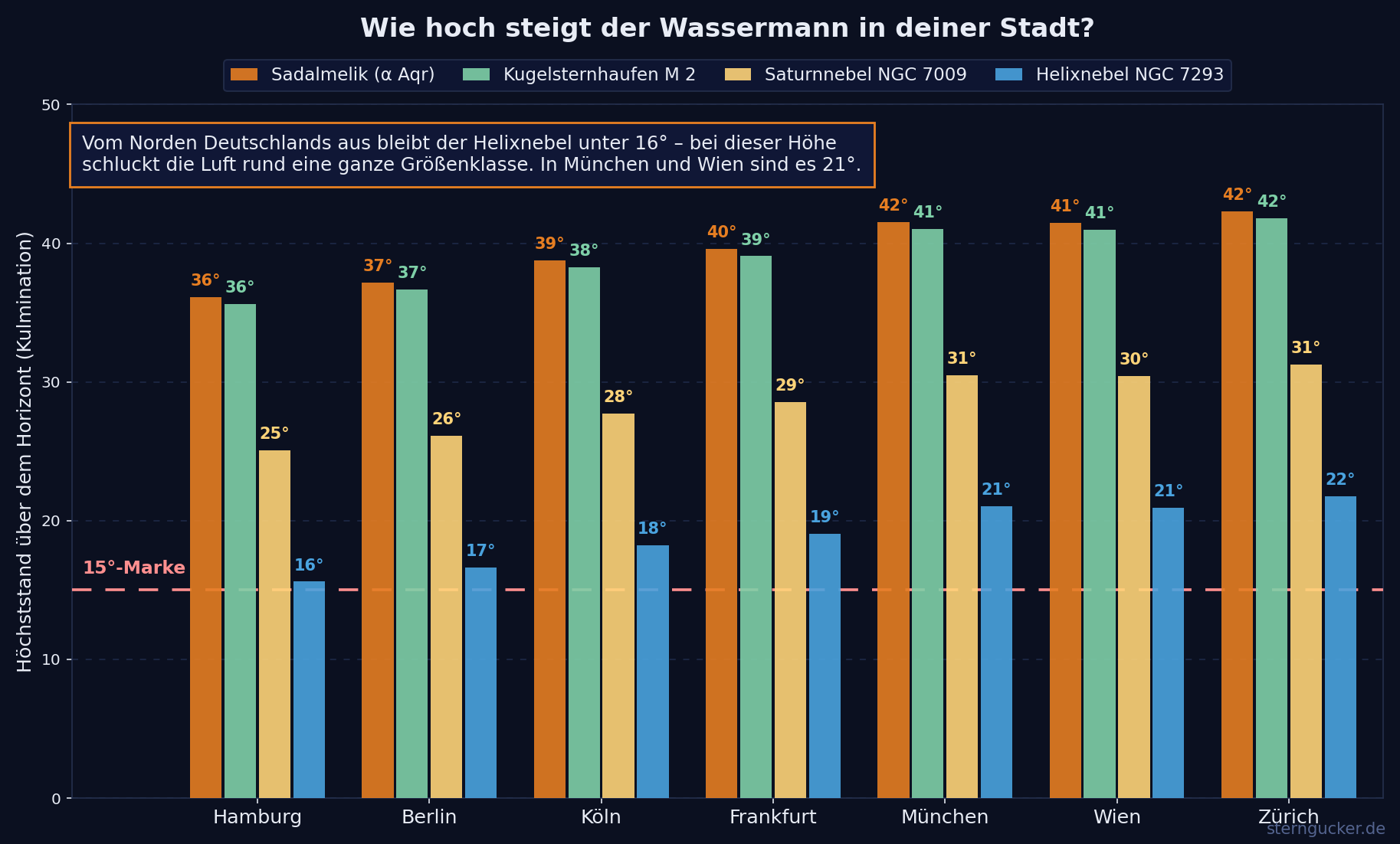
The last column is the real story here. Extinction refers to the light the Earth’s atmosphere absorbs before it reaches the eye. At an altitude of 15.6 degrees, roughly a whole magnitude is lost – so the already faint Helix Nebula gets dimmed by more than half again. In Munich it’s only 0.77 mag. Then there’s the usable time: from Hamburg, the Helix Nebula stays above 15 degrees for only about 1.6 hours per night, from Munich it’s 4.4 hours.
💡 What this means in practice
For the bright targets – Water Jar, M 2, Saturn Nebula – location barely matters. For the Helix Nebula it does: north of the Main river, you need a genuinely clear southern horizon and a clear, dry night, or it stays invisible.
More important than the instrument here is light pollution: the Helix Nebula is an extended object with very low surface brightness. Under city skies it stands little chance even with a large telescope; under dark rural skies it can already be glimpsed in binoculars.
Why Aquarius looks so faint
There is a structural reason for the faintness: Aquarius lies far from the Milky Way. Here we’re looking almost straight out of the disc of our galaxy, through a thin layer of stars into empty space. In constellations like Sagittarius or Cygnus, by contrast, you’re looking lengthwise through the disc – where stars crowd together. In Aquarius that background is entirely absent.
That has a pleasant flip side: where little Milky Way dust is in the way, you can see further out. That’s why Aquarius is poor in open star clusters and gas nebulae, but comparatively rich in far-distant objects – globular clusters in the halo of our galaxy and planetary nebulae standing against a black, undisturbed background.

Deep sky in Aquarius: nebulae, clusters and a planetary system
This is where the constellation gets interesting. What Aquarius lacks in bright stars, it makes up for in the deep-sky department – with two planetary nebulae that couldn’t be more different, two globular clusters, a famous mistake, and a planetary system that half of exoplanet research is talking about.
Helix Nebula NGC 7293: the “Eye of God”
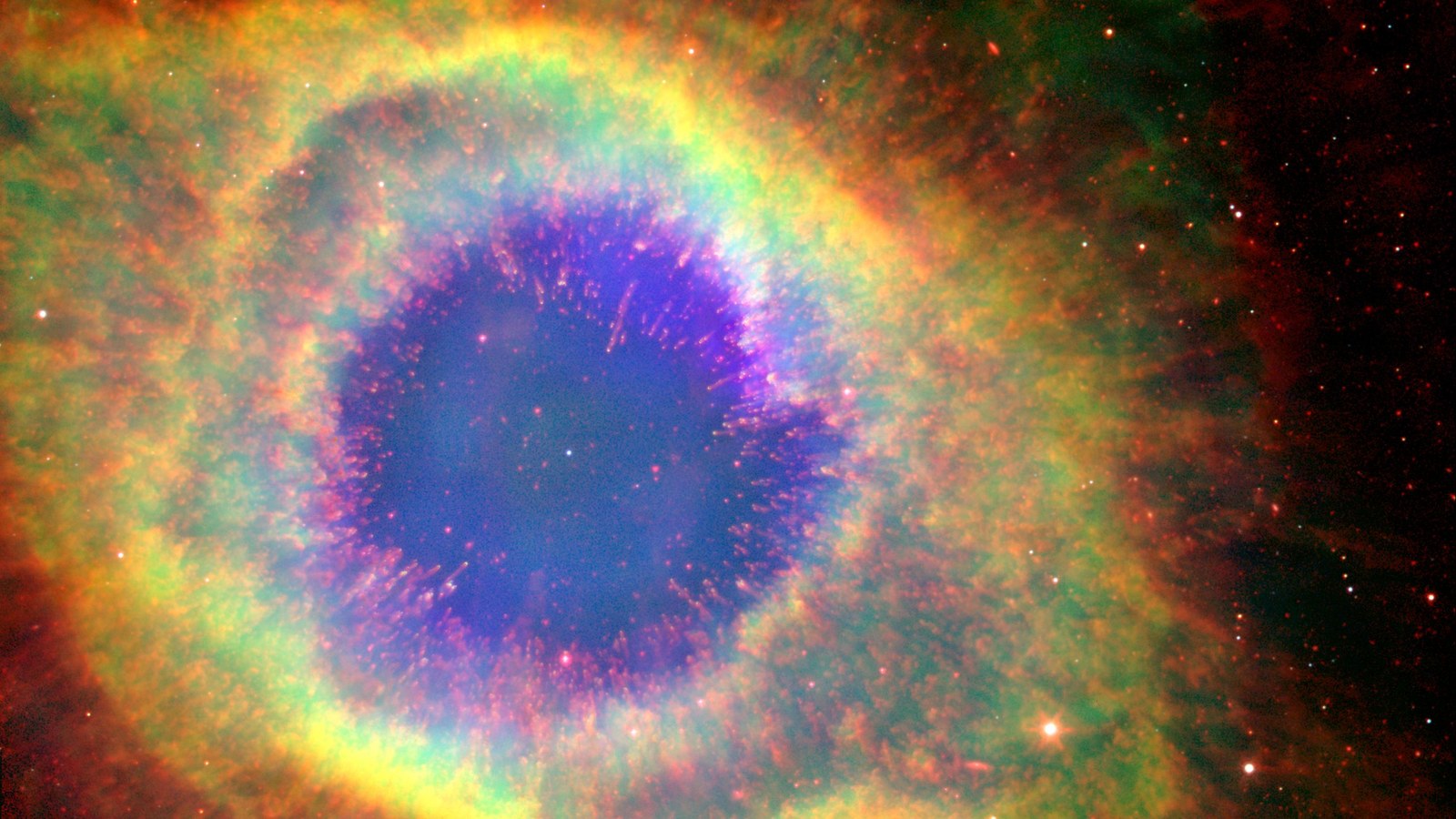
The Helix Nebula is the flagship of the constellation and one of the most famous sights in all of astronomy. Its images went around the world as the “Eye of God“: a glowing ring of red and blue-green gas, with a tiny, extremely hot star sitting at its centre. What you’re seeing is the death throes of a Sun-like star – it has shed its outer layers, and the hot core left behind makes them glow.
| Feature | Value |
|---|---|
| Distance | 655 ± 13 light-years (Gaia) – the closest large planetary nebula |
| Brightness | 7.6 mag |
| Apparent size | about 25 arcminutes – almost as large as the full moon |
| Actual size | about 2.5 light-years across |
| Age | about 10,600 years |
| Central star | white dwarf, 13.5 mag, about 120,000 degrees hot |
| Discovery | Karl Ludwig Harding, before 1824 |
The numbers also explain the problem at the eyepiece. 7.6 mag sounds bright – but that light is spread over an area the size of the full moon. Its surface brightness is therefore extremely low. The Helix Nebula must be treated the exact opposite of most deep-sky targets: low magnification, wide field of view, dark sky. Search for it at 200x and you’re guaranteed to find nothing.
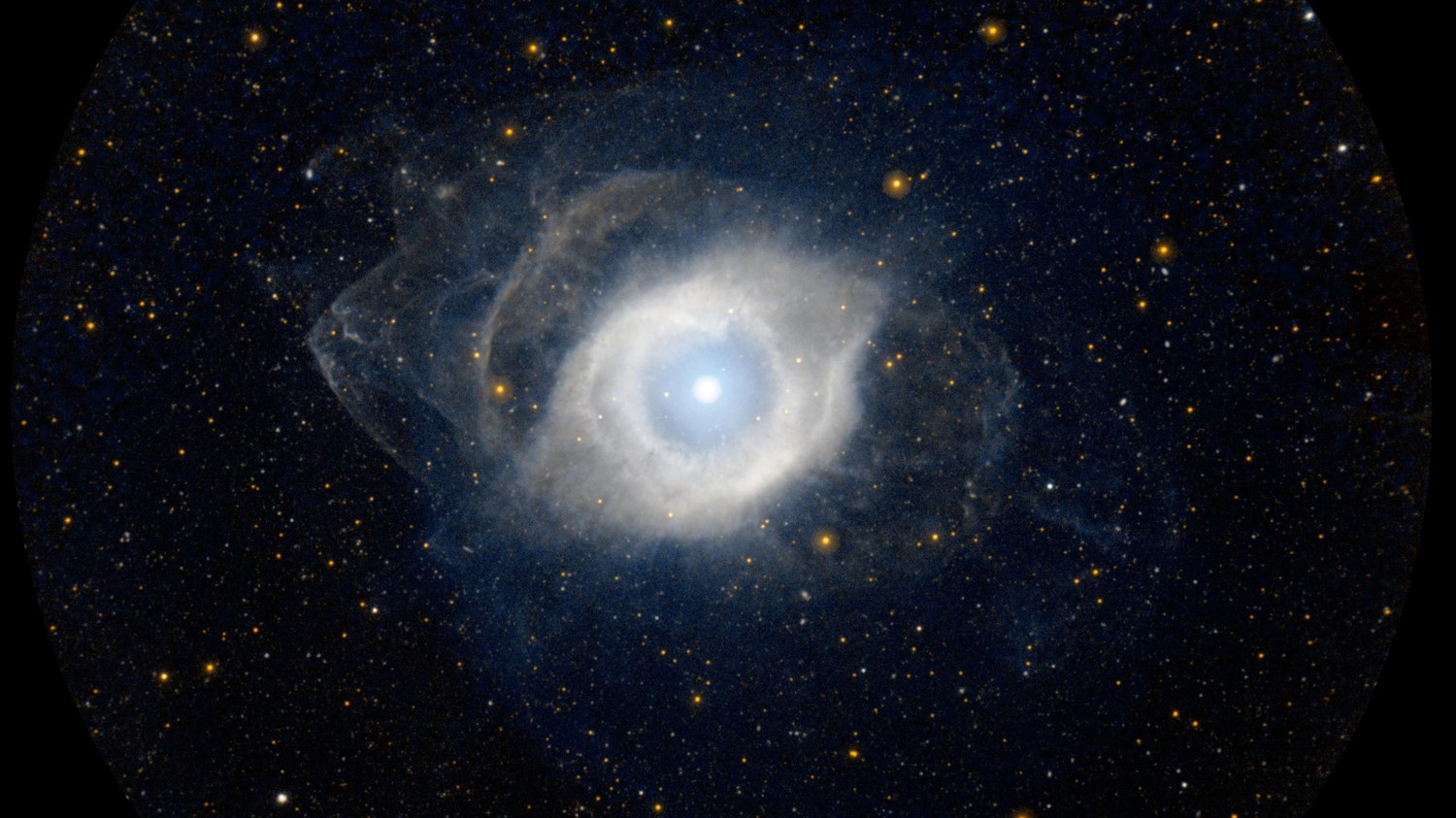
One detail the images barely reveal: the ring is dotted with about 40,000 cometary knots – clumps of gas with tails, each one larger than our entire solar system, all pointing away from the central star. They form where the fast, hot wind of the dying star meets the slower material shed earlier.
Saturn Nebula NGC 7009: tiny but bright
The Saturn Nebula is the exact opposite of the Helix Nebula – and therefore the more rewarding target for most telescope owners. It measures only 25 × 17 arcseconds, but packs the same amount of light into 8.0 mag. Its surface brightness is correspondingly enormous: it easily takes 200x magnification and can even be seen under moderate city skies.
William Herschel discovered it on 7 September 1782. It only got its name in the 1840s from Lord Rosse, who with his giant telescope spotted two faint extensions (“ansae”) to the left and right of the oval body – together resembling the planet Saturn with its ring. In an amateur telescope you first see a small, distinctly green-blue oval that you can immediately tell apart from a star at high magnification. The ansae, however, need large aperture and very steady air.
A practical finding tip: NGC 7009 stands about 1.2 degrees west of the star ν Aquarii. Since it looks point-like, the fastest way to find it is to search at low magnification for a “star with the wrong colour” and then zoom in.
Globular cluster M 2: 150,000 stars in one spot
Messier 2 is the brightest deep-sky object in the constellation and one of the finest globular clusters in the northern sky. Jean-Dominique Maraldi discovered it in 1746, and Charles Messier added it to his catalogue in 1760.
| Feature | Value |
|---|---|
| Brightness | 6.5 mag – just barely visible to the naked eye under very dark skies |
| Distance | about 38,000 light-years |
| Apparent size | 16 arcminutes |
| Actual diameter | about 175 light-years |
| Stars | about 150,000 |
| Age | about 12.5 billion years |
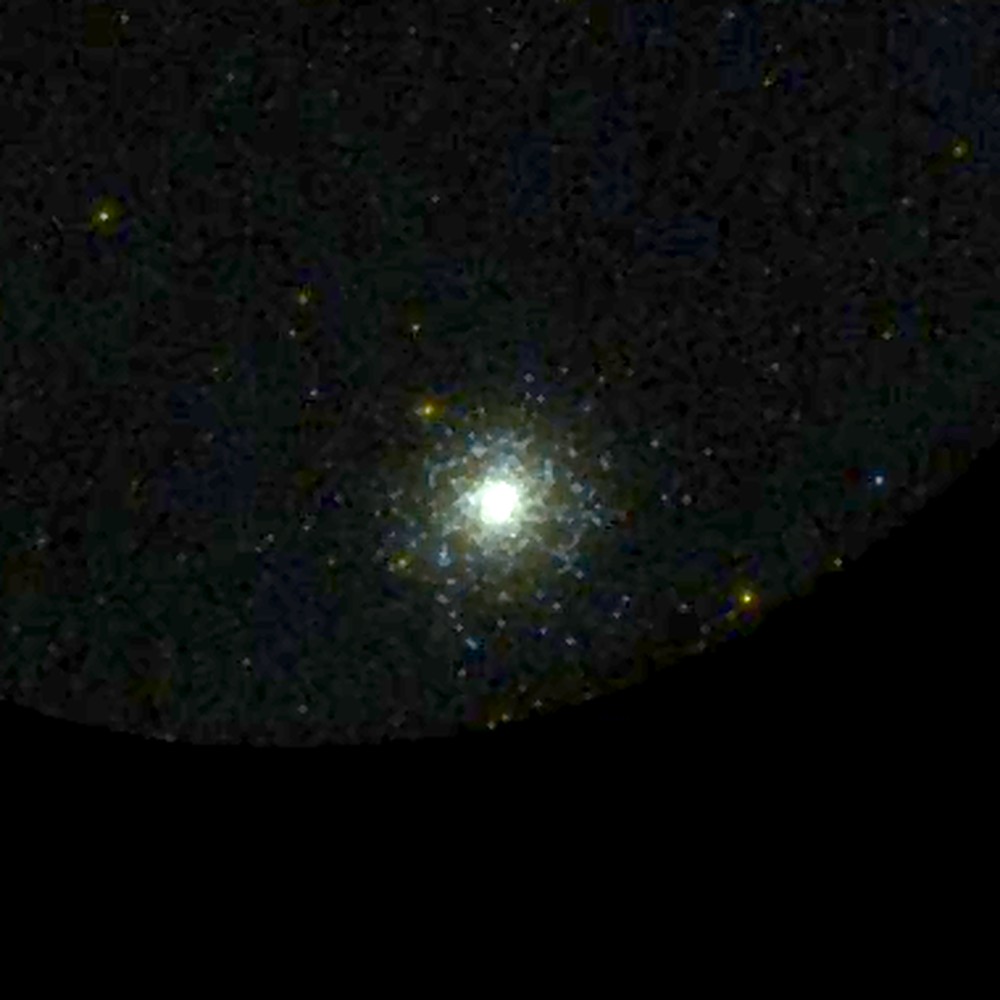
M 2 is a great example of just how much aperture matters with globular clusters. In binoculars it’s a round, distinctly fuzzy patch – nice, but featureless. From about 10 centimetres of aperture the edge turns grainy, and from 15 to 20 centimetres it resolves into thousands of individual stars. That exact moment, when a fuzzy patch turns into a star cluster, is the whole reason you go looking for globular clusters in the first place.
To find it: M 2 stands about 5 degrees north of Sadalsuud – a nice easy sweep with binoculars. That makes it noticeably easier to find than any other object in the constellation, and a good starting point for your first evening with Aquarius.
M 72 and M 73: the latecomer and the letdown
M 72 is the second globular cluster in the constellation – and the noticeably harder one. At 9.3 mag and roughly 55,000 light-years away, it’s among the most distant and faintest objects in the Messier catalogue. In a small telescope it remains a faint, small hazy patch with no resolution at all; only from 20 centimetres of aperture does graininess begin to show.
M 73, on the other hand, is the most famous letdown in the Messier catalogue – and worth a look for exactly that reason. Messier logged it in 1780 as a “star cluster with nebulosity”. In reality it’s four stars with no physical connection at all, which from our vantage point just happen to appear close together: a pure line-of-sight coincidence. Modern proper-motion measurements have settled the matter for good. If you’re working through the Messier list, you can tick it off in ten seconds – the two objects stand only 1.3 degrees apart.
TRAPPIST-1: seven rocky planets in Aquarius
Perhaps the most significant object in the constellation can’t be seen at all. TRAPPIST-1 is a red dwarf of only 18.8 mag, about 40 light-years away – out of reach for amateur telescopes. It became famous in 2017, when it turned out that seven roughly Earth-sized rocky planets orbit it, several of which lie in or near the habitable zone.
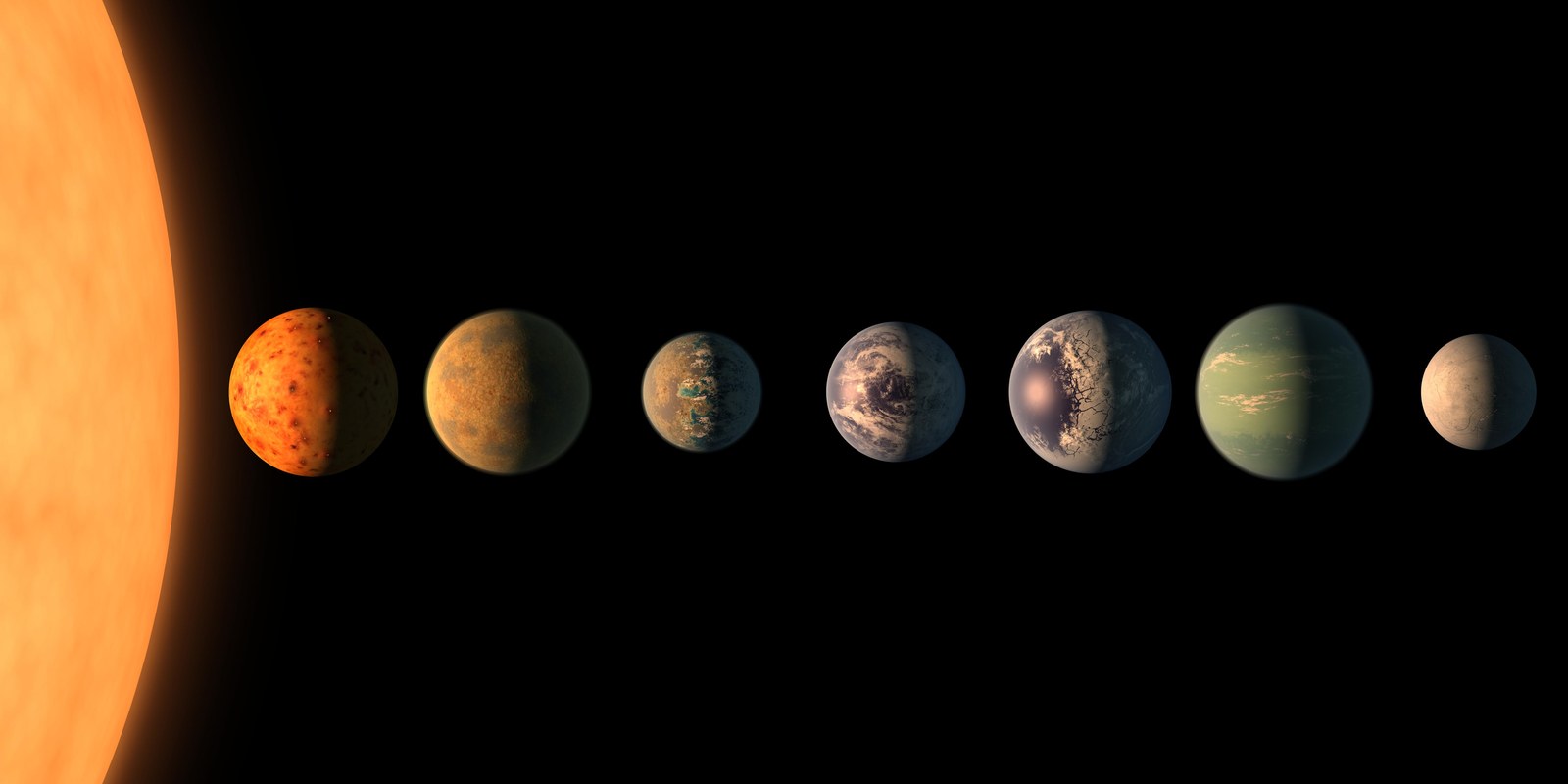
For observers, all that remains is the coordinate – but it’s a nice thought that, while sweeping through Aquarius, a complete planetary system sits out there that has been one of the top targets of exoplanet research for years. You can read more in our article on extrasolar single-star systems.
The Aquariids: two meteor showers from Aquarius
Twice a year, meteors rain from Aquarius – both showers are named after it, the Aquariids, and both share the same catch for Central Europe: the radiant sits too low.
Eta Aquariids in May: the shower from Halley’s Comet
The Eta Aquariids come from Halley’s Comet and peak around 6 May. In the southern hemisphere it’s one of the best showers of the year, with up to 50 meteors per hour. From Central Europe the picture is sobering: our own calculations for Berlin show that the radiant only clears the horizon as dawn begins to break – at 3:00 CEST it stands barely 2 degrees high, while the Sun is still 16 degrees below the horizon. An hour later it has climbed to 11 degrees, but the sky is already noticeably brightening.
Realistically that leaves a very short window in the last darkness before sunrise, during which the occasional Earthgrazer can be seen – meteors that enter the atmosphere at an extremely shallow angle, trace long paths, and therefore look especially dramatic. Still: in 2027 the peak falls on new moon, so conditions will be as good as they can possibly get here.
Delta Aquariids in July: the long, shallow shower
The Delta Aquariids run from mid-July to late August, with a broad peak around 30 July. They deliver about 15 to 20 meteors per hour – weaker than the Perseids, but they overlap with the Perseids’ early phase, so in late July both showers are often active at once. At our latitudes the radiant also sits low, but at least it’s above the horizon in the middle of the night.
The moon matters here: in 2026 the peak falls right on the full moon – you can skip that one. In 2027 only 16 percent of the Moon’s disc is illuminated, meaning practically ideal conditions. You’ll find all the dates in our meteor shower calendar.
🌠 No instrument needed for meteors
For meteor showers, any binoculars or telescope are a disadvantage: they narrow your field of view, right when you want to take in as much sky as possible at once. The best “meteor-watching spot” is a sleeping mat, a sleeping bag, and a view tilted upward, about 40 degrees away from the radiant.
Aquarius in mythology: water, flood and campaign
Aquarius is among the oldest constellations handed down to us. Its interpretations differ remarkably little between cultures – almost everywhere it’s about water, a jar, or a flood. There’s a sober reason for that: in antiquity, the Sun stood in Aquarius when the rainy season began.
Babylon: GU.LA and the god Ea
The Babylonians saw in this group of stars GU.LA, “the Great One” – and identified it with their god Ea, lord of fresh water and wisdom. He was depicted holding an overflowing vase, from which two streams of water poured. This iconography is over 3,000 years old and has survived into our modern star charts: the “waterfall” pouring from the Water Jar is the very same stream.
For the people of Mesopotamia this was no poetry, but a calendar. When the Sun entered Aquarius, the annual floods of the Euphrates and Tigris were approaching – the most important date of the agricultural year.
Greece: Ganymede and the great flood
The Greeks adopted the image and filled it with two stories. In the better-known one, Aquarius is Ganymede, a prince of such great beauty that Zeus, taking the form of an eagle, carried him off to become cupbearer to the gods – ever since, he pours out nectar in the sky. The neighbouring constellation Aquila is, in this reading, no coincidence.
The second story is darker and older: Deucalion, son of Prometheus, survived a great flood that Zeus sent upon humanity, together with his wife Pyrrha – in a self-built chest or ship. The parallel to other flood myths of the Ancient Near East is obvious, and it explains why this particular patch of sky stayed associated with water.
China: the Army of Yu-Lin and the Ramparts
Chinese astronomy divided the sky in a completely different way and arrived at a completely different picture. The faint stars of today’s Aquarius there formed the “Army of Yu-Lin” – armed foot soldiers with whips on a heavenly campaign. A whole series of Aquarius stars also belonged, together with stars of Pisces and Capricornus, to a separate constellation, the “Loui-pi-tschin”, the Ramparts – a fortification in the sky.
Aquarius in Latin: meaning and origin of the name
Aquarius is Latin and simply means “the water carrier” – derived from aqua, water. In classical Latin the word plainly denoted the water carrier as a profession, someone who fetches and pours water. The genitive is Aquarii; it appears in every star designation within the constellation, as in “Beta Aquarii”.
One claim circulating online should not be repeated: that Aquarius means “giant” and comes from Ancient Egyptian. That is false. The word is unambiguously Latin and a direct translation of the Greek Hydrochoos (“water pourer”), which in turn adopted the Babylonian interpretation. Egyptian attributions do exist for other constellations, but not for the name Aquarius.
| Language | Name | Note |
|---|---|---|
| German | Wassermann | 10 letters |
| Latin | Aquarius | 8 letters |
| English | Aquarius / The Water Bearer | – |
| Greek | Hydrochoos (Ὑδροχόος) | “water pourer” |
| IAU abbreviation | Aqr | 3 letters |
| Zodiac symbol | ♒ | two wavy lines |
The symbol ♒, incidentally, is not an invention of astrology but traces directly back to the Egyptian hieroglyph for water – two wavy lines representing flowing water. It is thus one of the oldest still-used written symbols in the world.
Zodiac sign and constellation Aquarius: the difference
Anyone born under the zodiac sign Aquarius is born between 21 January and 19 February. Anyone searching the night sky for the constellation Aquarius during that time finds nothing – it stands in the daytime sky then. That’s no contradiction, but the logical consequence: the astrological sign marks exactly the period during which the Sun, from our point of view, stands in front of the constellation.
A second effect adds to this. Through precession – the slow gyration of Earth’s axis, with a period of about 25,800 years – the astrological signs have shifted relative to the actual constellations. They were fixed over 2,000 years ago and have not been adjusted since. Today the Sun actually only stands in the constellation Aquarius from 16 February to 11 March – about a month later than the sign of the same name.
You’ll find the full comparison of all twelve signs with the real solar transits in our article Zodiac signs and constellations – it also explains why there are actually thirteen zodiac constellations in the sky.
Binoculars or telescope: what Aquarius calls for
With Aquarius the answer is clearer than for most constellations – and it favours the telescope. The reason lies in the nature of the objects: planetary nebulae and globular clusters are small, concentrated targets that reward aperture and magnification. That is exactly where binoculars fall short.
What binoculars can do
Even so, binoculars have a real job here, namely finding your way. The 3.7-degree Water Jar fits entirely into the field of view, the faint stars of the constellation become visible at all, and M 2 can be located within seconds. For your first evening with Aquarius, a 10×50 pair is genuinely a better tool than a telescope with a narrow finder field.
It reaches its limits immediately after that. In binoculars the Saturn Nebula stays a star among stars – you can’t even identify it as a nebula. M 2 remains a shapeless patch. ζ Aquarii stays a single point. And M 72 is already beyond what a 50-millimetre objective still shows under Central European skies.
When the telescope pays off
As soon as it comes to the actual targets – NGC 7009, M 2 resolved, M 72, the split binary ζ Aquarii – there’s no way around a telescope. With the Saturn Nebula it’s especially clear-cut: it’s so small that it only becomes recognisable as a little disc from around 100x magnification. No binoculars reach that magnification.
Add to that the extinction problem from earlier. If a whole magnitude is lost in the air at 16 degrees altitude, aperture has to make up for it. A 200-millimetre mirror gathers roughly 16 times as much light as a 50-millimetre binocular objective – for objects already at the edge of visibility, that’s the difference between “nothing to see” and “clearly there”.
If you can only buy one instrument and really want to explore the sky, go for the telescope; binoculars are the complement, not the replacement. For Aquarius that means, in concrete terms: a Dobsonian telescope with as much aperture as possible, because here every photon collected works against the deep proximity to the horizon.
For the Helix Nebula, Saturn Nebula and M 2: Skywatcher Dobson Telescope N 200/1200 Skyliner Classic
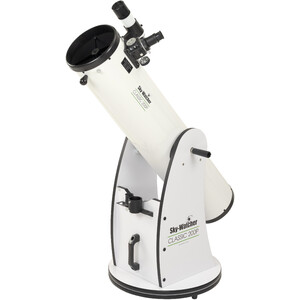
200 mm of aperture — the most sky for your money. Set it on the ground, point by hand: nebulae, clusters and galaxies for years to come.
Price: € 479
If you’d rather start smaller, the Skywatcher Heritage 130/650 FlexTube gets you a long way for around $305.00€ 265: 13 centimetres of aperture show the Saturn Nebula as a clear, greenish little disc and already resolve the edge of M 2 into grains. For the Helix Nebula it’s actually better suited than a large instrument, because the short focal length allows a wider field of view.
Compact entry point with a wide field of view: Skywatcher Dobson Telescope N 130/650 Heritage FlexTube
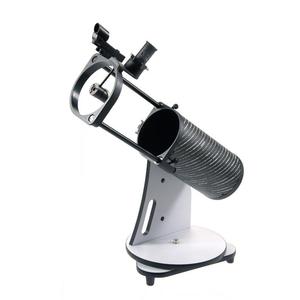
A compact tabletop Dobson with a true parabolic mirror. Folds down, fits in a bag: the Moon, planets and the bright deep-sky classics.
Price: € 265
Our comparison Telescopes under 300 euros gives an overview of the options in this price bracket. If you’re still unsure in general, our article Telescope or binoculars weighs it up in detail, and our beginner’s guide covers the basics of choosing one.
Frequently asked questions about the constellation Aquarius
What does the constellation Aquarius look like?
Like a very large, very faint field of dim stars. The only figure you recognise at once is the Water Jar: a small Y made of four stars, only 3.7 degrees across. From there, a curving chain of stars stretches southeast – the “waterfall”. Without a reference image, the ancient depiction of a man with a jar is practically impossible to make out.
Where in the sky is the constellation Aquarius?
In the south, below the Great Square of Pegasus and above the bright star Fomalhaut. More precisely: about two hand-widths below the lower edge of the square and about 30 degrees above Fomalhaut. Aquarius therefore stays permanently in the lower half of the sky.
When can you see Aquarius?
From August to late November, best in October around 22:00. On 1 October the constellation culminates at 22:30. In winter and spring it stands in the daytime sky and cannot be observed.
Can I observe Aquarius tonight?
Between August and November: yes, provided the sky is clear and the southern view is open. Between December and July: no. Also check the Moon – at full moon, none of Aquarius’s deep-sky objects are visible. Find out what else is currently in the sky in our astro events.
What is Aquarius called in Latin?
Aquarius, derived from aqua (water). Translated, it means “the water carrier”. The official IAU abbreviation is Aqr, the genitive Aquarii.
A constellation with eight letters – is that Aquarius?
In crossword puzzles, it’s usually the Latin form that’s being asked for: AQUARIUS has eight letters. The German name “Wassermann”, by contrast, has ten. Other zodiac constellations don’t fit eight letters either: not Sagittarius (eleven), nor Capricornus – in practice, when a clue asks for eight letters and points to the water carrier, it’s almost always Aquarius that’s meant.
How many stars does the constellation Aquarius have?
Under good rural skies, the naked eye can make out roughly 50 to 60 stars, but only two brighter than 3 mag: Sadalsuud (2.87 mag) and Sadalmelik (2.94 mag). In total the constellation covers an area of 979.9 square degrees – rank 10 of 88.
What is special about the constellation Aquarius?
The Helix Nebula NGC 7293. At 655 light-years it is the closest large planetary nebula to us, appears almost as large as the full moon, and as the “Eye of God” is one of the most photographed objects in the sky. Add to that the globular cluster M 2, the Saturn Nebula NGC 7009, and the planetary system TRAPPIST-1.
What role does Aquarius play in mythology?
Almost everywhere it’s about water. The Babylonians saw their water god Ea with an overflowing vase, the Greeks saw the cupbearer Ganymede or the flood survivor Deucalion, the Chinese saw the “Army of Yu-Lin”. The common thread is the calendar: the Sun’s transit marked the start of the rainy season.
Read more on Sterngucker
- Constellation Pegasus – the northern neighbour and most important sighting aid
- Constellation Pisces – the eastern zodiac neighbour
- Constellation Capricornus – the western zodiac neighbour
- The Aquariids – the two meteor showers from Aquarius
- Nebulae – how planetary nebulae like the Helix Nebula form
- Deep-sky objects – nebulae, clusters and galaxies at a glance
- Night sky in October – the best month for Aquarius
- Zodiac signs and constellations – why the sign and the constellation don’t line up
- All constellations at a glance – the starting point for our catalogue