By Alexander Merz · Published on · Details checked on 25 October 2026
Short answer: Under a dark sky, about 3,000 to 6,000 stars are visible to the naked eye. The Milky Way contains 100–400 billion, and the observable universe an estimated 1022 to 1024 stars – more than the grains of sand on all the beaches on Earth.
What you can really see
The whole sky (both hemispheres) shows the naked eye around 9,000 stars down to magnitude 6.5 – from any one place you see half of them, so a good 4,000 under a perfect country sky. In the city, often only a few dozen are left: light pollution eats up the starry sky. A pair of binoculars raises the number to more than 100,000, a medium-sized telescope to millions.
The Milky Way: our star island
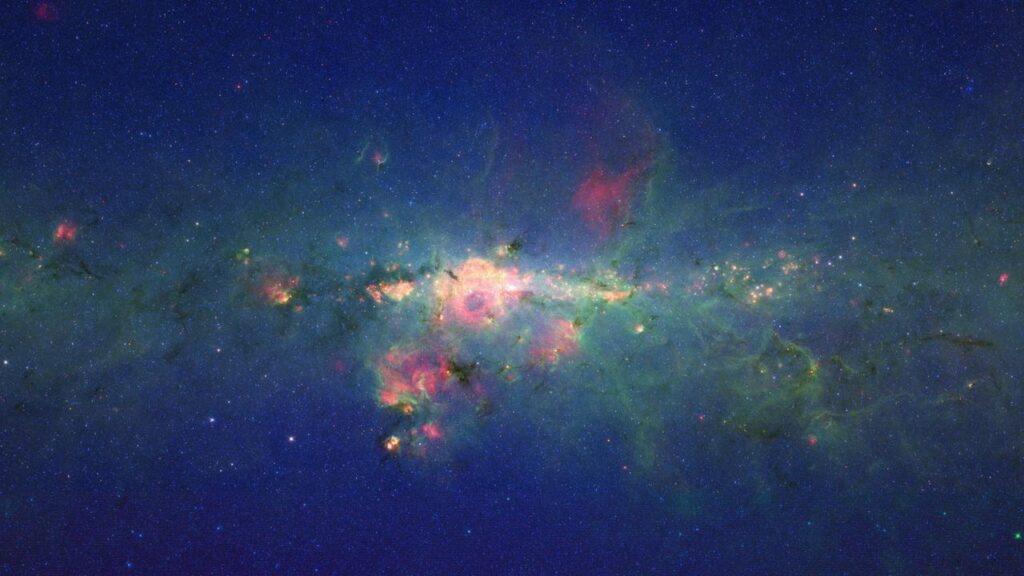
According to current estimates, our Milky Way contains 100 to 400 billion stars. The uncertainty is so large because the most common stars – faint red dwarfs – are hard to count, and dust blocks the view towards the centre.
And in the whole universe?
Roughly multiply 200 billion stars by more than 100 billion galaxies: you end up at about a 1 followed by 22 to 24 zeros. For comparison: all the grains of sand on Earth are estimated at about 1018 to 1019 – so there are thousands of stars for every grain of sand. And since most stars have planets (see exoplanets), the number of worlds is even larger.
Frequently asked questions
How many stars can you see with the naked eye?
Under a dark country sky 3,000–6,000 at the same time; in a light-polluted city often fewer than 100.
How many stars are in the Milky Way?
Estimates range from 100 to 400 billion – they cannot be counted exactly.
Are there more stars than grains of sand?
Yes, by common estimates the number of stars in the observable universe exceeds the grains of sand on all the beaches and deserts of Earth many times over.
Are new stars still being born?
Yes – in the Milky Way alone, stars with a total of about one to two solar masses form every year, for example in the Orion Nebula.