By Alexander Merz · Updated on · Details checked on 14 September 2026
Sirius is the brightest star in the night sky: a double star in the constellation Canis Major, just 8.6 light-years away and about 25 times more luminous than the Sun.
On any clear winter evening, one blue-white point outshines everything else low in the southern sky, flashing and sparkling above the horizon. That beacon is Sirius, the brightest star in the entire night sky. Tucked into the constellation Canis Major, it owes its dazzling reputation not only to its true power but also to its closeness: at just 8.6 light-years away, Sirius is one of our nearest stellar neighbours.
⚡ The quick answer: Sirius is the brightest star in the night sky (magnitude −1.46), lying 8.6 light-years away in the constellation Canis Major. It is a double star made up of Sirius A, roughly 25 times more luminous than the Sun, and Sirius B, a white dwarf. From the northern hemisphere it is best seen from December to March, low in the southern sky — just extend the line of Orion’s three belt stars to point straight at it.
The brightest star in the night sky
Nicknamed the “Dog Star,” Sirius outshines every other star in the heavens. That supremacy comes from a double gift: the star genuinely radiates about 25 times more energy than our Sun, and it sits a mere 8.6 light-years from Earth. Its restless blue-white twinkle — which seems to flicker through every colour when the star hangs near the horizon — is not the star’s own doing. It is our turbulent atmosphere continually bending and scattering its light.
How to find Sirius
Locating Sirius couldn’t be easier. Find Orion, the most recognisable constellation of winter, and follow the line of its three belt stars downward and to the left. The strikingly bright star you land on is Sirius. From mid-northern latitudes the best viewing window runs from December to March, in the evening, above the southern horizon. In summer the star sits too close to the Sun to be seen.
A simple pair of binoculars is enough to bring out its fierce sparkle and to sweep the rich star fields of Canis Major that surround it.
Best for beginners: Celestron Cometron 7x50 Binoculars
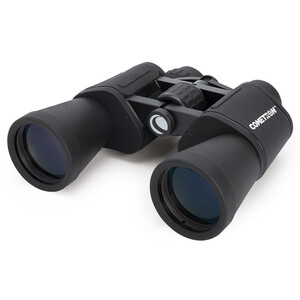
The astronomy classic among affordable binoculars: 7×50 with a large exit pupil for bright handheld views of the Moon and Milky Way – the ideal first step before a telescope.
Price: € 65
* Affiliate link: if you buy through this link we may earn a small commission from Astroshop or High Point Scientific, at no extra cost to you.
The hidden companion: Sirius B
Sirius is in fact a double star. Orbiting the brilliant primary roughly every 50 years is Sirius B, affectionately called “the Pup.” It is a white dwarf the size of the Earth yet packing a mass close to the Sun’s — a single teaspoon of its material would weigh several tonnes. Discovered in 1862, it was the very first white dwarf ever identified. Because of the blinding glare of Sirius A, spotting it remains a genuine challenge even for larger amateur telescopes.
Sirius through history
Few stars have shaped human cultures so deeply. In ancient Egypt, its first reappearance in the morning sky heralded the flooding of the Nile and anchored the calendar. The “dog days” of high summer still take their name from the Dog Star: people once believed that Sirius, rising alongside the Sun, added its own heat to the sweltering season.
Sirius by the numbers
| Property | Value |
|---|---|
| Apparent magnitude | −1.46 (brightest star) |
| Distance | 8.6 light-years |
| Constellation | Canis Major |
| Luminosity (Sirius A) | ≈ 25× the Sun |
| System | Double: Sirius A + white dwarf Sirius B |
| Best visibility | December to March, southern sky |
Frequently asked questions
Why does Sirius twinkle so much?
Its light often crosses thick layers of air near the horizon. Atmospheric turbulence bends it again and again, creating the colourful flickering it is famous for.
Is Sirius a planet or a star?
A star — in fact a double-star system, made up of the bright primary Sirius A and the white dwarf Sirius B.
When can you see Sirius?
During the winter half of the year, ideally from December to March, in the southern evening sky, down and to the left of Orion.
Is Sirius the biggest star?
No — only the brightest in our sky, thanks to its closeness. Giant stars such as Betelgeuse are hundreds of times larger, but far more distant.
How far away is Sirius?
8.6 light-years from the Solar System, making it one of our closest stellar neighbours.
📚 Read next:
- Orion: how to find winter’s flagship constellation
- All the constellations at a glance
- Best beginner telescopes