By Alexander Merz · Updated on · Details checked on 6 October 2026
Neptune is the eighth and outermost planet of the solar system: an ice giant 49,528 km across that circles the Sun once every 164.8 years at a distance of 4.5 billion km.

Neptune fact sheet
- Ice giant, 8th from the Sun
- 16 moons, 5 rings
- Diameter: 49,528 km
- Orbital period: 164.8 years
- Length of day: 16 h 07 min
- Distance from the Sun: 4.5 billion km
- Temperature: −214 °C
Let’s be honest up front: even in a telescope, Neptune stays a tiny disc – in binoculars it is just a point of light, and its blue-green colour only shows from about 15 cm aperture. What matters here is explained in our buying guide for planet telescopes; if you are planning bigger right away, you’ll find suitable instruments among the telescopes for advanced observers.
Neptune fact sheet: all the data at a glance
The table sums up the key figures of the ice giant. The values come from NASA and the NSSDC fact sheet; the number of moons reflects the status as of September 2026.
| Property | Value |
|---|---|
| Position in the solar system | 8th and outermost planet |
| Type | Ice giant (not a classic gas giant like Jupiter or Saturn) |
| Discovery | 23 September 1846 by Johann Gottfried Galle at the Berlin Observatory – predicted by Urbain Le Verrier |
| Equatorial diameter | 49,528 km (3.9 times Earth’s diameter) |
| Mass | 1.024 · 1026 kg = 17.1 Earth masses |
| Mean density | 1.64 g/cm³ |
| Surface gravity | 11.15 m/s² (1.14 times Earth’s gravity) |
| Mean distance from the Sun | 4.495 billion km = 30.07 AU – light takes about 4 hours |
| Distance from Earth | 4.3 to 4.7 billion km (closest at opposition) |
| Orbital period | 164.8 Earth years |
| Rotation period | 16 hours 7 minutes |
| Axial tilt | 28.3° (Earth: 23.4°) |
| Mean temperature | −214 °C (59 K) in the upper atmosphere |
| Atmosphere | about 80 % hydrogen, 19 % helium, 1.5 % methane |
| Wind speed | over 2,000 km/h – the fastest winds in the entire solar system |
| Magnetic field | about 27 times stronger than Earth’s, tilted 47° from the rotation axis |
| Moons | 16 known as of September 2026 (largest: Triton, 2,707 km across) |
| Rings | 5 main rings: Galle, Le Verrier, Lassell, Arago and Adams |
| Apparent magnitude | 7.7 to 8.0 mag – never visible to the naked eye |
| Spacecraft visits | only Voyager 2, on 25 August 1989 |
Sources: NASA Science (Neptune Facts, Neptune Moons), NSSDC Neptune Fact Sheet, NASA/JPL. As of September 2026.
At magnitude 7.7 to 8.0, Neptune stays invisible to the naked eye. A pair of 7×50 binoculars – 7x magnification, 50 mm objective lenses – will already show it as a faint pinpoint of light, as long as a finder chart tells you where to look. For the bluish disc you need a telescope; which one is worth it is covered in our telescope test.
Shows Neptune as a point of light: Celestron Cometron 7x50 Binoculars
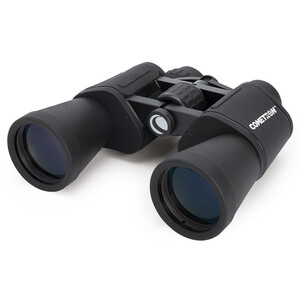
The astronomy classic among affordable binoculars: 7×50 with a large exit pupil for bright handheld views of the Moon and Milky Way – the ideal first step before a telescope.
Price: € 65
Size and distance: Neptune compared with Earth
At almost 50,000 km across, Neptune is larger than all the rocky planets of the solar system, but the smallest of the four giant planets. Almost 58 Earths would fit inside its volume, and its mass equals 17 Earths. How it compares with the other planets is shown in the overview of planets by size.
Distance from the Sun and Earth: 4.3 to 4.7 billion km
Neptune circles the Sun on an almost perfectly round orbit, so its distance from the Sun only varies between 4.47 and 4.56 billion kilometres. Seen from Earth, the distance changes more, because at one point we are on its side of the Sun and half a year later on the opposite side.
| Distance | Kilometres | Light travel time |
|---|---|---|
| Sun – Neptune, closest point (perihelion) | 4.47 bn km | 4 h 9 min |
| Sun – Neptune, average | 4.50 bn km (30.1 AU) | 4 h 10 min |
| Sun – Neptune, farthest point (aphelion) | 4.56 bn km | 4 h 13 min |
| Earth – Neptune at opposition (26 Sep 2026) | 4.32 bn km | 4 h 0 min |
| Earth – Neptune, maximum | about 4.7 bn km | 4 h 20 min |
Sources: NSSDC Neptune Fact Sheet (perihelion/aphelion); opposition distance calculated by us with the JPL ephemeris DE421 (Skyfield) and confirmed with JPL Horizons.
The only spacecraft ever to reach Neptune spent twelve years getting there. Even radio signals need about four hours one way – so in 1989 a question to Voyager 2 and its answer were eight hours apart.
Rotation: a day on Neptune lasts just over 16 hours
Neptune spins once on its axis in about 16 hours – despite being four times as wide as Earth. In 1989 Voyager 2 used the magnetic field to measure a rotation period of 16 hours 7 minutes; that is still the value NASA gives today.
An analysis of cloud features at the south pole in 2011 arrived at 15 hours 58 minutes, because the magnetic field does not reveal the rotation of the deep interior with perfect precision. The atmosphere itself does not rotate uniformly: at the equator the clouds lag hours behind because of the retrograde winds, while at high latitudes they run ahead.
The fast spin visibly flattens the planet: the equatorial diameter is about 850 km larger than the polar diameter. At 28.3°, the axis is tilted much like Earth’s, so Neptune has seasons – although each one lasts around 40 years.
Discovery in 1846: the planet found at a desk
Neptune is the only planet that nobody stumbled upon in the sky: it was calculated first and seen afterwards. The French mathematician Urbain Le Verrier worked out its position from the disturbances in the orbit of Uranus and sent the coordinates to Berlin.
There, Johann Gottfried Galle and Heinrich d’Arrest found it on the night of 23 September 1846 – less than one degree from the predicted spot, the very night the letter arrived. In England, John Couch Adams had made a similar calculation, but the search in Cambridge came to nothing because the observations were not analysed in time.
Someone had actually seen it much earlier: Galileo Galilei drew Neptune in December 1612 and January 1613 as a little star next to Jupiter, without realising it was a planet. The timeline shows the key milestones up to today.
| Year | Event |
|---|---|
| 1612/13 | Galileo records Neptune as a “fixed star” next to Jupiter |
| 1846 | Le Verrier calculates the position; Galle and d’Arrest find Neptune in Berlin on 23 September |
| 1846 | William Lassell discovers the large moon Triton on 10 October |
| 1949 | Gerard Kuiper finds the second moon, Nereid |
| 1989 | Voyager 2 flyby: six new moons, rings, the Great Dark Spot |
| 2011 | Neptune completes its first orbit of the Sun since its discovery |
| 2024 | Two more moons announced, bringing the total to 16 |
| 2025 | The James Webb Space Telescope captures Neptune’s aurorae for the first time |
Why is Neptune called Neptune?
The name comes from Neptune, the Roman god of the sea – the Greek Poseidon – which fits its blue colour, even though nobody knew about it when the planet was named. “Janus”, “Oceanus” and even “Le Verrier” were also suggested; Neptune won out because it matches the other planets’ names from mythology.
The planet’s symbol ♆ is a stylised trident, the sea god’s weapon. The chemical element neptunium is also named after the planet – just as uranium is named after Uranus.
What is the planet Neptune?
To orbit the Sun once from its distance, Neptune needs 165 Earth years. Around its own axis, by contrast, it turns in just under 16 hours. For a giant planet it is fairly compact – and even more massive than the larger Uranus.
On Neptune you would feel slightly heavier than on Earth: its gravity at the 1-bar level is about 14 % higher than ours. Only Jupiter and, just barely, Saturn manage that as well.
Even in the “summer regions”, temperatures never rise above minus 200 °C, and they usually sit 10 degrees or more below that. Only Uranus has recorded even lower values, down to −224 °C.
Despite the cold, several large storms have been discovered on Neptune over the past forty years. Some take years to dissipate, others fade after just a few weeks.
Structure: what is Neptune made of?
Neptune has no solid surface; instead it consists of three layers that merge smoothly into one another. On the outside is an atmosphere of hydrogen, helium and some methane, beneath it a thick mantle of hot water, ammonia and methane, and at the very centre a core of rock and ice.
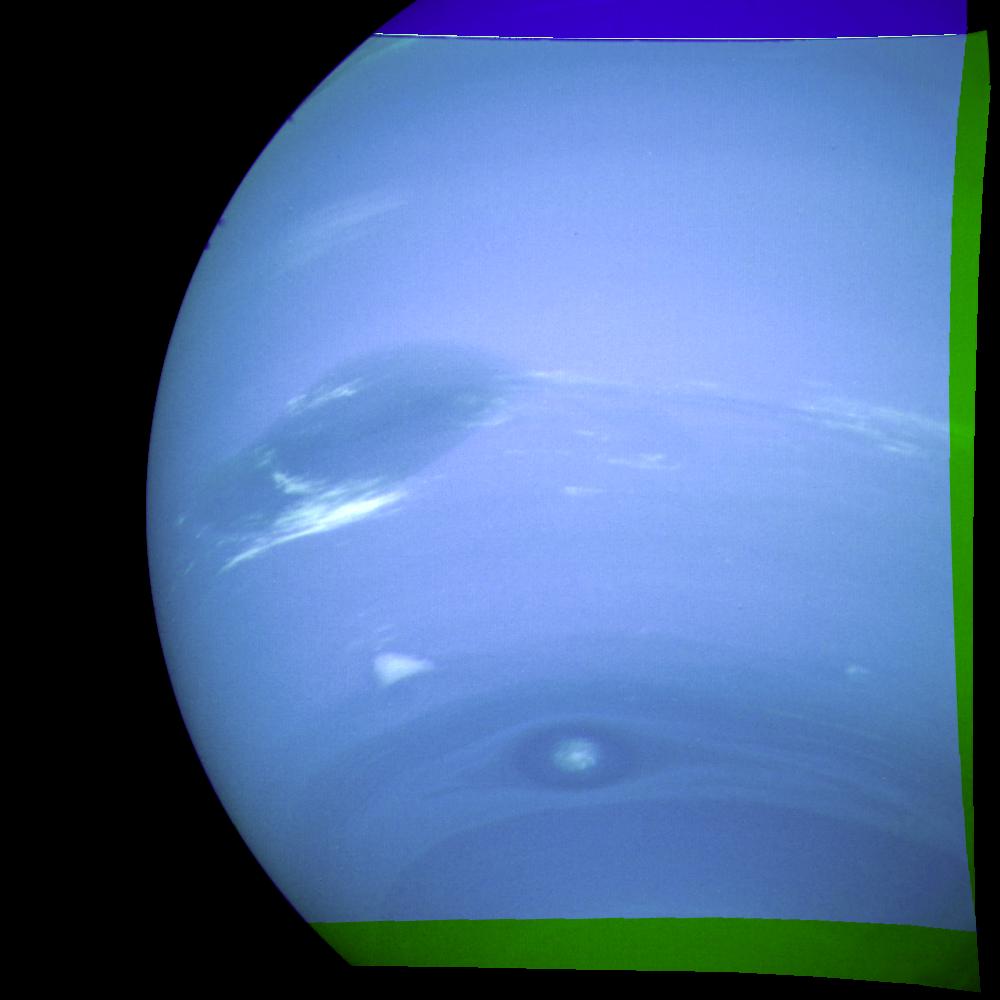
The atmosphere is about 80 % hydrogen, 19 % helium and 1.5 % methane. The methane absorbs red light and gives the planet its blue colour. Bright clouds of frozen methane form in the upper layers, and deeper down there are probably clouds of hydrogen sulphide and ammonia.
Most of the mass lies in the mantle, a hot, electrically conducting ocean of water, ammonia and methane. It is the source of the magnetic field, which is about 27 times stronger than Earth’s and tilted 47° from the rotation axis.
Because of this tilt, Neptune’s aurorae glow not at the poles but at mid-latitudes. The James Webb Space Telescope imaged them directly for the first time in 2025.
How did Neptune form?
How a giant planet of this size could form so far out has not been fully settled. The most popular explanation is the migration hypothesis: the giant planets formed closer to the Sun and only gradually moved out to their present orbits.
Other models have Neptune forming directly from instabilities in the protoplanetary disc; radiation from a nearby, massive star may have blown away part of its gas envelope in the process. That would explain why Neptune and Uranus contain much less hydrogen than Jupiter and Saturn.
During its migration, Neptune shaped the Kuiper Belt: to this day its gravity holds thousands of icy bodies in fixed orbital resonances, and so-called Trojan asteroids accompany it along its orbit. The dwarf planet Pluto, for example, circles the Sun exactly twice while Neptune goes round three times.
How cold is Neptune? Temperatures from the cloud tops to the core
There is no single answer to the question of Neptune’s temperature – and that is not down to poor measurements, but to the nature of the planet. Neptune has no solid surface on which you could place a thermometer. Its gas gets denser and denser towards the interior until it merges seamlessly into a supercritical ocean.
Astronomers therefore agree on a reference level: the altitude at which the pressure is 1 bar – the same as at sea level on Earth. What is commonly called the “surface temperature” is the value at this imaginary boundary.
A second reason for the confusing range of figures: Neptune is a fridge on the outside and a blast furnace on the inside. Between the top cloud layer and the core lies a difference of about 5,300 kelvin. The following table assigns the commonly quoted values to their respective levels.
| Level | Pressure | Temperature |
|---|---|---|
| Tropopause (coldest layer) | 0.1 bar | 55 K = −218 °C |
| Effective temperature (NASA mean) | — | 59 K = −214 °C |
| “Surface” (reference level) | 1 bar | 72 K = −201 °C |
| South pole (summer hemisphere) | 0.1 bar | up to 10 K warmer than elsewhere |
| Ionic ocean of water, methane, ammonia | several 100,000 bar | a few thousand kelvin |
| Rock/ice core | over 5 million bar | about 5,400 K – hotter than the surface of the Sun |
| Moon Triton (for comparison) | ~0.00002 bar | 38 K = −235 °C |
Sources: NASA Science (Neptune Facts), NASA/JPL, DLR Institute of Planetary Research. As of September 2026.
The last entry is remarkable: at −235 °C, Neptune’s moon Triton is even colder than the planet itself and has one of the coldest surfaces ever measured by a spacecraft. Only in permanently shadowed craters at the south pole of Earth’s Moon have even lower values of around −247 °C been recorded.
At roughly 5,400 kelvin, the planet’s core is about as hot as the surface of the Sun – except that this heat is locked away beneath thousands of kilometres of gas and supercritical water.
Right at the top, in the thin upper atmosphere, Neptune has cooled noticeably since 1989: according to James Webb measurements from 2023, the temperature there was only just over half the Voyager value. Why is still unclear.
Does Neptune have day and night temperatures?
Practically not. On Earth the night side cools down because the ground radiates heat; Neptune has no ground, and its dense hydrogen atmosphere distributes heat extremely quickly. With wind speeds of over 1,600 km/h, a parcel of air needs less than six hours to travel halfway round the planet.
The difference between the day and night sides is only a few kelvin – smaller than the seasonal effect at the south pole. So if you search for “Neptune temperature day and night”, you won’t find two separate values – unlike on Mercury, where the day and night sides are more than 600 °C apart.
Neptune or Uranus – which is really colder?
The question of the coldest planet in the solar system has two correct answers, depending on what you measure.
| Criterion | Neptune | Uranus |
|---|---|---|
| Mean distance from the Sun | 4.50 bn km (30.1 AU) | 2.87 bn km (19.2 AU) |
| Mean temperature | −214 °C | −216 °C |
| Lowest value measured | −218 °C | −224 °C |
| Internal heat source | yes – radiates 2.6 times more than it receives | practically none – incoming and outgoing radiation almost balanced |
| Wind speed | over 1,600 km/h, peaks around 2,100 km/h | up to about 900 km/h |
| Weather | stormy, visible cloud bands and spots | almost featureless for a long time |
Bottom line: on average Neptune is marginally warmer than Uranus, even though it lies one and a half billion kilometres farther out. The absolute cold record among the planets is held by Uranus at −224 °C.
So if you ask for the “coldest planet”, you get Neptune (greatest distance) or Uranus (lowest reading) depending on the yardstick – both answers are correct. And neither of them is the coldest place: that title goes to Neptune’s moon Triton.
Neptune’s internal heat source: 2.6 times more energy than it receives
At a distance of 4.5 billion kilometres, Neptune receives only about a thousandth of the solar energy that reaches Earth. Even so, it radiates 2.6 to 2.7 times as much energy as it absorbs from the Sun. The difference must come from the interior.
Two mechanisms overlap here: residual heat from its formation 4.5 billion years ago, which such a large body loses only extremely slowly, and gravitational energy being released. The planet is still contracting very slightly, and heavier components are sinking inwards.
This energy gradient is the engine behind the stormiest weather in the solar system: warm gas masses rise from the depths, cold ones sink, and the fast rotation of 16 hours 7 minutes stretches the currents into the familiar bands. Uranus lacks this heating almost entirely – which is why its atmosphere was strikingly calm for decades, while Voyager 2 photographed an Earth-sized storm vortex on Neptune.
Neptune is the only planet the naked eye never gets to see.
At magnitude 7.7 you need at least binoculars, and for the bluish disc a telescope from 15 cm aperture. Six short questions, an honest answer by email.
Is Neptune a gas planet or an ice giant?
Both – and that is exactly where the confusion lies. Neptune is about 80 % hydrogen, 19 % helium and 1.5 % methane; judged by the composition of its envelope, it is a gas planet.
In its internal structure, however, it differs fundamentally from Jupiter and Saturn. That is why planetary scientists have classed it and Uranus as a separate group since the 1990s: the ice giants.
| Property | Gas giants (Jupiter, Saturn) | Ice giants (Uranus, Neptune) |
|---|---|---|
| Main component by mass | Hydrogen and helium | Water, methane, ammonia (“ices”) |
| Share of H + He | over 90 % | only the outer envelope, about 15–20 % of the mass |
| Internal structure | metallic hydrogen around a small core | supercritical ionic ocean around a rocky core |
| Mean density | 1.33 g/cm³ (Jupiter) · 0.69 g/cm³ (Saturn) | 1.27 g/cm³ (Uranus) · 1.64 g/cm³ (Neptune) |
| Equatorial diameter | 139,820 km · 116,460 km | 51,118 km · 49,528 km |
The term “ice” is misleading here: it does not mean frozen ice cubes, but compounds of water, methane and ammonia that planetary science traditionally calls “ices”. At the pressures inside Neptune they exist as a hot, electrically conductive liquid.
This ionic ocean reaches up to about 70 % of the planet’s radius, makes up around 80 % of its mass and generates the unusually tilted magnetic field. Laboratory experiments suggest that at these depths methane breaks apart and the released carbon crystallises into diamond, which slowly rains downwards.
Remember: all four outer planets are gas planets, but only Jupiter and Saturn are gas giants. Uranus and Neptune are ice giants. Neptune is in no way a rocky planet – it has no solid surface, and its density of 1.64 g/cm³ is far below Earth’s 5.5 g/cm³.
Neptune’s rings: five dark rings and four ring arcs
After the ring discoveries at Saturn and Uranus, it became clear in the 1980s that ring systems are the norm for giant planets. Like those of Uranus, Neptune’s rings are very dark and consist largely of microscopically fine dust.
| Ring | Distance from Neptune’s centre | Special feature |
|---|---|---|
| Galle | about 42,000 km | innermost, broad and very faint ring |
| Le Verrier | about 53,200 km | narrow, sharply defined |
| Lassell | about 53,200 to 57,200 km | broad, thin band of dust |
| Arago | about 57,200 km | faint ring at the outer edge of the Lassell ring |
| Adams | about 62,900 km | outermost ring with the arcs Liberté, Egalité, Fraternité and Courage |
Sources: NASA Science (Neptune Moons & Rings), Wikipedia “Rings of Neptune” with reference to Voyager data.
In the outer Adams ring the dust clumps into four conspicuous ring arcs, which were at first mistaken for possible moons. What holds them together has not been definitively explained; the main suspect is the gravity of the small moon Galatea, which orbits just inside the ring.
The arcs are changing measurably: Liberté has faded markedly since Voyager 2, and the other arcs have also changed in brightness and position. Neptune’s rings cannot be seen in amateur telescopes – that takes space probes or large professional telescopes such as Webb, which imaged them sharply in the infrared in 2022.
Neptune’s moons: 16 known moons (as of 2026)
Neptune has 16 known moons – that is the count from NASA and the International Astronomical Union as of September 2026. The two most recent, S/2002 N5 and S/2021 N1, were announced by the Carnegie Institution in February 2024; they are only about 23 and 14 km across.
One moon dominates everything: Triton accounts for more than 99 % of the mass of all Neptune’s moons. The seven inner moons orbit close in and regularly, while the outer ones are tiny, distant chunks on tilted, partly retrograde orbits – probably captured objects.
| Moon | Diameter | Distance from Neptune | Discovered |
|---|---|---|---|
| Naiad | approx. 60 km | 48,200 km | 1989 (Voyager 2) |
| Thalassa | approx. 80 km | 50,100 km | 1989 (Voyager 2) |
| Despina | approx. 156 km | 52,500 km | 1989 (Voyager 2) |
| Galatea | approx. 175 km | 62,000 km | 1989 (Voyager 2) |
| Larissa | approx. 194 km | 73,500 km | 1981 (stellar occultation), confirmed 1989 |
| Hippocamp | approx. 35 km | 105,300 km | 2013 (Hubble) |
| Proteus | approx. 420 km | 117,600 km | 1989 (Voyager 2) |
| Triton | 2,707 km | 354,800 km | 1846 (Lassell) |
| Nereid | approx. 357 km | 5.5 million km | 1949 (Kuiper) |
| Halimede | approx. 60 km | 16.6 million km | 2002 |
| Sao | approx. 45 km | 22.2 million km | 2002 |
| S/2002 N5 | approx. 23 km | 23.4 million km | 2002, confirmed 2024 |
| Laomedeia | approx. 40 km | 23.5 million km | 2002 |
| Psamathe | approx. 40 km | 47.6 million km | 2003 |
| Neso | approx. 60 km | 49.9 million km | 2002 |
| S/2021 N1 | approx. 14 km | 50.7 million km | 2021, announced 2024 |
Sources: NASA Science “Neptune Moons” (16 moons, as of 21 Sep 2026), Carnegie Science 23 Feb 2024, Wikipedia “Moons of Neptune”. Diameters of the small moons are estimates based on their brightness.
In an amateur telescope, only Triton is within reach: at magnitude 13.5 it shows up from about 20 cm aperture as a faint little star that never strays more than 17 arcseconds from Neptune. All the other moons are far too faint for amateur instruments.
Neptune’s moon Triton: unique and originally nameless
The brewer William Lassell observed the planets in his spare time as an amateur astronomer. In autumn 1846 John Herschel encouraged him to take a closer look at the newly discovered Neptune – on 10 October 1846, just 17 days after Neptune’s discovery, Lassell found the large moon Triton.
The moon only got its name much later: “Triton” was proposed in 1880, but it did not come into official use until the 20th century.
Like Earth’s Moon, Triton is tidally locked: it always shows Neptune the same side. What makes it unique among the large moons, though, is its direction of travel – Triton orbits Neptune backwards (retrograde), against the planet’s direction of rotation.
This counter-motion has consequences: tidal forces are slowly braking Triton, so it is spiralling in towards Neptune. In a few billion years it is likely to cross the Roche limit, below which the planet’s gravity will tear it apart – and its debris could then form a mighty ring system.
Where the nearby moon came from
On Triton, Voyager 2 measured about −235 °C (38 kelvin) – one of the coldest surfaces ever recorded by a spacecraft. Only permanently shadowed crater floors at the south pole of Earth’s Moon are colder.
Triton’s properties closely resemble those of objects in the Kuiper Belt. Astronomers suspect that Neptune’s gravity captured it from there long ago – and the retrograde orbit fits that perfectly.
Since the New Horizons flyby in 2015 it has been clear that Pluto really does resemble Triton in many ways: both have nitrogen ice, a wafer-thin atmosphere and a young, active surface. Triton is therefore regarded as a “relative of Pluto” that ended up in orbit around a planet.
Geysers on Neptune’s moon Triton
Before 1989, nobody expected any activity at surface temperatures below −200 °C. Yet Triton’s icy crust shoots geysers up to 8 km high through cryovolcanism; winds then spread the mixture of nitrogen and dust across the surface as dark streaks.
Just as astonishing was the discovery that the moon’s weak gravity can hold on to a wafer-thin atmosphere of nitrogen and a little methane.
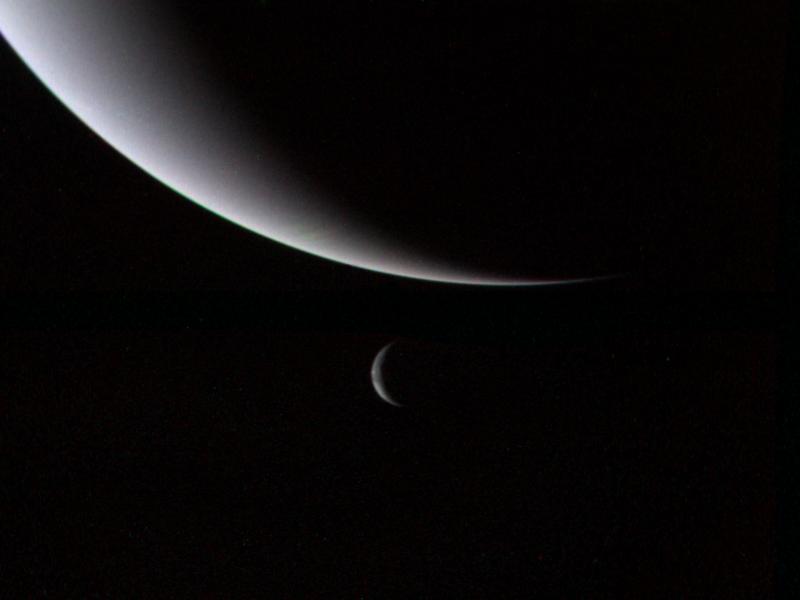
The flyby also showed that the icy moon is geologically active. The Voyager images reveal tectonic fractures, deformations and large-scale faulting of the crust caused by cryovolcanism.
There are too few craters for a surface shaped purely by impacts: Triton’s crust is geologically young, probably less than 100 million years old.
Mission to the gas giant – Voyager 2
For such long journeys to the outer planets, NASA developed the Voyager programme. Nobody knew whether the probes would survive the long trip, so at first only rough mission goals were set for Neptune.
They were to be carried out by the second probe on a veritable grand tour: Voyager 2 launched on 20 August 1977 and flew past Jupiter, Saturn, Uranus and Neptune in turn. This was made possible by a rare alignment of the planets that occurs only once every 175 years.
| Date | Voyager 2 milestone |
|---|---|
| 20 Aug 1977 | Launch from Cape Canaveral |
| 9 Jul 1979 | Jupiter flyby |
| 26 Aug 1981 | Saturn flyby |
| 24 Jan 1986 | Uranus flyby |
| 25 Aug 1989 | Neptune flyby, about 4,950 km above the clouds of the north pole |
| 2018 | Entry into interstellar space |
Source: NASA/JPL Voyager Mission.
Twelve years after launch, Voyager 2 reached its fourth and final planet. There was a brief dispute among the research teams, because each group wanted to use this one-off chance for moon, ring or atmosphere measurements; a compromise finally allowed observations of the planet and several of its moons.
Revelations from the far end of the solar system
In this icy region, scientists actually expected a quiet, almost motionless planet. Instead, Voyager 2 measured the strongest winds ever recorded on a planet. “Scooter”, a bright and very fast cloud, as well as a “Great Dark Spot” and a “Small Dark Spot”, were imaged and measured for the first time.
Scientists already suspected before the flyby that a giant planet would have moons; Voyager 2 discovered six new ones in one go. The probe also took a closer look at the moon Nereid, found from Earth back in 1949.
The biggest surprise came from the moon Triton. It “sprays” geysers and has polar caps, a wafer-thin atmosphere and even a faint cloud cover.
New missions to Neptune: status in 2026
A second spacecraft to Neptune has still not been approved. The NASA study “Neptune Odyssey” – an orbiter with an atmospheric probe – exists only as a concept; the smaller flyby mission “Trident” lost out in the 2021 selection to the Venus missions VERITAS and DAVINCI.
In their priority list for 2023 to 2032, US planetary scientists recommended a mission to Uranus first, not to Neptune. China is studying concepts for a flyby in the late 2030s, but there are no approved launch dates there either.
Neptune fact sheet for school projects: the 10 most important facts
For a school presentation or a fact-sheet worksheet, ten key statements are all you need. They are worded so that you can use them directly – from primary school right up to the final years of secondary school.
- Position: Neptune is the eighth and outermost planet of the solar system. Since Pluto was reclassified as a dwarf planet in 2006, it marks the edge of the planetary system.
- Discovery: found on 23 September 1846 by Johann Gottfried Galle in Berlin – the only planet to be calculated first and seen afterwards.
- Size: 49,528 km equatorial diameter, almost four times as wide as Earth. About 58 Earths would fit inside Neptune.
- Distance: on average 4.5 billion kilometres from the Sun (30 AU). Sunlight takes just over four hours to get there, but only eight minutes to reach Earth.
- A year on Neptune lasts 164.8 Earth years. Since its discovery it has circled the Sun only once – completed in 2011.
- A day on Neptune lasts only 16 hours and 7 minutes.
- Temperature: on average −214 °C; in the core, by contrast, about 5,400 kelvin.
- Colour: blue to blue-green, because methane in the atmosphere absorbs red light and reflects blue. The deep, vivid blue of old Voyager images was enhanced after the fact.
- Record: the fastest winds in the solar system at over 1,600 km/h, with peaks up to 2,100 km/h – faster than the speed of sound on Earth.
- Companions: 16 known moons (as of 2026) and 5 rings. The largest moon, Triton, orbits backwards and probably comes from the Kuiper Belt.
💡 Tip for your presentation: The best story about Neptune is not its size but its discovery. In 1846 Urbain Le Verrier worked out from tiny deviations in Uranus’s orbit where an unknown planet had to be, and sent the coordinates by letter to Berlin. Galle found it that very night, less than one degree from the prediction – making Neptune the first planet discovered at a desk, a triumph of Newtonian mechanics.
Observing Neptune: how to find the most distant planet (2026)
In 2026 Neptune reaches a brightness of magnitude 7.7 – invisible to the naked eye, but good binoculars show it as a faint “star”. You will recognise it as a bluish disc just 2.4 arcseconds across in a telescope from about 15 to 20 cm aperture at a magnification of at least 150x.
Neptune reached opposition on 26 September 2026 at 03:36 CEST (Central European Summer Time), at a distance of 4.32 billion kilometres from Earth. The next one follows on 28 September 2027; all the dates of the season are listed in the night sky in September and the night sky in October.
2026 is a good year for Neptune hunters: the planet lies in the constellation Pisces near the border with Cetus, about 9 to 10 degrees west of bright Saturn. Facing south, you’ll find it a fist’s width to the right of Saturn and slightly lower.
In autumn 2026 Neptune is well placed in the evening sky: from Central Europe (calculated for Germany, 51° N) it culminates – that is, reaches its highest point in the south – at about 39 degrees altitude. The table shows when that happens, in Central European time (CEST/CET); farther north it stands a little lower, farther south a little higher.
| Date | Highest point in the south | Observing |
|---|---|---|
| End of September 2026 | approx. 01:10 CEST | Opposition: visible all night |
| 15 October 2026 | approx. 23:55 CEST | from about 20:30 CEST a good 20° high in the south-east |
| 15 November 2026 | approx. 20:50 CET | best evening window, already 30° high when it gets dark |
| 15 December 2026 | approx. 18:50 CET | in the south right after nightfall |
| 15 January 2027 | approx. 16:50 CET | in the south-west after the end of twilight, sinking |
| Mid-February 2027 | — | disappears into the evening twilight |
Calculated by us for 51° N, 10° E (central Germany) with Skyfield and the JPL ephemeris DE421; times in CEST (UTC+2) and CET (UTC+1); brightness according to JPL Horizons. Conjunction with the Sun falls on 24 March 2027; from May 2027 Neptune reappears in the morning sky.
An app or a planisphere* helps with the fine search. The most reliable trick: memorise the star pattern in your binoculars and look again a few nights later – the “star” that has moved is Neptune.
Getting started: find Neptune reliably: Skywatcher Dobson Telescope N 130/650 Heritage FlexTube
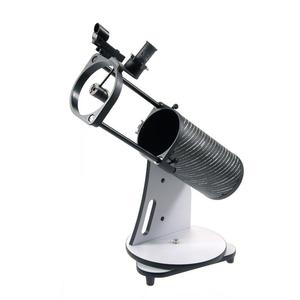
With 13 cm of aperture you'll reliably find Neptune as a bluish point, and with steady air and around 150x magnification, with a bit of luck, as a tiny disc. Compact, quick to set up – and a very good first telescope for the Moon, Jupiter and Saturn.
Price: € 265
If you want more: only from about 20 cm of aperture does Neptune reliably become a disc, and its moon Triton comes within reach too.
If you want more: Skywatcher Dobson Telescope N 200/1200 Skyliner Classic
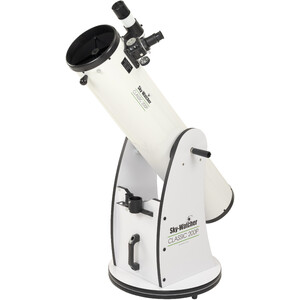
20 cm of aperture is the threshold at which Neptune stops being a point: at 200x magnification the Skyliner shows it as a tiny blue-grey disc, and Uranus noticeably larger and greenish. Dobsonian mount means: set it up, look, done – no alignment, no power supply.
Price: € 479
More options in our guide to the best beginner telescopes – or let a smart telescope show you Neptune fully automatically. If the bright planets matter more to you than the borderline case of Neptune, Which telescope for planets? compares the designs in detail.
Finding your way: Oculum Swivelling Sky Map 29 cm

In 2026 Neptune is in the constellation Pisces, about a fist's width west of Saturn. The planisphere shows you where Pisces is on any night – without a phone screen that ruins your dark adaptation.
Price: € 19.90
Frequently asked questions about Neptune
Can you see Neptune with the naked eye?
No – Neptune is the only planet that always stays below the eye’s visibility limit. With binoculars you can find it as a pinpoint of light; in a telescope from 15 cm aperture it becomes a bluish disc.
Why is Neptune blue?
Methane in its atmosphere absorbs the red part of sunlight and reflects the blue. Neptune is only slightly bluer than Uranus, because its haze layer is thinner. The deep blue of well-known Voyager photos was enhanced after the fact, as an Oxford study showed in 2024.
How long does Neptune take to orbit the Sun?
About 165 Earth years. Since its discovery in 1846 it has managed only a single complete orbit of the Sun (2011).
How many moons does Neptune have?
16 known moons (as of September 2026, according to NASA). The largest is Triton, which orbits Neptune against the planet’s direction of rotation – probably a captured Kuiper Belt object. The two most recent finds, S/2002 N5 and S/2021 N1, were announced in 2024; they are only about 23 and 14 km across.
How cold is it on Neptune?
In the upper atmosphere the temperature averages −214 °C (59 kelvin). The curious thing: Neptune radiates about 2.6 times as much energy as it receives from the Sun. So an internal heat source warms it from below – and it is exactly this energy gradient that drives its extreme storms. On the moon Triton it gets even colder, at −235 °C.
Is Neptune the coldest planet in the solar system?
Not quite: Neptune has a mean temperature of about −214 °C, Uranus about −216 °C – and Uranus also holds the lowest single value ever measured, at −224 °C. The reason: Uranus has practically no internal heat source, while Neptune does. That is why Neptune is not colder than its neighbour despite being 1.6 billion kilometres farther from the Sun – a puzzle that has still not been fully solved.
What makes Neptune special?
Four things make it unique: it has the fastest winds in the solar system at over 2,000 km/h. It is the only planet that was discovered at a desk. Its large moon Triton orbits it backwards – a captured object from the Kuiper Belt on which Voyager 2 photographed active nitrogen geysers. And it is the only planet that is never visible without optical aid.
Neptune explained for kids – what matters most?
Neptune is the planet farthest from the Sun – sunlight takes four hours to get there, but only eight minutes to reach us. It is blue because the gas methane in its air swallows red light. And it is the stormiest place in the solar system: the wind there blows more than twice as fast as a passenger jet flies. A year on Neptune lasts 165 Earth years, so since its discovery in 1846 it has only gone round the Sun once.
How big is Neptune?
At the equator Neptune measures 49,528 km – almost four times as much as Earth. That makes it the fourth-largest planet, slightly smaller than Uranus at 51,118 km. With 17.1 Earth masses, though, it is heavier than its neighbour. Almost 58 Earths would fit inside its volume.
What does Neptune look like?
Neptune is a ball of gas without a solid surface, pale blue to blue-green in colour. Unlike the almost featureless Uranus, it shows bright methane clouds, cloud bands and, at times, dark storm vortices such as the Great Dark Spot of 1989. In an amateur telescope you won’t see any of that: there it remains a bluish disc of just 2.2 to 2.4 arcseconds.
Does Neptune have rings?
Yes, five narrow and very dark main rings. They are named Galle, Le Verrier, Lassell, Arago and Adams – after astronomers connected with Neptune’s discovery and early exploration. The outer Adams ring also contains four conspicuous ring arcs called Liberté, Egalité, Fraternité and Courage. The rings can only be seen with space probes and large professional telescopes, not with an amateur telescope.
How far is Neptune from Earth?
Between about 4.3 and 4.7 billion kilometres. It is closest at opposition, when Earth and Neptune are on the same side of the Sun, and farthest when the Sun lies between them. Light takes about four hours to cover the distance.
How long does it take to fly to Neptune?
The only spacecraft that has ever been there took 12 years. Voyager 2 launched on 20 August 1977 and flew past Neptune on 25 August 1989. That was only possible because it picked up speed along the way at Jupiter, Saturn and Uranus – without such flybys the journey would take considerably longer.
When is the best time to see Neptune in 2026?
In the evenings from October to December 2026, when it stands high in the south around midnight or in the early evening. Opposition was on 26 September 2026, and the next one follows on 28 September 2027. You’ll find it in the constellation Pisces, about a fist’s width to the right (west) of Saturn.
* Affiliate link: if you buy through this link we may earn a small commission from Astroshop or High Point Scientific, at no extra cost to you.
Where Neptune stands in the line-up of the eight planets and how to remember their order is explained on our page planet mnemonic.