By Alexander Merz · Updated on · Details checked on 14 September 2026
October 2026 is the month telescope owners wait for all year. On 4 October Saturn is at opposition – brighter, bigger and longer in the sky than at any other time in 2026. Add to that two very different meteor showers, a full moon with a name of its own, and the clock change that suddenly hands us an extra hour of darkness in the evening at the end of the month. All the times below have been recalculated with the JPL ephemeris – not carried over from last year.
⚡ October 2026 in 30 seconds
- 4 October, 14:29 Central European Summer Time (CEST): Saturn at opposition – 0.3 mag bright, 19.7 arcseconds across, visible all night long. The highlight of the month.
- 8/9 October: the Draconids – the only shower you can watch in the early evening. In 2026 with a practically new moon.
- New moon on 10 October, 17:50 – from 8 to 15 October you get more than nine hours of completely moon-free, astronomically dark night.
- 21/22 October: the Orionids, ZHR around 20, with a three-hour moon-free window from 02:50 onwards.
- Full moon on 26 October, 05:11 Central European Time (CET) – the Hunter’s Moon.
- Clock change: in the night to Sunday 25 October, from 03:00 CEST back to 02:00 CET.
The key facts in brief
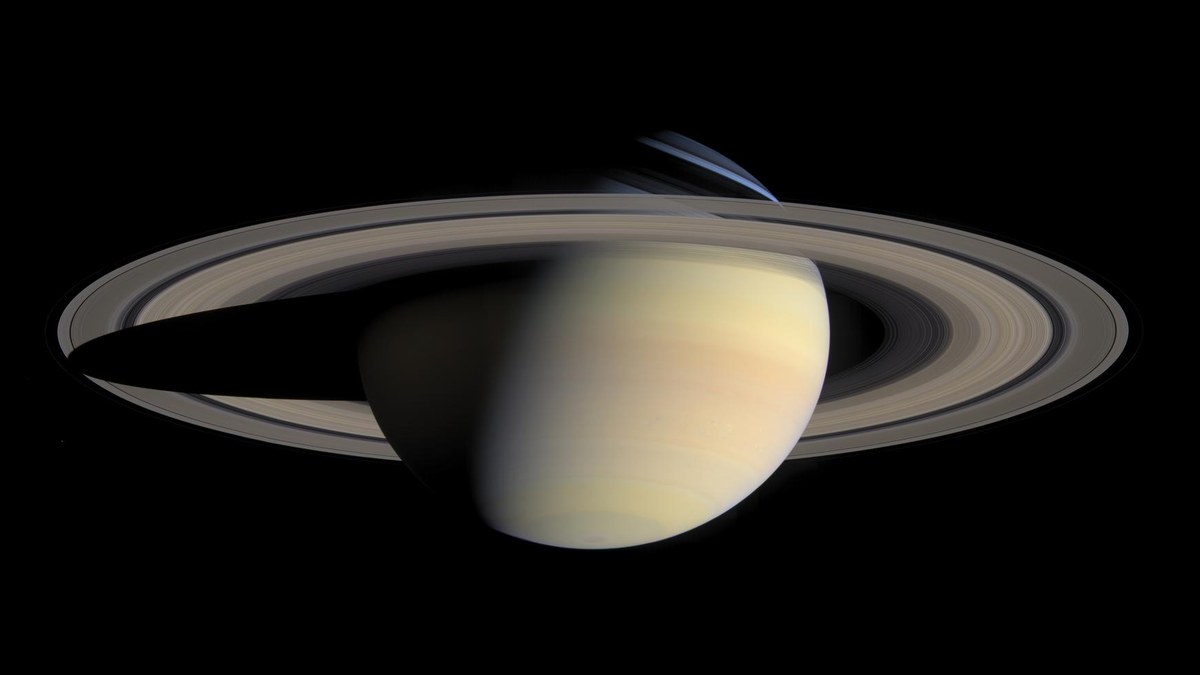
- Saturn at opposition on 4 October: the ringed planet comes as close to Earth as it will get in 2026, at 8.434 AU, reaches 0.33 mag and culminates – reaches its highest point in the sky – at 00:58 at an altitude of 39°. Everything about the planet in the Saturn guide.
- The rings are open by 9.2° again – after the edge-on position in March 2025 this is the best view for three years. Details of the system in the article on Saturn’s rings.
- Draconids on 8/9 October: slow, bright meteors, the radiant – the point they all seem to come from – highest in the evening, moon just 1 % illuminated. Few meteors, but perfect conditions.
- Orionids on 21/22 October: debris from Halley’s Comet, travelling at 66 km/s, leaving long glowing trails.
- Morning sky: Jupiter (−1.9 to −2.0 mag) and Mars climb higher, and on 5 and 6 October the moon passes close by both of them.
- Deep sky: the Andromeda Galaxy culminates in the middle of October at 00:12 at an altitude of 79° – almost overhead. It does not get any better all year.
🔎 Why the numbers here differ from those elsewhere
Very different figures are doing the rounds online for the opening angle of Saturn’s rings – from “only 7°” to “over 10°”. The values on this page come from the JPL Horizons ephemerides (the quantity PDObsLat, the planetographic latitude as seen by the observer): 9.15° on 4 October, 8.69° on 15 October, 8.10° on 31 October. Figures that are clearly lower than that are usually older approximations or calculated for a different date.
All times are given for Berlin (52.52° N, 13.41° E). Up to 24 October in CEST (= UTC+2), from 25 October in CET (= UTC+1). Bear that in mind when you compare figures from English-language sources: there Saturn’s opposition is listed under 4 October, 12:21 UTC – that is the very same moment.
Sky events in October 2026: the diary
All times are for Berlin. In southern Germany, Austria and Switzerland rise and set times shift by a few minutes; the moments of the events themselves are the same everywhere.
| Date | Time | Event |
|---|---|---|
| 3 Oct | 15:25 CEST | Last quarter |
| 4 Oct | 14:29 CEST | Saturn at opposition (0.33 mag, 19.7″) – best seen in the nights of 3/4 and 4/5 October |
| 5 Oct | 06:30 CEST | Moon just 0.8° from Mars, both 50° high in the morning sky |
| 6 Oct | 06:30 CEST | Moon 2.7° from Jupiter, both just under 40° high |
| 8/9 Oct | from 20:30 CEST | Draconids – maximum on 9 October at 03:00 CEST, but the radiant is highest in the evening |
| 10 Oct | 17:50 CEST | New moon – the start of the darkest window of the month |
| 12 Oct | 09:00 CEST | Mercury at greatest eastern elongation (25.2°) – invisible from central Europe all the same |
| 18 Oct | 18:12 CEST | First quarter |
| 21/22 Oct | from 02:50 CEST | Orionid maximum, ZHR around 20, moon-free window until dawn |
| 24 Oct | 05:45 CEST | Venus at inferior conjunction – it moves into the morning sky |
| 24 Oct | 18:30 CEST | The almost full moon stands 5.7° from Saturn |
| 25 Oct | 03:00 → 02:00 | End of summer time – the clocks go back |
| 26 Oct | 05:11 CET | Full moon – the Hunter’s Moon |
| 28 Oct | evening | Moon a good 4° from Uranus in Taurus |
| 1 Nov | 21:28 CET | Last quarter |
Saturn at opposition on 4 October: the best night of the year
Opposition means that Earth, Sun and planet line up, with Earth in the middle. The planet rises as the Sun sets, stands highest around midnight and sets with the morning twilight. It is visible all night, at its closest and at its brightest. For Saturn that moment in 2026 falls on 4 October at 14:29 CEST.
The fact that opposition happens in the middle of the day is no problem at all. Saturn barely changes over a matter of weeks. In practice that means the night of 3/4 October and the night of 4/5 October are equally good, and the whole first half of October loses hardly anything either.
| Parameter | Value on 4 October 2026 |
|---|---|
| Brightness | 0.33 mag – brighter than Deneb in Cygnus |
| Apparent diameter (globe) | 19.70 arcseconds |
| Ring opening | 9.15° (south face of the rings visible) |
| Distance | 8.434 AU = 1.262 billion kilometres |
| Light travel time | 70 minutes |
| Constellation | Cetus (the Whale) |
| Rise / culmination | 18:54 / 00:58 at an altitude of 39.4° |
One detail that many overviews get wrong: in October 2026 Saturn is not in Pisces, but in Cetus. It crossed the boundary during the summer and is moving retrograde just south of the ecliptic. For finding it that is rather helpful – Cetus is poor in stars, and Saturn is by far the brightest object there.
Over the month its brightness drops only slowly, from 0.32 to 0.46 mag, while culmination happens ever earlier: on 15 October at 00:12, and on 31 October – in CET by then – as early as 22:04. So at the end of October you no longer have to stay up long for Saturn.
What you see through the telescope
Saturn is the object that most often makes people at the eyepiece hold their breath. Here is what works with which aperture – the diameter of the main lens or mirror:
| Aperture | What becomes visible |
|---|---|
| 10×50 binoculars | Saturn looks elongated, “with handles” – but no real separation of the rings |
| 70–80 mm | Ring clearly separated from the planet, Titan as a tiny star |
| 100–130 mm | Cassini division when the air is steady, the planet’s shadow on the ring, 3–4 moons |
| 200 mm | Cassini division reliably, cloud belts, 5–6 moons, and with very good seeing the Encke minima |
The most important factor is not aperture but the steadiness of the air. In 2026 Saturn does not climb particularly high, reaching just under 40° – that is the flip side of its position in Cetus. Wait until it culminates, and let the telescope cool down for at least 30 minutes beforehand. A view across a sun-baked roof ruins more detail in the image than 50 millimetres of missing aperture.
The Saturn machine for October: Skywatcher Dobson Telescope N 200/1200 Skyliner Classic
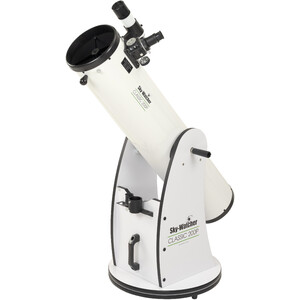
200 mm of aperture — the most sky for your money. Set it on the ground, point by hand: nebulae, clusters and galaxies for years to come.
Price: € 479
If you are only just starting out and do not want to jump straight into that class: for Saturn, the moon and Jupiter, considerably less will do, as long as the optics are clean.
The affordable way in to Saturn: Skywatcher Dobson Telescope N 130/650 Heritage FlexTube
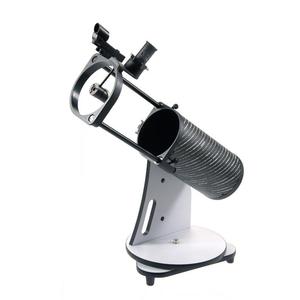
A compact tabletop Dobson with a true parabolic mirror. Folds down, fits in a bag: the Moon, planets and the bright deep-sky classics.
Price: € 265
Which aperture suits which budget and which sky is something the telescope calculator works out for you; for a broader overview, see the telescope test.
The right magnification
At 19.7 arcseconds Saturn is a small target. At 50× it is a tiny ring; at 150× it is a sight you never forget. The rule of thumb is: 1.5 to 2 times magnification per millimetre of aperture, and more when the air is very steady.
| Telescope | Sensible magnification for Saturn | Eyepiece focal length |
|---|---|---|
| 130/650 mm | 130–180× | 5 mm, or 10 mm + Barlow |
| 150/750 mm | 150–220× | 4–5 mm |
| 200/1200 mm | 200–300× | 5–6 mm |
Most beginner telescopes come with two eyepieces, neither of which is really any good for planets. A short focal length eyepiece is therefore the most effective upgrade you can make ahead of a Saturn opposition – more on that in the guide to eyepieces.
Eyepieces for high magnification: Omegon Eyepiece Starter Kit
Eyepieces, filters and a Barlow in one case: everything to round out your telescope at once, cheaply.
Price: € 89
Titan and the other moons of Saturn
At 8.3 mag Titan is bright enough for any pair of binoculars with a steady support – you just have to know which of the points of light it is. It orbits Saturn in just under 16 days and, at greatest elongation, stands around 3.3 arcminutes from the planet. These are the dates in October 2026:
| Date | Position | Separation |
|---|---|---|
| 4 October | greatest eastern elongation (to the left, and to the right in an inverting telescope) | ≈ 3.3′ |
| 12 October | greatest western elongation | ≈ 3.3′ |
| 20 October | greatest eastern elongation | ≈ 3.3′ |
| 28 October | greatest western elongation | ≈ 3.3′ |
That Titan of all things stands furthest from the planet on the very night of opposition is a happy coincidence – it makes the moon particularly easy to identify on 4 October. The other moons are considerably fainter: Rhea 9.6 mag, Tethys 10.2 mag, Dione 10.3 mag, Iapetus 11.0 mag, Enceladus 11.7 mag. Rhea, Tethys and Dione are within reach from about 100 mm of aperture; Enceladus demands 200 mm and a steady night, because it sits close to the bright ring.
The Seeliger effect: why Saturn brightens shortly before opposition
In the days around opposition Saturn brightens more than the change in distance alone can explain. The reason lies in the rings: at exact opposition the Sun is directly behind the observer, the chunks of ice in the ring no longer cast any visible shadows on one another, and on top of that they scatter light preferentially straight back towards the direction it came from. Hugo von Seeliger explained this in 1887 – and in passing proved that the rings consist of individual particles and are not a solid disc.
In practice that means that in the two or three nights around 4 October the rings look strikingly bright in the eyepiece compared with the globe of the planet. Anyone who has seen Saturn in the summer will notice the difference immediately.
Saturn’s rings are opening up again: where things stand in 2026
In March 2025 we looked at the rings exactly edge-on from Earth – for a few days they vanished almost completely. Since then they have been opening up again, and 2026 is the first year in which that really shows in the telescope.
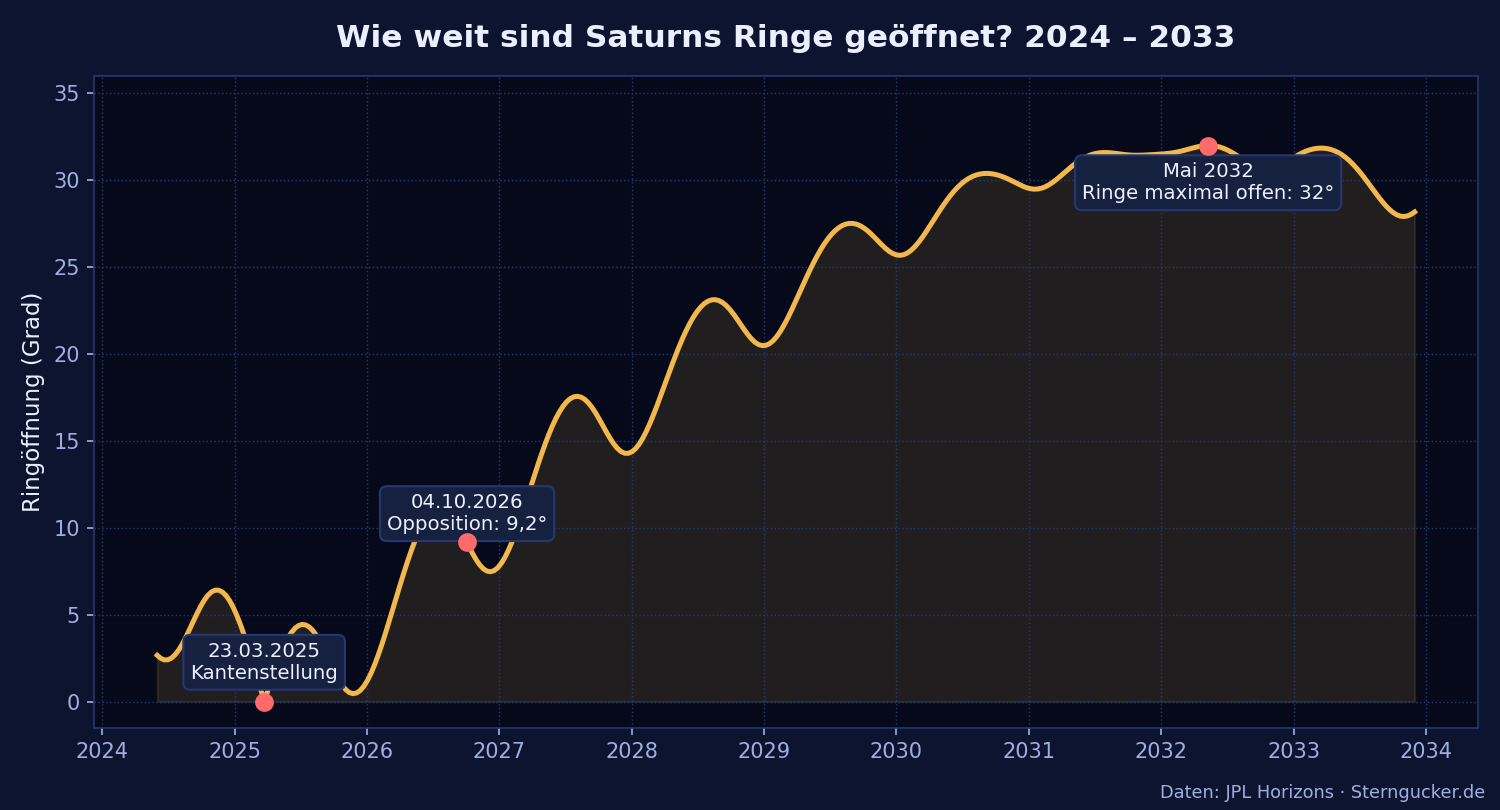
| Date | Opening angle | Appearance |
|---|---|---|
| 23 March 2025 | 0° | Edge-on – rings invisible |
| 15 January 2026 | 1.8° | a fine line |
| 21 July 2026 | 11.2° | maximum for the year |
| 4 October 2026 | 9.2° | a clear ellipse, Cassini division within reach |
| 31 October 2026 | 8.1° | practically unchanged |
| May 2032 | 32.0° | wide open, maximum of the cycle |
The angle varies within a single year because Earth moves around the Sun and in doing so changes its viewing angle on the plane of the rings. The big trend, by contrast, comes from Saturn’s 29.5-year orbit: we are now seeing the south face of the rings, and it will keep tilting further towards us until 2032. So if you want to see the rings wide open you do not have to wait until then – but every opposition over the next few years will be a little better than this one.
Draconids on 8/9 October: shooting stars as early as the evening
The Draconids are the odd one out among the meteor showers. Their radiant in the constellation Draco stands highest in the evening and sinks as the night goes on – exactly the opposite of every other major shower. If you want to see them you do not have to get up at three in the morning; you can walk into the garden with a blanket at half past eight.
The second difference: their particles come from comet 21P/Giacobini-Zinner and hit the atmosphere at only 20 km/s – barely a third of the speed of the Orionids. Draconids therefore drift across the sky strikingly slowly and unhurriedly, many of them in a warm yellow-orange.
| Parameter | Draconids 2026 |
|---|---|
| Maximum | 9 October, 03:00 CEST (λ☉ 195.4°) |
| Expected ZHR | 5 – highly variable, outbursts possible |
| Radiant | α 263°, δ +56° in Draco – circumpolar from central Europe |
| Speed | 20 km/s (very slow) |
| Parent comet | 21P/Giacobini-Zinner |
| Moon | 1 % illuminated, sets at 17:40 – perfect |
When and where you need to look
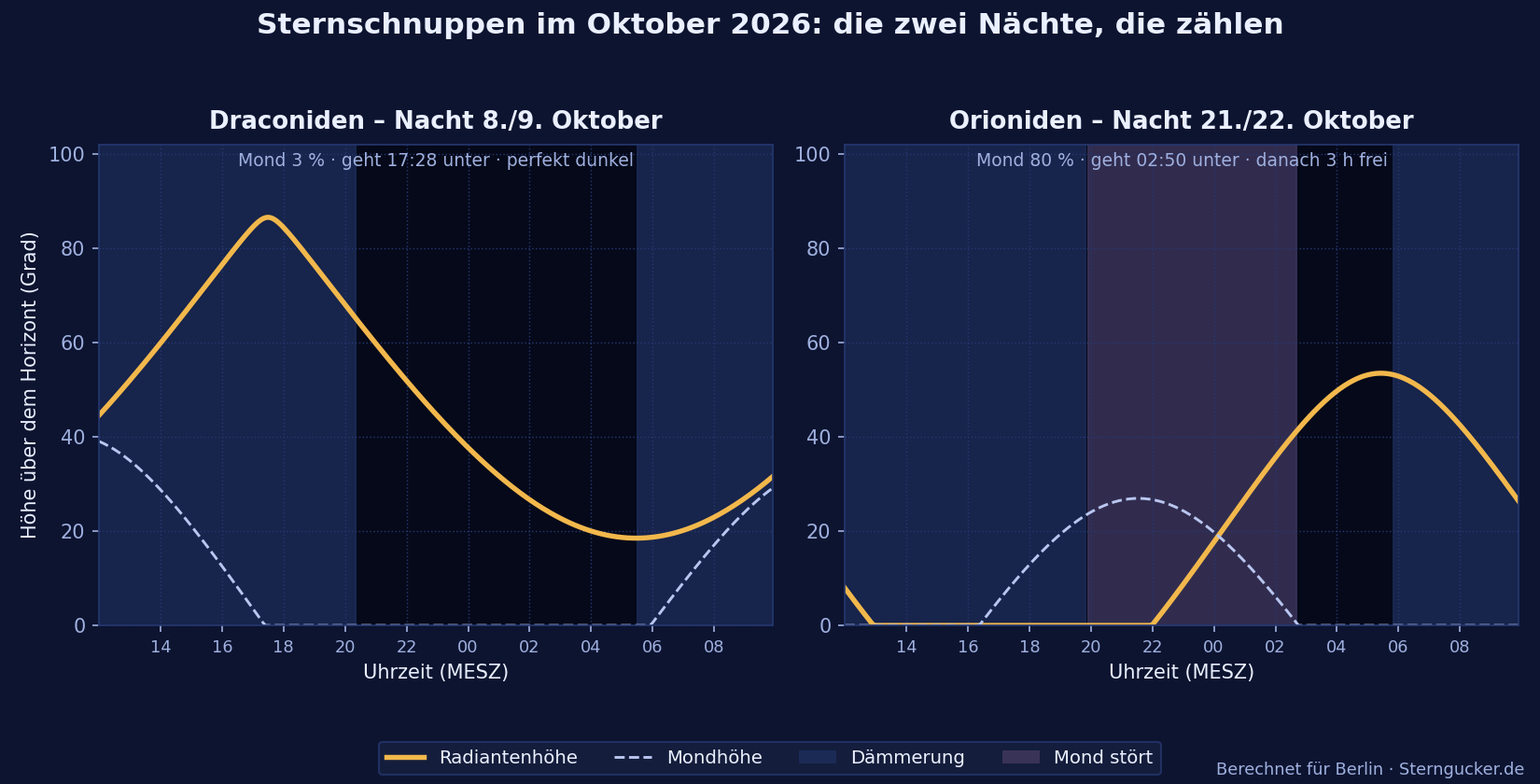
On 9 October the radiant stands at an altitude of 59° at 21:00, 51° at 22:00 and still 37° at midnight. By 03:00 – the calculated maximum – it is down to just 22°. The best window is therefore a compromise: the evenings of 8 and 9 October between 20:30 and 23:30.
Where to look: find the constellation Draco between the Plough and the Little Dipper – but do not look straight at it. Meteors appear longest when you watch about 40° away from the radiant. The most comfortable way is to lie flat on a camping mat with half the sky in view.
An honest expectation: at a ZHR of 5 under a dark sky that works out at about three to four meteors an hour. But the Draconids are the shower most inclined to spring a surprise – in 1933, 1946, 2011 and 2018 there were outbursts with hundreds of meteors an hour. There is no way to predict it. And because the moon conditions in 2026 are flawless, an attempt costs you nothing but an hour of your time.
Orionids on 21/22 October: fast meteors from Halley’s Comet
The Orionids are the exact opposite: their particles come from Halley’s Comet and race into the atmosphere at 66 km/s – so fast that many of them leave glowing trails that hang in the sky for a second or two.
| Parameter | Orionids 2026 |
|---|---|
| Maximum | 21 October (λ☉ 208°), broad plateau from 20 to 23 October |
| Expected ZHR | 20, up to 40 in good years |
| Radiant | α 95°, δ +16° – between Betelgeuse and Gemini |
| Speed | 66 km/s (very fast) |
| Parent comet | 1P/Halley |
| Moon | 87 % illuminated, sets on 22 October at 02:50 |
When the Orionids are at their best
This is where a lot of websites get it wrong. You keep reading that the full moon spoils the Orionids in 2026. That is not true: full moon is not until 26 October, five days after the maximum. On the night of the maximum the moon is 87 % illuminated – but it sets at 02:50, and after that there are three completely dark hours until astronomical twilight begins at around 05:50.
And that is exactly the time when the radiant stands highest:
| Time (CEST) | Radiant altitude | Moon |
|---|---|---|
| 00:00 | 17° | interferes |
| 01:00 | 26° | interferes |
| 02:00 | 35° | interferes, sets soon |
| 03:00 | 43° | gone |
| 04:00 | 49° | gone |
| 05:00 | 53° | gone |
The window from 03:00 to 05:30 in the night of 21/22 October is therefore almost ideal: a dark sky and a high radiant at the same time. Under a rural sky 15 to 20 meteors an hour are realistic during that phase, in town more like five.
For meteors you need no instrument at all – quite the opposite. Binoculars and telescopes show far too small a piece of sky. What really helps is 20 minutes of dark adaptation, warm clothing and a spot well away from street lights. Where you can find that near you is covered in the article on light pollution. All the other showers of the year are listed in the meteor shower calendar.
When does it get properly dark in October?
October is the month with the biggest gain in darkness. On 1 October astronomical night begins at 20:38, on 20 October as early as 19:54 – and after the clock change it starts at 18:34 CET on 31 October. What was 8.6 hours of true darkness becomes 10.6.
| Date | Sunset | Astronomical night from | Astronomical night until | Sunrise | Dark |
|---|---|---|---|---|---|
| 1 Oct | 18:43 | 20:38 | 05:12 | 07:07 | 8.6 h |
| 10 Oct | 18:22 | 20:16 | 05:29 | 07:22 | 9.2 h |
| 15 Oct | 18:11 | 20:05 | 05:37 | 07:31 | 9.5 h |
| 20 Oct | 18:00 | 19:54 | 05:46 | 07:40 | 9.9 h |
| 25 Oct (CET) | 16:50 | 18:44 | 04:54 | 06:49 | 10.2 h |
| 31 Oct (CET) | 16:38 | 18:34 | 05:04 | 07:00 | 10.6 h |
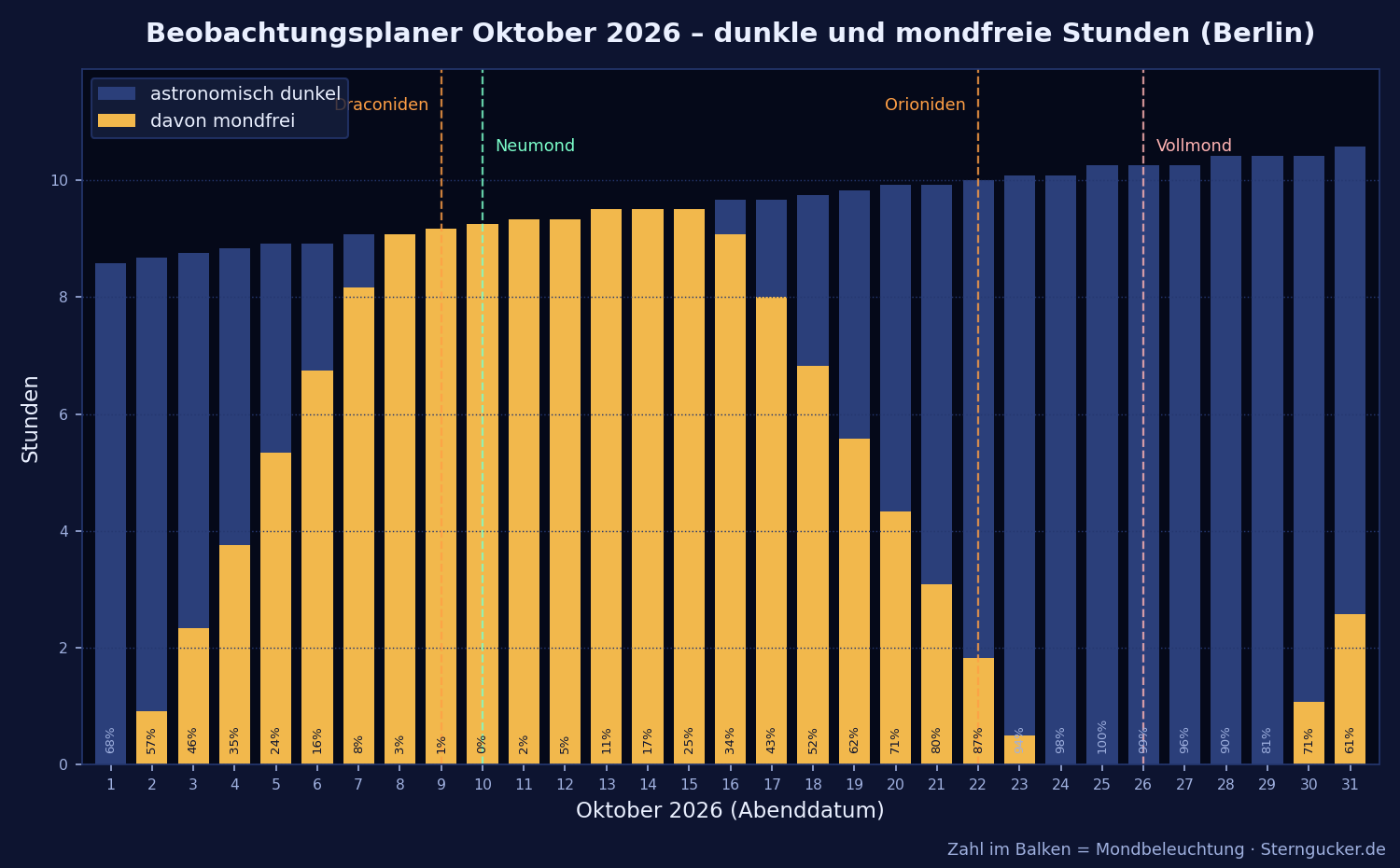
For deep sky, though, what counts is not darkness on its own but darkness without the moon. Put the two together and you get the observing planner for the month:
🌑 The best nights of the month
8 to 15 October. On these eight nights the entire astronomically dark period is moon-free as well – 9.1 to 9.5 hours in one go. That is the best deep-sky window since the spring and the moment to tackle Andromeda, the Triangulum Galaxy and h+χ Persei. From 22 October onwards practically every night is dominated by the waxing moon.
The moon phases in October 2026
| Phase | Date | Time |
|---|---|---|
| Last quarter | 3 October | 15:25 CEST |
| New moon | 10 October | 17:50 CEST |
| First quarter | 18 October | 18:12 CEST |
| Full moon (Hunter’s Moon) | 26 October | 05:11 CET |
| Last quarter | 1 November | 21:28 CET |
All the full moon dates of the year, together with their names and the background to them, can be found in the full moon calendar.
The clock change on 25 October
In the night from Saturday 24 to Sunday 25 October 2026 summer time ends: at 03:00 CEST the clocks go back to 02:00 CET. The night is an hour longer.
For stargazers this is the most welcome date of the year. Sunset appears to jump from 17:52 on 24 October to 16:50 on 25 October, and astronomical night starts at 18:44 instead of 19:46. If you previously had to wait until after 20:00, you can now observe straight after dinner – and that is the real reason why late autumn is so popular among amateur astronomers.
Hunter’s Moon on 26 October: the full moon after the harvest
The full moon on 26 October at 05:11 CET goes by the name of the Hunter’s Moon (in German Jägermond). It is defined as the full moon that follows the Harvest Moon – and in 2026 the Harvest Moon was the full moon of 26 September, because it fell closest to the equinox.
The name dates from the days before electric lighting: once the harvest was in, the fields lay open, the game came out to graze, and the full moon, rising early and bright, gave enough light for hunting. As with the Harvest Moon, the moon now rises on several evenings in a row unusually soon after one another, because in autumn the ecliptic lies at a shallow angle to the horizon.
On the evening of the full moon itself the moon is a rewarding target for photographs and a miserable one for craters: with the Sun overhead nothing casts a shadow, and the surface looks flat. The moon becomes interesting again from 28/29 October, when the terminator – the line between lunar day and night – travels across the big craters in the south. And if you want to look anyway in full moonlight, you should dim the brightness – 100 % moon through a telescope is uncomfortably bright.
Against the glare of the Hunter's Moon: Omegon Premium Moon Filter 1.25″
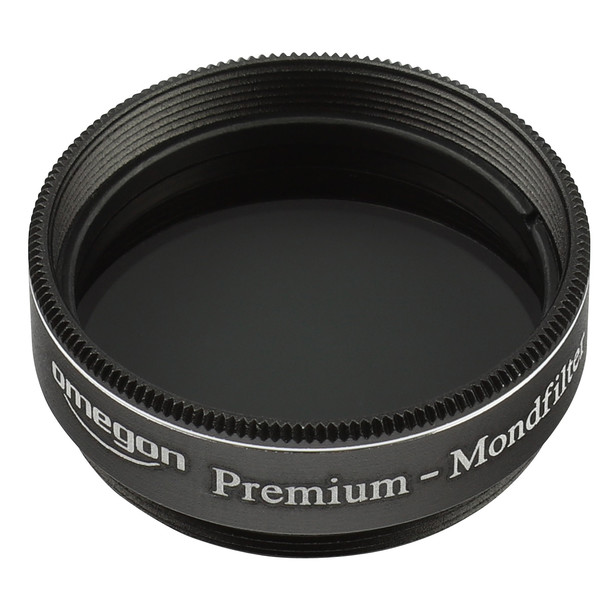
Dims the harsh moonlight, is easy on the eyes and brings out far more contrast and detail – our best-selling filter and the number-one pick to start with.
Price: € 19.90
The dates that are actually worth it are often months apart – and easily forgotten. So you do not miss one:
One short email, in good time – with the times and an honest take on whether it is worth getting up for.
You will get a confirmation email in a moment. Your address stays with us – no sharing, no third-party ads.
The planets in October 2026
| Planet | Brightness | Visibility in October 2026 |
|---|---|---|
| Saturn | 0.3 → 0.5 mag | All night, opposition on 4 October. Culmination 00:58 → 22:04, altitude 39°. In Cetus. |
| Jupiter | −1.9 → −2.0 mag | Morning sky, rising 02:24 → 23:52. On 15 October 28° high at 05:00, on 31 October already 36° at 04:00. In Leo. |
| Mars | 1.1 → 0.9 mag | Morning sky, 39° high on 15 October at 05:00. Still small, but it will gain a great deal before its opposition in 2027. Cancer → Leo. |
| Uranus | 5.7 mag | Almost all night, 45° high in Taurus on 15 October at 01:00. Opposition not until 26 November. |
| Neptune | 7.7 mag | First half of the night, 33° high in Pisces on 15 October at 22:00. Telescope only. |
| Venus | −4.8 → −4.2 mag | Invisible. Inferior conjunction on 24 October. |
| Mercury | −0.1 → 3.1 mag | Invisible, despite greatest elongation on 12 October. |
Jupiter and Mars in the morning sky
If you are an early riser, October gives you the better programme. By the end of the month Jupiter is above the horizon before midnight and, at −2.0 mag, is the brightest object in the morning sky. Even binoculars show the four Galilean moons as a string of pearls, and a telescope from 80 mm upwards shows the two main cloud belts.
Mars, at 1.0 mag, is still inconspicuous and through the telescope hardly more than a small orange disc – it will not come close to Earth again until early 2027. Even so, it is worth a look on 5 and 6 October: on 5 October at 06:30 the slim waning crescent moon stands just 0.8° from Mars, both about 50° high; a day later, on 6 October at the same time, it is 2.7° from Jupiter. Two subjects you can capture even with a camera on a tripod.
Mercury: the honest answer
On 12 October Mercury reaches its greatest eastern elongation at 25.2° – its largest angular distance from the Sun, and on paper a good figure. In practice it is not visible from central Europe. The reason is geometry: in autumn the evening ecliptic lies very flat against the horizon, so despite its large angular distance from the Sun, Mercury stays almost directly above it. On 15 October at 18:30 – that is, at the time of civil twilight – it is a mere 0.2° above the horizon.
Even so, you often read “good evening visibility” for this date. That applies to the southern hemisphere, where the ecliptic is steep at this time of year. It does not apply to Germany, Austria or Switzerland. The next genuinely usable Mercury date here comes in the spring.
Venus disappears: inferior conjunction on 24 October
Venus withdraws from the evening sky during October. Its angular distance from the Sun shrinks from 31° at the start of the month to 13° by the end, and on 24 October at 05:45 CEST it is at inferior conjunction – between Earth and Sun. On 15 October at 18:00 it is already 7° below the horizon; in effect it is invisible for the whole month.
What is interesting is what comes next: at inferior conjunction Venus is at its closest to Earth – just about 0.28 AU or 42 million kilometres away. Its disc then measures almost a whole arcminute, but as a wafer-thin crescent it is almost unlit. From the beginning of November it reappears as the morning star and becomes the most conspicuous object before sunrise right through to the turn of the year.
Deep sky in October 2026: Andromeda season begins
For deep-sky observers October is the real start of the season: long nights, the Great Square of Pegasus high in the south, the Milky Way still in the evening sky and an eight-night moon-free window around new moon. These objects culminate in the middle of October at the times given (CEST, Berlin):
| Object | Culmination | Altitude | Instrument |
|---|---|---|---|
| M57 Ring Nebula (Lyra) | 18:24 | 70° | from 100 mm |
| M27 Dumbbell Nebula (Vulpecula) | 19:30 | 60° | Binoculars / telescope |
| M15 globular cluster (Pegasus) | 21:00 | 50° | Binoculars / telescope |
| M2 globular cluster (Aquarius) | 21:04 | 37° | Binoculars / telescope |
| NGC 7662 Blue Snowball | 22:56 | 80° | from 100 mm |
| NGC 7789 Caroline’s Rose (Cassiopeia) | 23:28 | 86° | Binoculars / telescope |
| M31 Andromeda Galaxy | 00:12 | 79° | Naked eye / binoculars |
| M33 Triangulum Galaxy | 01:04 | 68° | Binoculars under a rural sky |
| M74 galaxy (Pisces) | 01:06 | 53° | from 150 mm |
| h+χ Persei Double Cluster | 01:50 | 85° | Binoculars |
| M34 open cluster (Perseus) | 02:12 | 80° | Binoculars |
| M45 Pleiades | 03:18 | 62° | Naked eye / binoculars |
The Andromeda Galaxy in October
In the middle of October the Andromeda Galaxy stands at an altitude of 79° at 00:12 – practically overhead. It does not get any higher all year, which means you are looking through the least possible air. Under a dark rural sky it can be seen with the naked eye as an elongated smudge of light; through binoculars it fills more than twice the field of view taken up by the full moon. How to find it is explained in the introduction to deep sky, and the constellation it sits next to in the article on Pegasus.
The most important piece of advice for Andromeda is this: do not use too much magnification. The galaxy is more than 3° across. Anyone hunting for it at 100× sees nothing but a structureless brightness gradient. A pair of binoculars or a short focal length wide-field eyepiece shows more than any planetary eyepiece.
Around Perseus and Cassiopeia lies the densest field of open star clusters in the autumn sky as well – in the middle of October the Double Cluster h+χ Persei stands at an altitude of 85° at 01:50 and is one of the few objects where binoculars really do beat a large telescope.
Equipment for the October sky
October 2026 makes two very different demands: high magnification for Saturn – and a wide field of view for Andromeda, the Pleiades and the Double Cluster. No single instrument covers both optimally, so here are both sides, honestly.
For Andromeda and the Pleiades: Celestron Cometron 7x50 Binoculars
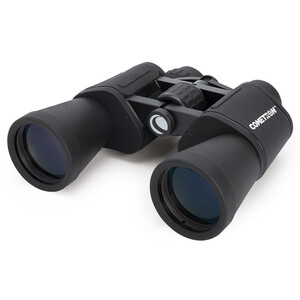
The astronomy classic among affordable binoculars: 7×50 with a large exit pupil for bright handheld views of the Moon and Milky Way – the ideal first step before a telescope.
Price: € 65
When a telescope is worth it anyway
For the large autumn objects binoculars really do have the advantage. But the very objects that define this month are beyond them: Saturn’s rings, the Cassini division, Titan as a disc, Jupiter’s cloud belts, Neptune as a blue disc, the craters along the terminator – those need magnification, and magnification needs a telescope. A pair of 10×50 binoculars shows Saturn as an elongated oval; a 130 mm telescope shows the ring as a ring.
If you can only buy one instrument and really want to explore the sky, go for the telescope; binoculars are the addition, not the replacement. Buying advice by budget class can be found under telescopes for beginners and telescopes under 300 euros; and when it comes to aperture per euro, the road usually leads to the Dobsonian telescope.
And whatever instrument you use: the autumn sky changes quickly, and finding your way around is easier if you know what is where before you go outside.
Finding your way around the autumn sky: Oculum Swivelling Sky Map 29 cm

Set date and time, hold it up, find the constellations: the swivelling star chart shows exactly the sky above you at that moment. No battery, no signal, no screen glare.
Price: € 19.90
A telescope for Christmas? October is the right month for it
That sounds two months too early, but it is not. The decent beginner instruments are regularly sold out from the end of November, or carry delivery times that run into the new year. Order in October and you have the choice; order in December and you take what is left.
There is a practical reason as well. A telescope that comes out of its box for the first time on Christmas Eve usually does not work that evening: aligning the mount, adjusting the finder and sorting the eyepieces takes a good hour the first time round. In room light, not in the dark, and not in front of an audience.
Set the instrument up once beforehand and point it at a distant chimney in daylight, and on 24 December you hand over a finished telescope instead of an assembly manual.
And the warning that belongs to this month: from November onwards, electronics stores stock telescopes whose boxes advertise a three-digit magnification. With 60 mm of aperture the limit is around 120 times, though; above that the image only gets bigger and mushier, not more detailed.
These are exactly the instruments that explain why so many first telescopes end up in the cellar after two weeks.
What actually brings joy, sorted by budget – from the poster through binoculars to the first real telescope –, is in the overview of astronomy gifts. If it is for a child, the telescope for kids buying guide gets to the goal faster; for adults with no previous knowledge, the beginner telescope guide.
And if you do not know what is already in the cupboard: with telescopes a voucher is not a last-resort present. Which first instrument fits depends a lot on what the recipient wants to observe and how much weight they are willing to carry into the garden – they decide that better themselves.
Frequently asked questions about the October night sky
When is Saturn’s opposition in 2026?
On 4 October 2026 at 14:29 CEST (12:21 UTC). Saturn then reaches 0.33 mag, an apparent diameter of 19.7 arcseconds and a distance of 8.434 AU. It can be observed equally well in the nights of 3/4 and 4/5 October – and practically unchanged throughout October.
When is the full moon in October 2026?
On 26 October 2026 at 05:11 CET. This full moon is called the Hunter’s Moon because it follows the Harvest Moon of 26 September.
When is the new moon in October 2026?
On 10 October 2026 at 17:50 CEST. The darkest nights of the month fall between 8 and 15 October – on these eight nights the entire astronomically dark period is moon-free as well.
When do the clocks change in 2026?
In the night to Sunday 25 October 2026 the clocks go back from 03:00 CEST to 02:00 CET. The night lasts an hour longer, and it gets dark an hour earlier in the evening.
Which planets can you see in October 2026?
Saturn (0.3 mag) all night, Uranus (5.7 mag) almost all night, Neptune (7.7 mag) in the first half of the night with a telescope, Jupiter (−2.0 mag) and Mars (1.0 mag) in the morning sky. Venus and Mercury stay invisible from central Europe, because in autumn the evening ecliptic lies too flat against the horizon.
When are the Orionids best seen in 2026?
In the night of 21/22 October 2026 between 03:00 and 05:30 CEST. The moon sets at 02:50, and after that the radiant stands between 43° and 53° high. Contrary to what is often claimed, no full moon gets in the way – that is not until 26 October.
Which telescope do I need for Saturn?
From about 70 mm of aperture the ring is visible separated from the planet, from 100 to 130 mm the Cassini division and the shadow it casts come within reach, and from 200 mm cloud belts and fainter moons are added. For Saturn, though, more decisive than aperture is a short focal length eyepiece for 130× to 250× magnification – and steady air.
What can you see in the evening in October 2026?
In short: Saturn in the south-east to south, well placed from about 21:00. Along with that, the Summer Triangle still high in the west, the Great Square of Pegasus in the south and the Andromeda Galaxy almost overhead. If you only have twenty minutes, take a pair of binoculars, find the Great Square of Pegasus and sweep from there towards the north-east to Andromeda – that is the most rewarding short route across the October sky.
When should you buy a telescope as a Christmas present?
In October, early November at the latest. The recommendable beginner instruments regularly sell out in the run-up to Christmas, and a telescope bought early can be assembled and aligned in peace before the day. Which instrument suits which budget is in the overview of astronomy gifts.
* Affiliate link: if you buy through this link we may earn a small commission from Astroshop or High Point Scientific, at no extra cost to you.
➡️ Where it goes from here: The night sky in November 2026 – with the opposition of Uranus and the Leonids.
⬅️ The month before: The night sky in September 2026 – with the occultation of Venus and the opposition of Neptune.
🪐 Also interesting: Saturn – the lord of the rings: structure, moons, storms and how best to observe it.
💫 Also interesting: Shooting stars 2026/2027: the complete meteor shower calendar
🗓️ Also interesting: Astronomy events 2026/2027: all the sky events at a glance