By Alexander Merz · Updated on · Details checked on 14 September 2026
September 2026 is the month in which the observing season comes back. On 1 September it does not get properly dark until 22:02, on 30 September it already does so at 20:40 – two and a half hours more darkness in just four weeks. And the month has two dates worth marking in your diary: on 14 September the Moon slides in front of Venus in the bright daytime sky, and on 26 September Neptune is at opposition. All the times below are calculated for Central Europe – from ephemerides, not carried over from old editions.
⚡ September 2026 in 30 seconds
- 14 September, approx. 11:29–12:42 Central European Summer Time (CEST): The Moon occults Venus – in the daytime sky, with the Sun 36–42° high. The highlight of the month.
- 26 September, 03:36 CEST: Neptune at opposition, 7.7 mag, 28.88 astronomical units away.
- New moon on 11 September, 05:26 – the darkest nights fall between 8 and 14 September.
- Full moon on 26 September, 18:49 – the Harvest Moon, and of all days on the day of the Neptune opposition.
- Autumn begins on 23 September, 02:05 CEST.
- Meteors: only weak showers. Mercury stays invisible, and Venus practically does too.
The key points at a glance
- Venus occultation on 14 September: The slender Moon, just 12% illuminated, slides in front of Venus in the late morning. Visible across the whole of Germany, Austria and Switzerland – but only with optical aid, and only if you know where to look. All the times for 13 cities
- Neptune at opposition on 26 September: The most distant planet is in the sky all night long, in Pisces, around 9° west of Saturn. Everything about the planet in the Neptune guide.
- Saturn rises as early as 19:00 at the end of September and stands 40° high at 01:20 – its opposition follows on 4 October. The rings are open by around 9.9° again. More in the Saturn guide.
- Harvest Moon on 26 September, 18:49: the full moon that falls closest to the equinox. All the dates in the full moon calendar.
- Deep sky: Around the new moon on 11 September there are up to seven hours of moon-free, astronomically dark night – the best combination in months for Andromeda, the Milky Way and globular clusters.
🔎 Why the numbers here differ from those elsewhere
Many German-language monthly overviews are simply carried forward year after year: you then find moon phases from 2023 or 2024 under the heading “September 2026”. All the times on this page have been recalculated with the JPL ephemeris DE440 for the location Berlin (52.52° N, 13.41° E), in CEST (Central European Summer Time = UTC+2).
So watch out for figures given in UTC: in 2026 the equinox falls on 23 September at 00:05 UTC – in Central Europe it is then already 23 September, 02:05. In North and South America it is still 22 September at that moment. Both dates are therefore correct, they simply refer to different time zones. Times that differ from one source to another by a minute or two usually come from exactly this conversion.
Sky events in September 2026: the calendar
All times in CEST, calculated for Berlin. For southern Germany, Austria and Switzerland the rise and set times shift by a few minutes; the event times (phases, opposition, equinox) apply everywhere alike.
| Date | Time | Event | What you need |
|---|---|---|---|
| 1 Sept | – | Maximum of the Aurigids (ZHR about 6), Moon 76% illuminated | naked eye |
| 4 Sept | 09:51 | Last quarter | – |
| 7 Sept | 03:30 | Waning Moon 4.8° from Mars, both around 19° high in the east | naked eye |
| 9 Sept | – | September ε-Perseids (ZHR about 8) – under an almost moonless sky | naked eye |
| 9 Sept | 05:00 | Slender crescent Moon 5.7° from Jupiter in the morning twilight | naked eye / binoculars |
| 11 Sept | 05:26 | New moon – darkest nights of the month | – |
| 13 Sept | – | September Lyncids (ZHR 3–4), very weak | naked eye |
| 14 Sept | 11:29–12:42 | The Moon occults Venus (times vary by location) | telescope, binoculars at a pinch |
| 18 Sept | 22:43 | First quarter – best time for lunar craters | telescope |
| 20–27 Sept | – | Venus at greatest brilliancy (−4.8 mag) – unobservable from Central Europe all the same | – |
| 23 Sept | 02:05 | Start of autumn (equinox), 00:05 UTC | – |
| 26 Sept | 03:36 | Neptune at opposition, 7.7 mag | telescope |
| 26 Sept | 18:49 | Full moon – the Harvest Moon | naked eye |
| 1 Oct | 04:10 | Moon 4.9° from Uranus, 63° high | binoculars |
| 4 Oct | 14:29 | Saturn at opposition – a look ahead to October | telescope |
What does not take place in September 2026, even though people often search for it: there is no lunar eclipse and no solar eclipse. Most recently there were two of them in August 2026 – the total solar eclipse on 12 August and the partial lunar eclipse on 28 August; the next lunar eclipse, a deep penumbral one, does not follow until 21 February 2027. And there is no comet in the sky brighter than 10 mag.
Venus occultation on 14 September: the Moon swallows Venus
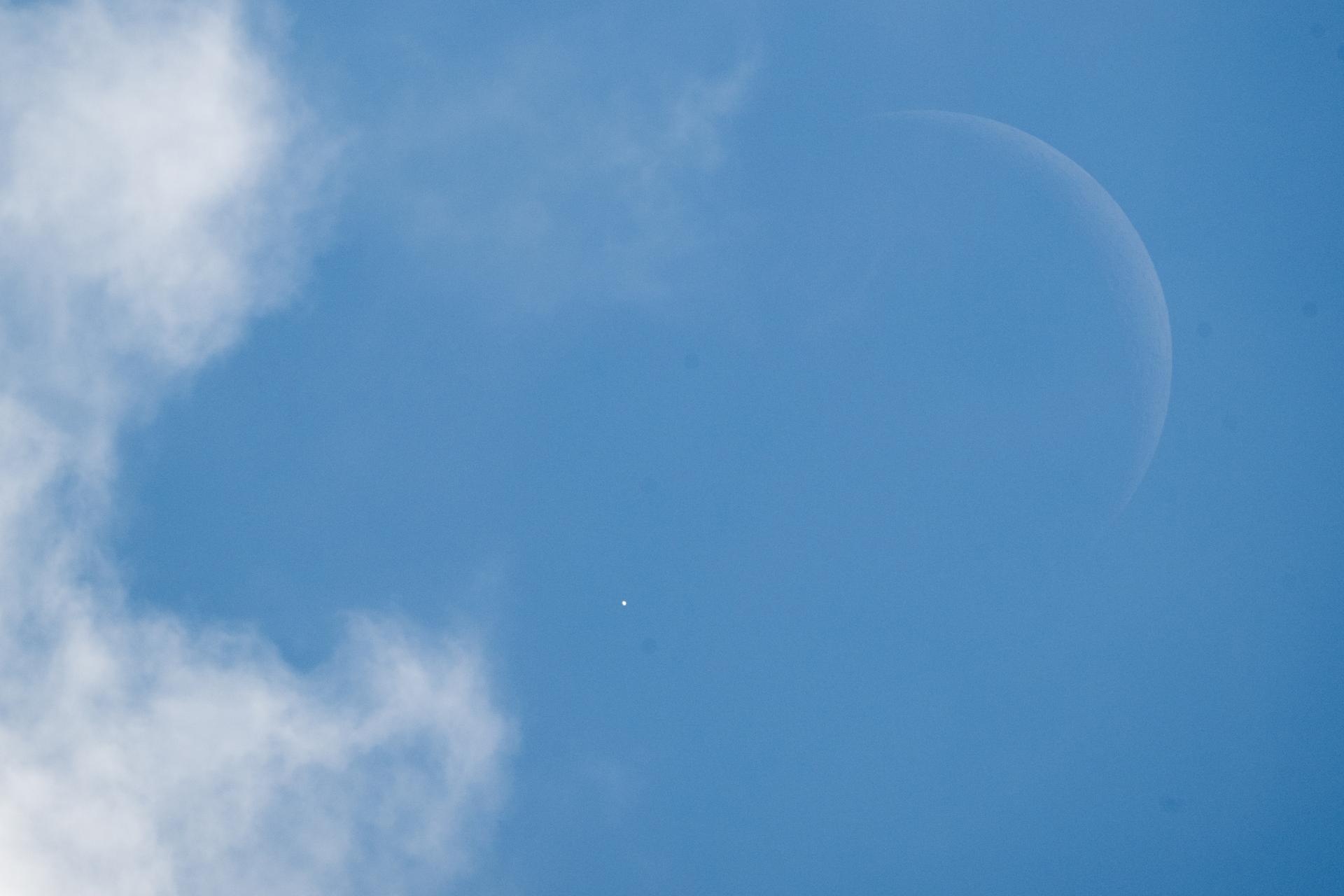
This is the event of the month – and it takes place in broad daylight. On the morning of 14 September the waxing Moon, just 12% illuminated, passes in front of Venus. Depending on where you are, Venus disappears behind the dark limb of the Moon between 11:29 and 11:37 CEST and reappears at the bright limb around 62 to 68 minutes later.
Occultations of bright planets are rare: from a fixed location you see a Venus occultation only every few years on average, and most of them fall in twilight or below the horizon. This one stands high in the daytime sky for the whole of Central Europe – which makes it easy to reach and demanding at the same time, because you first have to find something in a blue sky.
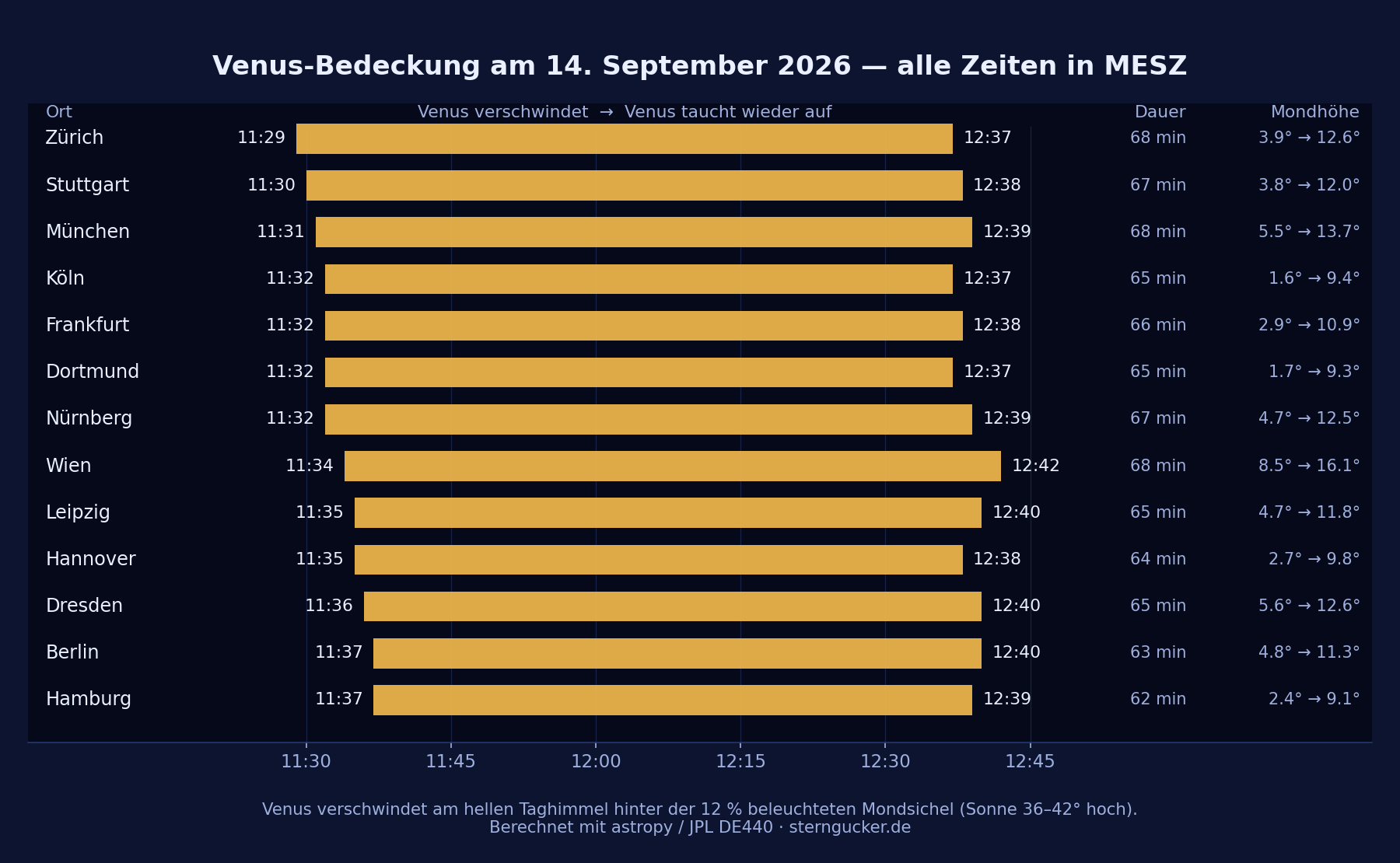
All the times for 13 cities
The altitude figures are decisive: at only 1.6° above the horizon (Cologne) you need a really clear view to the east and south-east. In Munich or Vienna the Moon is far more comfortably placed.
| Location | Ingress | Egress | Duration | Moon altitude at ingress | Moon altitude at egress |
|---|---|---|---|---|---|
| Zurich | 11:29 | 12:37 | 68 min | 3.9° | 12.6° |
| Stuttgart | 11:30 | 12:38 | 67 min | 3.8° | 12.0° |
| Munich | 11:31 | 12:39 | 68 min | 5.5° | 13.7° |
| Cologne | 11:32 | 12:37 | 65 min | 1.6° | 9.4° |
| Frankfurt am Main | 11:32 | 12:38 | 66 min | 2.9° | 10.9° |
| Dortmund | 11:32 | 12:37 | 65 min | 1.7° | 9.3° |
| Nuremberg | 11:32 | 12:39 | 67 min | 4.7° | 12.5° |
| Vienna | 11:34 | 12:42 | 68 min | 8.5° | 16.1° |
| Leipzig | 11:35 | 12:40 | 65 min | 4.7° | 11.8° |
| Hannover | 11:35 | 12:38 | 64 min | 2.7° | 9.8° |
| Dresden | 11:36 | 12:40 | 65 min | 5.6° | 12.6° |
| Berlin | 11:37 | 12:40 | 63 min | 4.8° | 11.3° |
| Hamburg | 11:37 | 12:39 | 62 min | 2.4° | 9.1° |
Be at the telescope at least 20 minutes before ingress. The times apply to the city centre; a few kilometres away makes a difference of a few seconds, but the altitude changes considerably more with the horizon profile at your own site.
Finding it in the daytime sky
The trick is to find the Moon first – in steady air the slender crescent is visible to the naked eye if you roughly know where it stands. On 14 September at around 11:30 it is low in the east to east-south-east, well to the left and below the Sun. Once you have the Moon in the finder, Venus is only a hand’s breadth away: shortly before ingress it sits right at the unlit edge of the crescent.
At −4.8 mag Venus is bright enough to hold its own even against a blue sky – in the telescope it appears on 14 September as a crescent 37 arcseconds across and 29% illuminated. That is larger than Saturn and unmistakable at a little magnification. Binoculars show it as a bright, slightly elongated dot; only from about 40× magnification does the crescent shape become clear.
A practical tip: set the focus on the lunar limb beforehand, not on Venus. And if you can, observe from the shadow of a building – stray light on the optics is the biggest killer of contrast in the daytime sky.
Safety: distance from the Sun
⚠️ Please read this once before you set up the telescope
At the time of the occultation the Sun stands 36 to 42° high – and the Moon and Venus are only around 40° away from it. That is a safe distance as long as you work in a controlled way, but: an unfiltered telescope that accidentally swings across the Sun will destroy your eyesight in a fraction of a second.
- Take the finder off or cap it – most accidents happen when looking through the finder.
- Set the telescope up so that a building or a house wall blocks the Sun. Then it cannot get into the field of view in the first place.
- Never swing the telescope around the sky freehand “just for a moment”. Point at the Moon deliberately, ideally using the coordinates or the GoTo control, the motor drive that moves the telescope to an object at the push of a button.
- Only let children at the eyepiece under supervision.
You will find everything about safe solar observing on our page Observing the Sun.
Photographing the occultation
In the daytime sky the exposure is uncritical – the Moon and Venus are both very bright. With a telephoto lens from 300 mm on a mirrorless camera you will get the crescent and Venus together in one frame; at 1/500 s, ISO 100 and f/8 you will usually be right. What matters is the focus: focus on the lunar limb in live view at maximum magnification, because autofocus usually fails in the low-contrast daytime sky.
The more spectacular moment, by the way, is not the ingress but the egress at the bright lunar limb at around 12:37 to 12:42: Venus seems to appear there out of nowhere. Because Venus is not dimmed by any atmosphere of the Moon – the Moon has no envelope of air – this happens within a few seconds. A video sequence starting two minutes before the calculated time is more worthwhile than single frames.
Neptune at opposition on 26 September: the most distant planet
On 26 September at 03:36 CEST Neptune stands exactly opposite the Sun. It is then 28.88 astronomical units away – around 4.32 billion kilometres – and at 7.7 mag as bright as it can ever get. It stays invisible to the naked eye, in binoculars it is an inconspicuous star, and only in the telescope does it give itself away through its tiny, blue-grey disc of 2.4 arcseconds.
At the end of September Neptune culminates at around 00:44 at an altitude of 37° – high enough for the turbulence in the air to stay bearable. It lies in the constellation Pisces, close to the border with Aquarius.
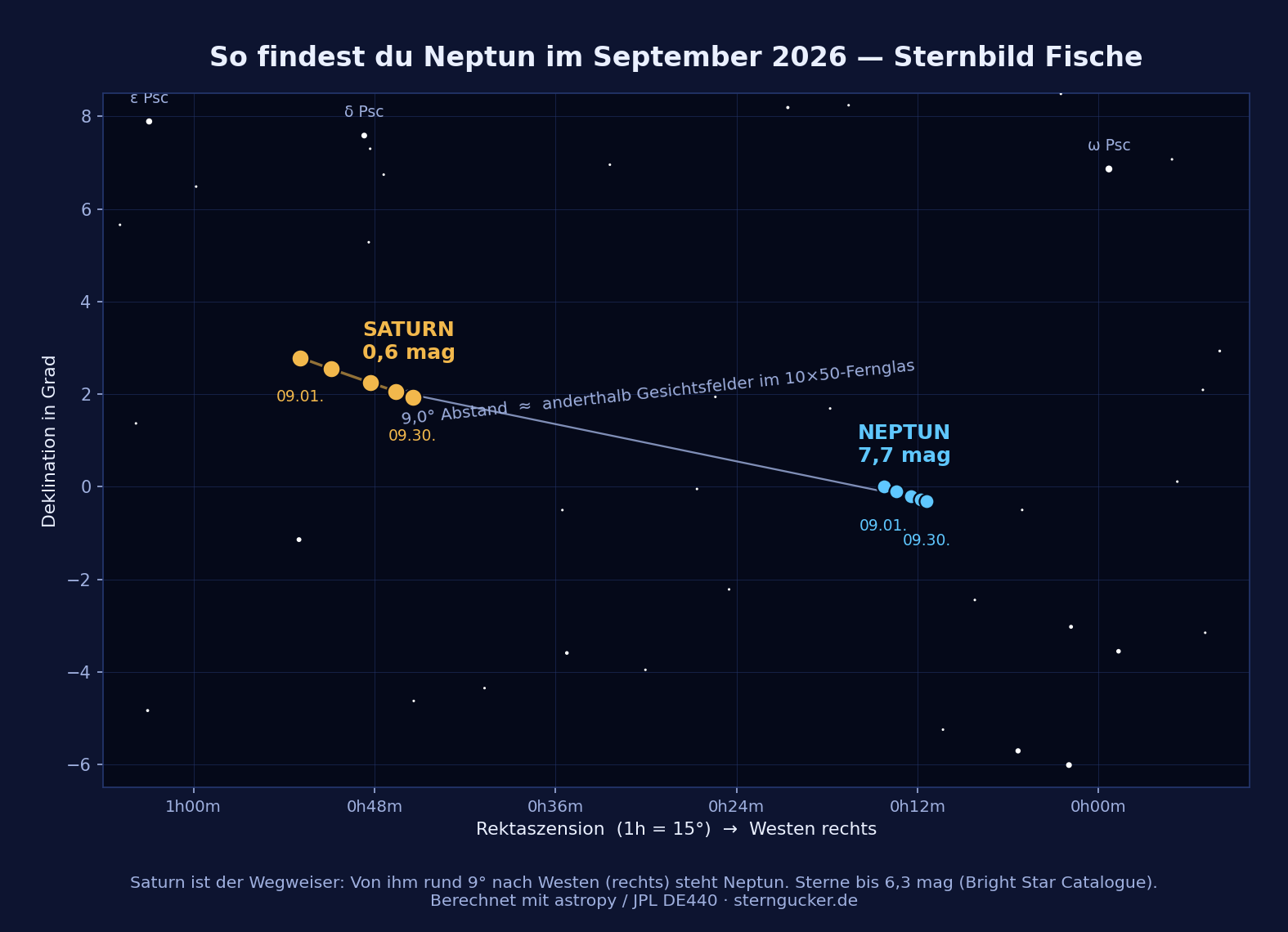
How to find Neptune
2026 is a lucky year for Neptune hunters: Saturn stands only around 9° east of it – 10.1° at the start of the month, 9.0° on 26 September, 8.8° at the end of September. Nine degrees is barely one and a half fields of view of a pair of 10×50 binoculars. For the first time in years there is a bright signpost visible to the naked eye right next to the faintest planet.
How to go about it:
- Step 1: Find Saturn. At 0.6 mag it is by far the brightest “star” in this otherwise empty region of the sky and stands in the south around midnight.
- Step 2: From Saturn, swing around 9° to the west – that is, against the daily motion, towards the constellation Aquarius.
- Step 3: On 26 September Neptune stands at right ascension 0h 11.8min and declination −0° 16′, practically exactly on the celestial equator. In binoculars it is one of several stars of 8th magnitude.
- Step 4: The identification succeeds in the telescope: at 150× magnification Neptune is the only object in the field to show an extended, non-twinkling disc with a distinct blue cast. Stars stay point-like.
If you want to be certain: sketch or photograph the field on two evenings about a week apart. In that time Neptune moves visibly against the background stars.
The problem with the full moon
And now the catch that most overviews keep quiet about: the full moon falls on the same day. At 18:49 on 26 September the Moon stands 100% illuminated in the sky – and it is only 3.3° away from Neptune. Looking for an object as faint as 7.7 mag next to the full moon is about as much fun as photographing a candle next to a floodlight mast.
The good news: an opposition is not a deadline. Neptune stays practically the same brightness and the same size for weeks. Simply move your observing:
- Best windows in September: the nights from 8 to 17 September. The Moon is then new or slender, and six to seven and a half hours of moon-free, astronomically dark time remain.
- Second-best option: 5 to 12 October – Saturn is then optimally placed too after its opposition on 4 October, and both planets can be worked through in a single night.
On the night of 11 to 12 September, for example, Neptune culminates at around 02:10 and the Moon is below the horizon the whole night. That is the night to make a note of – not the 26th.
Which telescope for Neptune?
Seeing Neptune is not a question of aperture, the diameter of the main lens or mirror – binoculars already manage 7.7 mag. Recognising it as a disc is a question of magnification. As a rule of thumb: from about 100 mm of aperture and 150× magnification the dot becomes a tiny disc. With 130 mm and steady air the blue tone is unambiguous.
The telescope for Neptune and Saturn: Skywatcher Dobson Telescope N 130/650 Heritage FlexTube
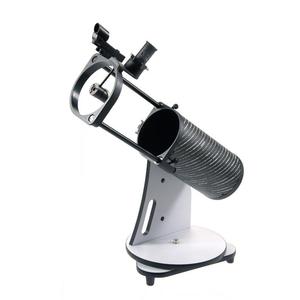
A compact tabletop Dobson with a true parabolic mirror. Folds down, fits in a bag: the Moon, planets and the bright deep-sky classics.
Price: € 265
Neptune’s moon Triton (13.5 mag) is theoretically within reach from 200 mm of aperture, but never stands more than 17 arcseconds from the planet – a real project for experienced observers. There is more background on the planet in the Neptune guide, and if you are still at the beginning, the guide Telescopes for beginners will help you further.
When does it get properly dark in September?
This is the real reason why September is so much better for stargazers than August: astronomical twilight – the time in which the Sun is more than 18° below the horizon and the sky is really black – expands rapidly.
| Date | Sunset | Nautical twilight | Astronomical darkness from | … until | Sunrise | Hours of darkness |
|---|---|---|---|---|---|---|
| 1 September | 19:54 | 21:14 | 22:02 | 04:10 | 06:18 | 6 h 08 min |
| 10 September | 19:32 | 20:50 | 21:34 | 04:30 | 06:32 | 6 h 56 min |
| 20 September | 19:08 | 20:24 | 21:06 | 04:52 | 06:50 | 7 h 46 min |
| 30 September | 18:46 | 19:58 | 20:40 | 05:12 | 07:06 | 8 h 32 min |
Within a single month you gain two and a half hours of real darkness per night. Anyone who was frustrated in June because it no longer got astronomically dark at all in northern Germany now gets their compensation. The values apply to Berlin; in Munich darkness begins about 15 minutes earlier and ends 15 minutes later, in Hamburg it is the other way round.
What is decisive, though, is the combination of darkness and the Moon. The graphic below shows for each of the 30 nights when it is astronomically dark (dark blue) and when the Moon is below the horizon as well (orange) – those are the windows in which deep-sky observing really makes sense.
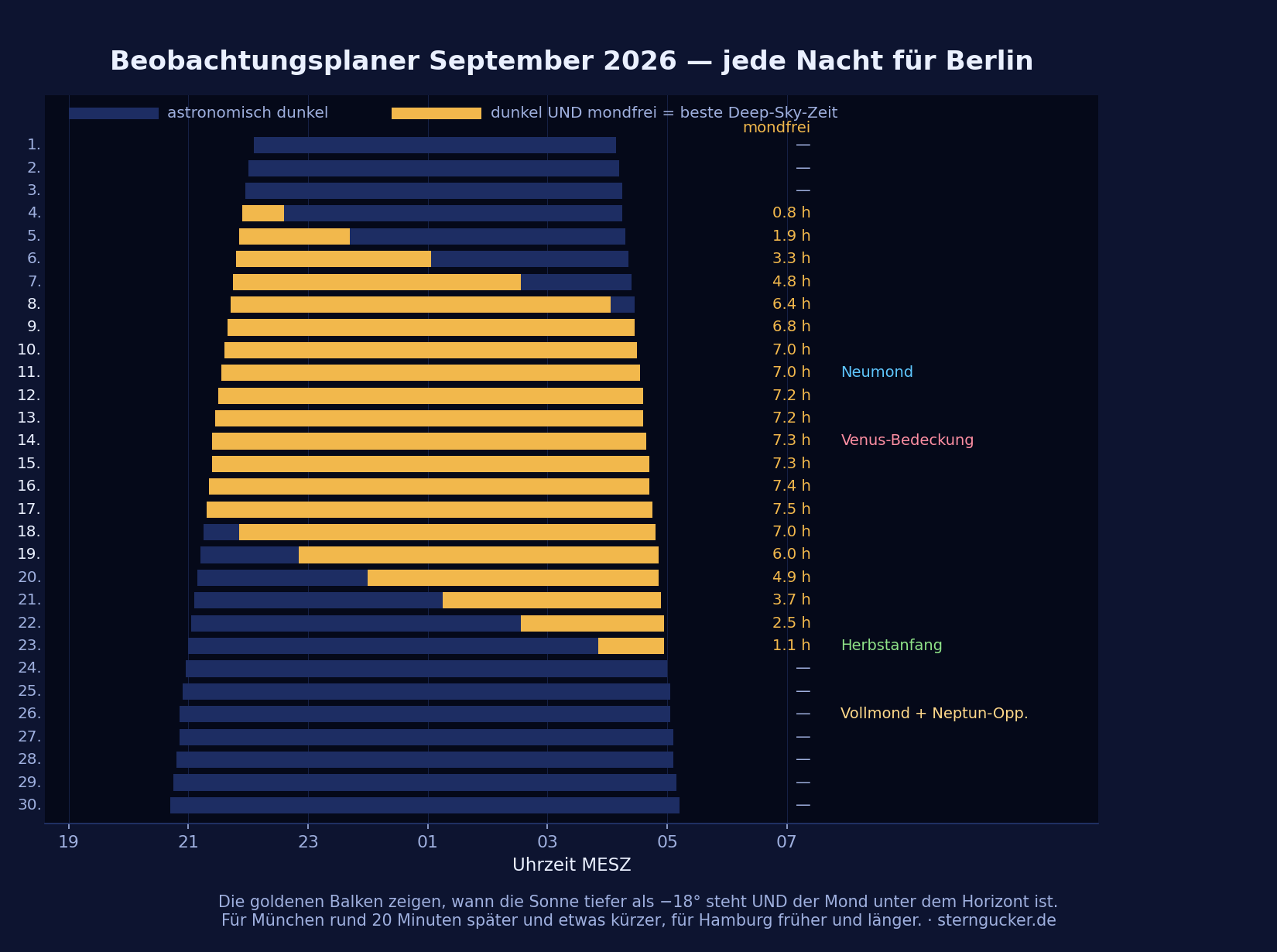
The bottom line at a glance: on the nights from 9 to 17 September the entire dark phase is moon-free – between 6.9 and 7.5 hours. From 24 September the Moon is above the horizon all night long, and then there is nothing left for faint objects. If you can only get out on one night in September, take one from the 9–17 window.
The moonless nights from 9 to 17 September are the window where a telescope really makes a difference this month.
Neptune at 7.7 mag and the autumn galaxies are out of reach without one – the Harvest Moon, the equinox and the Milky Way are not. Six short questions, an honest answer by email – even when binoculars are the better choice.
The moon phases in September 2026
| Date | Time (CEST) | Phase | What that means for you |
|---|---|---|---|
| 4 September | 09:51 | Last quarter | The first half of the night becomes moon-free – the deep-sky season begins |
| 11 September | 05:26 | New moon | The darkest nights of the month, around the 8th to the 14th |
| 18 September | 22:43 | First quarter | Half moon in the evening sky – the best time for lunar craters |
| 26 September | 18:49 | Full moon (Harvest Moon) | Bright all night, deep sky takes a break |
And because the phase alone says little about the actual interference, here are the rise and set times with the illuminated fraction:
| Date | Moonrise | Moonset | illuminated |
|---|---|---|---|
| 1 September | 20:52 | 11:36 | 76% |
| 5 September | 23:36 | 16:56 | 38% |
| 8 September | 02:28 | 18:36 | 6% |
| 11 September | 06:52 | 19:16 | 1% |
| 15 September | 12:12 | 20:12 | 15% |
| 18 September | 15:40 | 21:52 | 50% |
| 22 September | 17:44 | 01:16 | 85% |
| 26 September | 18:32 | 06:32 | 100% |
| 30 September | 19:48 | 12:16 | 79% |
The best compromise for moon observers is 18 September: at first quarter the terminator runs right through the middle of the disc, and that is exactly where the craters cast their longest shadows. You will find all the dates of the year in the full moon calendar, and the basics about our satellite on the page The Moon.
Harvest Moon on 26 September: why it rises so early
The full moon that falls closest to the autumn equinox is traditionally called the Harvest Moon (in German Erntemond). In 2026 it falls on 26 September, 18:49. The name comes from farming: in the days around this full moon the Moon rises at almost the same time on several consecutive evenings – the fields stayed lit unusually long into the evening.
That is not folklore, it is measurable. Normally moonrise is delayed by about 50 minutes a day. Around the equinox, however, the ecliptic lies very flat to the horizon, and the daily delay shrinks dramatically:
| Date | Moonrise (Berlin) | Delay compared with the previous day |
|---|---|---|
| 22 September | 17:46 | – |
| 23 September | 18:00 | 14 min |
| 24 September | 18:12 | 12 min |
| 25 September | 18:22 | 10 min |
| 26 September | 18:34 | 12 min |
| 27 September | 18:46 | 12 min |
| 28 September | 19:00 | 14 min |
| 29 September | 19:20 | 20 min |
| 30 September | 19:48 | 28 min |
On five evenings in a row the Moon rises with a delay of only ten to fourteen minutes instead of the usual fifty. That is the Harvest Moon effect – and it is more pronounced from northern Germany than from the Alps, because the angle of the ecliptic to the horizon becomes flatter still with increasing geographical latitude.
For observing that means: the rising full moon on 26 September is a subject worth photographing. It comes over the eastern horizon shortly after sunset, looks huge because of the moon illusion and combines superbly with a landscape, a church tower or a mountain silhouette. In the telescope, by contrast, the full moon is the dullest – and most dazzling – sight of the month.
So the full moon does not dazzle you: Omegon Premium Moon Filter 1.25″
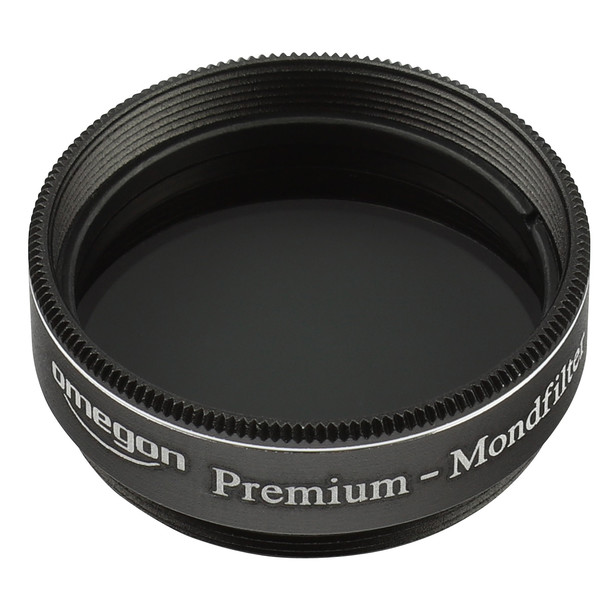
Dims the harsh moonlight, is easy on the eyes and brings out far more contrast and detail – our best-selling filter and the number-one pick to start with.
Price: € 19.90
The planets in September 2026
| Planet | Brightness | Visibility | In brief |
|---|---|---|---|
| Saturn | +0.6 mag | almost all night | The star of the month – opposition on 4 October |
| Neptune | +7.7 mag | all night | Opposition on 26 September, telescope needed |
| Uranus | +5.7 mag | second half of the night | Climbing towards opposition (26 November) |
| Jupiter | −1.9 mag | morning sky | Gets higher and more conspicuous from week to week |
| Mars | +1.2 mag | morning sky | Unremarkable – its great time only comes in 2027 |
| Venus | −4.8 mag | practically invisible | Greatest brilliancy, but too low in the twilight |
| Mercury | −1.4 to −0.1 mag | invisible | Evening ecliptic too flat |
Saturn definitively takes over the role of the evening planet. On 1 September it rises at 20:56, on 30 September as early as 19:00. In the middle of the month it stands 25.5° high at 23:00 and 37.2° high at 01:00 – the latter is the time at which you should observe. Particularly pleasing: after the ring plane crossing of 2025 the rings are open by 9.9° again (in January 2026 it was only 1.8°). The Cassini division is therefore within reach again when the air is steady.
Neptune – see above, opposition on 26 September.
Uranus stands in Taurus and reaches an altitude of 45° at 03:00 in the middle of the month. At 5.7 mag it is a borderline naked-eye object under a really dark sky and no problem at all in binoculars – but its opposition does not follow until 26 November.
Jupiter is the climber. It rises at 03:48 on 1 September, at 02:28 on 30 September; its altitude at 05:30 grows over the course of the month from 19.5° to 26.1°. At −1.9 mag it is the most conspicuous point in the morning sky. On 9 September the slender waning crescent stands 5.7° from it – a lovely binocular subject in the twilight.
Mars stays disappointingly pale at +1.2 mag; its disc measures a mere 5 arcseconds. It rises shortly after midnight and stands around 39° high at 05:30 on 15 September. On 7 September at around 03:30 the waning Moon stands 4.8° from it. The interesting Mars period only begins in the winter of 2026/27, ahead of the opposition in February 2027.
Venus is the most frustrating case of the month: between 20 and 27 September it reaches its greatest brilliancy at −4.8 mag and grows as a crescent to more than 45 arcseconds. From Central Europe there is nothing to be had of it – at sunset it stands only 6.1° high on 1 September, 3.3° on 15 September, 1.0° on 25 September, and from 30 September it has already set before the Sun disappears. The flat autumn evening ecliptic pushes it down into the haze. That is why 14 September – the occultation in the daytime sky – is paradoxically the best Venus opportunity of the month.
Mercury increases its angular distance from the Sun from 4.8° on 1 September to 22.7° on 30 September – on paper an evening apparition. In practice, no: Mercury sets at 19:08 on 30 September, the Sun at 18:46. Twenty-two minutes’ head start in the brightest twilight, a few degrees above the horizon – that is not enough. Mercury stays invisible from Central Europe in September.
The dates that are actually worth it are often months apart – and easily forgotten. So you do not miss one:
One short email, in good time – with the times and an honest take on whether it is worth getting up for.
You will get a confirmation email in a moment. Your address stays with us – no sharing, no third-party ads.
Start of autumn on 23 September: the sky tips over
On 23 September 2026 at 02:05 CEST the Sun crosses the celestial equator from north to south. That is the astronomical start of autumn, the equinox. In UTC it is 23 September, 00:05 – and the term “equal day and night” is strictly speaking wrong: because the Sun is a disc and the atmosphere lifts its light at the horizon, on 23 September the day in Central Europe is still around eight minutes longer than the night. The real balance falls on 25 or 26 September.
For observers the equinox means three things:
- The summer constellations clear the zenith. The Summer Triangle of Vega, Deneb and Altair still stands high in the evening, but moves westwards evening by evening. The Milky Way through Cygnus shows itself at a good altitude for the last time.
- The autumn square takes over. The four stars of the Square of Pegasus stand in the east at around 23:00 – the most important signpost of the autumn sky. From its north-eastern corner a chain of stars leads straight to the Andromeda Galaxy.
- The nights get longer quickly. Around the equinox the length of the day changes fastest – by about four minutes a day.
If you want to find your way around the autumn sky, a planisphere, a rotating star chart, often gets you further than a phone: it shows the whole sky at a glance, it works in the cold, and because it needs no light of its own it does not ruin your dark adaptation.
Orientation in the autumn sky: Oculum Swivelling Sky Map 29 cm

Set date and time, hold it up, find the constellations: the swivelling star chart shows exactly the sky above you at that moment. No battery, no signal, no screen glare.
Price: € 19.90
Deep sky in September 2026: what is really worth it
September is the month in which the summer and autumn skies are available at the same time. In the evening the summer objects still stand high, after midnight the galaxies of autumn take over. All culmination times and altitudes apply to 15 September, Berlin:
| Object | Highest point | Altitude | What you need |
|---|---|---|---|
| M13 Hercules Cluster | 18:10 | 74° | Binoculars show a fuzzy patch, a telescope resolves it into stars |
| M57 Ring Nebula | 20:22 | 71° | Telescope from 80 mm, at least 100× |
| M27 Dumbbell Nebula | 21:28 | 60° | Binoculars from 10×50 as a patch, a telescope shows the shape |
| M15 globular cluster | 22:58 | 50° | Binoculars, grainy in the telescope |
| M30 globular cluster | 23:08 | 14° | Only with a clear southern horizon, telescope |
| NGC 7293 Helix Nebula | 23:58 | 17° | Demanding: dark sky + large field of view |
| M31 Andromeda Galaxy | 02:10 | 79° | Naked eye under a rural sky, binoculars ideal |
| M33 Triangulum Galaxy | 03:02 | 68° | Only under a really dark sky, binoculars |
| h and χ Persei | 03:48 | 85° | The binocular object par excellence |
| M45 Pleiades | 05:16 | 62° | Binoculars – autumn announces the winter |
For the large, extended objects – Andromeda, the double cluster h and χ Persei, the Pleiades, the Milky Way fields in Cygnus – a pair of fast binoculars really is superior to a telescope: it shows them whole, instead of only a section. M31 is more than six full-moon widths long; only a fraction of that fits into a typical telescope field of view.
For Andromeda, the Pleiades and the Milky Way: Celestron Cometron 7x50 Binoculars
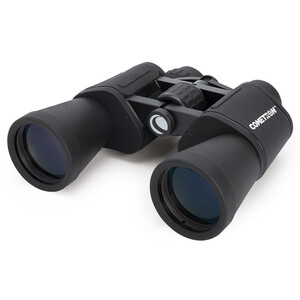
The astronomy classic among affordable binoculars: 7×50 with a large exit pupil for bright handheld views of the Moon and Milky Way – the ideal first step before a telescope.
Price: € 65
When the telescope is worth it anyway: as soon as it comes to detail, the relationship reverses. The Ring Nebula M57 is a star in binoculars, a smoke ring in the telescope. M13 is a ball of cotton wool in binoculars, a swarm of hundreds of individual stars in the telescope. Saturn, the crescent of Venus on 14 September, Neptune’s little disc, lunar craters on 18 September – none of that can be seen in binoculars at all. If you can only buy one instrument and really want to explore the sky, go for the telescope; binoculars are the addition, not the substitute.
Milky Way and zodiacal light: the last chances
The Milky Way shows two faces in September. Its centre in Sagittarius – the spectacular, cloud-rich part – is taking its leave: at the beginning of astronomical darkness it stands only 4.9° above the horizon on 1 September, 4.0° on 15 September, 2.6° on 30 September. The core season for Milky Way photography in Central Europe is thus over; anyone who wants to capture it one more time has to use 1 to 10 September and needs an absolutely clear southern horizon.
Its northern part, by contrast, stands as well as it ever does: the band through Cygnus, Lyra and Aquila runs directly through the zenith in the evening. Under a sky without light pollution the North America Nebula, the Veil Nebula and the dark gash of the Cygnus Rift are hinted at with the naked eye – in binoculars this turns into a firework display of star fields.
And then there is the zodiacal light, which most people have never seen. It is sunlight scattered by dust particles in the plane of the solar system, and it appears as a faint, triangular cone of light along the ecliptic. In autumn the ecliptic stands steeply to the eastern horizon in the morning – exactly the condition you need. Look for it in the nights around new moon, that is from 8 to 14 September, about 90 to 120 minutes before sunrise in the east. The prerequisites: a really dark site, no Moon, no haze. There is a risk of confusing it with the onset of twilight – but the zodiacal light is narrower, tilted at an angle and tapers to a point towards the top.
Meteors in September 2026: rather quiet
After the Perseids in August comes the lull. September has not a single strong shower to offer – but three small ones which are still worth a look in the good moon conditions in the middle of the month:
- Aurigids, maximum on 1 September, ZHR about 6. The Moon is 76% illuminated and interferes – only the hours before it rises at 20:52 are usable, and it is not dark yet then.
- September ε-Perseids, maximum on 9 September, ZHR about 8. This is the best shower of the month – and the moon conditions are ideal, because the Moon does not rise until 02:28 and is only 6% illuminated. It is best to look towards Perseus in the second half of the night.
- September Lyncids, maximum around 13 September, ZHR 3–4. A shower for statisticians.
Realistically that means five to ten meteors an hour under a dark sky, no more. Meteors are watched with the naked eye anyway – every pair of binoculars and every telescope restricts the field of view so much that you see fewer, not more. A blanket, a deck chair and patience are quite enough. You will find all the dates up to 2027 in the meteor shower calendar.
Equipment for the September sky
September makes two very different demands: the Venus occultation and Neptune call for magnification, the autumn deep-sky objects call for field of view. In short:
| What for? | What you need |
|---|---|
| Venus occultation on 14 Sept | Telescope from 70 mm, 40× to 100×. Binoculars only show a dot. |
| Neptune at opposition | Telescope from 100 mm, at least 150× for the disc |
| Saturn and lunar craters | Telescope from 100 mm, 100× to 200× |
| Andromeda, h and χ Persei, the Milky Way | 10×50 binoculars, dark site |
| Full moon on 26 Sept | Moon filter – without one the view in the telescope is painfully bright |
| Meteors and zodiacal light | Just your eyes, a blanket and 30 minutes of dark adaptation |
If you do not have any equipment at all yet: autumn is the best time to start, because the nights are long and not yet bitterly cold. Compare in the guide Telescopes under 300 euros or, if you prefer to look with both eyes, in the binoculars guide.
Start now or wait for Christmas? Why September is the better month to begin
Most first telescopes are given as Christmas presents. September is still the better month to actually start – and the reason is further up this page: on 1 September astronomical darkness begins at 22:02, on 30 September already at 20:40.
Then there is the weather, and that is not a side note. In September you stand in the garden at ten in the evening in double-digit temperatures; in December it is around freezing, and after forty minutes nobody wants to swap an eyepiece any more.
The real reason, though, is practice. A telescope needs a few evenings before the finder, the eyepiece changes and the compass directions in your own garden become second nature. Start in September and you will find the Orion Nebula at Christmas instead of hunting for it.
If you are still wondering what to get: for adults with no prior knowledge, the beginner telescope guide sorts the designs by what you actually get to see through them. If it is for a child, the telescopes for kids guide gets you there faster.
And if you are already thinking about Christmas, there is a practical advantage: usable beginner instruments are regularly sold out from late November onwards, or carry delivery times into the new year. What is worth having – from a poster through binoculars to a first real telescope – is in the overview astronomy gifts.
And the honest counter-argument: for most of this month you need none of it. The Harvest Moon, the equinox, the Milky Way and the zodiacal light belong to the naked eye, and the dark nights around 11 September stay interesting for a whole season with a pair of 10×50 binoculars. Only Neptune and the Venus occultation on 14 September genuinely need magnification.
* Affiliate link: if you buy through this link we may earn a small commission from Astroshop or High Point Scientific, at no extra cost to you.
Frequently asked questions about the September night sky
When is the full moon in September 2026?
On 26 September 2026 at 18:49 CEST. It is the Harvest Moon – the full moon that falls closest to the autumn equinox. In Berlin it rises at 18:32 that evening, so before the exact moment of full moon.
When is the new moon in September 2026?
On 11 September 2026 at 05:26 CEST. The nights from 8 to 14 September are therefore the darkest of the month – on the night of 11 to 12 September there are around seven hours of moon-free, astronomically dark time.
Which planets can you see in September 2026?
Saturn (+0.6 mag) almost all night, Uranus (+5.7 mag) in the second half of the night, Neptune (+7.7 mag) all night with a telescope, Jupiter (−1.9 mag) and Mars (+1.2 mag) in the morning sky. Venus and Mercury remain practically invisible from Central Europe, because the evening ecliptic stands too flat in autumn.
What is the Harvest Moon?
The Harvest Moon is the full moon that falls closest in time to the autumn equinox. Its name comes from the fact that in those days the Moon rises at almost the same time on several evenings in a row – in 2026 with a delay of only ten to fourteen minutes per evening instead of the usual fifty. As a result the fields stayed lit unusually long into the evening.
When does autumn begin in 2026?
Astronomical autumn begins on 23 September 2026 at 02:05 CEST (00:05 UTC). Meteorological autumn, by contrast, always begins on 1 September. Both statements are correct, they are simply based on different definitions.
Is there a lunar eclipse in September 2026?
No. In September 2026 there is neither a lunar nor a solar eclipse. Most recently August 2026 had both: the total solar eclipse on 12 August and the partial lunar eclipse on 28 August. The next lunar eclipse – a deep penumbral eclipse, fully visible from Central Europe – follows on 21 February 2027; all the coming dates are on the page Lunar eclipse.
Is September a good month to start out in astronomy?
Yes – it is the best one of the year. Darkness arrives two and a half hours earlier over the course of the month, temperatures are still comfortable, and the autumn sky offers three targets that already work in binoculars: the Andromeda Galaxy, h and χ Persei, and the Milky Way in Cygnus. Start now and you will have three months of practice before the winter sky with Orion arrives – instead of having to catch up on Christmas Eve.
What can you see in the sky tonight?
In September 2026 the short answer is: Saturn in the south to south-east, well placed from about 22:00. Plus the Summer Triangle in the zenith, the autumn square in the east and – as soon as it is really dark after 22:00 – the Andromeda Galaxy as a pale patch above the north-eastern horizon. If you only have ten minutes, take a pair of binoculars and sweep slowly once through the Milky Way in Cygnus, directly above your head.
➡️ What comes next: The night sky in October 2026 – with Saturn at opposition on 4 October.
⬅️ The month before: The night sky in August 2026 – with the total solar eclipse and the Perseids.
🔭 Also interesting: Neptune – the last planet: why it is blue, what sets it apart from Uranus and how to find it.
📅 Also interesting: Meteors 2026/2027: the complete meteor shower calendar
🗓️ Also interesting: Astronomical events 2026/2027: all the sky events at a glance