By Alexander Merz · Updated on · Details checked on 6 October 2026
Few sights stir the imagination like comets. These icy wanderers of the solar system spend most of their lives in the frozen dark, only unfurling their famous glowing tails as they sweep close to the Sun. Once feared as omens, comets are now prized as time capsules from the birth of the planets — and as some of the most rewarding targets for backyard skywatchers.
⚡ The quick answer: A comet is a small icy body made of frozen gases, dust and rock — essentially a “dirty snowball.” As it nears the Sun, its ice sublimates to form a glowing coma and a long tail. Most visible comets are best viewed through a simple pair of binoculars, whose wide field takes in both the bright core and the faint, spreading tail.
What is a comet?
A comet is a small celestial body named for the glowing “tail” that trails behind it near the Sun. Its nucleus is made of ices of various volatile elements together with dust and solid minerals. In fact, comet nuclei are among the darkest objects in the solar system and cannot be seen with the naked eye from Earth.
As a comet approaches our Sun, it crosses the orbit of Jupiter at roughly 5 AU (about 748 million kilometres). On the side facing the Sun, the solar wind drives a process called “sublimation”: the volatile parts of the nucleus turn straight into gas, beginning at its most brittle points.
Radiation pressure and the solar wind then blow the coma away from the nucleus. This “tail” of ions and radicals is finally visible from Earth.
Which comets are in the sky right now and how bright they are is on our hourly updated comet tonight list.
How is a comet structured?
In its make-up, a comet resembles a “dirty snowball” and is built from three distinct parts:
- The nucleus: ice, frozen carbon dioxide, methane and ammonia, along with dust and minerals.
- The coma: sublimated volatile substances that surround the nucleus near the Sun.
- The tail: coma material blown away by the increasingly strong solar wind.
What makes a comet’s tail special
Near the Sun, the sublimation of volatile matter creates the tail. The debris it leaves behind lingers in interplanetary space and produces shooting stars (meteors) whenever Earth’s orbit passes through it. A comet actually has two tails: a curved, yellowish dust tail and a straight, bluish ion tail that always points directly away from the Sun.
Types of comets
Aperiodic comets pass the Sun on unpredictable paths, unlike periodic comets. Research on them is still patchy: we don’t yet know whether they can overcome the gravity of the outer planets and leave our solar system for good.
Long-period comets
The orbits of long-period comets are disturbed by the gravitational forces of the “Oort Cloud.” They travel unpredictably, are deflected, and are eventually stabilised again by the gravity of the outer planets. Their orbital periods range from 200 years to several million years.
Short-period comets
Short-period comets move around the Sun relatively steadily. They are thought to originate in the “Kuiper Belt.” Former long-period comets are gradually pulled into ever tighter orbits by Jupiter’s gravity over many cycles. Most have orbital distances of 5 – 6 AU (749 to 898 million kilometres).
Where do comets come from?
Comets are leftovers from the birth of the solar system. Matter drawn toward the centre of the protoplanetary disk became the planets and moons. In the outer regions, material stayed put and formed the Kuiper Belt and the Oort Cloud — the source of most comets.
That is why a sample of their material would be priceless for science: it is matter from the dawn of the solar system, capable of answering many still-open questions.
Comet or asteroid: what’s the difference?
Telling a comet from an asteroid isn’t always easy. In general, a comet holds a significant amount of water ice, which produces a coma and tail near the Sun. An asteroid forms no tail because its water-ice content is too low.
It is thought, however, that comets which have lost all their water ice after countless trips around the Sun continue on as a rocky core. These “burnt-out” comet nuclei are indeed classified as asteroids.
How to observe a comet
Unlike the planets, a comet is a soft, extended object. The ideal instrument is therefore not necessarily a large telescope, but a pair of binoculars with a wide field of view and good light-gathering power. A 10×50 model is the sweet spot for capturing both the core and the delicate sweep of the tail from a genuinely dark sky.
| Instrument | What you see | Best for |
| Naked eye | Bright comets, tail as a faint smudge | The rare great comets |
| 10×50 binoculars | Crisp coma, start of the tail, diffuse colour | The vast majority of visible comets |
| Telescope | Detail in the core and coma structure | Fainter comets and astrophotography |
For getting started, a versatile pair of binoculars is the most practical choice: light, instant to use, and perfect for sweeping the sky in search of a comet.
Best for comets: Omegon Brightsky 10x50 Binoculars

Bright, high-contrast binoculars: perfect for the Moon, star clusters and Milky Way fields, handheld.
Price: € 289
If you later want to extend your observing to the Moon and planets, a small beginner refractor picks up where binoculars leave off, without breaking the bank.
Beginner telescope: Omegon Telescope AC 70/700 AZ-2
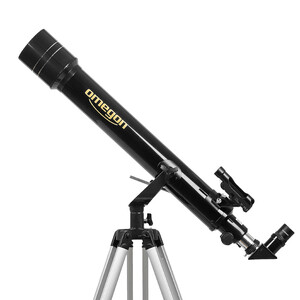
The no-pitfall starter refractor: Moon, Saturn's rings and Jupiter's moons from the very first night. No collimation.
Price: € 129
Best for advanced observers: Skywatcher Dobson Telescope N 200/1200 Skyliner Classic
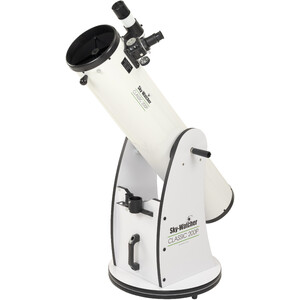
200 mm of aperture — the most sky for your money. Set it on the ground, point by hand: nebulae, clusters and galaxies for years to come.
Price: € 479
* Affiliate link: if you buy through this link we may earn a small commission from Astroshop or High Point Scientific, at no extra cost to you.
Famous comets and their return
| Comet | Orbital period | Last seen | Next appearance |
| Halley | 75 years | 1986 | 2061 |
| Tempel-Tuttle | 33 years | 1998 | 2031 |
| Swift-Tuttle | 130 years | 1992 | 2122 |
| Ikeya-Seki | 860 years | 1965 | approx. 2825 |
| Hale-Bopp | approx. 2,400 years | 1997 | approx. 4385 |
Fascinating facts about well-known comets
Halley’s Comet
- One of the most famous of all comets, with an orbital period of about 76 years.
- First documented in 240 BC, it is named after the English astronomer Edmond Halley.
- Its nucleus blends frozen water, carbon dioxide, ammonia and dust.
- Near the Sun it is estimated to reach temperatures of up to 2,500 °C.
Comet Hale-Bopp
- Visible in 1997, it was one of the brightest comets ever observed.
- Its nucleus is estimated at 40 to 80 kilometres across, with an orbital period of about 2,400 years.
- Its long coma of dust and gas stretched up to 100,000 kilometres into space.
Comet 67P/Churyumov-Gerasimenko
- Studied up close by the European Space Agency’s Rosetta spacecraft.
- Its unusual double-lobed shape and modest size of about 4 kilometres make it distinctive.
- Rosetta detected organic molecules on it, regarded as the building blocks of life.
Comet Lovejoy
- Visible in 2011, it was one of the brightest comets of the year.
- Discovered by Australian amateur astronomer Terry Lovejoy, its nucleus measured only an estimated 100 to 500 metres across.
- It survived a very close pass by the Sun, reaching temperatures of up to 2,000 °C.
Are comets a danger?
Like asteroids, comets pose a potential threat to Earth. Above a critical size they don’t burn up completely in the atmosphere and reach the ground. The scale of destruction then depends on the remaining mass and speed, ranging from local damage to planetary catastrophe. Fortunately, very few comets cross Earth’s orbit, and a collision remains an extremely rare event.
Frequently asked questions about comets
When will Halley’s Comet return?
Halley’s Comet last came close to Earth in 1986. Its next return is calculated for 2061, as it has an orbital period of about 75 years.
What would happen if a comet hit Earth?
Depending on the comet’s size and speed after passing through the atmosphere, the destruction could range from local to planetary scale.
Can you see a comet with the naked eye?
Yes, but only the brightest comets, under a dark sky. Most visible comets need binoculars to reveal the coma and the start of the tail.
What’s the difference between a comet and a shooting star?
A comet is an icy body that stays visible for days or even weeks. A shooting star is just a speck of dust — often left behind by a comet — burning up in the atmosphere in a fraction of a second.
Which region of the solar system do comets originate from?
Most come from the Kuiper Belt and the Oort Cloud at the edge of the solar system, where the original material from its formation still survives.