By Alexander Merz · Updated on · Details checked on 9 October 2026
A meteorite is the only visitor from space you can pick up and hold. No telescope, no space probe, no billion-dollar budget — just an inconspicuous, strikingly heavy stone that is 4.5 billion years older than any mountain on Earth and that fills whole libraries about the formation of the solar system.
The catch: out of a thousand stones that people take for meteorites, on average not a single one is. And the three terms meteoroid, meteor and meteorite are mixed up almost daily, even in newspapers. This guide clears up both: it explains the terms properly, shows you the features by which experts recognise a real meteorite, sorts out the meteorite types, tells the spectacular German falls of Elmshorn and Ribbeck — and says honestly what such a piece is worth and where you can buy one legally.
⚡ The quick answer: A meteorite is a lump of rock or metal from space that has survived the flight through Earth’s atmosphere and reached the ground. As long as the same body is still travelling through space, it is called a meteoroid (per the IAU definition of 2017: 30 micrometres to 1 metre across, anything larger is an asteroid). The luminous trail during entry is called a meteor — colloquially a shooting star.
Meteoroids enter the atmosphere at 11 to 73 km/s and light up at an altitude of 75 to 120 km. The vast majority come from the asteroid belt between Mars and Jupiter; barely half a percent comes from the Moon or from Mars. In Germany, 56 meteorites are officially recognised to date, and for 38 of them the fall was observed.
Identifying features of a genuine meteorite: unusually heavy for its size, a black or brown fusion crust, a smooth surface without gas bubbles, often magnetic, metallic inclusions glinting on a broken edge.
You don’t need a telescope to hunt for meteorites — you need patience and a magnet. Anyone looking for the trails in the sky gets furthest with the naked eye, and if the night sky won’t let go of you afterwards, a pair of binoculars is the most honest first step and a beginner telescope the second.
Meteoroid, meteor, meteorite: the difference in one sentence
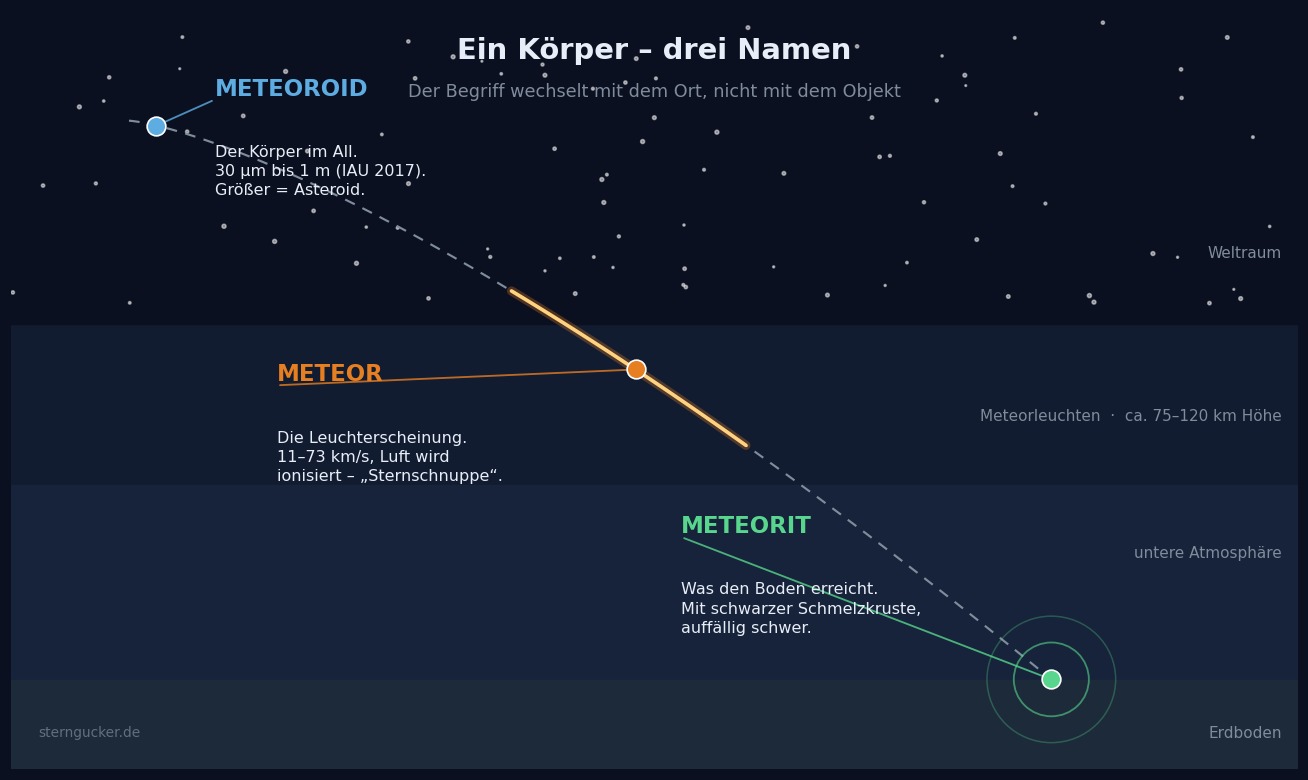
The three words do not describe three different objects, but one and the same body in three different places. That is the whole trick — and once you have understood it, you will never confuse them again.
| Term | Where? | What exactly |
|---|---|---|
| Meteoroid | in space | The solid body itself, before it hits the Earth. In 2017 the IAU set the range at 30 µm to 1 m. Larger means asteroid, smaller means interplanetary dust. |
| Meteor | in the atmosphere, 75–120 km up | The luminous phenomenon, not the stone. A meteor is essentially a glowing column of ionised gas — which is why you cannot “find” one. |
| Meteorite | on the ground | The remnant that survived the frictional heat and comes to rest. Only it is an object you can touch. |
A comparison that sticks: a meteoroid is like a diver on the ten-metre board, the meteor is the dive, and the meteorite is the swimmer who surfaces again. If the body disappears completely in the atmosphere — which happens in over 99 % of all cases — there is never a meteorite, only a meteor.
And what about asteroids and comets?
An asteroid is simply a meteoroid that is too big: the boundary lies at around one metre in diameter. Most asteroids orbit in the asteroid belt between Mars and Jupiter; collisions there constantly knock off fragments that travel into the inner solar system as meteoroids.
A comet, by contrast, is a mixture of ice and dust from the outer solar system. Comets normally deliver no meteorites, because their material is too loose and too volatile — it burns up completely. What they do deliver are the great meteor showers: the Perseids in August are dust from comet 109P/Swift-Tuttle, the Geminids in December come from asteroid (3200) Phaethon.
| Object | Made of / how big | Where from | Delivers meteorites? |
|---|---|---|---|
| Asteroid | rock/metal, > 1 m | asteroid belt, near-Earth orbits | yes, very often |
| Meteoroid | rock/metal, 30 µm – 1 m | fragments of asteroids, the Moon, Mars | yes |
| Comet | ice, dust, rock | Kuiper belt, Oort cloud | practically never |
| Interplanetary dust | < 30 µm | everywhere | only as micrometeorites |
Fireball, bolide, superbolide: when it gets really bright
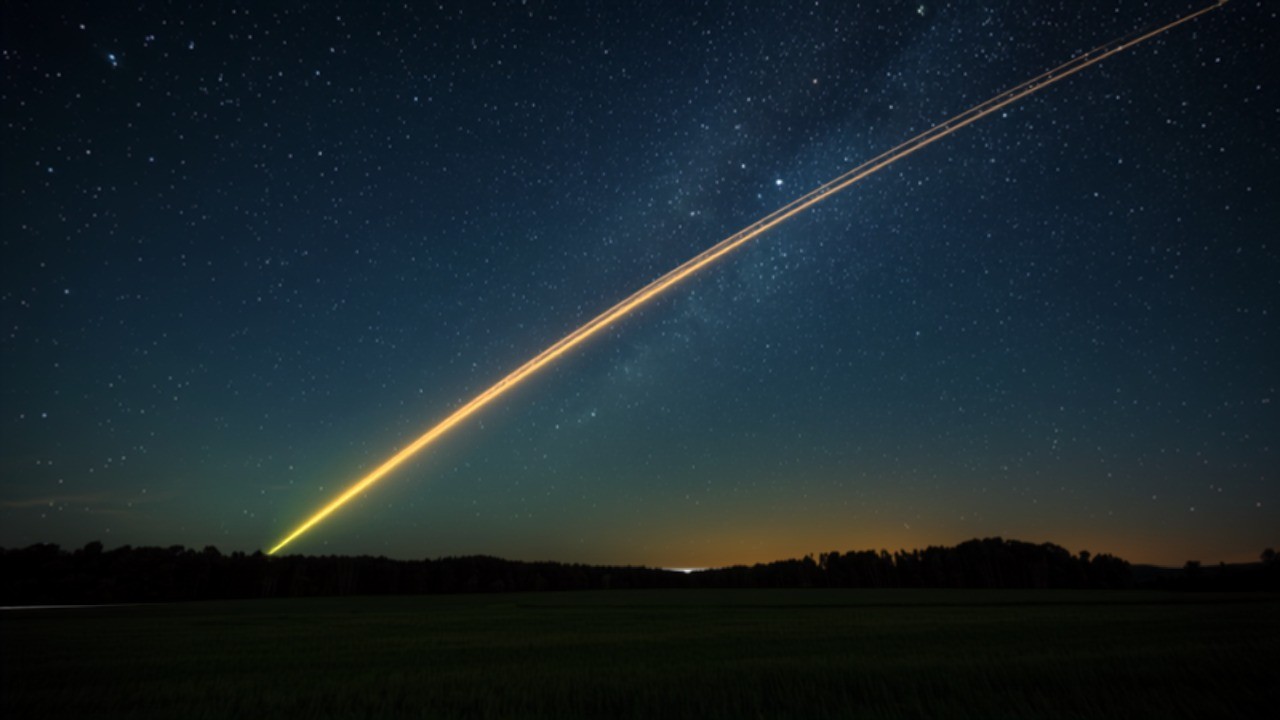
Not every meteor is a shooting star. Above a certain brightness the phenomena get their own names — and those are precisely the ones that can deliver meteorites at all.
| Phenomenon | Brightness | Typical body size | Meteorite possible? |
|---|---|---|---|
| Meteor / shooting star | fainter than −4 mag | millimetres to centimetres | no |
| Fireball (bolide) | brighter than −4 mag (brighter than Venus) | a few centimetres to decimetres | occasionally |
| Superbolide | brighter than −17 mag (brighter than the Sun appears in the sky) | metres and more | usually, often with a strewn field |
The thresholds of −4 mag and −17 mag come from the same IAU terminology of 2017. Rule of thumb: anyone who sees a fireball clearly brighter than Venus has a realistic chance that stones are lying somewhere. If a rumble follows as well, the probability is high.
Micrometeorites: meteorite dust in your gutter
Objects under one millimetre that reach the ground are called micrometeorites. They are so small that they are barely slowed down on entry and do not melt completely. Depending on the estimate, several thousand to a few tens of thousands of tonnes of cosmic material rain down on Earth each year — by far the largest part of it as dust.
Anything finer than 100 nanometres the IAU calls “meteoric smoke” — condensation products of vaporised meteoroids that float in the upper atmosphere and serve as condensation nuclei for noctilucent clouds. By the way: the term “micrometeoroid” has officially been regarded as superfluous since 2017 and should no longer be used.
Try it yourself: micrometeorites really can be collected — classically with a strong magnet in the sludge of a gutter or a rain barrel. You still have to stay honest about it: by far the largest share of the magnetic spherules in urban dust is terrestrial industrial debris (brake dust, welding beads). Genuine micrometeorites are only recognisable under the microscope by their perfectly round melt structure, often shot through with olivine crystals.
Where meteorites come from
Almost everything that lands on Earth as a meteorite has the same address: the asteroid belt between Mars and Jupiter. Bodies have been colliding there for billions of years, and Jupiter’s gravity gradually steers the fragments onto orbits that cross Earth’s path. From the collision to the impact, typically a few million to a few hundred million years pass — this so-called exposure age can be read off cosmogenic nuclides in the laboratory.
| Origin | Share of all meteorites | Typical representatives |
|---|---|---|
| Asteroid belt | > 99 % | chondrites, achondrites, iron meteorites, pallasites |
| Moon | approx. 0.1 % | lunar breccias and basalts |
| Mars | approx. 0.1 % | shergottites, nakhlites, chassignites (“SNC”) |
| Comets | practically 0 % | dust only, no falling fragments |
Lunar meteorites: rocks from next door
When a large lump strikes the Moon, material is ejected at over 2.4 km/s — fast enough to escape lunar gravity. Part of it lands on Earth thousands or millions of years later. Lunar meteorites were only recognised in 1982, because the Apollo samples suddenly provided a yardstick for comparison: their mineral chemistry and their oxygen isotope ratio match the returned samples exactly.
Worldwide, only about 40 kilograms of lunar rock as a meteorite are known to date — spread across a few hundred finds, mostly from the Sahara and from Antarctica. For comparison: the Apollo missions brought back 382 kilograms, which no private individual may ever buy. That is exactly why the grey splinter in the little box is so sought after by collectors.
Martian meteorites: mail from the Red Planet
That Martian meteorites exist at all was long disputed. The proof came in 1983 from tiny gas bubbles in the meteorite EETA 79001: their composition matched precisely the Martian atmosphere that the Viking landers had measured in 1976. Since then the origin has been regarded as certain.
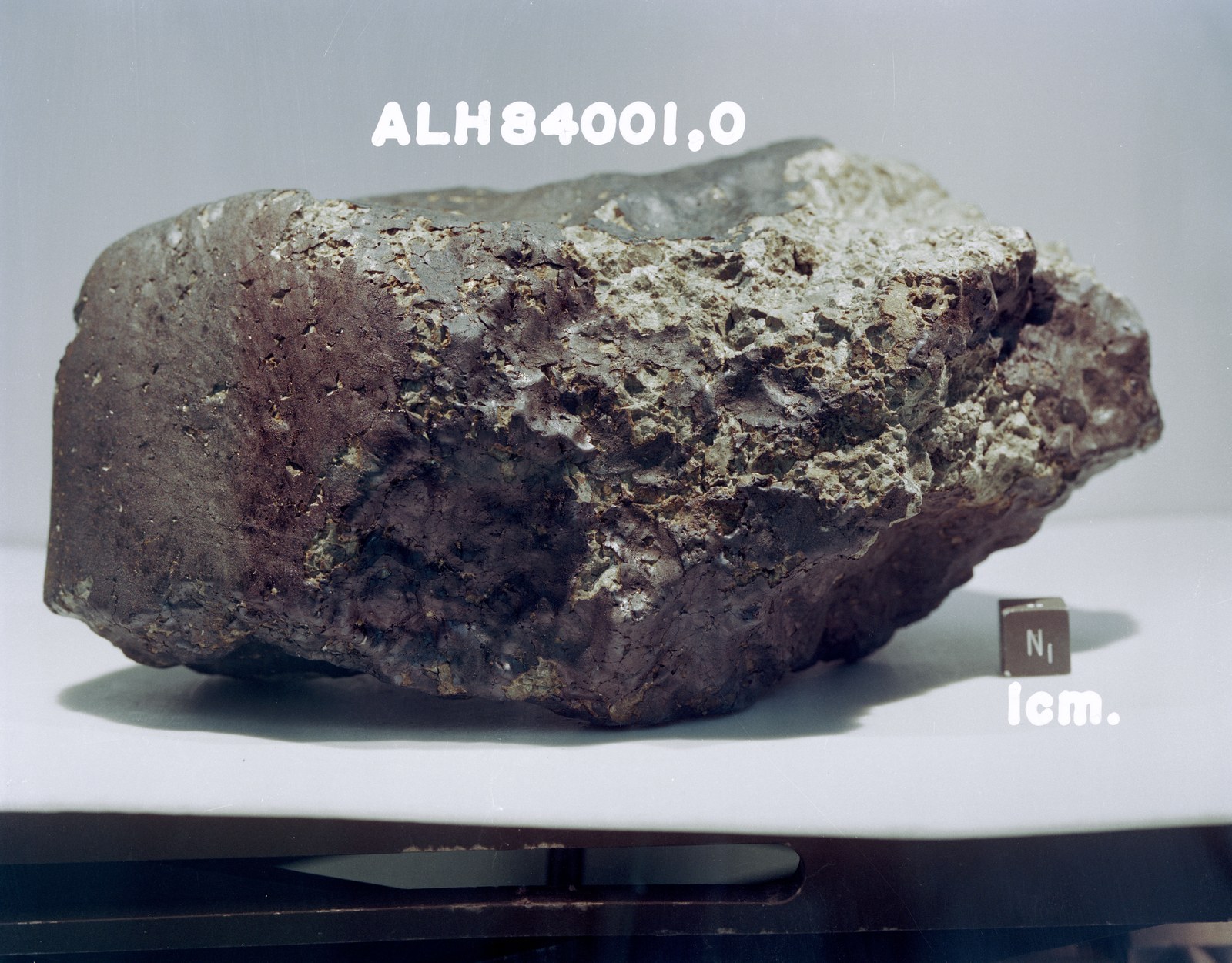
The most famous of all is ALH 84001, found in the Allan Hills region of Antarctica in 1984. In 1996 a NASA team presented worm-shaped structures and carbonate globules within it and interpreted them as possible traces of fossil Martian life. The find triggered one of the biggest debates in modern planetary science. Today the biological interpretation is considered unproven — the structures can also be explained purely inorganically. The scientific yield remained enormous nonetheless: the discussion is what really established astrobiology as a field.
Identifying a meteorite: the features that matter
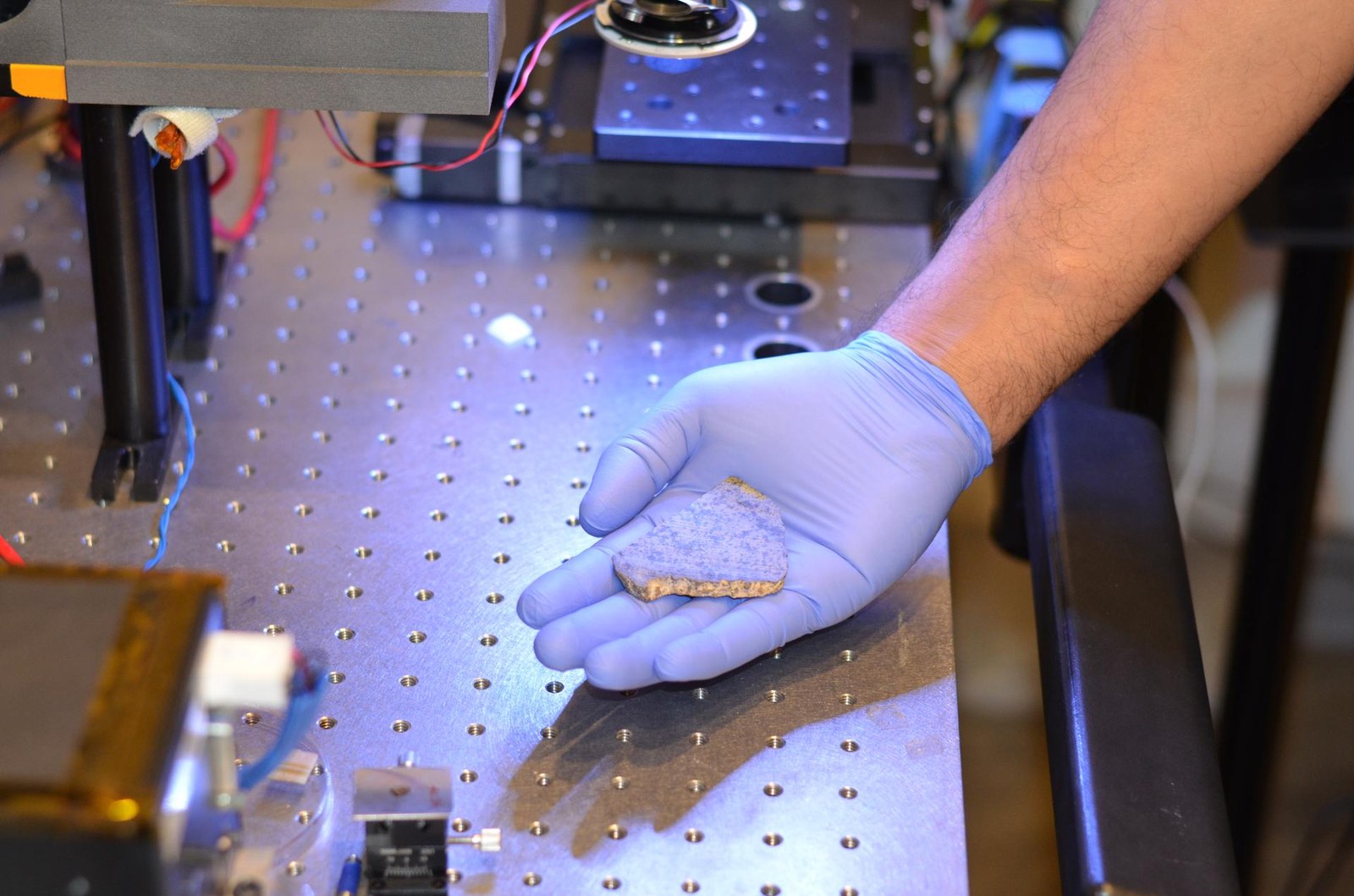
The sobering number first: museums and university institutes receive hundreds of supposed meteorites every year. On average, one in several hundred is recognised as genuine. The technical term for the failed candidates has long since caught on: meteorwrongs.
Even so, the field can be narrowed down considerably with simple means. These are the features experts check first:
| # | Feature | What to look for |
|---|---|---|
| 1 | Weight | Noticeably heavier than its size suggests. Meteorites almost always contain metallic iron-nickel and have densities of 3.0 to 7.8 g/cm³ — terrestrial rock lies between 2.5 and 3.0. |
| 2 | Fusion crust | Fresh meteorites carry a thin, matt to glossy black crust, often only a millimetre thick. After decades in the ground it weathers to rusty brown. |
| 3 | Surface | Smooth, rounded, sometimes with thumbprint-like depressions (regmaglypts). Anything with gas bubble holes is slag or lava — never a meteorite. |
| 4 | Magnetism | The vast majority of meteorites attract a magnet. But beware: so do many terrestrial iron ores. |
| 5 | Broken edge | On a ground-down spot, silvery metal grains glint in the dark rock. In chondrites you additionally see millimetre-sized spherules — the chondrules. |
| 6 | No quartz, no layering | Meteorites are compact and unlayered. Stripes, banding, mica or quartz veins always point to a terrestrial origin. |
The magnet test — and its pitfalls
A strong neodymium magnet on a thread about 50 centimetres long is the standard tool. Bring it close to the stone and it visibly swings towards an iron or stony meteorite. Carbonaceous chondrites, however, are only weakly magnetic, hence the long thread: it makes even small forces visible.
⚠ The most common mistake: a magnet test on its own proves nothing at all. Slag from old smelting furnaces, haematite, magnetite and iron concretions are magnetic too — and they make up the lion’s share of all the failed candidates that get sent in.
The second most common mistake: basalt. It is dark, heavy and looks convincing at first glance. The give-away is the gas bubbles — meteorites have no bubble cavities, because they were never inside a volcano.
Measuring density: the most honest test for home
Density can be determined with a kitchen scale and a measuring jug: weigh the stone, then submerge it in water and read off the displaced volume. Mass divided by volume gives the density. From about 3.3 g/cm³ it gets interesting, from 4.5 g/cm³ very interesting.
| Material | Density |
|---|---|
| Ordinary terrestrial rock | 2.5 – 3.0 g/cm³ |
| Stony meteorite (chondrite) | 3.2 – 3.8 g/cm³ |
| Stony-iron meteorite (pallasite) | approx. 4.7 g/cm³ |
| Iron meteorite | 7.0 – 7.8 g/cm³ |
| Slag (the typical mix-up) | 2.0 – 3.5 g/cm³, often porous |
Cutting and etching: Widmanstätten patterns
The most reliable proof of an iron meteorite is a small cut face, polished and etched with dilute nitric acid. A pattern of intersecting bands appears — the Widmanstätten patterns. They arise from the unmixing of the nickel-iron phases kamacite and taenite and require cooling rates of a few degrees per million years. On Earth that is simply not reproducible: Widmanstätten patterns are proof of authenticity. In iron meteorites very low in nickel (hexahedrites) you find fine parallel striations instead, the Neumann lines.
Please never smash the whole stone. A complete, undamaged meteorite with an intact fusion crust is worth a multiple of what crumbled fragments fetch — and scientifically, a shattered piece is almost worthless. A small ground-down area on one corner is enough for a test. If you are unsure, send a sharp photo with a scale to an institute before you reach for the angle grinder.
Where to get a free appraisal
Several German institutions examine suspected pieces free of charge or for a small fee, among them the Institute of Planetology at the University of Münster, the Natural History Museum in Berlin and the mineralogical institutes of a number of universities. In the English-speaking world, the Natural History Museum in London and the Center for Meteorite Studies at Arizona State University play the same role. The usual procedure is: first a photo by e-mail with a scale, the weight and the find location; the institute then decides whether sending the piece in is worthwhile. If a piece really is recognised as a meteorite, it receives an official name — usually that of the nearest settlement.
Meteorite types: stone, iron, stony-iron
The classic classification simply follows the metal content. It is coarse, but practical — and it tells you immediately what a piece looks like and how rare it is.
| Main group | Share of all falls | Composition | Subgroups |
|---|---|---|---|
| Stony meteorites | approx. 94 % | silicates, little metal | chondrites (with chondrules), achondrites (without) |
| Iron meteorites | approx. 5 % | iron-nickel alloy | octahedrites, hexahedrites, ataxites |
| Stony-iron meteorites | approx. 1 % | roughly half metal, half silicate | pallasites, mesosiderites |
Important for the statistics: among the observed falls, stony meteorites clearly dominate. Among chance finds, by contrast, iron meteorites are strongly over-represented — simply because they are more conspicuous, more resistant and easier to find with a metal detector.
Chondrites: the primordial matter of the solar system
Around 86 percent of all meteorite falls are chondrites. They are named after the chondrules: millimetre-sized, once-molten silicate spherules that solidified in the primordial nebula of the solar system before any planets existed at all. Chondrites have never been melted and never differentiated since — they are the least altered matter we possess.
That is exactly why they give us the age of the solar system: the calcium-aluminium-rich inclusions (CAIs) in the Allende meteorite, at around 4.567 billion years, count as the oldest dated solids of any kind. Particularly valuable are the rare carbonaceous chondrites: they contain water in bound form and complex organic molecules, including amino acids.
Achondrites: fragments of differentiated bodies
Achondrites lack chondrules because their parent body was large enough to melt completely. They resemble terrestrial basalts and are correspondingly hard to recognise as meteorites. This group includes the HED meteorites from asteroid Vesta, the aubrites — and the lunar and Martian meteorites.
Iron meteorites: the core of a destroyed planetesimal
Iron meteorites consist of 90 to 95 percent iron, the rest being predominantly nickel. They come from the metal core of minor planets that were shattered early in the history of the solar system. Because they are so resistant, they survive atmospheric entry best and form the largest known meteorites: the Hoba meteorite in Namibia tips the scales at around 60 tonnes and still lies where it was found — it is too heavy to move.
Pallasites: the most beautiful meteorites of all
Pallasites are stony-iron meteorites in which honey-yellow to green olivine crystals float in a matrix of nickel-iron. Cut, polished and held against the light, they look like a church window. They probably come from the boundary zone between the core and mantle of a differentiated asteroid. Less than one percent of all meteorites are pallasites — and prices are correspondingly high.
Meteorites in Germany: 56 recognised pieces
In meteoritic terms Germany is not a bad place — not because more falls there, but because a great many people there look very closely. Officially recognised are 56 meteorites, and for 38 of them the fall was observed. For the size of the country that is an exceptionally high rate, and a direct achievement of the European Fireball Network and the cameras of the Arbeitskreis Meteore.
| Meteorite | Fall / find | Federal state | Type | Total mass |
|---|---|---|---|---|
| Bitburg | before 1805 | Rhineland-Palatinate | iron meteorite (IAB) | approx. 1,500 kg |
| Issigau-Reitzenstein | 2020 (find) | Bavaria | iron meteorite (IIIAB) | 136.4 kg |
| Steinbach | before 1724 | Saxony | iron meteorite (IVA) | 99 kg |
| Untermässing | 1920 (find) | Bavaria | iron meteorite (IIC) | 80 kg |
| Treysa | 3 April 1916 | Hesse | iron meteorite (IIIB) | 63 kg |
| Neuschwanstein | 6 April 2002 | Bavaria | enstatite chondrite (EL6) | 6.2 kg |
| Elmshorn | 25 April 2023 | Schleswig-Holstein | H chondrite breccia | approx. 4.3 kg |
| Ribbeck | 21 January 2024 | Brandenburg | aubrite | approx. 1.8 kg |
Elmshorn 2023: a rain of stones over Schleswig-Holstein
On 25 April 2023 at 14:14 CEST a fireball crossed northern Germany in broad daylight — bright enough to be captured by the cameras of the Arbeitskreis Meteore. Shortly afterwards, stones struck within the town of Elmshorn. One went through the roof of a house, another — at 3,736 grams the largest piece — landed in a garden.
In total, 21 individual pieces weighing around 4.3 kilograms together were recovered. Analysis revealed an H chondrite breccia: a rock baked together from fragments with different histories, which therefore preserves the collisional history of its parent body directly. The largest fragment has been on display at the Museum der Natur Hamburg since April 2024.
Ribbeck 2024: the asteroid that was announced in advance
The fall at Ribbeck west of Berlin was a scientific sensation — not because of the mass, but because of the sequence of events. On 20 January 2024 Krisztián Sárneczky at the Hungarian Konkoly Observatory discovered an asteroid about 40 centimetres across, which was later given the designation 2024 BX1. Less than three hours later, at 00:33 UTC on 21 January, it entered the atmosphere over Brandenburg — exactly where the prediction had expected it.
It was only the eighth time ever that an asteroid had been discovered before impact. Around 200 fragments totalling about 1.8 kilograms were found, the largest weighing 212 grams. The twist came in the laboratory: Ribbeck is an aubrite — an extremely rare, almost white achondrite that is barely distinguishable from a piece of limestone out in a field. It is only the twelfth documented aubrite fall in history.
Neuschwanstein 2002: enstatite three times over in the Alps
On 6 April 2002 at 22:20 CEST a fireball lit up over the Allgäu region and was photographed simultaneously by three stations of the European Fireball Network — in Streitheim, in Přimda in the Czech Republic and at the Gahberg in Austria. From the stereo images the trajectory could be reconstructed by triangulation and the strewn field narrowed down.
Success took its time, but it came: on 14 July 2002 the first piece weighing 1,750 grams was found, and in 2003 two more followed at 1,625 and 2,842 grams — around 6.2 kilograms in total. The Neuschwanstein meteorite turned out to be a rare enstatite chondrite of type EL6 and was the first German meteorite to be found deliberately thanks to a photographically determined trajectory.
The Nördlinger Ries: Germany’s meteorite crater
Germany’s most spectacular piece of meteoritic evidence is not a stone but a landscape. The Nördlinger Ries on the border between Bavaria and Baden-Württemberg is an impact crater around 24 kilometres across, formed about 14.8 million years ago. The culprit was an asteroid estimated at one kilometre in diameter.
That it really is an impact crater was only proven in 1960 by the detection of the high-pressure minerals coesite and stishovite in the suevite rock. The town church of St. Georg in Nördlingen is built entirely from this impact rock — including tiny diamonds that formed during the impact. The Apollo astronauts trained in field geology here in 1970, because the Ries resembles lunar terrain more closely than any volcano.
Finding a meteorite: what the chances really are
A meteorite in your own garden is a lottery win. But there are places and methods that improve the odds by orders of magnitude — and they all come down to one principle: the ground must be such that a dark stone stands out and survives for a long time.
| Place | Prospects of success | Why |
|---|---|---|
| Antarctica (blue ice fields) | very high | ice concentrates meteorites at barriers, perfect contrast, hardly any weathering |
| Hot deserts (Sahara, Oman, Atacama) | high | dryness preserves, pale ground, hardly any vegetation |
| Dry lakes and salt pans | medium | flat pale surface, good visibility |
| Fresh strewn field after a fireball | very high, but time-critical | only with a trajectory calculation, within a few days |
| Central European fields and forests | very low | lots of terrestrial rock, rapid weathering, dense vegetation |
Antarctica and desert: why so much lies there
In Antarctica no more falls from the sky than anywhere else — the ice merely collects it. Meteorites sink in, are transported with the ice flow and carried back up at mountain barriers, where the katabatic wind erodes the surface. Over thousands of years the stones accumulate at blue ice fields in this way. More than two thirds of all meteorites catalogued worldwide come from there.
In the hot deserts the same effect works in weaker form: hardly any rain means hardly any weathering, and pale sand makes black crusts visible. That is why so many collector’s pieces carry names like NWA — Northwest Africa — plus a serial number.
Searching for meteorites in Europe and North America
Realistically, one strategy remains above all others in these latitudes: the targeted search of a freshly calculated strewn field after an observed fireball. That is exactly how Neuschwanstein, Elmshorn and Ribbeck were found — and how the Winchcombe meteorite was recovered in Gloucestershire in 2021, within days of the fall. If you want to take part, follow the reports of the Arbeitskreis Meteore and the European Fireball Network, of the UK Fireball Alliance or of the American Meteor Society, and be on site quickly when in doubt — after a few days of rain the fusion crust already loses a lot of its contrast.
A second, underrated route is collection research: quite a few meteorites lay unrecognised in private or museum holdings for decades before they were examined afresh.
Who owns a meteorite you find?
Legally the situation is more interesting than you might think, and it differs from country to country. In Germany a meteorite initially counts as an ownerless thing. Under § 958 of the German Civil Code (BGB), whoever takes possession of it becomes the owner — so the finder. But if the stone lies on someone else’s land, courts often apply § 984 BGB by analogy, the so-called Hadrianic division: finder and landowner then each own half. In the United States the opposite rule applies: since the Iowa Supreme Court decision in Goddard v. Winchell (1892), a meteorite is regarded as part of the land, and it therefore belongs to the landowner, not to the finder. In the United Kingdom a meteorite is likewise not covered by the Treasure Act and normally belongs to the owner of the land on which it came down.
Watch out for the treasure prerogative: several German federal states — Brandenburg among them — have written a “Schatzregal” into their heritage protection laws. There, a scientifically significant meteorite passes directly into the ownership of the state; the finder receives an appropriate reward. That is exactly the rule that became relevant in the Ribbeck case.
Practical advice: report finds to the responsible heritage authority or an institute before any sale, document the find location by GPS and, if possible, do not handle the stone with bare hands — skin oils and moisture interfere with the analysis of organic components. Aluminium foil and a freezer bag are better than any trouser pocket.
What is a meteorite worth?
The price per gram varies by more than a factor of a thousand. It depends on four things: type and rarity, state of preservation (a complete fusion crust beats a fragment), proof of provenance including classification — and how well known the fall is. The following table gives orders of magnitude for the collectors’ market, not guaranteed prices.
| Meteorite type | Price per gram (order of magnitude) | Why |
|---|---|---|
| Ordinary chondrite (NWA material) | approx. $0.50€0.50 – 5 | plentifully available |
| Iron meteorite (e.g. Campo del Cielo) | approx. $0.50€0.50 – 3 | large quantities found, robust |
| Observed fall with a name | approx. $5€5 – 50 | the story of the fall drives the price |
| Carbonaceous chondrite | approx. $20€20 – 200 | scientifically sought after, rare |
| Pallasite (cut, polished) | approx. $20€20 – 100 | looks and rarity |
| Martian meteorite | approx. $300€300 – 1,500 | only a few hundred kilograms known in total |
| Lunar meteorite | approx. $400€400 – 2,000 | only around 40 kg worldwide |
To put that in perspective: one gram of lunar meteorite therefore costs many times the price of gold. And yet getting started is cheap — a small, genuine iron meteorite fragment with a certificate can be had for under twenty dollarseuros.
Getting a meteorite valued: how to go about it
For a serious valuation a dealer or institute needs three things: the classification (which type, officially determined), the weight plus photos from all sides with a scale, and the documented find location. Without a classification, no price can be named at all. Collectors additionally look at how complete the crust is, at a clean cut face, and at whether the piece was ever held in a recognised collection.
Be careful with online offers that give no classification, no dealer name and no statement of origin. A look at the seller’s membership of the IMCA (International Meteorite Collectors Association) is the fastest credibility check there is.
Buying a meteorite: three honest ways in
If you don’t want to find one but simply want a genuine piece of outer space on your shelf: that is entirely legal and surprisingly affordable. The only important thing is to buy from a specialist dealer — with classification, statement of origin and proof of authenticity. The three pieces below cover the whole range, from the twenty-euro entry point to lunar rock. A larger selection including a price comparison is in the buying guide buying a meteorite.
The classic way in: Campo del Cielo Iron Meteorite in Gift Pouch
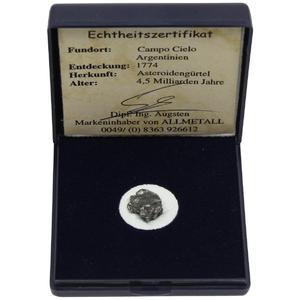
A genuine iron meteorite fragment from Argentina, about 4.5 billion years old — the cheapest way to hold outer space in your hand.
Price: € 16.90
Campo del Cielo fell around 4,000 years ago in what is now Argentina; the first pieces have been documented since 1576. It is a coarse octahedrite — a genuine iron meteorite, around 4.5 billion years old and therefore older than any rock on Earth. Because the strewn field is enormous, small fragments have remained affordable. For children, as a gift or as the first piece of a collection, this is the right choice. Delivered in a case with a shooting-star motif.
Genuine Martian rock for collectors: Genuine Martian Meteorite NWA 4766
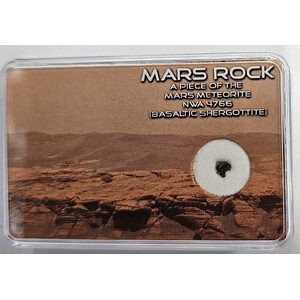
A real piece of Mars: shergottite NWA 4766, blasted off the red planet and found in the Sahara — with certificate.
Price: € 24.90
NWA 4766 is a shergottite — basaltic Martian rock, blasted off the Red Planet by an impact and recovered in the Sahara. The sample weighs only 7 to 14 milligrams and measures about three millimetres, but it is genuine and documented. It is offered by the Berlin mineral dealer Stefan Ralew, a member of the IMCA. If you have ever wanted to touch a Martian meteorite: this is the realistic way.
Genuine lunar rock for collectors: Genuine Moon Meteorite NWA 10203
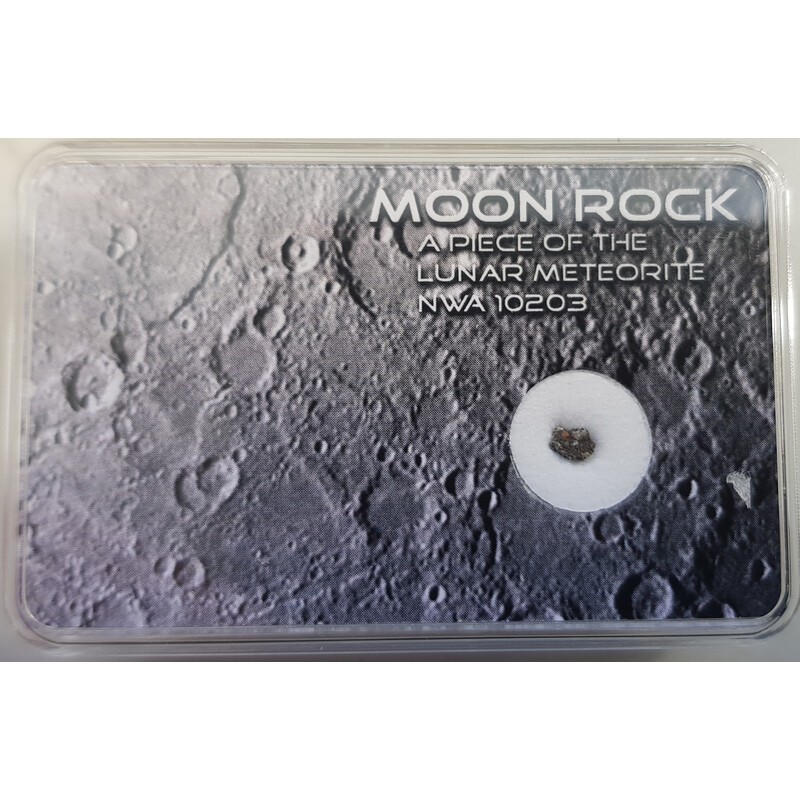
Moon rock you can actually touch: NWA 10203 from the Sahara — only about 40 kg of lunar meteorites are known worldwide.
Price: € 69.90
NWA 10203 was found in the Sahara in 2015; the total known mass of this meteorite is 3.3 kilograms. Since only about 40 kilograms of lunar meteorites exist worldwide and Apollo material never comes onto the market, such a splinter is the only legal way to own lunar rock. What is delivered is a sample about five millimetres across in a box measuring 55 × 35 × 15 mm.
What to watch out for when buying:
- The official classification and name (e.g. “NWA 4766”) must be stated.
- Country of origin and year of the find should be documented.
- A certificate of authenticity or IMCA membership of the dealer is a must.
- Keep away from “meteorites” sold at knock-down prices with no type given — that is almost always slag.
- Store iron meteorites dry: they rust, and once rust disease has started it is almost impossible to stop.
Links marked with * are partner links. If you buy through them, we receive a small commission — the price stays the same for you.
Meteorite research: what the stones reveal
No laboratory in the world can manufacture what a meteorite brings with it: unaltered material from the time the solar system formed. That is why meteorite research remains one of the most productive disciplines in planetary science to this day — and it is many times cheaper than any space probe.
From cult object to science
For a long time “stones from the sky” were considered nonsense. The French chemist Antoine Lavoisier still declared such reports impossible in 1772. The turning point came in 1794 with Ernst Florens Friedrich Chladni, who was the first to argue systematically that these stones must be of cosmic origin — he was ridiculed for it. When around 3,000 stones came down at L’Aigle in Normandy in 1803 and Jean-Baptiste Biot documented the fall on site, the debate was over.
Before that, meteorites had been cult objects for thousands of years: the dagger in Tutankhamun’s tomb is made of meteoritic iron — demonstrated by its high nickel content. Inuit in northern Greenland likewise worked iron from the Cape York meteorite into tools long before they knew terrestrial iron.
What modern laboratories read out
- Age: lead-lead and aluminium-magnesium dating of CAIs gives 4.567 billion years as the starting point of the solar system.
- Travel time: cosmogenic nuclides such as neon-21 show how long a fragment was exposed unprotected to cosmic radiation — usually millions to hundreds of millions of years.
- Origin: oxygen isotope ratios work like a fingerprint and assign a piece unambiguously to Earth, the Moon, Mars or a type of asteroid.
- Water and organics: carbonaceous chondrites contain bound water and over 80 amino acids, including some that do not occur on Earth.
- Shock history: shock veins and high-pressure minerals reveal how violently the parent body was hit.
From this combination emerges a remarkably detailed picture: meteorites show that the building blocks of life form in space entirely of their own accord — one of the strongest supports for astrobiology and one reason why missions such as OSIRIS-REx and Hayabusa2 deliberately brought asteroid samples back.
How dangerous are meteorites?
For the individual: practically not at all. To this day no case has been documented in which a person was killed by a falling meteorite. There have been isolated injuries — the best-known case struck a woman in Alabama in 1954, who was hit on the hip by a piece that had come through the roof.
For whole regions the calculation is different. On 15 February 2013 a body about 20 metres across broke apart over Chelyabinsk at an altitude of around 30 kilometres. The energy released corresponded to several hundred kilotonnes of TNT. The meteorite itself injured no one — but the shock wave destroyed thousands of windows and injured around 1,500 people, overwhelmingly through flying glass. The largest recovered fragment, weighing 654 kilograms, was lifted from the bed of Lake Chebarkul.
| Object size | Frequency | Effect |
|---|---|---|
| millimetres to centimetres | constantly, millions per day | burns up, harmless |
| approx. 1 metre | several times a year | bright fireball, usually small meteorites |
| approx. 20 metres | every few decades | airburst like Chelyabinsk, window damage |
| approx. 50 metres | roughly every 1,000 years | regional devastation like Tunguska in 1908 |
| > 1 kilometre | roughly every million years | global climate consequences |
It is precisely because of these statistics that planetary defence exists. The Ribbeck case showed that early warning now works — 2024 BX1 was discovered barely three hours before entry. And NASA’s DART mission demonstrated in 2022 that the orbit of a small body can be measurably changed by an impact. More on this in the article on meteorite impacts.
Looking out for meteors yourself
You don’t have to find a meteorite to get something out of the subject. A good shooting star evening delivers three-digit counts — and it costs nothing. All you need is a dark sky, a deckchair and patience.
- No telescope, no binoculars: meteors are wide-angle events. Any instrument only narrows the view.
- Allow around 20 to 30 minutes for dark adaptation — and then put the phone away or switch it to red light.
- Look about 40 degrees to the side of the radiant, not straight at it. The trails appear longer there.
- After midnight is almost always better: the Earth is then running into the meteor stream head-on.
- Dress warmly. Even in August, a meadow gets astonishingly cold at three in the morning.
When it is worth staying up is set out in the meteor shower calendar. The most reliable dates are the Perseids around 12 August and the Geminids around 14 December. And if you see an unexpected string of lights in the sky, pause for a moment: usually they are not meteors but satellite trains.
Binoculars or telescope — what actually helps here?
For the meteor itself: neither of the two. A shooting star crosses twenty degrees of sky in half a second; any instrument shows a section of that in which it practically never appears. Here the naked eye wins, and by a wide margin.
It looks different for the parent bodies. If you want to see the objects the meteoroids come from, you need optics — and a telescope beats binoculars in almost every respect. A pair of 10×50 binoculars is just about enough for the two brightest lumps: Vesta reaches around 6 mag at opposition, Ceres about 7 mag. Both remain star-like points of light that you can only identify over several nights by their movement against the background stars. Even the third-brightest asteroid, Pallas, is borderline at 7 to 8 mag — and the remaining roughly 1.4 million catalogued objects are out of reach with binoculars.
A telescope from about 130 millimetres of aperture gathers around seven times as much light and brings asteroids down to about 12 mag within reach — instead of two objects there are then several hundred. And it can do something no binoculars can: make the movement visible within a single night, if you sight the position against two field stars at high magnification. On top of that comes everything else in the sky on the same night — lunar craters, Saturn’s rings, Jupiter’s cloud belts, Mars as a small disc. If you can only buy one instrument and really want to explore the sky, you should therefore reach for the telescope; binoculars are the sensible addition for comets, meteor nights and a quick look from the balcony, not a replacement.
Recommendation for asteroid hunting: Skywatcher Dobson Telescope N 130/650 Heritage FlexTube
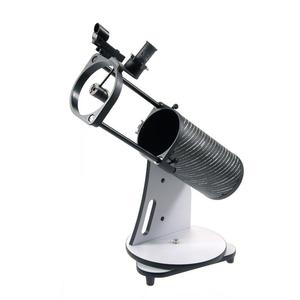
A compact tabletop Dobson with a true parabolic mirror. Folds down, fits in a bag: the Moon, planets and the bright deep-sky classics.
Price: € 265
For advanced observers: Skywatcher Dobson Telescope N 200/1200 Skyliner Classic
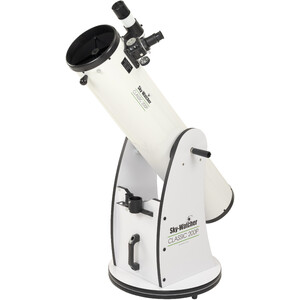
200 mm of aperture — the most sky for your money. Set it on the ground, point by hand: nebulae, clusters and galaxies for years to come.
Price: € 479
Frequently asked questions about meteorites
What is the difference between a meteor and a meteorite?
A meteor is the luminous phenomenon in the sky — the shooting star. A meteorite is the solid remnant that reaches the ground. So you can see a meteor but not touch it; with a meteorite it is exactly the other way round.
What is the difference between a meteorite and a meteoroid?
The same body, a different place. As long as it is flying through space it is called a meteoroid. As soon as it has reached the ground it is called a meteorite. The IAU limits meteoroids to 30 micrometres up to 1 metre — larger objects are asteroids.
How do I tell whether my stone is a meteorite?
Check in this order: is it strikingly heavy for its size? Does it have a dark, smooth crust without gas bubble holes? Does it attract a magnet? Do metal grains glint on a ground-down spot? If all four points apply, an appraisal by an institute is worthwhile. If the stone contains quartz, bubble cavities or layering, it is terrestrial with a high degree of certainty.
Is a meteorite radioactive or dangerous?
No. Meteorites are not appreciably radioactive and are harmless in the hand. They do contain cosmogenic nuclides, but in vanishingly small amounts — the radiation lies within the range of normal background levels. Freshly fallen pieces are not glowing hot either: the core stays ice-cold, because only the outermost layer melts.
How much is a meteorite worth?
That ranges from under one dollareuro per gram for ordinary iron meteorites to over a thousand dollarseuros per gram for lunar and Martian rock. The decisive factors are type, classification, state of preservation and how well known the fall is. Without an official classification, no reliable price can be named.
How often do meteorites fall to Earth?
Every day many tonnes of material reach the Earth’s atmosphere, most of it as dust. Objects that actually reach the ground as collectable meteorites come down an estimated few thousand times a year — the vast majority of them over oceans, deserts and uninhabited areas, where nobody finds them.
May I keep a meteorite I have found?
In Germany, in principle yes, because a meteorite is initially ownerless. On someone else’s land, finder and landowner usually share ownership equally. In federal states with a treasure prerogative — Brandenburg, for instance — a scientifically significant piece may however fall to the state, in return for an appropriate reward. In the United States and the United Kingdom the rule is different: there a meteorite normally belongs to the owner of the land. Always involve the heritage authority before any sale.
Further reading on sterngucker.de
- Meteorite impacts — the largest craters on Earth and what happens on impact
- Chondrites — the most common meteorite type in detail
- Pallasites — olivine in nickel-iron, the most beautiful meteorite of all
- Lunar rock — how rock from the Moon reaches us
- Martian meteorites — the SNC group and its history
- The Neuschwanstein meteorite — the fall of 6 April 2002
- Shooting stars and the meteor shower calendar — when it is worth looking up
- Asteroids and the asteroid belt — the region they come from